Follow the authors@Edspencive+ Get alerts forEddie Spence+ Get alerts forSing Yee
In this article
There’s a global migration underway in the gold market, as western investors dump bullion while Asian buyers take advantage of a tumbling price to snap up cheap jewelry and bars.
Rising rates that make gold less attractive as an investment mean that large volumes of metal are being drawn out of vaults in financial centers like New York and heading east to meet demand in Shanghai’s gold market or Istanbul’s Grand Bazaar.
In fact, it can’t move fast enough.
Logistical issues combined with quirks of the market are making it difficult for traders to get enough bullion where it’s wanted. As a result, gold and silver are selling at unusually large premiums over the global benchmark price in some Asian markets.
“The incentive to hold gold is a lot lower. It’s going from west to east now,” said Joseph Stefans, head of trading at MKS PAMP SA, a gold refining and trading firm. “We are trying to keep up as best we can.”
Gold items displayed in the window of a jewelry shop inside the Grand Bazaar in Istanbul, Turkey.Photographer: Nicole Tung/Bloomberg
The rotation of metal around the world is part of a gold-market cycle that has repeated for decades: when investors retreat and prices drop, Asian buying picks up and precious metals flow east — helping to put a floor on the gold price during times of weakness.Sponsored ContentWomen are Finding Their Voices in Financial PlanningFirst Horizon Bank
Then, when gold eventually rallies again, much of it returns to sit in bank vaults beneath the streets of New York, London and Zurich.
Since peaking in March, gold prices have tumbled 18% as the Federal Reserve’s aggressive rate hikes caused mass liquidation by financial investors.
More than 527 tons of gold has poured out of New York and London vaults that back the two biggest Western markets since the end of April, according to data from the CME Group Inc. and London Bullion Market Association.
At the same time, shipments are rising into big Asian gold consumers like China, whose imports hit a four-year high in August.
Gold Flows East
Asia has net-imported gold from the West since Aprilhttps://www.bloomberg.com/toaster/v2/charts/8e101e907831c2855279f794770d9a13.html?brand=business&webTheme=default&web=true&hideTitles=true
Source: Swiss Federal Customs Administration
Note: Data shows net-imports from Switzerland from May to August
While plenty of gold is heading east, it’s still not enough to meet demand. Gold in Dubai and Istanbul or on the Shanghai Gold Exchange has traded at multi-year premiums to the London benchmark in recent weeks, according to MKS PAMP — a sign that buying is outstripping imports.
“Demand typically picks up when prices fall,” said Philip Klapwijk, managing director of Hong Kong-based consultant Precious Metals Insights Ltd. “Buyers want to source metal at the lower price and in the local physical market in question there may not be sufficient metal available when the price falls, so the local premium increases.”
Gold in Thailand is also trading at a premium to London prices, due to a lack of supply and weakness in the local currency, according to Jitti Tangsithpakdi, the president of Thailand’s Gold Traders Association.
In India, it is silver that is seeing big premiums. The differential has soared recently to $1, more than triple the usual level, according to consultancy Metals Focus Ltd.
“Right now the demand for silver is huge as traders restock,” said Chirag Sheth, the firm’s principal consultant in Mumbai. “Premiums could remain elevated during the festival season that concludes with Diwali.”
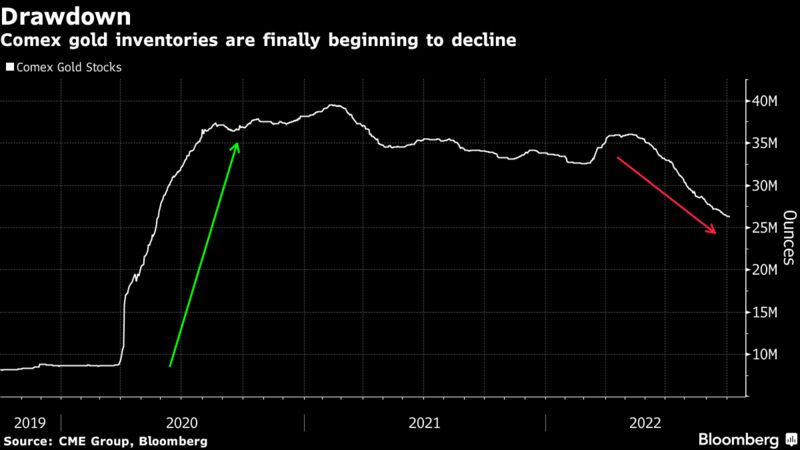
Analysts say that much of the precious metals feeding Asia’s appetite is coming out of vaults run by CME Group, which back the Comex futures market in New York.
Market dislocations early in the pandemic drove a massive surge in prices there, forcing banks to build large stockpiles to cover their futures positions. In recent months gold has traded at a discount on the Comex compared to London, and those inventories are now being drawn down to meet Asian demand.
However, it can be slow going, partly because Asian buyers tend to prefer one-kilogram bars over larger sizes. To fill a standard shipment box of 25 kg of gold, physical traders must take delivery of multiple Comex gold futures, often backed by bullion in different warehouses.
Traders say they are facing other logistical challenges as well, which are contributing to the high Asian premiums.
“Getting stuff on boats or on planes is a bit harder than it used to be,” said MKS PAMP’s Stefans. “It’s really just a classic example of demand far out-pacing supply.”
— With assistance by Swansy Afonso, Suttinee Yuvejwattana and Masumi Suga
APC-12 intersected the highest-grade assay results drilled to date in the Main Breccia discovery at the Apollo target. The hole intercepted a continuous, broad, and consistently high-grade zone of copper-silver-gold mineralization with multiple, overprinting carbonate base metal veins observed within the breccia matrix and returned:
APC-14 intersected two separate zones of mineralization. Importantly, the shallower intercept, beginning at only 45 metres down hole, extended the southern dimension of the Main Breccia discovery and confirmed continuity of copper-silver-gold mineralization directly below the recently announced outcrop discovery with assay results as follows:
The second intercept, which was slightly deeper down hole, cut a remarkably continuous zone of Main Breccia copper-silver-gold mineralization and extended the width of the system slightly to the north with results as follows:
As a result of the intercepts in APC-14, the known width of the system increased by approximately 90% with the overall maximum dimensions of the Main Breccia now measuring 385 metres along strike by 190 metres width by 500 metres depth (prior dimensions were 350 metres x 100 metres x 500 metres). The deposit remains open in all directions.
TORONTO, Oct. 6, 2022 /CNW/ – Collective Mining Ltd. (TSXV: CNL) (OTCQX: CNLMF) (“Collective” or the “Company”) is pleased to announce assay results from four additional holes completed at the Apollo target (“Apollo”) within the Company’s Guayabales project located in Caldas, Colombia. The Main Breccia discovery at Apollo is a high-grade, bulk tonnage copper-gold-silver porphyry-related breccia target with previously announced intercepts including hole APC-2, which intersected 207.15 metres @ 2.68 g/t AuEq and APC-8, which intersected 265.75 metres @ 2.44 g/t gold equivalent (See press releases dated August 10th and September 13th respectively). As part of its fully funded 20,000+ metre drill program for 2022, there are currently three diamond drill rigs operating at the Apollo target.
“The Main Breccia discovery at the Apollo target continues to deliver robust results demonstrating remarkable continuity and grade over significant drilling widths. Drill-hole APC-14 is a very important hole as it not only confirmed that the Main Breccia comes directly to surface in the southern portion of the system but also extended the size (width) of the system to the south and to the north. Subsequent step out drill holes either recently completed or currently underway appear to have intersected significant extensions to the size of the system in the north. Once logging has been completed and interpreted by our team, a further update will be provided in the near term on this exciting development,” commented Ari Sussman, Executive Chairman.
Details (See Table 1 and Figures 1– 5)
Eleven diamond drill holes with accompanying assay results have now been announced at Apollo and based on results, the Main Breccia at Apollo continues to grow and now measures up to 385 metres along strike by 190 metres in width by 500 metres vertical. The target remains open in all directions and continues to develop into a significant bulk tonnage mineralized system.
Assay results have been received for four new sequential drill holes APC-11 through APC-14. Drill holes APC-12 and APC-14 intersected the Main Breccia and were drilled in different directions from two separate drill pads. APC-14 was drilled to the north from Pad 3 to a final depth of 407.5 metres and APC-12 was drilled eastwards to a final depth of 474.4 metres from the newly constructed Pad 4, which is located 300 metres to the north of Pad 3. Drill holes APC-11 and 13 were collared from Pad 2 and were drilled to the south and east to final depths of 243.75 metres and 313.20 metres respectively.https://embed.fireplace.yahoo.com/embed?ctrl=Monalixa&m_id=monalixa&m_mode=document&site=sports&os=android&pageContext=%257B%2522ctopid%2522%253A%25221542500%253B1577000%2522%252C%2522hashtag%2522%253A%25221542500%253B1577000%2522%252C%2522wiki_topics%2522%253A%2522Target_Corporation%253BMetre%253BBreccia%2522%252C%2522lmsid%2522%253A%2522a0770000002lA5sAAE%2522%252C%2522revsp%2522%253A%2522cnwgroup.com%2522%252C%2522lpstaid%2522%253A%25226ced45bf-fe56-3155-9ef3-33846db874a1%2522%252C%2522pageContentType%2522%253A%2522story%2522%257D
Assay results and related details are listed below:
APC-12: 237.70 metres @ 2.88 g/t AuEq from 191.35 metres down hole (170 metres vertical) including: 14.3 metres @ 5.58 g/t AuEq from 209.70 metres down hole; and 21.75 metres @ 8.27 g/t AuEq from 339.55 metres down hole.
APC-12 is the Company’s highest-grade intercept to date within the Main Breccia discovery at Apollo and includes broad, continuous and consistent zones of gold (1.15 g/t Au), silver (72 g/t Ag) and copper (0.38% Cu) grades. The mineralized angular Breccia consists of quartz porphyry clasts and a matrix of chalcopyrite, pyrrhotite and pyrite, all of which are over printed by CBM veins hosting quartz, carbonate, sphalerite and galena.
APC-14:47.45 metres @ 1.36 g/t AuEq from 84.25 metres down hole (45 metres vertical) and 194.30 metres @ 2.00 g/t AuEq from 197.0 metres down hole (130 metres vertical). APC-14 intercepted two zones of mineralized angular breccia with a similar sulphide matrix to APC-12. The shallower zone was intersected only 45 metres below a recently discovered outcrop of the Main Breccia body. The deeper intercept is separated from the shallower one by a post mineralization, diorite dyke and includes the highest proportion of copper intersected to date within the Main Breccia discovery grading 0.44% copper over the entire 194.30 metre interval.
APC-11 was drilled specifically to target a zone of high grade CBM veins and intersected multiple sheeted northwest trending veins and returned a grade range of 11.9 g/t AuEq to 3.48 g/t AuEq over widths ranging from 0.55 metres to 1.35 metres.
APC-13 was sited to intersect the Main Breccia body at depth but was terminated early due to mechanical issues with the rig. Prior to termination, the hole did intercept multiple CBM veins at shallow elevations including:
Three rigs continue to drill at the Apollo project with additional assay results anticipated in the near term, including potentially significant step out holes drilled to the north well past the currently modeled northern boundary of the Main Breccia system.
The Apollo target area, as defined to date by surface mapping, rock sampling and copper and molybdenum soil geochemistry, covers an 800 metres X 700 metres area. The Apollo target area hosts the Company’s new Main Breccia discovery plus a vein system located above and on the eastern flank of the Main Breccia discovery and the Northern Breccia discovery located 250 metres to the north of the Main Breccia. Multiple additional untested breccia, porphyry and vein targets have been generated and will be drilled in due course. The overall Apollo target area also remains open for further expansion.
Table 1: Apollo Target Assays Results
HoleID
From (m)
To (m)
Intercept (m)
Au (g/t)
Ag (g/t)
Cu %
Zn %
Pb %
Mo %
AuEq (g/t)*
APC-11
55.00
55.60
0.60
7.73
28
0.02
0.07
0.47
0.001
8.02
157.55
158.10
0.55
1.88
61
0.06
0.58
0.68
0.001
3.48
160.00
161.20
1.20
2.89
113
0.07
0.74
1.49
0.001
5.64
173.60
174.25
0.65
5.95
18
0.02
0.14
0.17
0.002
6.13
231.00
231.65
0.65
11.80
12
0.01
0.54
0.13
0.001
11.90
234.70
235.45
0.75
2.42
50
0.02
0.14
0.89
0.001
3.51
237.10
238.45
1.35
4.22
11
0.02
0.08
0.08
0.001
4.30
APC-12
191.35
429.05
237.70
1.15
72
0.38
0.08
0.07
0.001
2.88
Incl
209.70
224.00
14.30
4.01
77
0.21
0.27
0.26
0.001
5.58
339.55
361.30
21.75
3.84
210
0.68
0.37
0.45
0.001
8.27
416.90
429.05
12.15
3.64
84
0.22
0.04
0.06
0.001
5.09
APC-13
126.40
143.20
16.80
4.24
19
0.01
0.24
0.21
0.001
4.60
Incl
128.95
132.85
3.90
9.73
34
0.02
0.46
0.32
0.000
10.25
141.20
143.20
2.00
15.54
65
0.02
1.03
1.10
0.001
16.99
242.10
242.80
0.70
3.63
24
0.02
0.12
0.10
0.000
3.97
343.60
353.70
10.10
1.15
16
0.01
0.05
0.05
0.000
1.39
and
343.60
345.60
2.00
2.77
25
0.01
0.10
0.05
0.000
3.09
APC-14
84.25
131.70
47.45
0.81
13
0.20
0.01
0.00
0.003
1.36
197.00
391.30
194.30
0.39
56
0.44
0.03
0.01
0.002
2.00
*AuEq (g/t) is calculated as follows: (Au (g/t) x 0.95) + (Ag g/t x 0.014 x 0.95) + (Cu (%) x 1.96 x 0.95) + (Mo (%) x 7.35 x 0.95)+(Zn(%)x 0.86 x 0.95)+ (Pb(%)x 0.44 x 0.95) utilizing metal prices of Cu – US$4.00/lb, Mo – US$15.00/lb, Zn – US$1.75/lb, Pb – US$0.9/lb, Ag – $20/oz and Au – US$1,400/oz and recovery rates of 95% for Au, Ag, Cu, Mo, Zn and Mo. Recovery rate assumptions are speculative as no metallurgical work has been completed to date.
** A 0.2 g/t AuEq cut-off grade was employed with no more than 15% internal dilution. True widths are unknown, and grades are uncut.
Figure 1: Plan View of the Guayabales Project Highlighting the Apollo Target (CNW Group/Collective Mining Ltd.)
Figure 2: Plan View with Traces of Drill Holes Completed to Date in the Main Breccia Discovery at Apollo with Assay Results for Holes APC-12 to APC-14 in Red (CNW Group/Collective Mining Ltd.)
Figure 3: Zoomed in Plan View of the Main Breccia Discovery at Apollo Highlighting the Increase in the Width of the System in the South and North Due to Hole APC-14 (CNW Group/Collective Mining Ltd.)
Figure 4: Cross Section A-A with Core Photo Highlights for APC-12 (CNW Group/Collective Mining Ltd.)
Figure 5: Cross Section B-B with Core Photo Highlights for APC-14 (CNW Group/Collective Mining Ltd.)
About Collective Mining Ltd.
To see our latest corporate presentation and related information, please visit www.collectivemining.com
Collective Mining is an exploration and development company focused on identifying and exploring prospective mineral projects in South America. Founded by the team that developed and sold Continental Gold Inc. to Zijin Mining for approximately $2 billion in enterprise value, the mission of the Company is to repeat its past success in Colombia by making significant new mineral discoveries and advance the projects to production. Management, insiders and close family and friends own nearly 45% of the outstanding shares of the Company and as a result, are fully aligned with shareholders.
The Company currently holds an option to earn up to a 100% interest in two projects located in Colombia. As a result of an aggressive exploration program at both the Guayabales and San Antonio projects, a total of seven major targets have been defined at Guayabales as well as another three at San Antonio. The Company has made a total of five significant grassroot discoveries at both projects with near-surface discovery holes at the Guayabales project yielding 301.9 metres at 1.11 g/t AuEq at the Olympus target, 163 metres at 1.33 g/t AuEq at the Donut target, 207.15 metres at 2.68 g/t AuEq, 180.6 metres at 2.43 g/t AuEg and 87.8 metres at 2.49 g/t AuEg at the Apollo target and most recently, 102.2m @ 1.53 g/t AuEq at the Trap target. At the San Antonio project, the Company intersected, from surface, 710 metres at 0.53 AuEq. (See related press releases on our website for AuEq calculations)
Qualified Person (QP) and NI43-101 Disclosure
David J Reading is the designated Qualified Person for this news release within the meaning of National Instrument 43-101 (“NI 43-101”) and has reviewed and verified that the technical information contained herein is accurate and approves of the written disclosure of same. Mr. Reading has an MSc in Economic Geology and is a Fellow of the Institute of Materials, Minerals and Mining and of the Society of Economic Geology (SEG).
Technical Information
Rock and core samples have been prepared and analyzed at SGS laboratory facilities in Medellin, Colombia and Lima, Peru. Blanks, duplicates, and certified reference standards are inserted into the sample stream to monitor laboratory performance. Crush rejects and pulps are kept and stored in a secured storage facility for future assay verification. No capping has been applied to sample composites. The Company utilizes a rigorous, industry-standard QA/QC program.
FORWARD-LOOKING STATEMENTS
This news release contains certain forward-looking statements, including, but not limited to, statements about the drill programs, including timing of results, and Collective’s future and intentions. Wherever possible, words such as “may”, “will”, “should”, “could”, “expect”, “plan”, “intend”, “anticipate”, “believe”, “estimate”, “predict” or “potential” or the negative or other variations of these words, or similar words or phrases, have been used to identify these forward-looking statements. These statements reflect management’s current beliefs and are based on information currently available to management as at the date hereof.
Forward-looking statements involve significant risk, uncertainties, and assumptions. Many factors could cause actual results, performance, or achievements to differ materially from the results discussed or implied in the forward-looking statements. These factors should be considered carefully, and readers should not place undue reliance on the forward-looking statements. Although the forward-looking statements contained in this news release are based upon what management believes to be reasonable assumptions, Collective cannot assure readers that actual results will be consistent with these forward-looking statements. These forward-looking statements are made as of the date of this news release, and Collective assumes no obligation to update or revise them to reflect new events or circumstances, except as required by law.
Neither the TSXV nor its Regulation Services Provider (as that term is defined in the policies of the TSXV) accepts responsibility for the adequacy or accuracy of this news release.
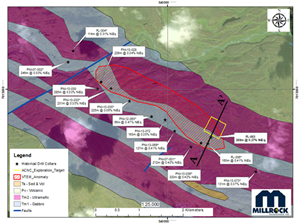
Overview map of the Eureka Zone, including VTEM anomaly, exploration target and historical drill results. An asterisk denoted after the drill hole indicates that Pure Nickel Inc. reported the drill hole ended in mineralization. Refer to Millrock’s September 26, 2022 press release for cross-section A – A’.
Figure 2
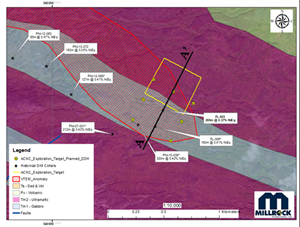
Overview map of proposed collar locations for initial exploration target testing
VANCOUVER, British Columbia, Oct. 05, 2022 (GLOBE NEWSWIRE) — Millrock Resources Inc. (TSX-V: MRO) (“Millrock”) is pleased to report that a significant exploration target of Ni-Cu-Co-PGE mineralization has been identified at Millrock’s 100% owned Nikolai Project. The Nikolai Project is located within Alaska’s Delta Mining District, approximately 130 kilometers by road south of Delta Junction and approximately 280 kilometers southeast of Fairbanks. The Eureka zone consists of disseminated Ni-Cu-Co-PGE mineralization initially discovered by a subsidiary of INCO and further expanded by Pure Nickel Inc., as reported in their press releases released between 2007-2014. https://embed.fireplace.yahoo.com/embed?ctrl=Monalixa&m_id=monalixa&m_mode=document&site=sports&os=android&pageContext=%257B%2522ctopid%2522%253A%25221542500%253B1480989%253B1481489%2522%252C%2522hashtag%2522%253A%25221542500%253B1480989%253B1481489%2522%252C%2522wiki_topics%2522%253A%2522Target_Corporation%253B%25C3%2589cu%253BNio%253BExploration%2522%252C%2522lmsid%2522%253A%2522a0770000002m0AbAAI%2522%252C%2522revsp%2522%253A%2522globenewswire.com%2522%252C%2522lpstaid%2522%253A%2522c5ed4c96-c955-3257-9e0b-95a99f98e1d5%2522%252C%2522pageContentType%2522%253A%2522story%2522%257D
Millrock President and CEO Gregory Beischer commented: “Our exploration geologists have outlined a block of mineralized rock that could likely be converted to a NI43-101 compliant Inferred Resource with a single drill program estimated to cost approximately $2 million. If successful, Millrock estimates the resulting Inferred Resource may comprise a deposit with approximately 400,000 metric tonnes of contained nickel metal, plus copper, cobalt, and platinum group metals. Other companies exploring similar deposits have significantly higher market capitalization than Millrock. Establishing an Inferred Resource at Nikolai could substantially increase the value of the Company. The planned drilling program would delineate an Inferred Resource over a 400-meter-long strike length. However, indications from sparse drilling along strike in both directions indicate the suspected deposit may be in excess of five kilometers long and contain a very large, albeit low-grade metal endowment.”
Based on historical INCO Ltd. drill hole assay data available to Millrock, newly received assays reported on September 26, 2022, and positive mineralogy results reported on September 29, 2022, Millrock has established a clear exploration target. From the data, a block of mineralized rock measuring 400 meters by 300 meters by 400 meters has been outlined. Drill density is not presently sufficient to calculate an Inferred Resource. However, it is estimated that the exploration target contains between 140 million tonnes and 211 million tonnes, with grades ranging from 0.28% nickel equivalent (“NiEq”*) to 0.42% NiEq*. The target has been developed and modeled in 3D using the average thickness and grade from historical drill holes FL-003 and FL-006 of the Upper Eureka Zone, Central Eureka Zone and Lower Eureka Zone (Figure 1). Historical density studies of the Nikolai ultramafic sequence have returned an average density of 2.83 g/cm3, which was used in the tonnage calculation for this exploration target.
This target is based on two drill hole intersections, extrapolated along strike ~400-meter distance, with the base of the target as the lower mineralized elevation of FL-003. Additional drill holes reported by Pure Nickel are present in the area but were not used in exploration targeting as Millrock does not have access to the full dataset.
Table 1 below details the exploration target’s potential grade and tonnage, with the potential tonnage and grade using a maximum and minimum increase/decrease of 20% to allow for uncertainty.
Table 1. Exploration Target potential grade and tonnages.
Nikolai Ni-Cu-Co-PGE Exploration Target (NiEq & CuEq = $7.00, Cu = $3.50, Co = $25.00, Pt = $900, Pd = $1800, Au = $1600)
Zone
Metric Tonnage Range
Base & Battery Metals
Platinum Group and Precious Metals
Total NiEq2 Range
Total CuEq3 Range
Ni Range
Cu Range
Co Range
NiEq Range1
Pt Range
Pd Range
Au Range
%
%
%
%
g/t
g/t
g/t
%
%
Upper Eureka Zone
48-73
0.16-0.24
0.04-0.06
0.013-0.019
0.23-0.34
0.037-0.055
0.078-0.117
0.005-0.007
0.26-0.39
0.53-0.79
Core Eureka Zone
39-58
0.19-0.29
0.10-0.15
0.016-0.023
0.30-0.45
0.053-0.080
0.113-0.170
0.017-0.025
0.36-0.53
0.66-1.07
Lower Eureka Zone
53-80
0.16-0.24
0.04-0.06
0.013-0.019
0.23-0.34
0.021-0.031
0.050-0.074
0.011-0.016
0.25-0.38
0.51-0.75
Total Eureka Zone
140-211
0.16-0.25
0.06-0.08
0.014-0.020
0.25-0.37
0.035-0.053
0.077-0.115
0.010-0.015
0.28-0.42
0.55-0.85
1. NiEq calculated as Ni+(Cu% x $3.50/$7.00)+(Co% x $25.00/$7.00)
2. Total NiEq calculated as Ni + Cu% x $3.50/$7.00 + Co% x $25.00/$7.00 + Pt(g/t)/31.103 x $900/$7.00/22.04 + Pd(g/t)/31.103 x $1800/$7.00/22.04 + Au(g/t)/31.103 x $1600/$7.00/22.04
3. Total CuEq calculated as Cu + Ni% x $7.00/$3.50 + Co% x $25.00/$3.50 + Pt(g/t)/31.103 x $900/$3.50/22.04 + Pd(g/t)/31.103 x $1800/$3.50/22.04 + Au(g/t)/31.103 x $1600/$3.50/22.04
The potential quantity and grade is conceptual in nature. There has not been sufficient exploration drilling to estimate a Mineral Resource, and it is uncertain if further exploration will result in the estimation of a Mineral Resource.
Additionally, significant upside potential exists, as historical geophysical reports indicated a VTEM anomaly ~3.5 kilometer in length and 400 to 600 meters in width in this part of the Eureka Zone. The developed exploration target accounts for only 12% of the length of the VTEM anomaly (Figure 1). Historical drill hole assay results in this VTEM anomaly, reported by Pure Nickel Inc. (Pure Nickel Inc., News Release, October 29th, 2013), indicate an area of mineralization with an estimated true width ranging from 94.8 meters to 320 meters, and grades ranging from 0.20% to 0.25% nickel, 0.05% to 0.15% copper, 0.016% to 0.019% cobalt, 39 ppb to 96 ppb platinum, 62 ppb to 156 ppb palladium and 11 ppb to 31 ppb Au, with a calculated nickel equivalent (NiEq) ranging from 0.33% to 0.47%.
As reported previously, the Millrock Qualified Person (QP) does not have access to all the Pure Nickel Inc. drill logs, assay results, and geophysical data and has no way to verify the results that were published. The Millrock QP has access to the drill logs and assay certificates for the INCO holes that are designated with the “FL” prefix.
Exploration Target Drill Testing A drill program consisting of seven holes totaling approximately 2,750 meters has been recommended. If successful, the program would, along with historical drill hole information, provide a drill density on 200 meters centers. This drill hole density is believed to be adequate to allow a calculation of an Inferred Resource, given the apparent relative continuity and homogeneity of the mineralized zone. Figure 2 depicts the approximate surface locations of the recommended drill collars for the intial test. Millrock anticipates that the recommended program will prove the exploration target holds significant mineralization and could be expanded along the VTEM anomaly.
Qualified Person The technical information within this document has been reviewed and approved by Gregory A. Beischer, President, CEO, and a director of Millrock. Mr. Beischer is a Qualified Person as defined in NI 43-101.
About Millrock Resources Inc. Millrock Resources Inc. is a premier project generator to the mining industry. Millrock identifies, packages, and operates large-scale projects for joint venture, thereby exposing its shareholders to the benefits of mineral discovery without the usual financial risk taken on by most exploration companies. The company is recognized as the premier generative explorer in Alaska and is a significant shareholder of junior explorers ArcWest Exploration Inc. (TSXV : AWX), Resolution Minerals Limited (ASX : RML), and Felix Gold (ASX: FXG). Funding for drilling at Millrock’s exploration projects is primarily provided by its joint venture partners. Business partners of Millrock have included some of the leading names in the mining industry: EMX Royalty, Coeur Explorations, Centerra Gold, First Quantum, Teck, Kinross, Vale, Inmet and, Altius as well as junior explorers Resolution, Riverside, PolarX, Felix Gold, and Tocvan.
ON BEHALF OF THE BOARD “Gregory Beischer” Gregory Beischer, President & CEO
FOR FURTHER INFORMATION, PLEASE CONTACT: Melanee Henderson, Investor Relations Toll-Free: 877-217-8978 | Local: 604-638-3164 Twitter | Facebook | LinkedIn
Some statements in this news release contain forward-looking information, including but not limited to execution of deportment studies. These statements address future events and conditions and, as such, involve known and unknown risks, uncertainties and other factors which may cause the actual results, performance, or achievements to be materially different from any future results, performance or achievements expressed or implied by the statements. Such factors include without limitation the completion of planned expenditures, the ability to complete exploration programs on schedule and the success of exploration programs.
“NEITHER TSX VENTURE EXCHANGE NOR ITS REGULATION SERVICES PROVIDER (AS THAT TERM IS DEFINED IN THE POLICIES OF THE TSX VENTURE EXCHANGE) ACCEPTS RESPONSIBILITY FOR THE ADEQUACY OR ACCURACY OF THIS RELEASE.”
VANCOUVER, British Columbia, Oct. 05, 2022 (GLOBE NEWSWIRE) — Rover Metals Corp. (TSXV: ROVR) (OTCQB: ROVMF) (FSE:4XO) (“Rover” or the “Company”) is pleased to announce that its new corporate presentation is now available on its website. The Company is also featuring a recently recorded interview with its CEO, Judson Culter, who has provided a corporate update and plans for Q4 of this year.
Rover is a publicly traded junior mining company that trades on the TSXV under symbol ROVR, on the OTCQB under symbol ROVMF, and on the FSE under symbol 4XO. The Company is now developing a diverse portfolio of mineral resource projects: (1) Nevada Claystone Lithium; (2) Zinc-Copper-Lead-Silver in NT, Canada; as well as (3) Gold in NT, Canada. The Company is exclusive to the mining jurisdictions of Canada and the U.S.https://embed.fireplace.yahoo.com/embed?ctrl=Monalixa&m_id=monalixa&m_mode=document&site=sports&os=android&pageContext=%257B%2522ctopid%2522%253A%25221542500%253B1577000%2522%252C%2522hashtag%2522%253A%25221542500%253B1577000%2522%252C%2522wiki_topics%2522%253A%2522Vancouver%253BRover_(marque)%253BTSX_Venture_Exchange%2522%252C%2522lmsid%2522%253A%2522a0770000002m0AbAAI%2522%252C%2522revsp%2522%253A%2522globenewswire.com%2522%252C%2522lpstaid%2522%253A%2522b243763e-490c-3642-8311-1f09ba99905e%2522%252C%2522pageContentType%2522%253A%2522story%2522%257D
You can follow Rover on its social media channels:
ON BEHALF OF THE BOARD OF DIRECTORS “Judson Culter” Chief Executive Officer and Director
For further information, please contact: Email: info@rovermetals.com Phone: +1 (778) 754-2617
Statement Regarding Forward-Looking Information This news release contains statements that constitute “forward-looking statements.” Such forward-looking statements involve known and unknown risks, uncertainties and other factors that may cause Rover’s actual results, performance or achievements, or developments in the industry to differ materially from the anticipated results, performance or achievements expressed or implied by such forward-looking statements. Forward-looking statements are statements that are not historical facts and are generally, but not always, identified by the words “expects,” “plans,” “anticipates,” “believes,” “intends,” “estimates,” “projects,” “potential” and similar expressions, or that events or conditions “will,” “would,” “may,” “could” or “should” occur. There can be no assurance that such statements prove to be accurate. Actual results and future events could differ materially from those anticipated in such statements, and readers are cautioned not to place undue reliance on these forward-looking statements. Any factor could cause actual results to differ materially from Rover’s expectations. Rover undertakes no obligation to update these forward-looking statements in the event that management’s beliefs, estimates or opinions, or other factors, should change.
THE FORWARD-LOOKING INFORMATION CONTAINED IN THIS NEWS RELEASE REPRESENTS THE EXPECTATIONS OF THE COMPANY AS OF THE DATE OF THIS NEWS RELEASE AND, ACCORDINGLY, IS SUBJECT TO CHANGE AFTER SUCH DATE. READERS SHOULD NOT PLACE UNDUE IMPORTANCE ON FORWARD-LOOKING INFORMATION AND SHOULD NOT RELY UPON THIS INFORMATION AS OF ANY OTHER DATE. WHILE THE COMPANY MAY ELECT TO, IT DOES NOT UNDERTAKE TO UPDATE THIS INFORMATION AT ANY PARTICULAR TIME EXCEPT AS REQUIRED IN ACCORDANCE WITH APPLICABLE LAWS.
NEITHER THE TSX VENTURE EXCHANGE NOR ITS REGULATION PROVIDER (AS THAT TERM IS DEFINED IN THE POLICIES OF THE TSX VENTURE EXCHANGE) ACCEPTS RESPONSIBILITY FOR THE ADEQUACY OF THIS RELEASE.
Vancouver, British Columbia–(Newsfile Corp. – October 4, 2022) – Goldshore Resources Inc. (TSXV: GSHR) (OTCQB: GSHRF) (FSE: 8X00) (“Goldshore” or the “Company“), is pleased to announce assay results from its initial scout drilling campaign testing the historic North Coldstream copper mine (“North Coldstream“) at the Moss Lake Project in Northwest Ontario, Canada (the “Moss Lake Gold Project“).
Highlights:
Initial results from one North Coldstream hole confirm significant copper, cobalt and gold mineralization hosted within a sheared volcanic massive sulphide deposit with best intercepts of:
62.8m @ 0.88% CuE (0.36% Cu, 0.06% Co, 0.30 ppm Au and 3.1 ppm Ag) from 8.2m depth in CND-22-006, including
13.35m @ 1.18% CuE (0.54% Cu, 0.07% Co, 0.39 ppm Au and 3.5 ppm Ag) from 8.2m
14.65m @ 1.30% CuE (0.57% Cu, 0.09% Co, 0.39 ppm Au and 4.4 ppm Ag) from 23.1m
These copper and cobalt results confirm that North Coldstream hasimportant critical mineral value and highlights multiple deposit styles in the district, which is a hallmark of important mineral districts worldwide.
North Coldstream was mapped by last year’s VTEM survey (press release dated March 10, 2022) as a discrete magnetic conductor. There are twelve similar targets in the Moss Lake Project, highlighting the potential for similar copper-cobalt-gold deposits.
Drilling also identified a gold only intercept of 2.1m @ 1.88 g/t Au from 98.9m in the footwall to the North Coldstream VMS deposit, which is related to the East Coldstream style of mineralization 1.6 kilometers to the east, suggesting greater continuity of the gold-bearing structures.
President and CEO Brett Richards stated: “Although we are very focused on the Moss Lake drilling and defining a higher-grade resource within the lower grade historical resource; these findings at North Coldstream are extremely encouraging and provide tremendous potential optionality in the future. As we have illustrated previously to the market, North Coldstream was a past producing copper-gold mine, so these results are not unexpected. However, I think the exciting story is the emergence and identification of cobalt in the historic mine. These drill results prove the value and priority of further drilling and exploration at the North Coldstream deposit, and could identify it as a critical mineral asset, which is important for the development of renewable energies, electrification of vehicles and global decarbonization initiatives.”
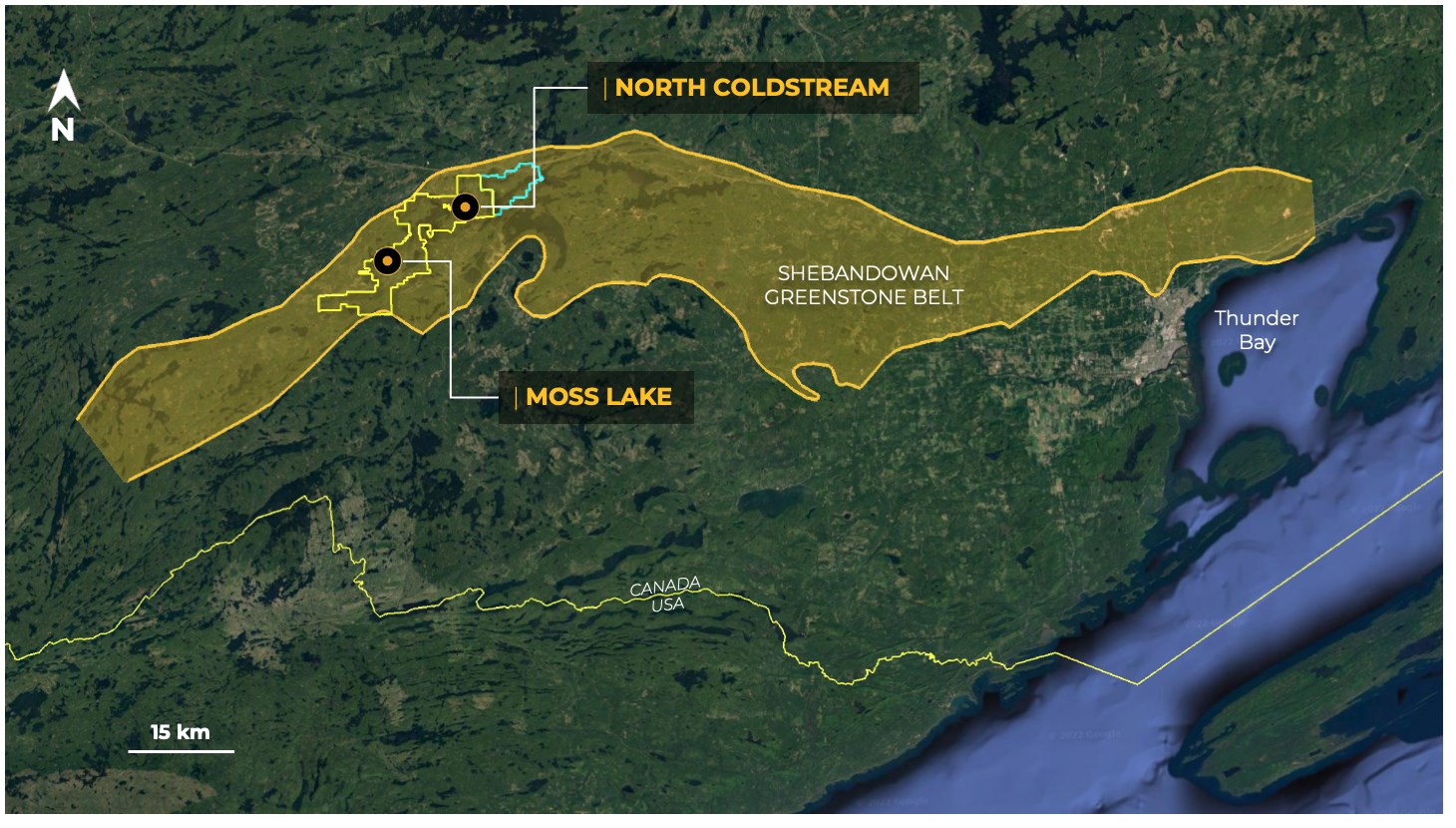
Figure 1 shows the location of North Coldstream relative to the main Moss Lake Gold Deposit. Figures 2 and 3 show a plan and long section of the historic workings, respectively, with the location of CND-22-006. Figure 4 shows a photograph of the drill core to illustrate the style of mineralization. Table 1 shows the hole details and Table 2 shows the significant intercepts.
Figure 1: Location map showing North Coldstream relative to Moss Lake
Intersections calculated above a 0.1% Cu cut off with no top cut and a maximum internal waste interval of 2 metres. Bordered intervals are higher grade intersections above a 0.2% Cu cut off. Copper equivalent values assume prices of $3.50/lb Cu, $25/lb Co, $1700/oz Au and $19/oz Ag. Metallurgical recoveries are assumed at 90% Cu, 70% Co, 70% Au and 70% Ag based on similar mineralization in the Copperbelt, however, metallurgical test work is yet to be conducted. True widths are approximate and assume a subvertical body.
Figure 2: Drill plan showing drill hole relative to the historic copper mine
The Company has completed six scout holes to test the geology and multi-element chemistry of the North Coldstream deposit that was mined for copper between 1957 and 1967. The challenging aspect of this program has been drilling to avoid the historic stopes, which has meant, at this stage, drilling the fringes of the deposit as we target extensions to shoots.
CND-22-006 intersected a broad zone of copper mineralization associated with the western edge of the historic workings. While gold and silver credits were expected, based on historic production figures, elevated levels of cobalt in the range of 0.02 to 0.2% Co suggest previously unrecognized critical mineral value at North Coldstream.
A review of the geology has confirmed that the deposit is a sheared volcanic massive sulphide deposit with chalcopyrite-pyrite-pyrrhotite mineralization associated with brecciated siliceous cherts containing variable amounts of syngenetic magnetite (Figure 4). Minor sphalerite mineralization defines a very distinct 40-meter halo around the main massive sulphide lens, bolstering the interpretation of a VMS setting for the mineralization. Within the massive sulphide lens copper, cobalt, gold, and silver grades track each other closely, indicating that they precipitated as part of a single event. In contrast, the narrow intervals of gold mineralization outboard of the main lens are associated with quartz-carbonate veining and have only minor silver and weak copper-cobalt values. These are likely related to the gold mineralization 1.6 kilometers along strike at the East Coldstream deposit and highlight the prospectivity of this trend for additional gold targets.
Figure 4: Photograph of drill core in the main high-grade zone (CND-22-006: 25.9-38.15m averages 1.34% CuE, including 0.59% Cu, 0.09% Co, 0.41 ppm Au and 4.5 ppm Ag)
The Company will address the backlog of North Coldstream core once it has cleared the balance of drill core from Moss Lake. Future drilling will target pillars within the deposit, potential depth extensions, and test similar targets in the district that are characterized by magnetic conductors (press release dated March 10, 2022).
Pete Flindell, VP Exploration for Goldshore, said, “These drill results confirm our expectations of high-grade copper mineralization, especially as we are on the margin of the volcanic massive sulphide lens, and are extremely encouraging with respect to Cobalt grades. While the five pending holes are also around the margin of the system, and therefore likely to contain similar grades, I look forward to drilling closer to the core of the deposit to understand how the critical mineral elements may increase. These data will be invaluable in guiding our future drilling of similar, untested targets within the Moss Lake Project.”
Analytical and QA/QC Procedures
All samples were sent to ALS Geochemistry in Thunder Bay for preparation and analysis was performed in the ALS Vancouver analytical facility. ALS is accredited by the Standards Council of Canada (SCC) for the Accreditation of Mineral Analysis Testing Laboratories and CAN-P-4E ISO/IEC 17025. Samples were analyzed for gold via fire assay with an AA finish (“Au-AA23”) and 48 pathfinder elements via ICP-MS after four-acid digestion (“ME-MS61”). Samples that assayed over 10 ppm Au were re-run via fire assay with a gravimetric finish (“Au-GRA21”).
In addition to ALS quality assurance / quality control (“QA/QC”) protocols, Goldshore has implemented a quality control program for all samples collected through the drilling program. The quality control program was designed by a qualified and independent third party, with a focus on the quality of analytical results for gold. Analytical results are received, imported to our secure on-line database and evaluated to meet our established guidelines to ensure that all sample batches pass industry best practice for analytical quality control. Certified reference materials are considered acceptable if values returned are within three standard deviations of the certified value reported by the manufacture of the material. In addition to the certified reference material, certified blank material is included in the sample stream to monitor contamination during sample preparation. Blank material results are assessed based on the returned gold result being less than ten times the quoted lower detection limit of the analytical method. The results of the on-going analytical quality control program are evaluated and reported to Goldshore by Orix Geoscience Inc.
About Goldshore
Goldshore is an emerging junior gold development company, and owns the Moss Lake Gold Project located in Ontario. Wesdome is currently a large shareholder of Goldshore with an approximate 27% equity position in the Company. Well-financed and supported by an industry-leading management group, board of directors and advisory board, Goldshore is positioned to advance the Moss Lake Gold Project through the next stages of exploration and development.
About the Moss Lake Gold Project
The Moss Lake Gold Project is located approximately 100 km west of the city of Thunder Bay, Ontario. It is accessed via Highway 11 which passes within 1 km of the property boundary to the north. The Moss Lake Gold Project covers 14,292 hectares and consists of 282 unpatented and patented mining claims.
The Moss Lake Gold Project hosts a number of gold and base metal rich deposits including the Moss Lake Deposit, the East Coldstream Deposit (Table 3), the historically producing North Coldstream Mine (Table 4), and the Hamlin Zone, all of which occur over a mineralized trend exceeding 20 km in length. A historical preliminary economic assessment (the “Moss Lake Historical Estimate“) was completed on the Moss Lake Gold Project in 2013 and published by Moss Lake Gold Mines Ltd. (“Moss Lake Gold Mines“)1,3. A historical mineral resource estimate (the “East Coldstream Historical Estimate“) was completed on the East Coldstream Deposit in 2011 by Foundation Resources Inc.2,3 In addition to these zones, the Moss Lake Gold Project also hosts a number of under-explored mineral occurrences which are reported to exist both at surface and in historically drilled holes. The Moss Lake Deposit is a shear-hosted disseminated-style gold deposit which outcrops at surface. It has been drilled over a 2.5 km length and to depths of 300 m with 376 holes completed between 1983 and 2017. The last drilling program conducted in 2016 and 2017 by Wesdome Gold Mines Ltd. (“Wesdome“), which consisted of widely spaced holes along the strike extension of the deposit was successful in expanding the mineralized footprint and hydrothermal system 1.6 km to the northeast. Additionally, the deposit remains largely open to depth. In 2017, Wesdome completed an induced polarization survey which traced the potential extensions of pyrite mineralization associated with the Moss Lake Deposit over a total strike length of 8 km and spanning the entire extent of the survey grids.
The East Coldstream Deposit is a shear-hosted disseminated-style gold deposit which locally outcrops at surface. It has been drilled over a 1.3 km length and to depths of 200 m with 138 holes completed between 1988 and 2017. The deposit remains largely open at depth and may have the potential for expansion along strike. Historic drill hole highlights from the East Coldstream Deposit include 4.86 g/t Au over 27.3 m in C-10-15.
The historically producing North Coldstream Mine is reported to have produced significant amounts of copper, gold and silver4 from mineralization with potential iron-oxide-copper-gold deposit style affinity. The exploration potential immediately surrounding the historic mining area is not currently well understood and historic data compilation is required.
The Hamlin Zone is a significant occurrence of copper and gold mineralization, and also of potential iron-oxide-copper-gold deposit style affinity. Between 2008 and 2011, Glencore tested Hamlin with 24 drill holes which successfully outlined a broad and intermittently mineralized zone over a strike length of 900 m. Historic drill hole highlights from the Hamlin Zone include 0.9 g/t Au and 0.35% Cu over 150.7 m in HAM-11-75.
The Moss Lake, East Coldstream and North Coldstream deposits sit on a mineral trend marked by a regionally significant deformation zone locally referred to as the Wawiag Fault Zone in the area of the Moss Lake Deposit. This deformation zone occurs over a length of approximately 20 km on the Moss Lake Gold Project and there is an area spanning approximately 7 km between the Moss Lake and East Coldstream deposits that is significantly underexplored.
Table 3: Historical Mineral Resources1,2,3
INDICATED
INFERRED
Deposit
Tonnes
Au g/t
Au oz
Tonnes
Au g/t
Au oz
Moss Lake Historical Estimate
Open Pit Potential
39,795,000
1.1
1,377,300
48,904,000
1.0
1,616,300
Underground Potential
–
–
–
1,461,100
2.9
135,400
Moss Lake Total
39,795,000
1.1
1,377,300
50,364,000
1.1
1,751,600
East Coldstream Historical Estimate
East Coldstream Total
3,516,700
0.85
96,400
30,533,000
0.78
763,276
Combined Total
43,311,700
1.08
1,473,700
80,897,000
0.98
2,514,876
Notes:
(1) Source: Poirier, S., Patrick, G.A., Richard, P.L., and Palich, J. “Technical Report and Preliminary Economic Assessment for the Moss Lake Project”, prepared for Moss Lake Gold Mines Ltd. The qualified persons for the Moss Lake Historical Estimate are Pierre-Luc Richard, MSc, PGeo (InnovExplo Inc), and Carl Pelletier, BSc, PGeo (InnovExplo Inc), and the effective date of the Moss Lake Historical Estimate is February 8, 2013. In-Pit results are presented undiluted and in situ, within Whittle-optimized pit shells. Underground results are presented undiluted and in situ, outside Whittle-optimized pit shells. The Moss Lake Historical Estimate includes 18 gold-bearing zones and 1 envelope containing isolated gold intercepts. Whittle parameters: mining cost = C$2.28; pit slope angle = 50.0 degrees; production cost = C$9.55; mining Dilution = 5%; mining recovery = 95%; processing recovery = 80% to 85%; gold price = C$1,500. In-Pit and Underground resources were compiled at cut-off grades from 0.3 to 5.0 g/t Au (for sensitivity characterization). A cut-off grade of 0.5 g/t Au was selected as the official in-pit cut-off grade and a cut-off grade of 2.0 g/t Au was selected as the official underground cut-off grade. The Moss Lake Historical Estimate is based on 352 diamond drill holes (90,978 m) drilled from 1983 and 2008. A fixed density of 2.78 g/cm3 was used. A minimum true thickness of 5.0 m was applied, using the grade of the adjacent material when assayed or a value of zero when not assayed. Capping was established at 35 g/t Au, supported by statistical analysis and the high grade distribution within the deposit. Compositing was done on drill hole sections falling within the mineralized zone solids (composite = 1 m). Resources were evaluated from drill hole samples using the ID2 interpolation method in a multi-folder percent block model using Gems version 6.4. Based on geostatistics, the ellipse range for interpolation was 75m x 67.5m x 40m. The Indicated category is defined by combining the blocks within the two main zones and various statistical criteria, such as average distance to composites, distance to closest composite, quantity of drill holes within the search area. Ounce (troy) = metric tons x grade / 31.10348. Calculations used metric units (metres, tonnes and g/t). The number of metric tonnes was rounded to the nearest thousand. Any discrepancies in the totals are due to rounding effects; rounding followed the recommendations in NI 43-101.
(2) Source: McCracken, T. “Technical Report and Resource Estimate on the Osmani Gold Deposit, Coldstream Property, Northwestern Ontario”, prepared for Foundation Resources Inc. and Alto Ventures Ltd. The East Coldstream Historical Estimate is based on a 0.4 g/t Au cut-off grade. The qualified persons for the East Coldstream Historical Estimate are Todd McCracken, P.Geo. (Tetratech Wardrop), and Jeff Wilson, Ph.D., P.Geo. (Tetratech Wardrop), and the effective date of the East Coldstream Historical Estimate is December 12, 2011. Resources are presented unconstrained, undiluted and in situ. The East Coldstream Historical Estimate includes 2 gold-bearing zones. A cut-off grade of 0.4 g/t Au was selected as the official resource cut-off grade. The East Coldstream Historical Estimate is based on 116 diamond drill holes drilled from 1986 to 2011. A fixed density of 2.78 g/cm3 was used. Capping was established at 5.89 g/t Au and 5.70 g/t Au for domains EC-1 and EC-2, respectively. This is supported by statistical analysis and the high grade distribution within the deposit. Compositing was done on drill hole sections falling within the mineralized zone solids (composite = 1 m). Resources were evaluated from drill hole samples using the ID2 interpolation method in a multi-folder percent block model using Datamine Studio 3 version 3.20.5321.0. Resource categorization is based on spatial continuity based from the variography of the assays within the drillholes. Ounce (troy) = metric tons x grade / 31.10348. Calculations used metric units (metres, tonnes and g/t). The number of metric tonnes was rounded to the nearest thousand. Any discrepancies in the totals are due to rounding effects; rounding followed the recommendations in NI 43-101.
(3) The reader is cautioned that the Moss Lake Historical Estimate East and the East Coldstream Historical Estimate (the “Historical Estimates“) are considered historical in nature and as such is based on prior data and reports prepared by previous property owners. The reader is cautioned not to treat them, or any part of them, as current mineral resources or reserves. The Company has determined these historical resources are reliable, and relevant to be included here in that they demonstrate simply the mineral potential of the Moss Lake Gold Project. A qualified person has not done sufficient work to classify the Historical Estimates as current resources and Goldshore is not treating the Historical Estimates as current resources. Significant data compilation, re-drilling, re-sampling and data verification may be required by a qualified person before the Historical Estimates can be classified as a current resource. There can be no assurance that any of the historical mineral resources, in whole or in part, will ever become economically viable. In addition, mineral resources are not mineral reserves and do not have demonstrated economic viability. Even if classified as a current resource, there is no certainty as to whether further exploration will result in any inferred mineral resources being upgraded to an indicated or measured mineral resource category. The Historical Estimates relating to inferred mineral resources were calculated using prior mining industry standard definitions and practices for estimating mineral resource and mineral reserves. Such prior definitions and practices were utilized prior to the implementation of the current standards of the Canadian Institute of Mining for mineral resource estimation, and have a lower level of confidence.
Table 4: Reported Historical Production from the North Coldstream Deposit4
Deposit
Tonnes
Cu %
Au g/t
Ag
Cu lbs
Au oz
Ag oz
Historical Production
2,700,0000
1.89
0.56
5.59
102,000,000
44,000
440,000
Note::
(4) Source: Schlanka, R., 1969. Copper, Nickel, Lead and Zinc Deposits of Ontario, Mineral Resources Circular No. 12, Ontario Geological Survey, pp. 314-316.
Peter Flindell, P.Geo., MAusIMM, MAIG, Vice President – Exploration of the Company, a qualified person under NI 43-101 has approved the scientific and technical information contained in this news release.
Neither the TSXV nor its Regulation Services Provider (as that term is defined in the policies of the TSXV) accepts responsibility for the adequacy or accuracy of this release.
For More Information – Please Contact:
Brett A. Richards President, Chief Executive Officer and Director Goldshore Resources Inc.
This news release contains statements that constitute “forward-looking statements.” Such forward looking statements involve known and unknown risks, uncertainties and other factors that may cause the Company’s actual results, performance or achievements, or developments to differ materially from the anticipated results, performance or achievements expressed or implied by such forward-looking statements. Forward looking statements are statements that are not historical facts and are generally, but not always, identified by the words “expects,” “plans,” “anticipates,” “believes,” “intends,” “estimates,” “projects,” “potential” and similar expressions, or that events or conditions “will,” “would,” “may,” “could” or “should” occur.
Forward-looking statements in this news release include, among others, statements relating to expectations regarding the exploration and development of the Moss Lake Gold Project, and other statements that are not historical facts. By their nature, forward-looking statements involve known and unknown risks, uncertainties and other factors which may cause our actual results, performance or achievements, or other future events, to be materially different from any future results, performance or achievements expressed or implied by such forward-looking statements. Such factors and risks include, among others: the Company may require additional financing from time to time in order to continue its operations which may not be available when needed or on acceptable terms and conditions acceptable; compliance with extensive government regulation; domestic and foreign laws and regulations could adversely affect the Company’s business and results of operations; the stock markets have experienced volatility that often has been unrelated to the performance of companies and these fluctuations may adversely affect the price of the Company’s securities, regardless of its operating performance; and the impact of COVID-19.
The forward-looking information contained in this news release represents the expectations of the Company as of the date of this news release and, accordingly, is subject to change after such date. Readers should not place undue importance on forward-looking information and should not rely upon this information as of any other date. The Company undertakes no obligation to update these forward-looking statements in the event that management’s beliefs, estimates or opinions, or other factors, should change.
This news release does not constitute an offer to sell, or a solicitation of an offer to buy, any securities in the United States. The securities have not been and will not be registered under the United States Securities Act of 1933, as amended (the “U.S. Securities Act”) or any state securities laws and may not be offered or sold within the United States or to U.S. Persons unless registered under the U.S. Securities Act and applicable state securities laws or an exemption from such registration is available.
Vancouver, British Columbia–(Newsfile Corp. – October 4, 2022) – EMX Royalty Corporation (NYSE American: EMX) (TSXV: EMX) (FSE: 6E9) (the “Company” or “EMX”) is pleased to announce that it will receive a US$3 million milestone payment from Arizona Sonoran Copper Company, Inc. (TSX: ASCU) (“ASCU”) for the Parks-Salyer royalty property (the “Royalty Property”) in Arizona. The Royalty Property was held under a lease arrangement by EMX’s wholly owned subsidiary Bronco Creek Exploration Inc., and was transferred to ASCU via Assignment and Royalty Agreements (the “Agreements”) executed earlier this year (see EMX news release dated February 10, 2022). EMX’s Royalty Property covers 158 acres of ASCU’s Parks-Salyer copper project. The milestone payment results from ASCU’s maiden resource estimate for the Parks-Salyer project that exceeds thresholds for contained copper included within EMX’s Royalty Property footprint. The Company also retains a 1.5% net smelter return (“NSR”) royalty covering the Royalty Property.
EMX’s Parks-Salyer Royalty Property provides an example of a significant pre-production payment to the Company resulting from its copper porphyry royalty generation program in Arizona. The Property’s porphyry targets, which are concealed beneath post-mineral cover, were identified by EMX based upon structural geological assessments of historical exploration data. The open ground covering these targets was acquired by EMX at minimal cost. The 158 acres transferred to ASCU complemented the property position at its Parks-Salyer project, while providing EMX with pre-production payments and exploration, development, and royalty upside optionality at no additional cost to the Company.
Commercial Terms and Property Summary (all dollar amounts in USD). The Agreements provided for a one-time cash payment to EMX for the assignment of EMX’s rights covering the Property, as well as the 1.5% NSR royalty interest (ASCU may buy back 1% of the royalty for $500,000), work commitments, annual advance royalty (“AAR”) payments, and the $3 million milestone payment to EMX based upon declared resources totaling 200 million pounds or more of contained copper covered by EMX’s Royalty Property. ASCU’s (global) maiden resources for its Parks-Salyer project were disclosed in a news release dated September 28, 2022.
Parks-Salyer is located approximately five kilometers northwest of Casa Grande, Arizona and approximately 1.5 kilometers southwest of the historical Sacaton open pit copper mine. Sacaton was a porphyry copper-molybedenum mine operated by Asarco (1974-1984), and is now being advanced by ASCU as the PEA stage Cactus Project. The Parks-Salyer deposit lies beneath post-mineral gravels and represents a tilted, and fault-displaced portion of the Casa Grande-Santa Cruz porphyry system.
Qualified Person. Michael P. Sheehan, CPG, a Qualified Person as defined by National Instrument 43-101 and employee of the Company, has reviewed, verified and approved the disclosure of the technical information contained in this news release.https://embed.fireplace.yahoo.com/embed?ctrl=Monalixa&m_id=monalixa&m_mode=document&site=sports&os=android&pageContext=%257B%2522ctopid%2522%253A%25221542500%253B1577000%2522%252C%2522hashtag%2522%253A%25221542500%253B1577000%2522%252C%2522wiki_topics%2522%253A%2522Arizona%253BCompany%253BCasa_Grande%252C_Arizona%253BCopper_Project%2522%252C%2522lmsid%2522%253A%2522a0V0W00000HOPDcUAP%2522%252C%2522revsp%2522%253A%2522newsfile_64%2522%252C%2522lpstaid%2522%253A%2522d7d1d544-54c0-352e-9892-db00e84c428c%2522%252C%2522pageContentType%2522%253A%2522story%2522%257D
About EMX. EMX is a precious, base and battery metals royalty company. EMX’s investors are provided with discovery, development, and commodity price optionality, while limiting exposure to risks inherent to operating companies. The Company’s common shares are listed on the NYSE American Exchange and the TSX Venture Exchange under the symbol EMX, and also trade on the Frankfurt exchange under the symbol “6E9”. Please see www.EMXroyalty.com for more information.
About Arizona Sonoran Copper Company. ASCU’s objective is to become a mid-tier copper producer with low operating costs, develop the Cactus and Parks-Salyer Project that could generate robust returns for investors, and provide a long term sustainable and responsible operation for the community and all stakeholders. The Company’s principal asset is a 100% interest in the Cactus Project (former ASARCO, Sacaton mine) and Parks-Salyer deposit which is situated on private land in an infrastructure-rich area of Arizona.
For further information contact:
David M. Cole President and Chief Executive Officer Phone: (303) 973-8585 Dave@emxroyalty.com
Scott Close Director of Investor Relations Phone: (303) 973-8585 SClose@emxroyalty.com
Neither the TSX Venture Exchange nor its Regulation Services Provider (as that term is defined in policies of the TSX Venture Exchange) accepts responsibility for the adequacy or accuracy of this release.
Forward-Looking Statements
This news release may contain “forward looking statements” that reflect the Company’s current expectations and projections about its future results. These forward-looking statements may include statements regarding perceived merit of properties, exploration results and budgets, mineral reserve and resource estimates, work programs, capital expenditures, timelines, strategic plans, market prices for precious and base metal, or other statements that are not statements of fact. When used in this news release, words such as “estimate,” “intend,” “expect,” “anticipate,” “will”, “believe”, “potential” and similar expressions are intended to identify forward-looking statements, which, by their very nature, are not guarantees of the Company’s future operational or financial performance, and are subject to risks and uncertainties and other factors that could cause the Company’s actual results, performance, prospects or opportunities to differ materially from those expressed in, or implied by, these forward-looking statements. These risks, uncertainties and factors may include, but are not limited to: unavailability of financing, failure to identify commercially viable mineral reserves, fluctuations in the market valuation for commodities, difficulties in obtaining required approvals for the development of a mineral project, increased regulatory compliance costs, expectations of project funding by joint venture partners and other factors.
Readers are cautioned not to place undue reliance on these forward-looking statements, which speak only as of the date of this news release or as of the date otherwise specifically indicated herein. Due to risks and uncertainties, including the risks and uncertainties identified in this news release, and other risk factors and forward-looking statements listed in the Company’s MD&A for the quarter ended June 30, 2022 and the year ended December 31, 2021 (the “MD&A”), and the most recently filed Revised Annual Information Form (the “AIF”) for the year ended December 31, 2021, actual events may differ materially from current expectations. More information about the Company, including the MD&A, the AIF and financial statements of the Company, is available on SEDAR at www.sedar.com and on the SEC’s EDGAR website at www.sec.gov.
On February 16th the comedian running Ukraine began a massive shelling attack on the Donbas after murdering over 14,000 innocent civilians since 2014 in the region because they did not support the illegal coup d’état sponsored by the US.
In a speech given at the Munich Security Conference on February 19th the clown made it clear Ukraine wanted to regain its nuclear arsenal. Also on February 19th Brandon announced he knew Putin was about to attack Ukraine. That may have had something to do with Ukraine’s planned invasion of the Donbas scheduled for early March.
Russia responded with a preemptive attack on Ukraine on February 24th. Brandon called for more sanctions on Russia in response in addition to those imposed before Russia had done anything.
The European allies and US seized billions of dollars of Russian reserves in the west and other assets without even a shred of legal justification. The Ruble went into free fall going from 85 to the dollar on February 15th to a high of 147 on March 7th. Clearly the sanctions had an effect and cut the value of the Ruble almost in half.
Russia was prepared for yet another round of sanctions. They raised internal interest rates and demanded payment for their gas and oil in Rubles. Since then the Ruble has been the strongest currency in the world currently trading at 55 to the dollar. The Euro has fallen to below par with the Dollar, the British Pound is down over 20% and almost at par with the dollar. The sanctions hurt.
But they hurt Europe, they didn’t hurt Russia.
On March 1st I posted an article I had written in response to the sanctions. I called it The US, EU and Nato Just Committed Suicide. I’m going to take credit for being the first person in the world to write about how stupid and self-destructive the sanctions were. Since then the word suicide has been recognized by hundreds or thousands of other commentators. Everyone now understands just how much damage the sanctions have done to the economy of Europe and the US.
You see, there is no energy shortage. There is lots of natural gas available and coal and oil to any willing buyer. But at the insistence of the US upon their European sock puppets, Europe refused to agree to perfectly reasonable terms offered by Russia. This wasn’t a case of Russia refusing to sell resources to the EU. It was a case of the EU first stealing from Russia and then demanding Russia agrees to their terms.
Putin understood something that none of the “leaders” of the EU understood and most of the world still doesn’t get.
Europe needs Russia.
Russia does not need Europe.
So the cost of energy and food across the world has skyrocketed. This winter thousands of businesses in Europe are going to be forced to close because they cannot afford to pay their energy bills. Millions of Europeans are going to starve or freeze or be forced into poverty as a result of their own stupidity or all three at the same time.
I’ve been amazed because the solution to the problem was so simple but the actions of the “leaders” of the EU so obtuse.
Regardless of how they feel about the war, right or wrong on anyone’s part, if the sanctions hurt Europe and didn’t hurt Russia, all the EU had to do was declare victory and announce the end of the sanctions. Agree to pay on the terms Russia has offered to everyone and the economy recovers from this latest stupidity in government in a few months.
If Germany needs natural gas as a feedstock for their chemical plants and to provide heat for businesses and homes, all they had to do was turn on the Nord Stream II pipeline.
That was until September 27th when the US blew up Nord Stream I and Nord Stream II. Which Brandon has promised was in the works long ago.
So we are in one of those good news, bad news places. The good news is that thousands and perhaps millions of Europeans led by the Germans are going to starve, freeze and go bankrupt this year.
Because of this act of war on the part of the US, the probability of a nuclear exchange just went through the roof. We are closer to nuclear annihilation than we have ever been in history.
The bad news of course is that no matter how grim this winter is in Europe, they are totally fucked next year. Turning on the tap is no longer an option even if the EU sobered up.
Welcome to World War III brought to you by Brandon and the idiot neo-cons surrounding him. Is anyone stupid enough to believe Russia will not respond in kind?
About 5.7 tons of Russian bullion arrived in August, data show
Metal arrived from the UK, not under sanctions: Swiss customs
By
Eddie Spence+FollowSeptember 20, 2022, 4:26 AM EDTUpdated on
Switzerland’s imports of Russian gold surged to the highest in more than two years, a sign that more old bullion from the country may be being remelted to make it easier to sell.
About 5.7 tons — worth $324 million — of Russian metal was imported by the refining hub in August, according to data from the Swiss Federal Customs Administration. That’s the most since April 2020.
The shipment was Russian metal that arrived from the UK, the customs administration said in a statement on Tuesday. Swiss customs data show the last place the precious metal was refined, rather than where it was last shipped from.
Russia’s gold has become taboo since the country invaded Ukraine earlier in the year. New Russian gold has been sanctioned by the US, EU and Switzerland, but bars exported from the country before Aug 4. are not subject to the import ban, the customs authority said Tuesday.
Some investors with old Russian gold bars may wish to remelt them at Swiss refineries to make them easier to sell. Though the country’s bullion minted before the war can still be traded in most major centers, including London and Zurich, there’s a stigma around it. Russia — the world’s second-biggest gold miner globally — was previously a major supplier of new bullion to the UK market.
China is still importing Russian gold, though the quantities remain relatively low. The country bought 0.3 tons of the precious metal from Russia in August, a small fraction of its
I have some extremely exciting news to share with you today — the launch of our new Rule Classroom video series.
Over his 49-year career in investment management, Rick has engaged thousands of investors on countless topics related to investment and speculation in natural resource companies. Over time, he’s come to understand what most investors get right and get wrong.
In this 10-part free video series, Rick and I focus on the fundamentals of successful investing and speculation, while addressing many of your most frequently asked questions.
In the first episode, Alpha vs. Beta, we cover:
investing vs. speculating
alpha vs. beta
the reason the market sometimes favors alpha over beta investing or vice versa
the necessity of a contrarian mindset
whether you should engage in alpha or beta investing
recent investing examples
the critical role of time preference in investing
the critical role of uncertainty in alpha investing
With high inflation, teetering markets and critical decisions looming for the Fed, this year’s New Orleans Conference will be the most important in decades.
That’s why we’re expecting a sell-out…and why you’ll need to secure your place now.
Dear Friend,
As a serious investor, you’re well aware of the unique challenges presented by today’s markets.
• Central banks – led by the Federal Reserve – intent to fight off rising inflation with rate hikes no matter what the economic fallout…
• The markets responding with roller-coaster volatility — massive sell-offs followed by floods of buying — and gold just beginning a rebound…
• Inflation remaining at 1970s levels — and the U.S. economy hurtling into a deepening recession…
• …While the Fed itself is running head-long into towering debt-service costs — an insurmountable obstacle blocking their rate-hike campaign.
With all of this and more going on, many investors are caught like deer in the headlights, unsure of which way to turn.
But a few others are quietly confident, taking comfort in one unassailable fact:
And this is why I’m writing you now: This year’s New Orleans Investment Conference may be the most eagerly awaited event in our 48-year history…
…But your opportunity to attend may soon disappear.
There are a number of reasons for the excitement over this year’s conference, and why time is running short.
First, we’ll finally be “back” after a three-year absence due to the Covid pandemic.
Yes, we hosted our first in-person event last year, but many of our exhibiting companies and friends from around the world weren’t able to travel and join us. Still, it was an extraordinary gathering, seeping with intellectual energy from our attendees and value from our elite speakers.
Now that everyone will be able to join us, we’re going to absolutely blow the doors off with this year’s New Orleans Conference.
Our phones have been ringing and our email inboxes bursting with inquiries from across the globe.
This event is not to be missed!
Second, the fundamentals and technical are lined up perfectly for the precious metals, commodity and mining stock opportunities that the New Orleans Conference is renowned for offering.
• Inflation has surged to 1970s levels…real rates are more negative than at any time since the 1940s.
• The Fed is dead-set on the most aggressive monetary tightening in decades — with enormous repercussions now being felt in every investment sector.
• But with an enormous federal debt today — over four times its level in 2008 — the Fed is absolutely powerless to fight inflation.
• The next big development: When the Fed is forced to retreat from its rate hikes…
• Because when the Fed wavers, specific investment sectors are going to explode higher.
What does it all mean?
It means you’re now facing tremendous risks and opportunities…and you have to be prepared for what’s coming.
Third, we’ve already lined up an extraordinary roster of speakers…drawing heavily on the wildly popular experts from last year…with many more still to come.
Consider who’s told us they’re coming to talk to you so far:
Again, there’s much more to come — we’re still in the midst of planning this year’s event, and I’ve got some big surprises in store.
But even at this early date, one thing seems certain…
New Orleans 2002 Is Going To Be A Blockbuster!
I strongly urge you to secure your place for New Orleans 2022.
You see, I don’t think I remember an investment event as eagerly awaited as this one.
Everything — the years spent mired in the pandemic…the macro-economic set-up…the geopolitical uncertainty…the teetering stock markets…soaring inflation…a looming generational commodities bull market…and the Fed’s upcoming retreat on monetary tightening — make New Orleans 2022 a must-attend event.
But here’s the urgency: Our hotel room block is set to expire soon, and the only way to ensure you’ll get in is to register immediately.
By registering now, you’ll not only guarantee your place, but you’ll also save up to $400 from the full registration fee.
So just click on the link below to learn more…and join us in New Orleans!
All the best,
Brien Lundin
Publisher, Gold Newsletter CEO, the New Orleans Investment Conference
To Register For New Orleans 2022 And Save Up To $400
Sign up to Stay Up to Date on News and Progress from Page