Toronto, Ontario–(Newsfile Corp. – October 22, 2026) – Coyote Copper Mines Inc (TSXV: CCMM) (the “Corporation”) is pleased to announce announces that, subject to regulatory approval, it has engaged the services of Independent Trading Group (“ITG”) to provide market-making services in accordance with TSX Venture Exchange (“TSXV”) policies. ITG will trade shares of the Company on the TSXV and all other trading venues with the objective of maintaining a reasonable market and improving the liquidity of the Company’s common shares.
Under the agreement, ITG will receive compensation of CAD$6,500.00 per month, payable monthly in advance. The agreement is for an initial term of one month and will renew for additional one-month terms unless terminated. The agreement may be terminated by either party with 30 days’ notice. There are no performance factors contained in the agreement and ITG will not receive shares or options as compensation. ITG and the Company are unrelated and unaffiliated entities and at the time of the agreement, neither ITG nor its principals have an interest, directly or indirectly, in the securities of the Company.
About Independent Trading Group
Independent Trading Group (ITG) Inc. is a Toronto based CIRO dealer-member that specializes in market making, liquidity provision, agency execution, ultra-low latency connectivity, and bespoke algorithmic trading solutions. Established in 1992, with a focus on market structure, execution and trading, ITG has leveraged its own proprietary technology to deliver high quality liquidity provision and execution services to a broad array of public issuers and institutional investors.
Agreement generates non-dilutive funding; PEA evaluating direct shipping planned for H1 2027
VANCOUVER, British Columbia, Oct. 21, 2026 (GLOBE NEWSWIRE) — Blue Jay Gold Corp. (TSXV: JAY) (OTCQB: JAYGF) (FSE: JAY) (“Blue Jay” or the “Company“) is pleased to announce a materials purchase agreement with Ocean Partners UK Limited (“Ocean Partners“), an international trader of base and precious metal concentrates, in support of its Steller Gold Project (“Steller” or the “Project“), located 55 km south of Whitehorse, Yukon. The materials purchase agreement (the “Agreement“) provides for the sale of the Company’s remediation material (the “Remediation Material“) and gives Ocean Partners exclusivity over the purchase of any further remediation stockpile and similar material from Steller during 2027.
The Remediation Material consists of surface stockpile material extracted by a previous operator during underground development at Skukum Creek. This material will be shipped to the Port of Skagway under the agreement with Ocean Partners.
Highlights
Work that Should be Done: Removing this material reduces the historical legacy stockpiles at Steller and advances part of the Company’s remediation program. Shipping it to Skagway makes the remediation work more sustainable, turning a remediation obligation into a source of non-dilutive capital.
2027 Exclusivity: Ocean Partners will have exclusivity over the purchase of any further remediation stockpile and similar material from Steller during 2027.
PEA Planned: Blue Jay intends to complete a Preliminary Economic Assessment (“PEA“) in the first half of 2027 evaluating a direct shipping ore (“DSO“) option for the current Steller Mineral Resource under a life-of-mine scenario.
Infrastructure Advantage: Steller is connected by road to both Whitehorse and the deep-water port of Skagway, Alaska. The Project is approximately 165 km by road from the point where the material will be delivered.
Advance Payment on Delivery: Ocean Partners will pay 90% of the estimated value of each shipment shortly after loading, with the balance settled on final weights and assays.
“Projects with past operations often come with legacy stockpiles, and they create an opportunity to use progressive and novel approaches to rehabilitation. At Steller, geography gives us an elegant solution,” said Geordie Mark, CEO of Blue Jay Gold. “Our approach also highlights a part of Steller that is easy to overlook. Many projects have no simple way to deal with stockpiles. At Steller, we can truck the material from site to a nearby port and load it onto a ship. Doing this with Ocean Partners means the work generates capital for the Company instead of consuming it, and an Agreement that extends through 2027 shows that Ocean Partners sees longer-term value in Steller. This work also gives us an early indication of whether a lower-impact direct shipping approach could work at Steller. That access is a real advantage for the Project, and it is why we intend to complete a PEA in the first half of 2027 that evaluates development options, including direct shipping. This shipment gives us a working test of the logistics that approach would rely on, while our exploration capital stays focused on drilling.”
Brent Omland, CEO of Ocean Partners, added, “Direct shipping of remediation material is one of the products Ocean Partners trades, and Steller has the attributes, with its high-grade gold and silver mineralization, a past-producing mine and road access to a deep-water port, that make it a good fit. The remediation material gives us a practical place to start working together, and our exclusivity through 2027 reflects our confidence in the Project. We look forward to supporting Blue Jay as it advances Steller and considers the options available to bring its material to market.”
Infrastructure and Logistics
Steller is accessed by an approximately 84 km road from Whitehorse and sits approximately 20 km north of the British Columbia border. The material will be collected and trucked by existing highway to Skagway, Alaska, an established port on the Pacific coast. Delivery would take place at Skagway and then shipped to Ocean Partners’ facilities.
Materials Purchase Agreement
Under the Agreement, Ocean Partners will purchase 100% of stockpiled and similar material to the end of 2027. Material will be delivered free on board at Skagway, with payment based on a grade-based payability scale. Ocean Partners will advance 90% of the estimated value of each shipment shortly after loading, with the balance settled on final weights and assays.
Preliminary Economic Assessment
Blue Jay intends to complete a PEA in the first half of 2027 that evaluates a DSO option for the current Mineral Resource Estimate at Steller under a life-of-mine scenario. The Mineral Resource Estimate, prepared by P&E Mining Consultants Inc. with an effective date of October 31, 2025, includes Indicated Mineral Resources of 1,372,000 tonnes grading 9.06 g/t AuEq for 400,000 ounces AuEq and Inferred Mineral Resources of 2,166,000 tonnes grading 6.45 g/t AuEq for 449,000 ounces AuEq, at a 3.0 g/t AuEq cut-off1. Practical experience from shipping the 2026 Remediation Material, including logistics, sampling and commercial terms, is expected to inform the PEA.
The 2026 Remediation Material is not a mineral resource or mineral reserve under National Instrument 43-101 (“NI 43-101”). The Company has not based any decision on a feasibility study of mineral reserves demonstrating economic and technical viability, and there is increased uncertainty and economic and technical risk associated with the bulk sample program.
2026 Technical Report. TECHNICAL REPORT AND UPDATED MINERAL RESOURCE ESTIMATE OF THE STELLER GOLD PROJECT, WHITEHORSE MINING DISTRICT, YUKON TERRITORY, CANADA. P&E Mining Consultants Inc. Effective Date: Oct. 31, 2025. Cut-off: 3.0 g/t AuEq. Au: US$2,850/oz. Ag: US$34.20/oz. AuEq ratio = Au:Ag 85.6:1
Next Steps
Blue Jay expects to ship the Remediation Material in the near term. The Company will engage a consultant and begin work on the PEA this quarter. Blue Jay will continue to evaluate further remediation pathways in consultation with its partners and stakeholders. Proceeds from the sale of the 2026 Remediation Material will be used to fund exploration at Steller and for general working capital.
Qualified Person
The scientific and technical content of this news release has been reviewed and approved by Freeman Smith, P.Geo., VP Exploration of Blue Jay Gold Corp., who is a Qualified Person as defined by National Instrument 43-101 – Standards of Disclosure for Mineral Projects.
About Ocean Partners
Ocean Partners UK Limited is part of the Ocean Partners group, a leading international trader of base and precious metal concentrates. Headquartered in the United Kingdom, with offices across North America, Europe, Asia and Latin America, Ocean Partners provides marketing, logistics, blending and warehousing, and financing services to metal producers worldwide.
About Blue Jay Gold Corp.
Blue Jay Gold Corp. is a Canadian gold exploration company focused on growing and discovering resources within established gold producing regions in Canada. The Company’s flagship asset is the 100%-owned Steller Gold Project in southern Yukon, an infrastructure-supported, past-producing mine with significant exploration upside and clear near-term catalysts. Blue Jay has also built a portfolio of projects in Ontario. With strategically located assets and a leadership team experienced in geology and capital markets, Blue Jay will advance disciplined, modern exploration programs focused on target definition, resource growth, and new discoveries in known gold-mineralized regions. For more information, please visit: www.bluejaygoldcorp.com.
ON BEHALF OF BLUE JAY GOLD CORP.
signed “Geordie Mark” Geordie Mark, CEO
For additional information contact:
BLUE JAY GOLD CORP.
Geordie Mark CEO Blue Jay Gold Corp. info@bluejaygoldcorp.com Phone: (604) 235-4059
Eric Negraeff Investor Relations Blue Jay Gold Corp. eric@bluejaygoldcorp.com Phone: (604) 235-4059
Cautionary Note Regarding Forward-Looking Statements Certain statements in this press release contain forward-looking information. Forward-looking information involves risks, uncertainties and other factors that could cause actual results to differ materially from those expressed or implied by such forward-looking information. In addition, the forward-looking statements require management to make assumptions and are subject to inherent risks and uncertainties. There is significant risk that the forward-looking statements will not prove to be accurate, that the management’s assumptions may not be correct and that actual results may differ materially from such forward-looking statements. These statements can be identified by the use of forward-looking terminology (e.g., “expect”, “estimates”, “intends”, “anticipates”, “believes”, “plans”). Forward-looking statements contained in this press release may include, but are not limited to, the terms and completion of the Agreement with Ocean Partners, the timing of shipments and the amount and timing of payments, Ocean Partners’ exclusivity over 2027 material, the timing, scope and results of the PEA, the potential for direct shipping at Steller, the Company’s remediation obligations and the evaluation of further remediation pathways, the use of proceeds, and future business plans of the Company. Such information involves known and unknown risks, including the receipt of regulatory approval, compliance with the bulk sample permit, fluctuations in gold and silver prices, variations in grade and tonnage, penalties for deleterious elements, transportation and port availability and costs, the ability to finalize definitive terms with Ocean Partners, the results of future financing and exploration activities, the interpretation of exploration results and other geological data, or unanticipated costs and expenses and other risks identified by Blue Jay in its public securities filings that may cause actual events to differ materially from current expectations. Readers are cautioned not to place undue reliance on these forward-looking statements, which speak only as of the date of this press release. Except as required by applicable securities laws and regulation, Blue Jay disclaims any intention or obligation to update or revise any forward-looking statement, whether as a result of new information, future events or otherwise.
Neither TSX Venture Exchange nor its Regulation Services Provider (as that term is defined in the policies of the TSX Venture Exchange) accepts responsibility for the adequacy or accuracy of this release.
I have a giant advantage over many of the financial commentators covering the junior resource markets. For about twenty years I spent 2-3 weeks a month traveling to different projects all over the world. Barb was quite happy to have me out of her hair so I got to see almost every sort of resource properties. I never counted how many sites I visited but it had to be in the 400-500 range.
The mining business is interesting because the level of education is higher than any other field, I know of. Everybody seems to have at least a Bachelor’s degree with many Master’s degrees and a surprising number of Doctorates. When I was a systems programmer in computers a lot of years ago, I ran into a similar percentage of very bright people but they were almost all self-taught as I was. Computer programmers do not share their knowledge but geologists love teaching what they know and theorize. So, I learned a lot.
That gives me a leg up because if you haven’t been to a whole lot of projects, there are simple issues you would have not experienced. Once I went to a big coal project in China with a 43-101 that was 100% Measured. I’d never seen that before, nor have I seen one since. But it was coal and that is why.
When you have a flat project with similar grade in many holes, the QP can change the requirement for each of the three classifications. Measured, the highest, indicated, lower than measured but higher than inferred, and inferred, the lowest category. In the case of the Chinese resource, I seem to recall they could drill holes on a 500 or 1 km center. So, it didn’t take a lot of holes to generate resources into the measured category.
Potash is the same. Sage Potash (SAGE-V) has a deposit in a large basin where it was once a large lake. Salt and other minerals flowed into the lake and settled at the bottom. Sage demonstrated this quality recently when they announced their 2nd drill hole resource on October 19th, 2026. If you go to page 3 of that press release you can see the new incredible resource of 771.5 million metric tonnes. And just below that table you can see how the QP justified the numbers.
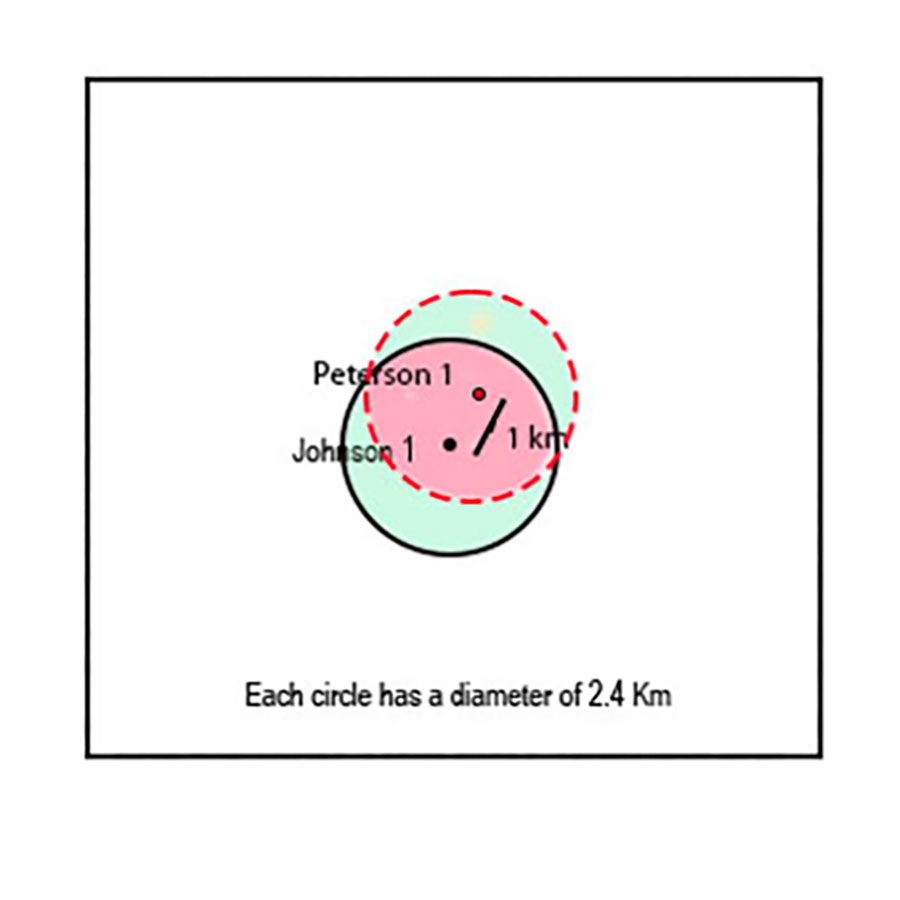
For the Measured Resource, he used a radius of influence of 0-750 metres. For the Indicated Resource he used a radius of influence of 750-2,000 meters and for the Inferred Resource he used a radius of influence of 2,000-4,000 meters.
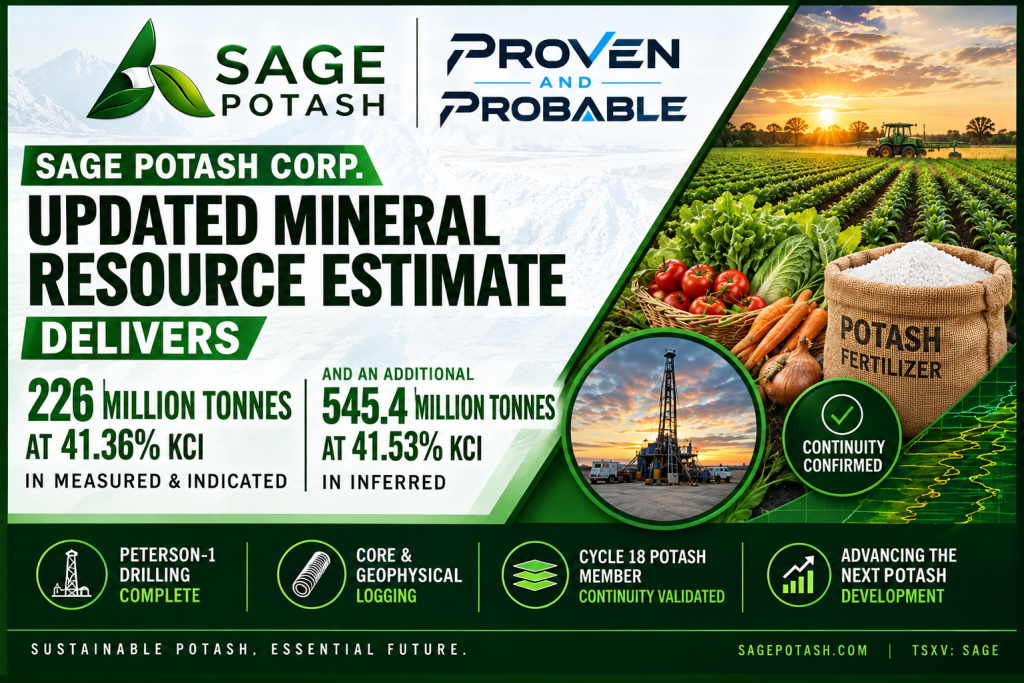
Drilling the 2nd hole has taken the 43-101 Resource from 298 million tonnes in the Inferred category to 771.5 million tonnes total. That’s a 259% increase in total resource with the higher regarded M&I resource showing a total of 226.1 million tonnes. In addition, the grade is one of the highest grade potash deposits in the world at over 40%.
(Click on image to enlarge)
Based on only the first hole, Sage delivered a PEA in September of 2025. It showed an after-tax NPV of $502 million. If you use the same guess but increase the 43-101 resource by 259% by all rights you should increase the new NPV when it is completed to $1.3 billion. For a company with a $20 million market cap, that seems absurdly cheap to me.
On the 19th when the new resource came out, the market was flooded with cheap shares that took the price down from $.115 to a low of $.09 on volume of over 2.6 million. Since there was an almost complete change of management in the past year over internal affairs, I suspect that a lot of former employees with a chip on their shoulder dumped their cheaply bought shares just to send a message. This stock was $.50 a share just over a year ago with only one hole complete. Frankly I thought the stunning new 43-101 number would double the price of the stock. Instead, it went down 25% and that makes no sense at all.
Few people know this but the US only produces a tiny amount of potash, most is imported from Canada. “On March 20, 2025, President Trump declared potash a “critical mineral” and called for an increase in domestic production to reduce import dependence and strengthen national security (EO 14241)”
I see two potential paths forward from here. First of all, readers need to be aware that this is actually a giant project. But giant projects require a lot of money to get into production. The US government appears to want to get involved in mining either directly or indirectly. They could fund this project to production. Alternatively, potash is not a commodity freely traded in any open market. There are only a few really big and powerful companies who control the potash marketplace today. I will guarantee they are watching Sage carefully. The resource they have already outlined represents many years of production and many billions in revenue. Any of them could come in and buy the entire company at a big premium and everyone would walk away happy.
Meanwhile the company is working to further advance the project and at some point, will produce a pre-feasibility study. When they do, the shares will fly.
I have bought a fair number of shares in the open market prior to this news. When I saw the fools dumping shares yesterday and today, I bought more. Sage is an advertiser. Naturally I am biased so do your own due diligence. Their only problem is a lack of visibility.
Sage Potash CorpSAGE-V $.115 Oct 20, 2026 SGPTF-OTCQB 171 million shares Sage Potash website
VANCOUVER, British Columbia, Oct. 20, 2026 (GLOBE NEWSWIRE) — Riverside Resources Inc. (“Riverside” or the “Company“) (TSX-V: RRI) (OTCQB: RVSDF) (FSE: 5YY0), is pleased to announce that its subsidiary, Ravena Resources Corp. (“Ravena“), together with RRM Exploraciones, S.A.P.I. DE C.V., has completed an option agreement with 1559239 B.C. Ltd., operating as Calu Resources Corp (“Calu“) for the Cecilia Project in Sonora, Mexico. Under the agreement, Calu can earn 100% interest in the project by completing the business terms outlined below with a total earn-in work expenditure of $6,650,000. Ravena, the subsidiary of Riverside, will manage the exploration work and receive a 10% operations fee. The work will include an updated NI 43-101 report, followed by a firm commitment exploration program of at least C$150,000 in the first 12 months. Calu has made the initial payment of C$50,000 to Ravena to begin the option commitment. Calu is a new private company that intends to become public through a three-way amalgamation with Pender Capital. That transaction is described in a separate news release issued by Calu and Pender Street Capital Corp.
“Riverside is pleased to progress another property in its portfolio where Riverside retains a 2% NSR royalty and its subsidiary, Ravena Resources, receives option payments and acts as the operator of the exploration program,” said John-Mark Staude, CEO of Riverside Resources. “As we build our royalty portfolio, we are focusing on properties where discovery can add value to those royalties, particularly properties held through Riverside and, going forward, those included in the planned 2027 spin-out of Ravena Resources Corp. With more than C$6,500,000 in exploration expenditures under the earn-in, this agreement allows Cecilia to advance at no cost to Riverside.”
Option and Earn-In Terms
Under the Option Agreement, Calu may acquire a 100% interest in the Cecilia Project by making aggregate cash and share payments of C$1,200,000 and funding aggregate exploration expenditures of C$6,650,000 over five years, as follows:
Due Date
Payments
Cumulative Exploration Expenditures
Effective date of Option Agreement
$50,000 in cash
Nil
First anniversary
$150,000 in cash or Calu shares
$150,000
Second anniversary
$150,000 in cash or Calu shares
$500,000
Third anniversary
$150,000 in cash or Calu shares
$2,000,000
Fourth anniversary
$200,000 in cash or Calu shares
$2,000,000
Fifth anniversary
$500,000 in cash
$2,000,000
Total:
$1,200,000
$6,650,000
Unless otherwise indicated, all amounts in this news release are expressed in Canadian dollars.
The initial C$50,000 cash payment and at least C$150,000 in exploration expenditures during the first 12 months are firm commitments of Calu under the Option Agreement. All remaining payments and exploration expenditures are optional, but Calu must complete them to keep the option in good standing and to exercise it.
Where permitted under the option agreement, Calu may elect, with at least 10 business days’ notice, to make all or part of a cash payment in Calu shares. The number of shares issued will be based on the 10-trading-day volume-weighted average price of Calu shares on a recognized stock exchange, subject to applicable securities laws and stock exchange policies. Shares will be issued fully paid and free of encumbrances, other than statutory resale restrictions.
Ravena will act as operator of all exploration programs on the Cecilia Project during the option period and will be entitled to a management fee equal to 10% of eligible exploration expenditures.
The Cecilia Project is subject to an existing 2.0% net smelter returns royalty in favour of 1412597 B.C. Ltd., a subsidiary of Riverside Resources Inc. Upon exercise of the option, Calu will grant Ravena an additional 0.5% net smelter returns royalty. Calu will have the right to purchase the entire 0.5% royalty from Ravena for US$1,500,000 in cash at any time prior to January 1, 2035.
Cecilia Project
The Cecilia Project is located in northeastern Sonora, Mexico, approximately 40 kilometres southwest of Agua Prieta, near the Mexico-United States border, and 100km due east of the Cananea large copper mining complex. Operations of Couer Mining, First Majestic, Agnico Eagle, Grupo Mexico, Penoles, Hylander Silver are all active in the area around the Project. Riverside’s exploration work has included drilling at four key targets that warrant follow-up exploration. Six additional targets are permitted for drilling and could host a new discovery as well. If exploration is successful, Riverside will benefit through its royalty interests in addition to the option payments. The main concession block includes the Cecilia 1 titled claim and collectively covers > 60 km2 of titled ground plus an additional 16 km2 of application ground for a total property area of approximately 7,583 hectares (76 km2). Further information about the property has been provided previously and is available on the Riverside website.
On September 4, 2026 the Company granted incentive stock options to purchase an aggregate of 1,650,000 common shares of the Company to certain directors, officers, employees and consultants of the Company, in accordance with the Company’s Stock Option Plan. The options are exercisable at a price of $0.41 per share for a period of five years, expiring September 4, 2031. Options granted to Director’s vest in three equal installments of 33% on the six-month, twelve month and eighteen-month anniversaries. Options granted to certain officers, employees and consultants vest in four equal installments of 25% of the common shares on the three-month, six-month, nine-month and twelve-month anniversaries. The grant is subject to the policies of the TSX Venture Exchange.
Qualified Person & QA/QC
The scientific and technical data contained in this news release pertaining to the Project was reviewed and approved by Julian Manco, P.Geo, a non-independent qualified person to Riverside Resources Inc., who is responsible for ensuring that the information provided in this news release is accurate and who acts as a “qualified person” under National Instrument 43-101 Standards of Disclosure for Mineral Projects.
About Riverside Resources Inc.
Riverside is a well-funded exploration company driven by value generation and discovery. The Company has a solid balance sheet with no debt and fewer than 95M shares outstanding with a strong portfolio of gold-silver and copper assets and royalties in North America. Riverside has extensive experience and knowledge operating in Mexico and Canada and leverages its large database to generate a portfolio of prospective mineral properties. Riverside has properties available for option, with information available on the Company’s website at www.rivres.com.
ON BEHALF OF RIVERSIDE RESOURCES INC.
“John-Mark Staude”
Dr. John-Mark Staude, President & CEO
For additional information contact:
John-Mark Staude President, CEO Riverside Resources Inc. info@rivres.com Phone: (778) 327-6671 Fax: (778) 327-6675 Web: www.rivres.com
Eric Negraeff Corporate Communications Riverside Resources Inc. Eric@rivres.com Phone: (778) 327-6671 TF: (877) RIV-RES1 Web: www.rivres.com
Certain statements in this press release may be considered forward-looking information, including statements regarding the Option Agreement, the planned exploration program, and payments and exploration expenditures to be made by Calu. These statements can be identified by the use of forward-looking terminology (e.g., “expects”, “estimates”, “intends”, “anticipates”, “believes”, “plans”). Such information involves known and unknown risks, including the risk that Calu does not complete the payments and exploration expenditures required under the Option Agreement, the risk that Calu’s proposed amalgamation with Pender Capital is not completed as contemplated, or at all, the value of any Calu shares issued as payment, availability of funds, the results of financing and exploration activities, the interpretation of exploration results and other geological data, unanticipated costs and expenses, and other risks identified by Riverside in its public securities filings, that may cause actual events to differ materially from current expectations. Readers are cautioned not to place undue reliance on these forward-looking statements, which speak only as of the date of this press release.
Neither the TSX Venture Exchange nor its Regulation Services Provider (as that term is defined in the policies of the TSX Venture Exchange) accepts responsibility for the adequacy or accuracy of this release.
Prototype hits the maximum groundspeed permitted under FAA Part 107 without a waiver; Company is pursuing FAA authorization to test beyond it.
Demonstrated speed places the platform at the upper end of small one-way attack systems in the field today, as the Company continues toward initial prototype completion in Q4 2026 and scaled production in Q2 2027.
HAGERSTOWN, MD / ACCESS Newswire / October 20, 2026 / First Breach Inc. (NASDAQ:FBDT) (“First Breach” or the “Company”), an American-made defense technologies company focused on vertically integrated ammunition production and next-generation unmanned aerial systems, today announced that its proprietary drone prototype has reached a speed of 161 km/h (100 mph) in flight testing without a payload, the maximum groundspeed the Federal Aviation Administration permits for small unmanned aircraft under Part 107 without a waiver. The Company is in the process of obtaining FAA authorization to test at speeds above that limit.
“We did not stop at 100 mph because the aircraft ran out of margin. We stopped because the rulebook did,” said Jeffrey Low, Co-Founder and Chief Executive Officer of First Breach. “This is a platform that was flying tethered a few months ago. Today it is operating at the regulatory ceiling for its class, and we are working with the FAA to find out how much is left above it. For the defense customers we are building for, speed is survivability and mission tempo, and this airframe has both to spare.”
The 161 km/h (100 mph) result was achieved on the current prototype configuration, with no payload, and exceeds the 120 km/h (74 mph) maximum speed the Company published in its prior specifications for the platform. Hellbender has initiated the process of obtaining FAA waivers that would permit testing above that threshold and expects to characterize the platform’s full speed envelope once that authorization is in place.
“Range, payload, and the ability to fight through jamming are what win these programs, and speed is what makes each of those harder to stop,” said Jordan Low, Co-Founder, President and Chief Operating Officer of First Breach. “Together with Hellbender, we have built a platform that outruns most of what is flying in its class and simple enough to produce at the rate the Department of War is asking for. The FAA waiver process runs in parallel with the production ramp. Neither waits on the other.”
The Company continues to target completion of its initial prototypes in the fourth quarter of 2026 and the start of scaled production in the second quarter of 2027, with a targeted production capacity of more than 2,500 drones per week as manufacturing operations expand.
About First Breach
First Breach Inc. is an ISO 9001:2015 certified, American-made defense technologies company focused on manufacturing match-grade ammunition components, finished ammunition, and developing next-generation unmanned aerial systems for commercial, law enforcement, and military markets. The Company manufactures its products in-house at its Hagerstown, Maryland facility, where it produces brass cups, casings, projectiles, lead cores, lead wire, and completed ammunition with rigorous quality control standards. First Breach is also advancing its drone strategy through the development of U.S.-made unmanned systems, leveraging advanced engineering, robotics, ISR and sensor technologies, and precision manufacturing capabilities to address evolving defense, homeland security, law enforcement, and commercial requirements across domestic and international markets.
Hellbender, Inc. is a Pittsburgh-based engineering and advanced manufacturing company specializing in physical AI, computer vision, drones, robotics, electronics design, and automated manufacturing. Operating from approximately 90,000 square feet of facilities, the company provides integrated product development capabilities spanning engineering, prototyping, printed circuit board assembly, advanced sensor integration, robotic manufacturing, and production testing. More than 25% of Hellbender’s workforce consists of military veterans, supporting its commitment to American manufacturing and technical innovation.
This press release contains forward-looking statements within the meaning of the Private Securities Litigation Reform Act of 1995. Forward-looking statements are not historical facts and include statements regarding the Company’s expectations, beliefs, plans, objectives, strategies, future events, future performance, business prospects, growth initiatives, acquisitions, market opportunities, capital resources, operational objectives, and other statements that are predictive in nature. Forward-looking statements may be identified by the use of words such as “anticipate,” “believe,” “continue,” “could,” “estimate,” “expect,” “forecast,” “intend,” “may,” “plan,” “potential,” “predict,” “project,” “seek,” “should,” “target,” “will,” “would,” and similar expressions, although not all forward-looking statements contain these identifying words.
Forward-looking statements are based on management’s current expectations, assumptions, and beliefs regarding future developments and their potential effect on the Company. These statements are not guarantees of future performance and involve known and unknown risks, uncertainties, assumptions, and other factors that may cause actual results, performance, or achievements to differ materially from those expressed or implied by such forward-looking statements.
Factors that could cause actual results to differ materially from those expressed or implied by forward-looking statements include, but are not limited to, changes in economic, business, market, competitive, regulatory, technological, legal, and geopolitical conditions; the Company’s ability to execute its business strategy; access to capital and financing; customer demand; industry developments; and other risks and uncertainties described from time to time in the Company’s filings with the U.S. Securities and Exchange Commission, which are available for review at www.sec.gov.
Readers are cautioned not to place undue reliance on forward-looking statements, which speak only as of the date they are made. Except as required by applicable law, the Company undertakes no obligation to update, revise, or publicly disclose any revisions to any forward-looking statements to reflect events, circumstances, or changes in expectations occurring after the date of this press release.
Vancouver, British Columbia and Salt Lake City, Utah–(Newsfile Corp. – October 19, 2026) – Sage Potash Corp. (TSXV: SAGE) (OTCQB: SGPTF) (“Sage Potash” or the “Company”) is pleased to announce a significant upgrade to its potash resource estimates after the successful completion of its Summer 2026 drill program at the Company’s flagship Sage Plain Potash Project in Utah’s Paradox Basin. The new Mineral Resource Estimate (“MRE”), as prepared by independent engineering firm RESPEC LLP, materially expands the inferred potash resource and allows the addition of measured and indicated resource categories.
Summary
Measured Potash Resource of 54.3 million tonnes grading 41.31% KCl.
Indicated Potash Resource of 171.8 million tonnes grading 41.37% KCl
Inferred Potash Resource of 545.4million tonnes grading 41.53% KCl
Executive Comment
“Completion of the Summer 2026 drilling of the Peterson 1 Well and the resulting Mineral Resource Estimate mark a major milestone for the Company,” said Pat Varas, CEO of Sage Potash. “The results validate the project’s extensive potash resources and confirm the Paradox Basin’s potential to support a scalable, high-quality potash operation. The upgraded estimate provides a strong foundation for our next core objective: completing a Pre-Feasibility Study to demonstrate the viability and economic metrics of the Sage Plain Potash Project. We will now focus on optimizing the mining and processing plans, including the potential to scale up the project substantially from the preliminary economic assessment reported in September 2025.”
Resource Estimate
The Summer 2026 drilling of the Peterson 1 Well delivered high-grade thick intervals of both the Upper and Lower Cycle 18 potash beds. The new data confirms consistent lateral continuity of potash horizons, confirmation of high-grades and impressive thicknesses for solution mining.
Table 1.0 – Sage Plain Project Resource Estimate
Cycle 18 Member
Classification
Area (km2)
Area with Exclusions (km2)8,9
Thickness (m)
Average KCl Grade (%11)
In-Place Sylvinite Tonnage (MMT)1,2,3,4
Average Carnallite Content (%)
Average Insoluble Content (%)
Upper 18
Measured
3.05
2.29
7.2
40.73
33.9
0.09
0.47
Lower 18
Measured
3.05
2.29
4.3
42.27
20.4
0.01
0.42
Total Measured5
54.3
Upper 18
Indicated
9.64
7.23
7.1
40.88
106.8
0.09
0.48
Lower 18
Indicated
9.64
7.23
4.3
42.17
65.0
0.01
0.42
Total Indicated6
171.8
Total Measure and Indicated
226.1
Upper 18
Inferred
30.56
22.92
7.1
41.17
336.9
0.09
0.48
Lower 18
Inferred
30.56
22.92
4.4
42.11
208.5
0.01
0.42
Total Inferred7,10
545.4
Total Resource
771.5
MMT = Million Metric Tonnes.
Density of Sylvinite = 2.07 tonnes/m3.
In-Place Sylvinite is based on Area x Thickness.
Gross Resource based on 100% extraction ratio and 0% plant loss.
Measured Resource radius of influence is 0-750m.
Indicated Resource radius of influence is 750 – 2,000 m.
Inferred Resource radius of influence is 2,000 – 4,000 m.
Exclusions or deductions for unknown seismic anomalies are 25% of the area as no 3D seismic has been completed
The following deductions are anticipated, but not yet applied: A) Mining Parameter deductions for extraction ratio and cavern or plan loss; B) Economic Cut-offs from a project specific analysis. The appropriate deductions values are anticipated as outputs from further studies.
Potash Bed Inferred Resource uses a 5% K2O cutoff to define the upper and lower contacts.
Average KCl Grades are the weighted average for the interval thickness based on core recovered and Gamma ray readings in instances of core removal for geomechanical testing or core losses (Johnson 1 hole Lower Bed only and eight 30 cm sections form Peterson 1 Well).
The upgraded resource estimate provides an overall 259% increase in tonnage compared to the resource estimate in the Preliminary Economic Assessment Technical Report (dated November6, 2025, with an effective date of September 8, 2025, and available on www.sedarplus.ca under the Company’s profile) as shown in Table 2.
Resource classifications and estimates have been determined by RESPEC LLC of Grand Junction Colorado. RESPEC is the Qualified Professional (QP) as required by National Instrument 43-101, Standards of Disclosure for Mineral Projects (“NI 43-101″). Mr. Erik Hemstad – Principal Consultant with RESPEC commented, “RESPEC has been involved with the Sage Plain Project for many years and is pleased to provide this mineral resource estimate. We are also pleased to provide ongoing input on geological interpretation and appropriate potash solution mining techniques for this basin in general and the Sage Plain Project specifically. The Sage Plain Project is located within the heart of the Paradox Basin and is showing very strong potential as a potash producer in Utah.”
Next Steps
The Company will publish and file on Sedar+ a Technical Report in accordance with the requirements of NI43-101 within 45 days of this news release. Thereafter, the next phases of work will include:
Advancement of solution-mining engineering and process design including determination of solution mining and plant throughput capacity
Continued environmental study work and permitting activities for the new throughput capacity design
Ongoing collaboration with regional stakeholders and local communities
Trade-off and availability studies for the provision of power, water and transportation logistics to the Sage Plain site.
The Company plans to summarize the above facets and demonstrate the financial viability of the project in a Pre-Feasibility Study.
Qualified Person
The scientific and technical information contained in this news release has been reviewed and approved by Eric Hemstad, PE, a Qualified Person as defined by NI 43-101. Mr. Hemstad is a Consulting PE at RESPEC Company, LLC and is independent of Sage Potash.
About Sage Potash Corp.
Sage Potash Corp. (TSXV: SAGE) (OTCQB: SGPTF) is dedicated to the development of its flagship Sage Plain Potash Project, located in the Paradox Basin, Utah. With a large and high-grade resource base, the Company is advancing toward its goal of establishing a secure and sustainable domestic potash production platform in the United States. Sage Potash is committed to food security, environmental stewardship, and creating value for shareholders and stakeholders alike.
Neither the TSX Venture Exchange nor its Regulation Services Provider (as that term is defined in the policies of the TSX Venture Exchange) accepts responsibility for the adequacy or accuracy of this release.
Forward-Looking Statements
This news release contains “forward-looking information” and “forward-looking statements” within the meaning of applicable securities legislation. The forward-looking statements herein are made as of the date of this news release only, and the Company does not assume any obligation to update or revise them to reflect new information, estimates or opinions, future events or results or otherwise, except as required by applicable law. Often, but not always, forward-looking statements can be identified by the use of words such as “plans”, “expects”, “is expected”, “budgets”, “scheduled”, “estimates”, “forecasts”, “predicts”, “projects”, “intends”, “targets”, “aims”, “anticipates” or “believes” or variations (including negative variations) of such words and phrases or may be identified by statements to the effect that certain actions “may”, “could”, “should”, “would”, “might” or “will” be taken, occur or be achieved. Forward-looking information in this news release includes, but is not limited to, statements with respect to future events or future performance of Sage Potash, including but not limited to: filing on Sedar+ within 45 days of the date hereof a technical report to support the contents of this news release; advancement of solution mining engineering and process design including determination of solution mining and plant throughput capacity; completing environmental study work and permitting activities for the new throughput capacity design; continuing ongoing collaboration with regional stakeholders and local communities; completion of trade-off and availability studies for the provision of power, water and transportation logistics to the Sage Plain site; completion of a Pre-Feasibility Study to demonstrate the viability and economic metrics of Sage Plain Potash Project; and establishing a secure and sustainable domestic potash production platform in the United States. Forward-looking statements and information are subject to various known and unknown risks and uncertainties, many of which are beyond the ability of the Company to control or predict, that may cause the Company’s actual results, performance or achievements to be materially different from those expressed or implied thereby, and are developed based on assumptions about such risks, uncertainties and other factors set out herein, including, but not limited to, the risk factors set out under the heading “Risk Factors and Uncertainties” in the Company’s Management’s Discussion & Analysis available for review under the Company’s profile at www.sedarplus.ca. Such forward-looking information represents management’s best judgement based on information currently available. No forward-looking statement can be guaranteed and actual future results may vary materially. Accordingly, readers are advised not to place undue reliance on forward-looking statements or information.
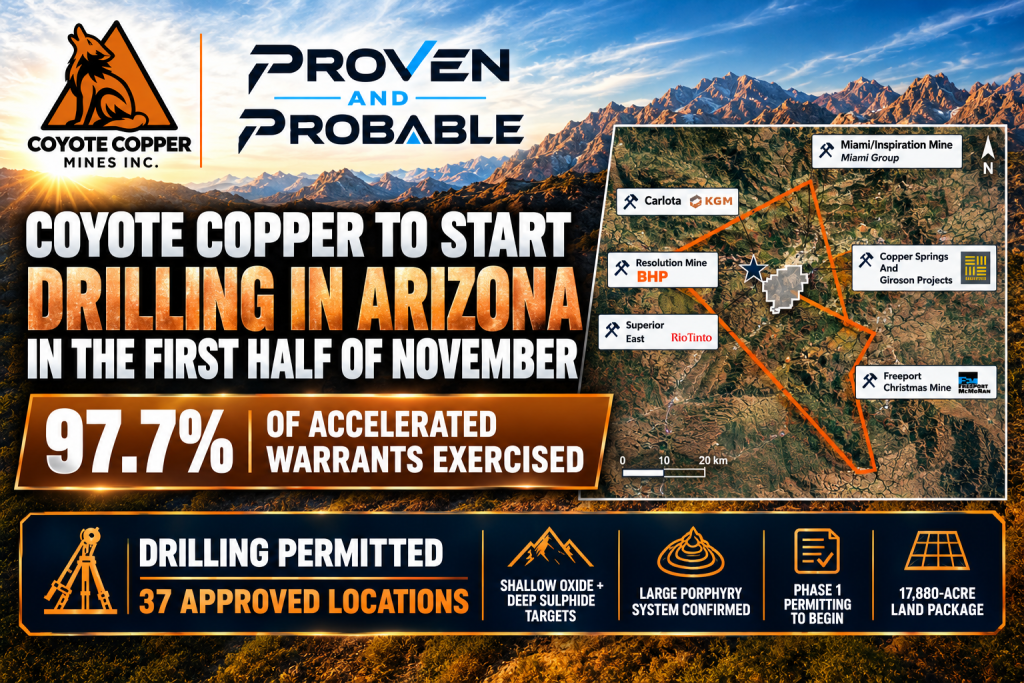
Toronto, Ontario–(Newsfile Corp. – October 16, 2026) – Coyote Copper Mines Inc. (TSXV: CCMM) (“Coyote Copper” or the “Company “) is pleased to announce that it has signed a drilling contract to commence drilling the first half of November.
Warrant Acceleration
As of October 15, 2026 at 4:00 pm the following Warrants were exercised
7,311,901 Warrants with an exercise price of $0.15 from a financing that was completed in July and August of 2025 were exercised.
10,622,351 Warrants with an exercise price of $0.20 from a financing that was completed in January and February of 2026 were exercised.
1,052,152 finder’s Warrants with an exercise price of $0.14 from a financing that was completed in January and February of 2026 were exercised.
The total amount received by the Company from the exercising of the Warrants was C$3,368,556.63
97.7% of the Warrants were exercised.
The money received from the Warrant exercise will help fund the ongoing and planned exploration program, and fund additional mining claims being staked and acquired.
Exploration Update
The previously announced geophysical programs will be completed shortly. Once completed and interpreted, the company shall release the results.
Soil and channel sampling continue, results will be disseminated prior to drilling.
Drill roads and pads are being built, all necessary permits are in hand.
Drilling to start the first half of November. The drill slated for our program is finishing up another company’s project, so the exact date for our drilling to start is not known yet.
Dan Weir, CEO of Coyote Copper Mines Inc., stated: “We are very excited to see the drilling begin in approximately 20 to 30 days. The geophysics programs are yielding great results. We completed a site visit at the end of November which 35 people attended including 4 geologists from major mining and fund companies and numerous investors. Having 97.75% of the Warrants exercised, shows that our investors believe in the company, and the work we are doing. I would like to acknowledge all the amazing work that our geologists and geophysical contractors are completing. The large mining companies that have visited the project, have positively commented on the professional work.”
Qualified Person Michael N. Feinstein, PhD, CPG, is a “Qualified Person” under National Instrument 43-101 – Standards of Disclosure for Mineral Projects, and he has reviewed and approved the scientific and technical disclosure contained in this press release. Mr. Feinstein is independent of the Company.
For more information, please contact: Dan Weir CEO, Coyote Copper Mines Inc. DanWeir@CoyoteCopper.com Tel: +1-416-720-0754
Neither the Exchange nor its Regulation Services Provider (as that term is defined in the policies of the Exchange) accepts responsibility for the adequacy or accuracy of this release.
This news release does not constitute an offer to sell or a solicitation of an offer to buy any of the securities in the United States. The securities of the Company have not been and are not expected to be registered under the United States Securities Act of 1933, as amended (the “U.S. Securities Act“), or any state securities laws, and may not be offered or sold within the United States or to U.S. persons absent registration or an applicable exemption from registration requirements.
Cautionary Statement Regarding Forward-Looking Information This news release contains statements which constitute “forward-looking information” within the meaning of applicable securities laws, including statements regarding the plans, intentions, beliefs and current expectations of the Company.
Often, but not always, forward-looking information can be identified by the use of words such as “plans”, “expects”, “is expected”, “budget”, “scheduled”, “estimates”, “forecasts”, “intends”, “anticipates”, or “believes” or variations (including negative variations) of such words and phrases, or statements formed in the future tense or indicating that certain actions, events or results “may”, “could”, “would”, “might” or “will” (or other variations of the foregoing) be taken, occur, be achieved, or come to pass. Forward-looking information in this news release includes, without limitation, statements regarding, planned exploration activities including drilling, permitting for exploration, environmental remediation outcomes, and the potential for mineral resource delineation on the property. Forward-looking information is based on currently available financial and economic data and operating plans, strategies or beliefs as of the date of this news release, but involve known and unknown risks, uncertainties, assumptions and other factors that may cause the actual results, performance or achievements of the Company to be materially different from any future results, performance or achievements expressed or implied by the forward-looking information. Such factors may be based on information currently available to the Company including information obtained from third-party industry analysts and other third-party sources, and are based on management’s current expectations or beliefs. Any and all forward-looking information contained in this news release is expressly qualified by this cautionary statement.
Investors are cautioned that forward-looking information is not based on historical facts but instead reflects management’s expectations, estimates or projections concerning future results or events based on the opinions, assumptions and estimates of management considered reasonable at the date the statements are made. Forward-looking information reflects management’s current beliefs and is based on information currently available to them and on assumptions they believe to be not unreasonable in light of all of the circumstances. In some instances, material factors or assumptions are discussed in this news release in connection with statements containing forward-looking information. Such material factors and assumptions include, but are not limited to, those risk factors applicable to mineral exploration companies, including risks related to title to mineral properties, environmental liabilities, permitting delays, exploration results, and commodity prices. Although the Company has attempted to identify important factors that could cause actual actions, events or results to differ materially from those described in forward-looking information, there may be other factors that cause actions, events or results to differ from those anticipated, estimated or intended. Forward-looking information contained herein is made as of the date of this news release and, other than as required by law, the Company disclaims any obligation to update any forward-looking information, whether as a result of new information, future events or results or otherwise. There can be no assurance that forward-looking information will prove to be accurate, as actual results and future events could differ materially from those anticipated in such statements. Accordingly, readers should not place undue reliance on forward-looking information.
Edmonton, Alberta–(Newsfile Corp. – October 16, 2026) – Grizzly Discoveries Inc. (TSXV: GZD) (FSE: G6H) (OTCQB: GZDIF) (“Grizzly” or the “Company”) announces that it closed on a private placement originally announced on September 15, 2026 (the “Offering”) by the issuance of 1,000,000 Units, 325,000 FT Units, and 4,866,668 CMFT Units for gross proceeds of $359,875. The Company also completed the Midway-Beaverdell Option entered into on October 10, 2023.
PRIVATE PLACEMENT
Each Unit, priced at $0.05 per Unit, consisted of one common share of the Company (“Common Share”) and one Common Share purchase warrant entitling the warrant holder to purchase an additional Common Share for $0.12 and expiring on the earlier of a) 30 days following written notice by the Company to the warrant holder that the volume-weighted average trading price of the Common Shares on the TSX Venture Exchange is at or greater than CA$0.18 per Common Share for 10 consecutive trading days; and (b) 24 months (2 years) from the date of issuance (“Warrant”). Each FT Unit, priced at $0.055 per FT Unit, consisted of one Common Share and one half of one Warrant, each issued as a “flow through share” for the purposes of the Income Tax Act (Canada). Each CMFT Unit, priced at $0.06 per CMFT Unit, consisted of one Common Share and one half of one Warrant, each issued as a “flow through share” for the purposes of the Income Tax Act (Canada).
The Offering was offered to qualified subscribers in the Provinces of Alberta, British Columbia and Ontario and in other jurisdictions as the Company in its discretion determined, in reliance upon exemptions from the registration and prospectus requirements of applicable securities legislation. The Offering is now closed.
The Company intends to use the proceeds of the sale of the Units for mineral property exploration and general working capital the proceeds from the sale of FT Units for mineral property exploration, and the proceeds from the sale of the CMFT Units for mineral property exploration specifically targeting Critical Minerals (as defined in the Income Tax Act (Canada).
In connection with the sale of 325,000 FT Units and 4,866,668 CMFT Units, the Company paid cash finders fees totaling $21,692 amongst Canaccord Genuity Corp, Hampton Securities Limited, GloRes Securities Inc., and Mr. Jean-Pierre Colin. The Company also issued a total of 328,416 non-transferrable Finder Warrants (with each Finder Warrant having the same terms as the Warrants included in the Units) amongst Canaccord Genuity Corp. among Canaccord Genuity Corp, Hampton Securities Limited, and GloRes Securities Inc. in connection with the sale of 325,000 FT units and 4,366,668 CMFT Units.
Following closing of the Offering, the Company has 240,313,037 common shares issued and outstanding. The Common Shares and any Common Shares issued on exercise of the Warrants and Finder Warrants are subject to restrictions on trading for four months from the date of issuance, expiring on February 17, 2027. The Offering is subject to final acceptance of the TSX Venture Exchange.
COMPLETION OF MIDWAY-BEAVERDELL OPTION
On October 13, 2026, the Company paid $5,000 and issued 100,000 common shares of the Company to Mr. Daniel Hurd of Peachland, British Columbia to complete the Midway-Beaverdell Option Agreement entered into on October 10, 2023. The Company is now the 100% owner of the Midway-Beaverdell mineral rights covering 761.25 hectares (approx. 1,881 acres) in the Greenwood Mining District of British Columbia. Mr. Hurd retains a 1% NSR Royalty and the right to any quarriable rocks.
ABOUT GRIZZLY DISCOVERIES INC.
Grizzly is a diversified Canadian mineral exploration company with its primary listing on the TSX Venture Exchange focused on developing its approximately 72,700 ha (approximately 180,000 acres) of precious and base metals properties in southeastern British Columbia. Grizzly is run by a highly experienced junior resource sector management team, who have a track record of advancing exploration projects from early exploration stage through to feasibility stage.
On behalf of the Board,
GRIZZLY DISCOVERIES INC. Brian Testo, CEO, President
Neither the TSX Venture Exchange nor its Regulation Services Provider (as that term is defined in the policies of the TSX Venture Exchange) accepts responsibility for the adequacy or accuracy of this release.
Caution concerning forward-looking information
This press release contains “forward-looking information” and “forward-looking statements” within the meaning of applicable securities laws. This information and statements address future activities, events, plans, developments and projections. All statements, other than statements of historical fact, constitute forward-looking statements or forward-looking information. Such forward-looking information and statements are frequently identified by words such as “may,” “will,” “should,” “anticipate,” “plan,” “expect,” “believe,” “estimate,” “intend” and similar terminology, and reflect assumptions, estimates, opinions and analysis made by management of Grizzly in light of its experience, current conditions, expectations of future developments and other factors which it believes to be reasonable and relevant. Forward-looking information and statements involve known and unknown risks and uncertainties that may cause Grizzly’s actual results, performance and achievements to differ materially from those expressed or implied by the forward-looking information and statements and accordingly, undue reliance should not be placed thereon.
Risks and uncertainties that may cause actual results to vary include but are not limited to the availability of financing; fluctuations in commodity prices; changes to and compliance with applicable laws and regulations, including environmental laws and obtaining requisite permits; political, economic and other risks; as well as other risks and uncertainties which are more fully described in our annual and quarterly Management’s Discussion and Analysis and in other filings made by us with Canadian securities regulatory authorities and available at www.sedar.com. Grizzly disclaims any obligation to update or revise any forward-looking information or statements except as may be required by law.
Chief Revenue Officer Ken Leith to present on Tuesday, October 20, at 4:30 p.m. Pacific Time
HAGERSTOWN, MD / ACCESS Newswire / October 15, 2026 / First Breach Inc. (NASDAQ:FBDT) (“First Breach” or the “Company”), an American-made defense technologies company focused on vertically integrated ammunition production and next-generation unmanned aerial systems, today announced that Chief Revenue Officer Ken Leith will present at the 20th Annual LD Micro Main Event, taking place October 19-21, 2026, at the Luxe Sunset Boulevard Hotel in Los Angeles, California.
Mr. Leith will also be available for one-on-one investor meetings on Tuesday, October 20. Investors interested in meeting with First Breach can request a meeting through LD Micro or contact the Company’s investor relations representative below.
Presentation Details Event: LD Micro Main Event XX Presenter: Ken Leith, Chief Revenue Officer Date: Tuesday, October 20, 2026 Time: 4:30 p.m. Pacific Time Location: Luxe Sunset Boulevard Hotel, Los Angeles, California Webcast: LD Micro Webcast
About the LD Micro Main Event XX
The 20th Annual LD Micro Main Event will take place October 19-21, 2026, at the Luxe Sunset Boulevard Hotel in Los Angeles. The conference brings together public companies and investors for company presentations, private meetings, and networking opportunities. To register to attend the event or for webcasts, use the following link: LD Micro Webcast.
About First Breach
First Breach Inc. is an ISO 9001:2015 certified, American-made defense technologies company focused on manufacturing match-grade ammunition components, finished ammunition, and developing next-generation unmanned aerial systems for commercial, law enforcement, and military markets. The Company manufactures its products in-house at its Hagerstown, Maryland facility, where it produces brass cups, casings, projectiles, lead cores, lead wire, and completed ammunition with rigorous quality control standards. First Breach is also advancing its drone strategy through the development of U.S.-made unmanned systems, leveraging advanced engineering, robotics, ISR and sensor technologies, and precision manufacturing capabilities to address evolving defense, homeland security, law enforcement, and commercial requirements across domestic and international markets.
This press release contains forward-looking statements within the meaning of the Private Securities Litigation Reform Act of 1995. Forward-looking statements are not historical facts and include statements regarding the Company’s expectations, beliefs, plans, objectives, strategies, future events, future performance, business prospects, growth initiatives, acquisitions, market opportunities, capital resources, operational objectives, and other statements that are predictive in nature. Forward-looking statements may be identified by the use of words such as “anticipate,” “believe,” “continue,” “could,” “estimate,” “expect,” “forecast,” “intend,” “may,” “plan,” “potential,” “predict,” “project,” “seek,” “should,” “target,” “will,” “would,” and similar expressions, although not all forward-looking statements contain these identifying words.
Forward-looking statements are based on management’s current expectations, assumptions, and beliefs regarding future developments and their potential effect on the Company. These statements are not guarantees of future performance and involve known and unknown risks, uncertainties, assumptions, and other factors that may cause actual results, performance, or achievements to differ materially from those expressed or implied by such forward-looking statements.
Factors that could cause actual results to differ materially from those expressed or implied by forward-looking statements include, but are not limited to, changes in economic, business, market, competitive, regulatory, technological, legal, and geopolitical conditions; the Company’s ability to execute its business strategy; access to capital and financing; customer demand; industry developments; and other risks and uncertainties described from time to time in the Company’s filings with the U.S. Securities and Exchange Commission, which are available for review at www.sec.gov.
Readers are cautioned not to place undue reliance on forward-looking statements, which speak only as of the date they are made. Except as required by applicable law, the Company undertakes no obligation to update, revise, or publicly disclose any revisions to any forward-looking statements to reflect events, circumstances, or changes in expectations occurring after the date of this press release.
Vancouver, British Columbia and Salt Lake City, Utah–(Newsfile Corp. – October 13, 2026) – Sage Potash Corp. (TSXV: SAGE) (OTCQB: SGPTF) (“Sage Potash” or the “Company”) is pleased to report positive results from hydrogeological testing completed at the Peterson 1 well at its flagship Sage Plain Potash Project in southeast Utah. Testing confirmed two saline, non-potable water bearing zones within the project area, with preliminary results supporting their potential use as future process water for solution mining operations.
The results represent an important step in advancing Sage’s water strategy, with the identified zones occurring at depths consistent with the Company’s existing water right and providing potential sources of process water that would not compete with potable municipal or agricultural supplies.
HYDROGEOLOGICAL PROGRAM HIGHLIGHTS
Two water-bearing zones confirmed at Peterson 1, providing potential sources of process water within the Sage Plain Project area.
Non-potable saline water has been confirmed, with water chemistry considered adequate for future processing and solution mining applications.
Results align with Sage’s existing water right, which authorizes up to 185,000 cubic meters of brackish groundwater annually for processing and solution mining.
An additional high permeability zone was identified in the Honaker Trail Formation, providing another target for future groundwater evaluation.
Results will now be incorporated into the Company’s ongoing engineering studies alongside the updated NI 43-101 resource estimate.
As previously announced on June 24, 2026, the Peterson 1 drill program included a hydrogeological assessment designed to conduct targeted Drill Stem Tests (“DSTs”) in formations exhibiting water flow. The DSTs are field screening tools used to evaluate yield rates and water quality, primarily targeting saline, non-potable aquifers, for future solution mining operations.
“Peterson 1 continues to deliver important results for the Sage Plain Project. In addition to the strong potash grades and thicknesses we recently reported, we have now identified multiple potential sources of non-potable process water within the project area,” said Patricio Varas, CEO of Sage Potash. “Water is a critical component of solution mining, and these results provide another important piece of the development picture. Importantly, the water identified is saline and non-petpotable, and the tested horizons align with our existing water right. We view this as another meaningful step in de-risking Sage Plain as we advance the project into its next phase of engineering.”
DRILL STEM TEST PROGRAM
Northstar Drillstem Testers Inc. conducted three inflate-straddle DSTs, each over a 38-meter (125-foot) interval of the 8¾ inch hole, between July 17 and July 19, 2026. The tests were designed to measure formation pressure, estimate permeability and inflow rates, and collect downhole fluid samples for water quality analyses.
DST 1 was completed with three flow periods and two shut-in periods. The test recovered 663 m (2,175 feet) of formation water, approximately 2.8 cubic meters (17.5 barrels), and recorded consistent shut-in pressures of 1,068 pound per square inch gauge (“psig”)and 1,061 psig, indicating a pressurized, water-bearing horizon. Downhole temperature was 41°C (105°F).
DST 2 recorded a shut-in pressure of 1,345 psig but produced negligible inflow during a single 16-minute flow period, indicating a low-permeability interval. The fluid recovered consisted predominantly of drilling fluid. The sample was submitted for laboratory analysis, which confirmed it was not representative of formation water, and it has been excluded from the water chemistry summary.
DST 3 was completed with three flow periods and two shut-in periods. The test recovered 610 m (2,000 feet), approximately 2.5 cubic meters (16 barrels), of formation water and recorded shut-in pressures of 1,434 psig and 1,419 psig, confirming a second, deeper water-bearing horizon.
DSTs are short-duration tests that primarily characterize the formation immediately surrounding the wellbore. Yields estimated from DST data are preliminary and may not be representative of sustained, long-term production rates. Additional testing will be completed to further characterize the anticipated available water volumes.
PRELIMINARY YIELD ESTIMATES
The Company engaged RESPEC LLC (“RESPEC”), which completed the Company’s September 8, 2025 NI 43-101 resource estimate, to review the DST data. RESPEC’s preliminary estimates assume a pumping well with the same length and diameter as each tested interval.
Erik Hemstad, PE, MBA, of RESPEC, commented: “From DST 1, preliminary estimates indicate a water volume yield of 7 m³/h (75 gpm), and from DST 3,- 4.5 m³/h (20 gpm). Moreover, DSTs are excellent for measuring formation pressures. While the results can also be used to estimate hydraulic conductivity, these tests are inherently short in duration and therefore primarily characterize the formation immediately surrounding the borehole.”
WATER CHEMISTRY AND ALIGNMENT WITH WATER PERMIT
Fluid samples from all three DSTs were submitted to ACZ Laboratories, Inc. in Steamboat Springs, Colorado, a NELAC-accredited laboratory, for comprehensive inorganic analysis. Results for DST 1 and DST 3 are summarized in Table 2 (Appendix).
Both samples are sodium-chloride type waters. The DST 1 (Cutler) sample has a calculated dissolved solids content of 32,400 mg/L. The DST 3 (Lower Cutler/Rico) sample has a calculated dissolved solids content of 79,600 mg/L. Both waters are non-potable and unsuitable for agricultural or irrigation or domestic use.
Solution mining recovers potash by dissolving it with injected water or brine. Sodium-chloride concentrations in recovered water samples are well below salt saturation and therefore retain substantial dissolving capacity. The Company therefore considers the quality of these waters adequate for processing and solution mining. Specific process design requirements will be addressed in future engineering studies.
Importantly, these findings validate the Company’s existing water permitting framework. In July 2023, the Utah Division of Water Rights approved the Company’s 20-year Fixed-Time Application (Water Right 09-2684, Application F83735) authorizing the withdrawal of up to 150 acre-feet annually, of brackish water to support processing and solution mining cavern operations. The permit specifically contemplated sourcing brackish water from an underground aquifer at an approximate depth of 1,200 meters (3,950 feet)-a target depth directly validated by the productive horizons confirmed in DST 1 (1,033 – 1,071 m; 3,390 – 3,515 feet) and DST 3 (1,295 – 1,334 m; 4,250 – 4,375 feet).
HONAKER TRAIL FORMATION
While drilling the Peterson 1 hole, the well encountered an anticipated lost-circulation zone in the Honaker Trail Formation. Approximately 12.7 cubic meters (80 barrels) of drilling fluid were lost between 1,408 and 1,445 m (4,620 and 4,740 feet) (1,408 – 1,445 m) despite lost circulation material already present in the mud system. Continued fluid losses of approximately 1.6 cubic meters (10 barrels) per hour persisted to 1,509 m (4,950 feet). In order to protect wellbore integrity, the Company elected not to run a DST or sample this interval.
The Company believes the rapid rate and volume of fluid loss indicates a highly permeable, high-transmissivity horizon capable of supplying significant water volumes, representing a compelling target for future hydrogeological evaluation. Regional studies of the Paradox Basin report that formation-water salinity generally increases with depth toward the Paradox evaporites (Hanshaw and Hill, 1969). Consistent with this regional trend and the increasing salinity observed from DST 1 to DST 3 at Peterson 1, the Company expects Honaker Trail formation fluids to be similarly saline and non-potable.
NEXT STEPS
The hydrogeological results will be incorporated into the Company’s ongoing and future engineering studies.
Qualified Person
The scientific and technical information contained in this news release has been reviewed and approved by Greg Vogelsang, P.Geo., P.Eng., the Qualified Person as defined by National Instrument 43-101 Standards of Disclosure for Mineral Projects. Mr. Vogelsang is Vice President, Project Development for the Company.
About Sage Potash Corp.
Sage Potash Corp. (TSXV: SAGE) (OTCQB: SGPTF) is dedicated to developing its flagship Sage Plain Potash Project, located in the Paradox Basin in Utah. With a large, high-grade resource base, the Company is advancing toward its goal of establishing a secure and sustainable domestic potash production platform in the United States. Sage Potash is committed to food security, environmental stewardship, and creating value for shareholders and stakeholders.
Neither the TSX Venture Exchange nor its Regulation Services Provider (as that term is defined in the policies of the TSX Venture Exchange) accepts responsibility for the adequacy or accuracy of this release.
This news release contains “forward-looking information” and “forward-looking statements” within the meaning of applicable securities legislation. The forward-looking statements herein are made as of the date of this news release only, and the Company does not assume any obligation to update or revise them to reflect new information, estimates or opinions, future events or results or otherwise, except as required by applicable law. Often, but not always, forward-looking statements can be identified by the use of words such as “plans”, “expects”, “is expected”, “budgets”, “scheduled”, “estimates”, “forecasts”, “predicts”, “projects”, “intends”, “targets”, “aims”, “anticipates” or “believes” or variations (including negative variations) of such words and phrases or may be identified by statements to the effect that certain actions “may”, “could”, “should”, “would”, “might” or “will” be taken, occur or be achieved. Forward-looking information in this news release includes, but is not limited to, statements with respect to: estimated potential water yields from the Cutler and Lower Cutler/Rico formations; the adequacy of the formation waters for processing and solution mining; the potential of the Honaker Trail Formation to supply significant volumes of water and the expected salinity of its formation waters; future evaluation of the Honaker Trail Formation; and the incorporation of the hydrogeological results into future engineering studies and the updated resource estimate. Forward-looking statements and information are subject to various known and unknown risks and uncertainties, many of which are beyond the ability of the Company to control or predict, that may cause the Company’s actual results, performance or achievements to be materially different from those expressed or implied thereby, and are developed based on assumptions about such risks, uncertainties and other factors set out herein, including, but not limited to, the risk factors set out under the heading “Risk Factors and Uncertainties” in the Company’s Management’s Discussion & Analysis available for review under the Company’s profile at www.sedarplus.ca. Such forward-looking information represents management’s best judgement based on information currently available. No forward-looking statement can be guaranteed and actual future results may vary materially. Accordingly, readers are advised not to place undue reliance on forward-looking statements or information.