This was originally posted on our Voronoi app. Download the app for free on iOS or Android and discover incredible data-driven charts from a variety of trusted sources.
Key Takeaways
Africa leads with 1,010 tonnes of gold, driven by Ghana, Mali, and South Africa.
China (380t) and Russia (330t) are the world’s top national producers.
Australia (284t) stands as the largest Western producer.
Gold remains one of the world’s most valuable natural resources, central to everything from central bank reserves to jewelry and electronics.
During 2025, the yellow metal set multiple price records, driven by a soft dollar, strong central bank buying and heightened global uncertainty.
This visualization breaks down global gold production by region in 2024, spotlighting the top-producing countries and their contributions to the region supply landscape. The data for this visualization comes from the World Gold Council.
Africa Leads Global Output
Africa is the world’s top gold-producing region, generating 1,010 tonnes in 2023. Ghana leads the continent with 141 tonnes, followed by Mali (100 tonnes) and South Africa (99 tonnes).
Region
Production (tonnes)
Largest Contributors
Africa
1,010
Ghana (141), Mali (100), South Africa (99)
Asia
665
China (380), Indonesia (140)
CIS
584
Russia (330), Uzbekistan (129)
North America
500
Canada (202), U.S. (158), Mexico (140)
Central & South America
519
Peru (137), Brazil (84), Colombia (66)
Oceania
346
Australia (284), Papua New Guinea (50)
Europe
36
This dominance reflects the continent’s vast mineral resources, though political and operational challenges continue to affect output in some areas.
China, Russia, and Australia Dominate Nationally
China remains the top national producer with 380 tonnes, followed by Russia at 330 tonnes. These two countries alone account for almost 20% of global output.
Australia follows with 284 tonnes, making it the leading Western gold producer and a cornerstone of Oceania’s 346-tonne total.
The Americas Remain Strong Contributors
North America produced 500 tonnes in 2023, driven by Canada (202 tonnes), the United States (158 tonnes), and Mexico (140 tonnes).
Central and South America added 519 tonnes, led by Peru (137 tonnes), Brazil (84 tonnes), and Colombia (66 tonnes). Combined, the Americas contribute more than one-fifth of global supply.
Gold Hits Record Highs: Gold surged nearly 12% in September to an all-time high of $3,859 per ounce, up 47.04% year-to-date, leading all major asset classes.
Yield Curve Steepens on Lost Trust: Rising long-term bond yields reflect waning confidence in fiscal and monetary policy, driving investors toward tangible stores of value like gold.
Central Banks Anchor the Bid: Persistent central bank buying underscores gold’s status as a trusted reserve asset amid mounting concerns over debt and currency debasement.
Fed Policy Set to Fall Below Neutral: Expected rate cuts below the neutral rate could create a “run-it-hot” market, boosting inflation expectations and weakening the U.S. dollar.
Silver Rally: Silver surged 17.44% in September and 61.39% year-to-date, nearing record highs as tightening supply and strong ETF inflows signal a potential price squeeze.
Silver ETFs** (Total Known Holdings ETSITOTL Index Bloomberg)
823.91
806.00
17.90
2.22%
15.04%
Best year-to-date performance since 2020.
Gold ETFs** (Total Known Holdings ETFGTOTL Index Bloomberg)
96.90
93.28
3.61
3.87%
16.20%
Best year-to-date performance since 2020.
Source: Bloomberg and Sprott Asset Management LP. Data as of September 30, 2025. * BPS stands for basis points. **ETF holdings are measured by Bloomberg Indices; the ETFGTOTL is the Bloomberg Total Known ETF Holdings of Gold Index; the ETSITOTL is the Bloomberg Total Known ETF Holdings of Silver Index.
Gold Market: Breakout Catalysts
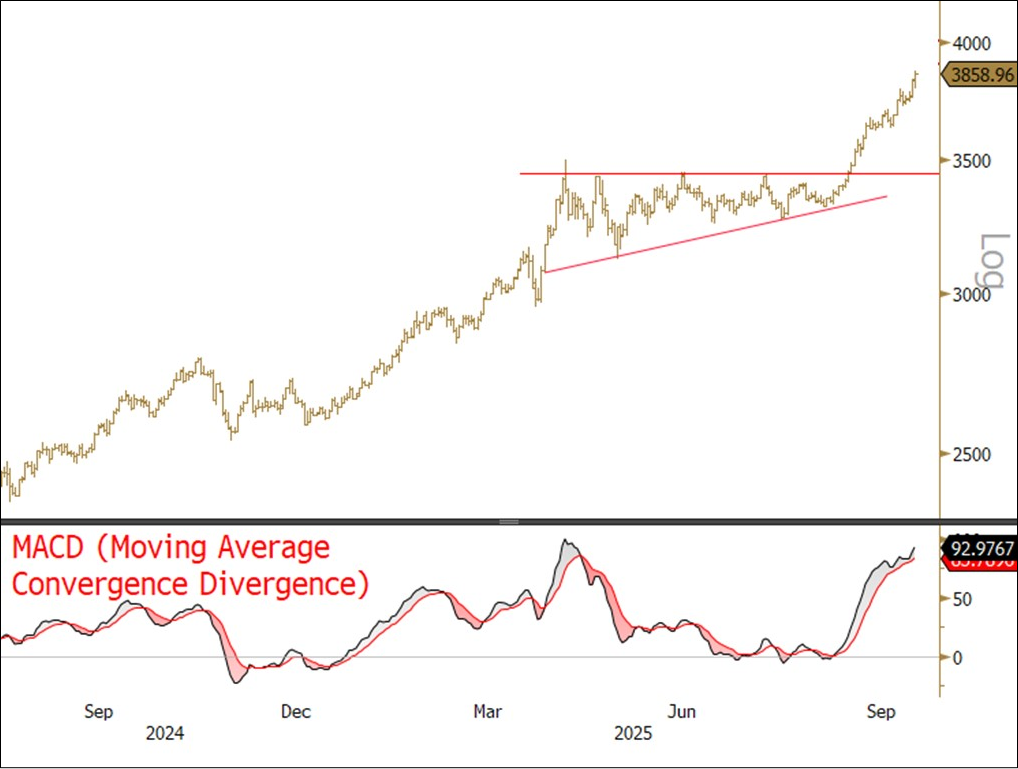
In September, spot gold increased $411.01 per ounce (or 11.92%) to close the month at $3,858.96, an all-time closing high. At the end of September, gold was 47.04% higher than at the start of the year, its best year-to-date performance since 1979. Gold is well on its way to being one of the best-performing asset classes for a second straight year. In the third quarter, spot gold rose $555.82 per ounce (or 16.83%), another exceptional quarterly performance.
Gold’s 47.04% rally this year marks its most powerful advance since the late 1970s.
Gold broke out of its bullish7 flag (see Figure 1) and steadily extended its record-setting breakout throughout September. The initial price breakout catalyst was driven by a dramatic rise in developed-market long-end bond yields and a rotation out of long-duration assets (i.e., 30-year bonds) into non-fiat stores of value, such as gold. The headline driver began with the UK 30-year bond yield surging to ~5.70%, its highest in nearly three decades, alongside a sharp drop in pound sterling as markets priced in higher inflation risks, runaway debt and deficit levels, government budget uncertainty and reduced issuance of ultra-long gilts (UK government bonds). These pressing issues were not confined to the UK, however. Virtually all developed economies have similar concerns, creating pressure on almost all long-end bond yields, steepening 2s30s yield curves8 globally and sparking the gold rally.
During September, gold rose about $210 per ounce between the start of the month and the September 17 meeting of the U.S. Federal Reserve’s Open Market Committee (FOMC). This rise was catalyzed mainly by long-end yields pricing an unsustainable monetary and fiscal path for the developed economies. Then, when the FOMC indicated it would cut rates three times in 2025, or likely 75 basis points by the time of the December FOMC meeting, gold rose another ~$200 per ounce into the month-end. Surprisingly weak employment data forced the Fed to focus on the labor market at the expense of inflation, thus prioritizing one side of its dual mandate. The market began to price in the likely effects of the federal funds rate falling to either the neutral rate9 or below—that is, higher growth and inflation in a “run-it-hot” monetary policy setup.
At the same time in September, the broad equity market (as measured by the S&P 500 Index) rallied for the fifth straight month to an all-time high. September was an “everything rally” month as loose financial conditions benefited all financial assets. Risk assets were well-supported by expected rate cuts, ample liquidity, robust economic numbers led by technology spending, positive earnings revisions, easy financial conditions and heightened investor risk appetite. Equities were further aided by massive share buybacks and continuous volatility selling across various fund strategies and yield enhancement products.
Figure 1. Gold’s Record-Setting September
Source: Bloomberg. Data as of September 30, 2025. Gold bullion spot price, U.S. dollar/oz. Moving average convergence/divergence is a trend-following momentum indicator that shows the relationship between two exponential moving averages. Past performance is no guarantee of future results.
Yield Curve Steepens as Trust Declines
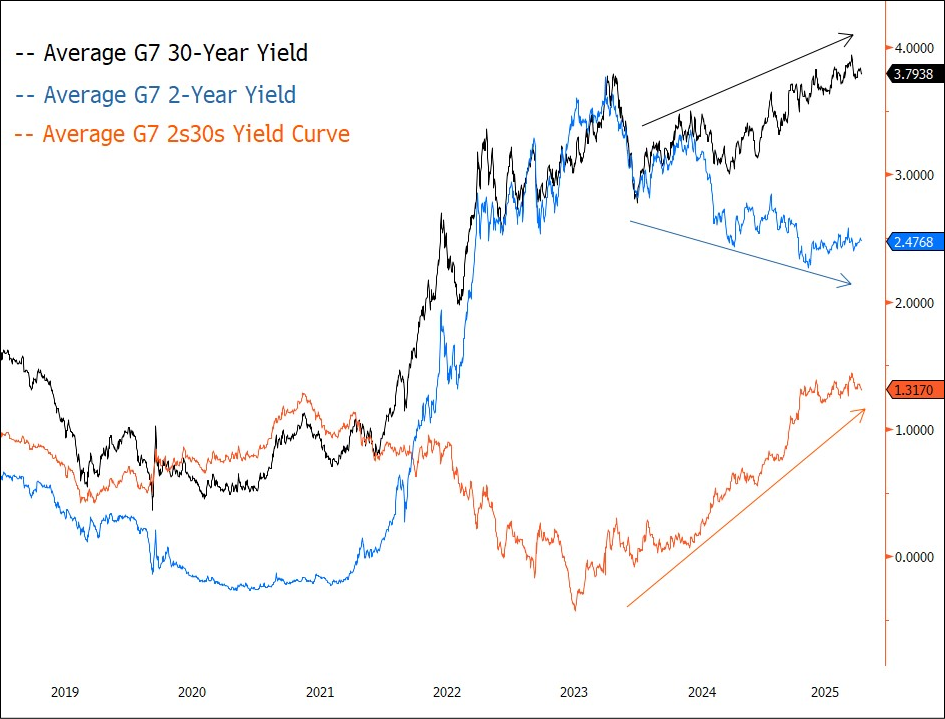
Long-end bond yields for most developed markets rose sharply in 2022 as inflation proved to be more than transitory. While two-year yields peaked in 2023 and began to decline, reflecting the policy rate path of the G710 central banks, the 30-year yield diverged and has been climbing higher (see Figure 2).
Even after aggressive G7 rate cuts, 30-year yields keep rising — a credibility gap that continues to underpin gold’s breakout.
The recent global yield steepener was driven not by cyclical demand, but by credibility. Policy rates are transmitted through long-end loan markets (mortgages, investment grade and high-yield bond issuance, project finance, discounted cash flow models), so losing faith in policy keeps term premia persistently elevated. Despite rampant rate cuts across G7 countries, long-end yields continue to track higher, unlike prior rate-cutting cycles. In such regimes, policy easing does not bring yields down across the curve as the market loses trust in central banks.
Figure 2. Rising 2s30s YR Bond Yield Curve (2019-2025)
Source: Bloomberg. Data as of September 30, 2025. Average G7 30-year and 2-year bond yields, and the difference between them in percentage points. Past performance is no guarantee of future results.
There are several possible reasons why long-end yields in developed markets have been rising, and the intensity of this rise varies by country.
Still, the following factors are the most likely and common for developed markets:
Government deficits and credibility. Large and growing debt levels and fiscal deficits across the G7 are ballooning the expected supply of sovereign bonds. For example, the U.S. had already reached an all-time high of 120% debt-to-GDP and a ~7% fiscal deficit before the One Big Beautiful Bill Act (OBBBA), the 2025 budget reconciliation law, adds an estimated $3.5 trillion to the deficit, compounding term premium and credibility worries. Once fiscal confidence is questioned, the required yield level to attract bond buyers rises. As discussed in our recent commentaries, most advanced economies have likely entered a state of fiscal dominance, where fiscal needs take precedence over and constrain monetary policy. Financial repression measures have already begun (with more in the future) to cap yields at the expense of monetary debasement.
De-globalization and capital flows. As the world rapidly de-globalizes (from a unipolar to a multi-polar world), the recycling of trade surpluses from countries such as China and oil exporters into U.S. Treasury bonds has declined, reducing the bid for yield. The capital-light era of inexpensive, China-made capital goods (offshoring to low-cost locales) is reversing or may be over. The current massive capital expenditure on technology and IT infrastructure demands greater investment (capital-intensive), which in turn pushes equilibrium long-term interest rates higher.
Geopolitics and defense outlays. A multi-polar world becomes a more dangerous world, and defense budgets are soaring (including higher NATO spending: Germany plans to more than double expenditure), increasing investment demand and raising neutral long-term rate estimates.
Central banks and monetary policy. Quantitative tightening adds to term premiums as central bank balance sheets shrink. The Bank of Japan’s exit from its policy of buying bonds to control yield curves exposes long bonds to market forces and higher volatility. This exposure of long bonds to market forces has reasserted itself after decades in which they were shielded by central bank actions.
Inflation and expectations. Reawakening inflation, plus broader concerns about developed market inflation, push up required yields at the long end, even as front-end policy is easing.
Demographics and institutional demand. As developed market populations age and birth rates decline, dependency ratios are increasing, thereby reducing aggregate savings. In general, retiree drawdowns and maturing defined benefit schemes are structurally shrinking demand for long bonds.
Technology and productivity. A massive capex cycle around AI (artificial intelligence) data center power and related infrastructure can see equities and long bond rates rise together as demand for capital soars.
Investor confidence. A loss of confidence in political leaders and institutions is shrinking the cohort of buyers willing to lock up capital for 30 years without a higher premium.
Gold Takes Its Cue from the Steeper Spread
In overly simple terms, the long-term yield can be viewed as the average expected path of future short-term interest rates and the term premium. When central bank credibility is robust, both components tend to compress. But when credibility is in doubt, both can expand.
If central banks are credible, markets will follow and react to central bank policy, whether in rate decisions, balance sheet actions (such as quantitative easing or quantitative tightening), or alignment with fiscal policy. This trust enables the central bank to lower yields across the curve with forward guidance, without necessitating significant changes to the policy rate.
When credibility is lost, however, central bank rate cuts may fail to lower yields, and they can even tighten them if markets expect inflation to remain sticky or fear fiscal dominance. In such cases, long-term yields rise due to both a higher expected rate path and an elevated term premium. In September 2024, the Fed began its first steps in the current rate-cutting cycle and had cut rates by 100 basis points by December 2024. After pausing for nine months, the Fed began its second round of rate cuts in September 2025 with a 25-basis points cut and indicated two more 25-basis points cuts by December 2025.
Immediately after the September 2024 rate cuts, 10-year U.S. Treasury yields increased by ~115 basis points and the 30-year yield rose by ~100 basis points. For the first time since the hyperinflation days of 1980/81, long yields increased after a federal funds rate cut as the bond market revolted against Fed policy.
When fiscal credibility erodes and long yields stay elevated, investors price in currency debasement, driving curve steepening and gold buying.
The transmission of policy rates into loan markets matters most in areas like 30-year mortgage rates in the U.S., corporate weighted average cost of capital (WACC), primary debt issuance, public debt servicing costs and asset valuation discount rates. When 10- to 30-year bonds sell off, this transmission mechanism becomes impaired, regardless of where the policy rate is set.
Warning signs of eroding credibility include long yields rising despite dovish signals (e.g., rate cuts that fail to lower rates on 10-year or 30-year bonds), estimates of breakeven inflation and term premiums jumping while growth softens, weak demand in long-duration bond auctions, and policy communication that appears subordinated to fiscal needs. Over the past year, we have seen examples of all the above.
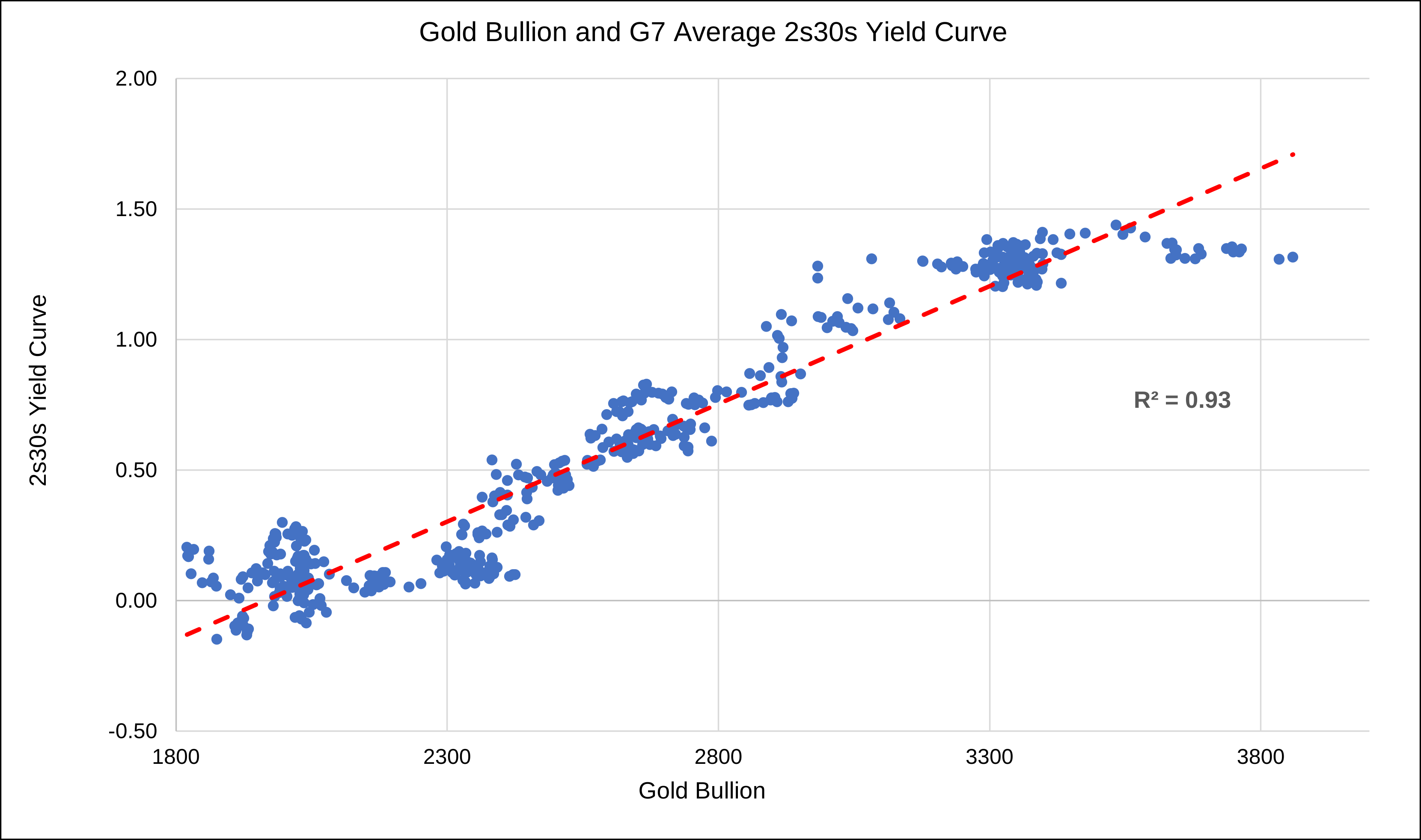
This dynamic has implications for gold. When fiscal and monetary credibility is questioned and long-term yields resist easing, markets begin to price in greater currency debasement risk. This risk steepens the yield curve and increases demand for non-fiat stores of value, especially gold. Over the past two years, gold’s correlation with the G7 2s30s yield curve has been the strongest macroeconomic linkage in our work (R² ≈ 0.93), far outpacing correlations with currency and other metrics (see Figure 3). This lack of confidence in central banks and their faltering credibility is widespread across developed market economies, resulting in a global bid for gold.
Figure 3. Gold Tracks the 2s30s Yield Curve
Source: Bloomberg. Data as of September 30, 2025. Correlation coefficient (r-squared) between gold bullion spot price and 2s30s yield curve, which is the difference between the 30-year U.S. Treasury yield and the 2-year U.S. Treasury yield. Past performance is no guarantee of future results.
Idling Below the Neutral Rate
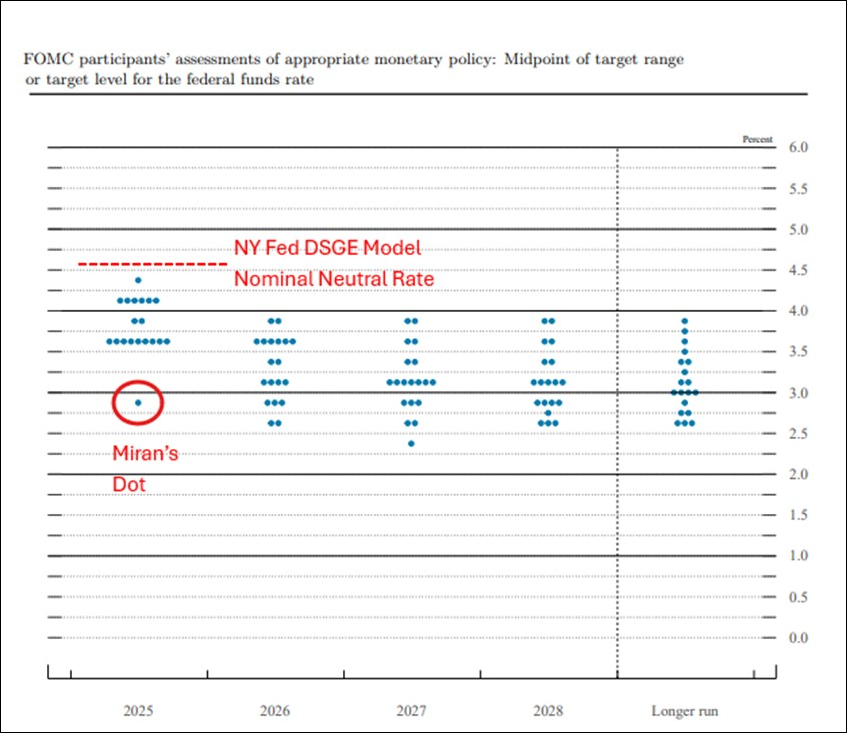
Following the September 17 FOMC meeting, the median dot plot of expectations for rate cuts by FOMC participants indicated 75 basis points of cuts in 2025 (see Figure 4). This would take the target federal funds rate range from 4.25-4.50% down to 3.50-3.75% by December. On a conventional yardstick, a reasonable nominal neutral rate has been ~3.5% (the 2% Fed inflation target plus a ~75 basis points real federal funds rate). By that gauge, policy would be right on neutral by late‑2025.
However, the latest update to the New York Federal Reserve’s dynamic stochastic general equilibrium (DSGE) model11 puts the real neutral rate near 2.6% and by adding the 2% inflation target, we get a ~4.6% nominal neutral rate. By that measure, the current stance is already accommodative. If the Fed delivers the expected 2025 rate cuts, the federal funds rate would be ~100 basis points below neutral on this reading. It would be outright stimulative against the backdrop of very easy financial conditions and buoyant risk assets. In its own framing, Fed policy is not only not restrictive, but also already stimulative and will become more so. Furthermore, the NY Fed’s DSGE model indicates that easy financial conditions push up the estimate of the neutral rate.
With the Fed set to run policy below neutral, gold is rallying as markets price in easier money and rising debasement risk.
A below neutral rate monetary policy with already‑easy financial conditions is calculated to boost the growth/inflation mix, lower real policy rates, and put downward pressure on the U.S. dollar. In credibility-constrained regimes, where markets doubt fiscal-monetary alignment, term premia at the long end stay sticky even as the front end declines. The result is steepening across the yield curve,12 which correlates very strongly with gold (+90% past two years) as shown in Figure 3.
When the curve steepens due to debasement risk rather than growth, gold is a highly desired hedge asset against financial repression across all investment funds, central banks, and sovereign entities. Between the FOMC meeting on September 17 and the end of September gold rose by over $210/oz or 5.8%. This is a significant price move higher as markets appear to be quickly pricing in the monetary stance we have described and its debasement effects.
The FOMC publishes its participants’ assessment of appropriate future monetary policy rates (see Figure 4). Based on these we can project two possible scenarios and sets of rate ranges:
⦁ Base Case: The Fed Dot Plot Path. The federal funds rate is expected to reach 3.50–3.75% by the December 2025 FOMC meeting, compared to the ~4.6% nominal neutral rate posited by the New York Fed’s latest DSGE model. This suggests that the federal funds rate would be about 100 basis points below the neutral rate, which would likely continue driving growth and inflation impulses (i.e., a run-it-hot policy).
⦁ Aggressive Case: The Miran Dot Plot Path. At the September 17 FOMC meeting, Stephen Miran, a recent Trump appointee to the Fed Board of Governors, provided a target level for the federal funds rate that was much lower than the consensus (see Figure 4). His action was perceived to reflect the Trump administration’s desire for a more dovish Fed monetary path. If this aggressive easing scenario materialized, the policy rate would be ~175 basis points below the neutral rate, in addition to ~3% GDP growth and easy financial conditions. This extreme scenario could be an even stronger impulse for the debasement-driven hedge bid for gold.
The gold price movement in September indicated that the market was pricing in fiscal dominance and financial repression via monetary subservience, the defining feature of the current macro regime. With the U.S. debt-to-GDP ratio at an historic high and the fiscal deficit swelling further under the OBBBA’s projected multi-trillion-dollar budget expansion, it appears the Trump administration has embraced a “run-it-hot” policy stance. Its implicit strategy is to grow nominal GDP faster than the real burden of debt. However, this approach comes at a cost and risk.
Financial repression is the mechanism through which this cost is transmitted. Policy rates are being set below the neutral rate. Rising gold and global 30-year yields have become the market’s protest vote. Long-end yields are rising despite front-end easing and signaling skepticism about the sustainability of fiscal and monetary policies. The net effect is monetary debasement.
When real yields are suppressed and inflation is encouraged as a tool of debt management, the value of monetary assets erodes. U.S. Treasuries and the dollar, once unquestioned stores of value, are now subject to the slow grind of inflationary dilution. In such an environment, investors are seeking other stores of value. Gold’s meteoric rise and persistent bids seem completely rational in an environment of financial repression and currency debasement. In this environment, we expect that gold is likely to continue to rise.
Silver Market: Potential Price Squeeze
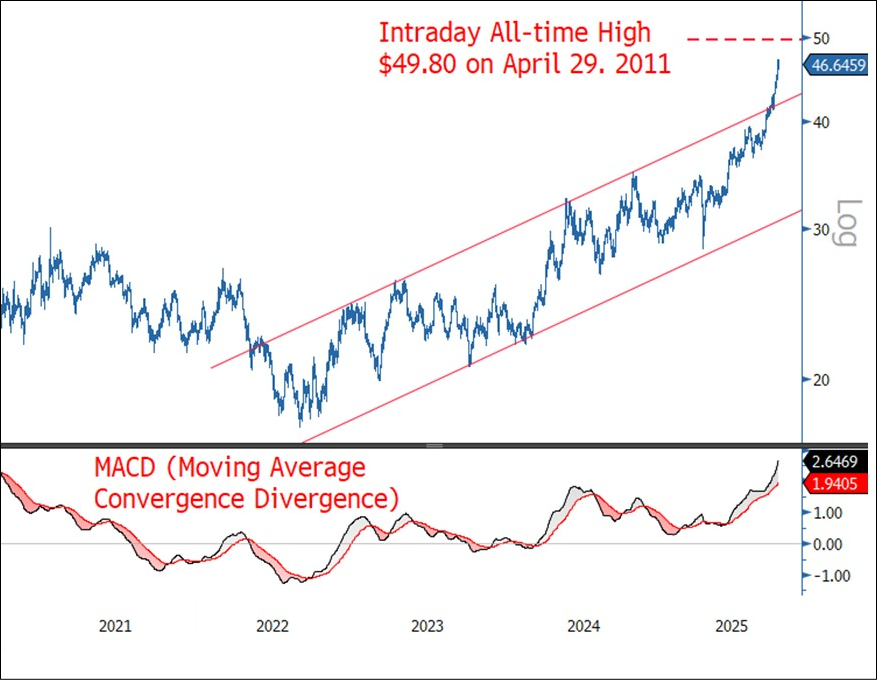
Spot silver increased $6.93 per ounce (or 17.44%) in September to close the month at $46.65, its highest closing price since April 2011, and just below its all-time closing high of $48.44. By month-end, spot silver was up 61.39% since the start of the year, its best year-to-date performance since 1979. Like gold, it is well on its way to being one of the best-performing asset classes for a second straight year. During the third quarter, spot silver increased $10.54 per ounce (or 29.18%), making for another exceptional quarter.
Silver’s steady climb is turning into a breakout. Supply is thinning, and investors are taking notice.
Silver advanced steadily through the month, tracking the gold price movement higher. CFTC net silver (non-commercial) positioning13 rose only modestly in September (and was still below June’s peak), but ETF buying14 increased by 2.2% (17.9 million ounces) and has now increased eight months in a row. Year-to-date, silver buying in ETFs has totaled 107.7 million ounces, the most since 2020. In prior commentaries, we have noted the possibility that silver could be entering a potential price squeeze situation as the amount of available free-trading silver (per LBMA vault data15) is reaching its limits. In Figure 5, we show how the silver price has broken out of its rising channel in a squeeze-like manner and is quickly approaching its all-time intraday high of $49.80 made on April 29, 2011.
Figure 5. Breakout to New Highs (2021-2025)
Source: Bloomberg. Data as of September 30, 2025. Silver spot price, U.S. dollar/oz. Moving average convergence/divergence is a trend-following momentum indicator that shows the relationship between two exponential moving averages. Past performance is no guarantee of future results.
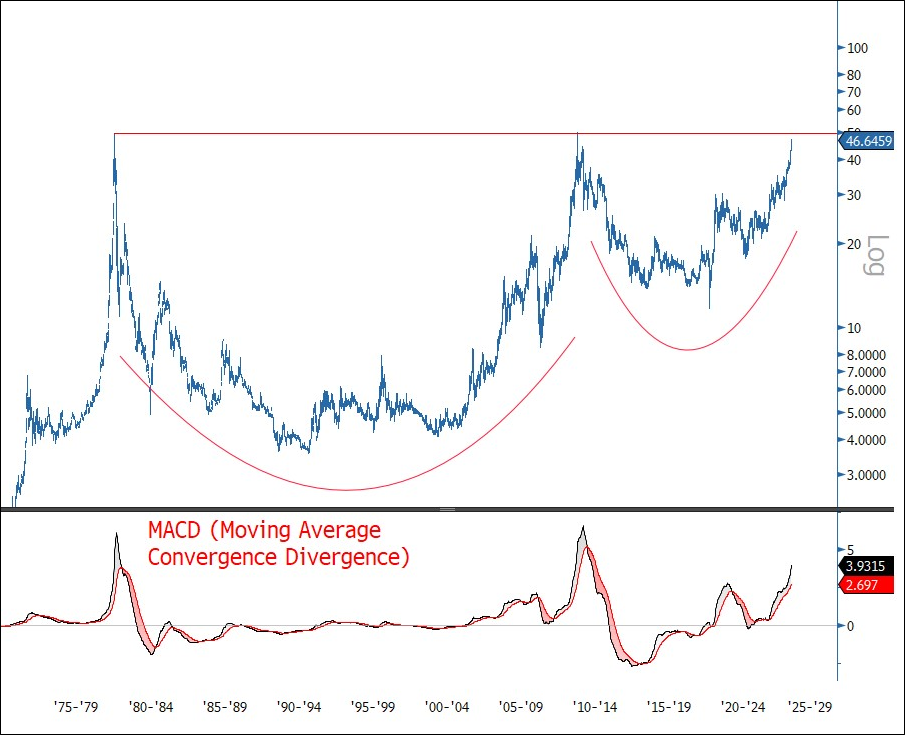
As silver approaches its all-time price high, the very long-term secular chart (Figure 6) shows silver is forming possibly the largest cup and handle pattern16 we have ever seen. In our view, for the silver price to not keep rising, there would need to be severe demand destruction in lower economic value-added end uses for silver, like photography and silverware. Meanwhile, there would need to be a growing demand for higher economic end uses, such as electrical and electronic demand from AI-related spending, photovoltaics and other technology-related demand. Supply demand data confirm both trends. However, as we have noted, investment demand remains the wild card. Historically, investment demand can swing wildly and can become relatively price inelastic given market conditions. The Silver Institute provides a supply and demand table that illustrates these trends.
As far as we are aware, there is no central bank or sovereign entity that views silver as a neutral reserve asset, but there are investment funds and other investors that do consider silver to have a reserve value. Silver’s correlation to gold over any time frame has stayed consistently high. If silver were to trade above $50 sustainably, it could be a sign that silver’s economic worth and store of value function was being re-evaluated, or it could be a mark-to-market reality repricing of the metal.
Figure 6. Forming a Cup and Handle (1975-2029)
Source: Bloomberg. Data as of September 30, 2025. Silver spot price, U.S. dollar/oz. Moving average convergence/divergence is a trend-following momentum indicator that shows the relationship between two exponential moving averages. Past performance is no guarantee of future results.
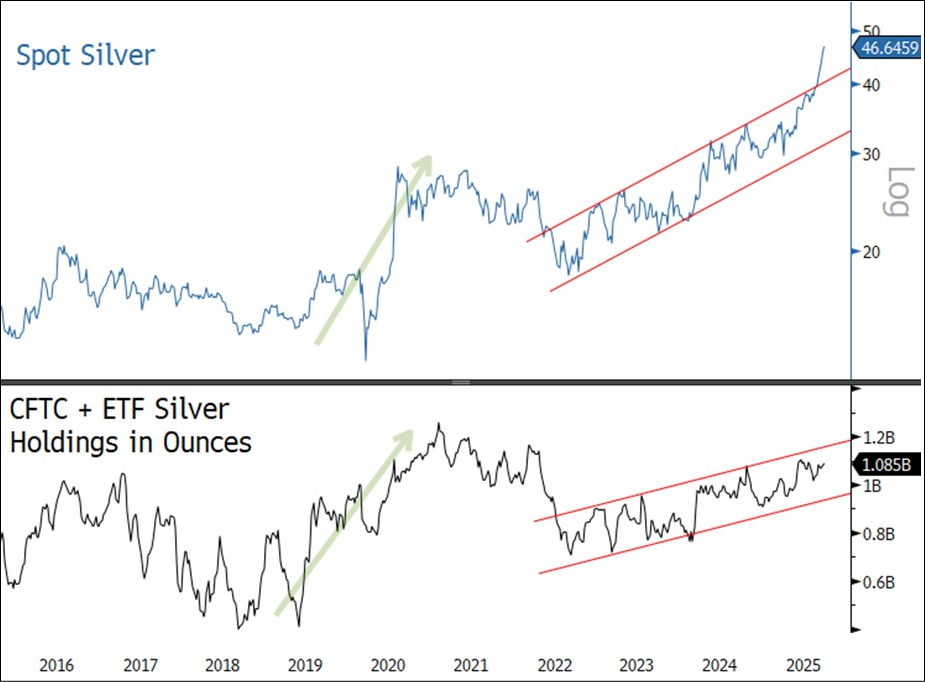
The move in silver prices relative to CFTC and ETF positioning (proxy investment fund holdings) is another way to illustrate that a potential silver price squeeze may be in play. In Figure 7, the upper panel shows the silver price accelerating while the positioning data remains flat (lower panel). Since central banks and sovereigns are not buying silver (unlike gold), most of the silver pricing is in the hands of investors. In the prior 2020 cycle, there was a notable increase in CFTC + ETF silver holdings commensurate with the silver price (see the green arrows). Today, that pricing relationship is diverging, possibly an early indication of the long-awaited silver demand squeeze.
Figure 7. Silver Prices versus Positioning (2016-2025)
Source: Bloomberg. Data as of September 30, 2025. Silver spot price, U.S. dollar/oz. CFTC silver holdings refer to long positions taken by non-commercial traders as defined by the Commodity Futures Trading Commission (CFTC), such as individual investors and hedge funds, who buy futures contracts primarily for speculation, and do not have a direct business interest in the commodities they trade. ETF silver holdings refer to silver held by exchange traded funds for investment purposes. Past performance is no guarantee of future results.
North Vancouver, British Columbia–(Newsfile Corp. – October 9, 2025) – Lion One Metals Limited (TSXV: LIO) (OTCQX: LOMLF) (“Lion One” or the “Company“) is pleased to report significant new high-grade gold results from 4,180.5 meters of underground infill and grade control drilling at its 100% owned Tuvatu Alkaline Gold Project in Fiji (“Tuvatu“). The drilling is focused on the Zone 5 area of the mine, down-dip of current mine levels.
All drilling was conducted from near surface underground workings. The Company intersected high-grade mineralized structures in 24 holes up to 100 m below current underground workings. The primary target for the drilling was the down-dip extension of the Zone 5 lodes below the current mine levels. Most of the high-grade drill intercepts are located within 60 m of current underground workings, and include multiple very high-grade gold assays, such as 267.95 g/t over 0.3 m, 168.25 g/t over 0.9 m, 179.52 g/t over 0.3 m, 126.49 g/t over 0.5 m, and 175.52 g/t over 0.4 m. Previous drilling in this part of the mine has returned similarly high-grade results, including the highest intercept ever recorded at Tuvatu – 2,749.86 g/t over 0.3 m (see press release dated January 23, 2025). Due to the proximity of these drill results to existing workings there is a strong probability that these intercepts can be incorporated into the mine plan in the next six to twelve months.
Highlights of New Drill Results:
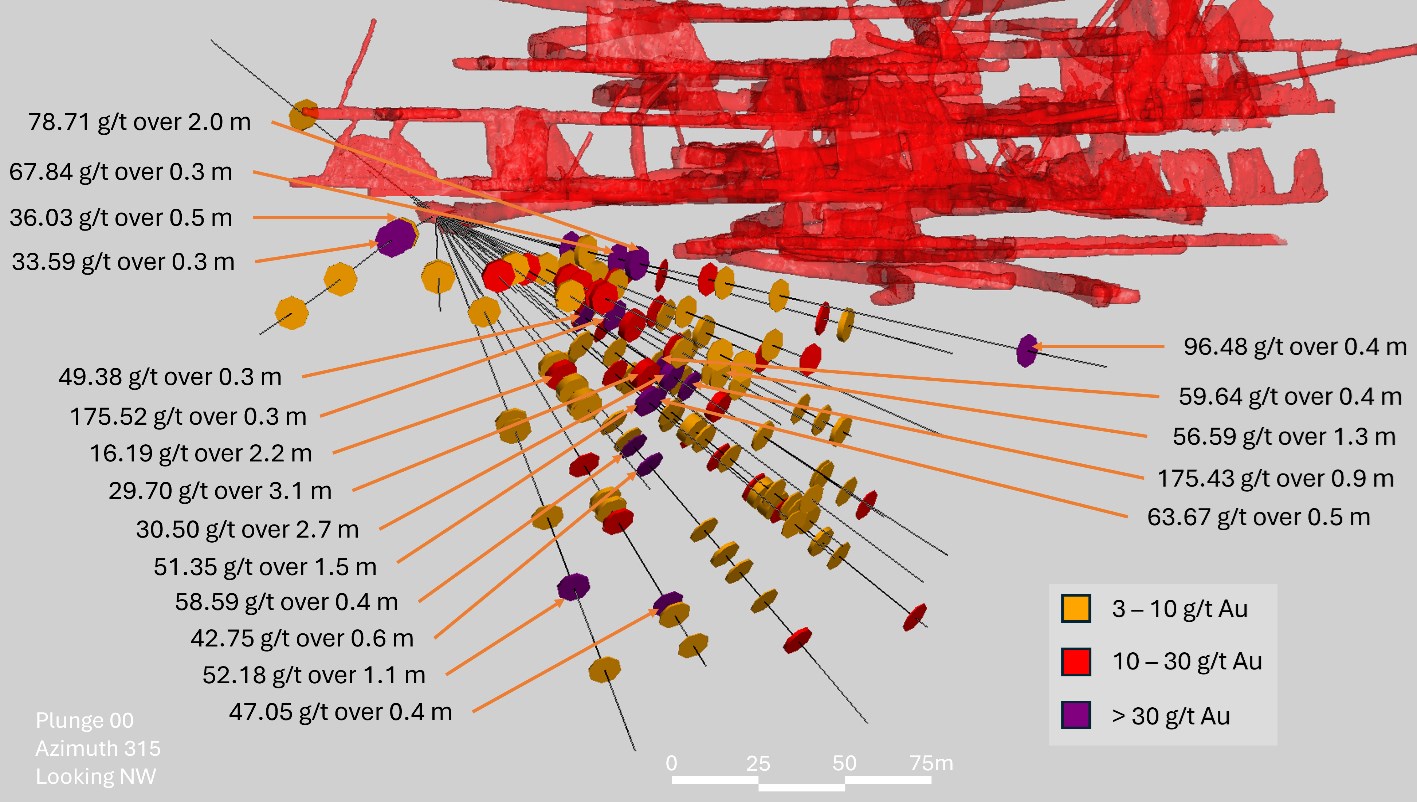
175.43 g/t Au over 0.9 m (including 267.95 g/t Au over 0.3 m) (TGC-0451, from 89 m depth)
78.71 g/t Au over 2.0 m (including 168.25 g/t Au over 0.9 m) (TGC-0383, from 69.7 m depth)
29.70 g/t Au over 3.1 m (including 179.52 g/t Au over 0.3 m) (TGC-0406, from 83.2 m depth)
30.50 g/t Au over 2.7 m (including 45.78 g/t Au over 0.7 m) (TGC-0424, from 85.9 m depth)
51.35 g/t Au over 1.5 m (including 126.49 g/t Au over 0.5 m) (TGC-0379, from 89.5 m depth)
56.59 g/t Au over 1.3 m (including 62.39 g/t Au over 0.9 m) (TGC-0447, from 92 m depth)
175.52 g/t Au over 0.4 m (TGC-0387, from 67.1 m depth)
52.18 g/t Au over 1.1 m (including 86.25 g/t Au over 0.5 m) (TGC-0373, from 157.8 m depth)
16.19 g/t Au over 2.2 m (including 84.47 g/t Au over 0.3 m) (TGC-0414, from 74.9 m depth)
96.48 g/t Au over 0.4 m (TGC-0383, from 212.5 m depth)
12.83 g/t Au over 2.5 m (including 69.57 g/t Au over 0.3 m) (TGC-0451, from 99.0 m depth)
8.37 g/t Au over 3.6 m (including 17.91 g/t Au over 0.7 m) (TGC-0449, from 128.0 m depth)
*Drill intersects are downhole lengths, 3.0 g/t cutoff. True width not known. See Table 1 for additional data.
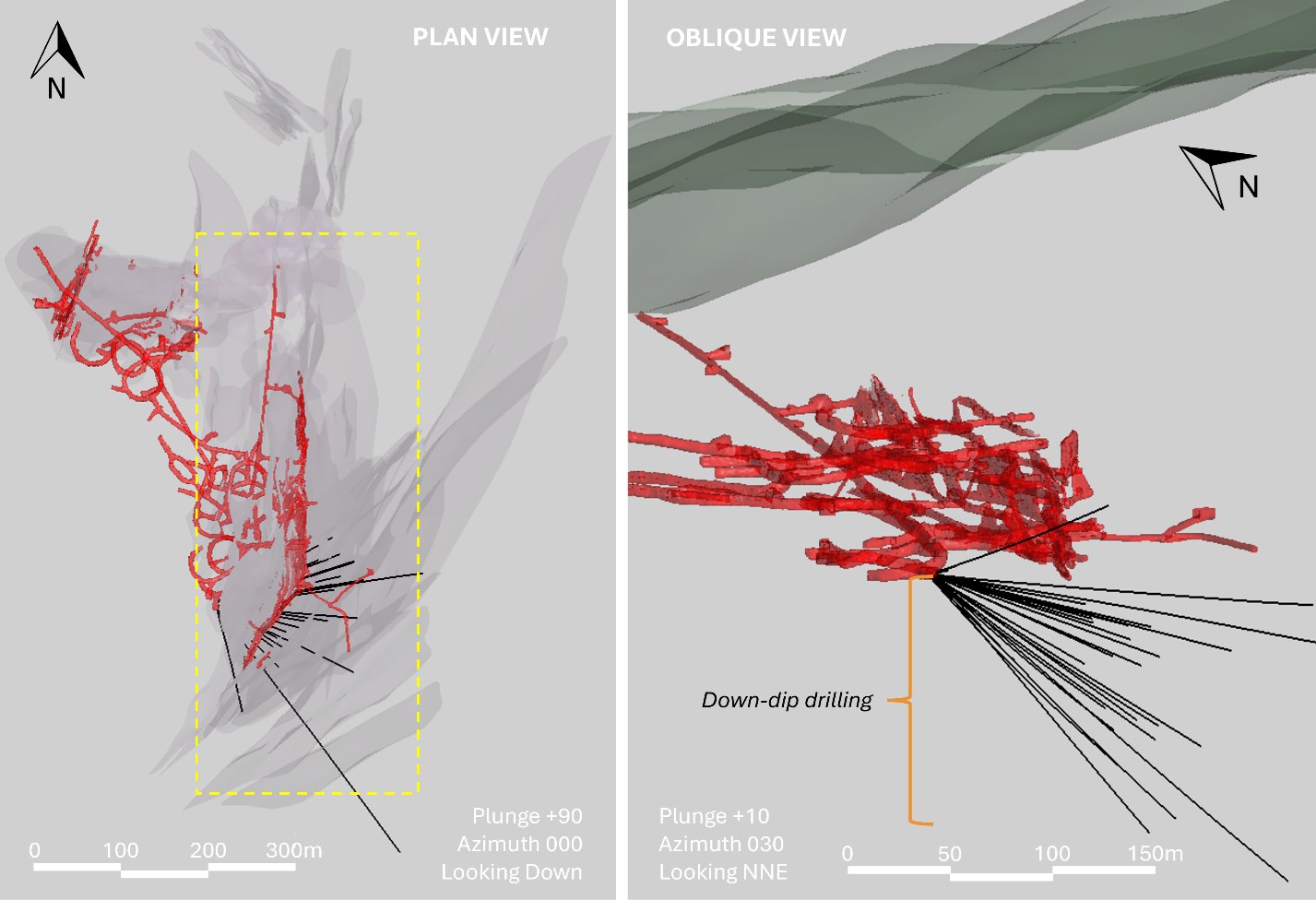
Figure 1. Location of the Zone 5 drilling reported in this news release. Left image: Plan view of the Zone 5 drilling in relation to the mineralized lodes shown in grey, with Tuvatu underground development shown in red. The yellow dashed square represents the area illustrated in the image on the right. Right image: Oblique view of the Zone 5 drilling looking NNE. The primary target for the Zone 5 drilling was the down-dip extension of the Zone 5 lodes up to 100 m below current underground workings.
The Zone 5 area of Tuvatu is located on the east side of the deposit and includes the principal north-south and northeast-southwest oriented lode arrays. These lodes are steeply dipping structures that converge at approximately 500 m depth to form Zone 500, which is believed to be the highest-grade part of the deposit and is interpreted to be a feeder zone at Tuvatu. The system remains open at depth with the deepest high-grade (>10 g/t Au) intersects occurring below 1000 m depth.
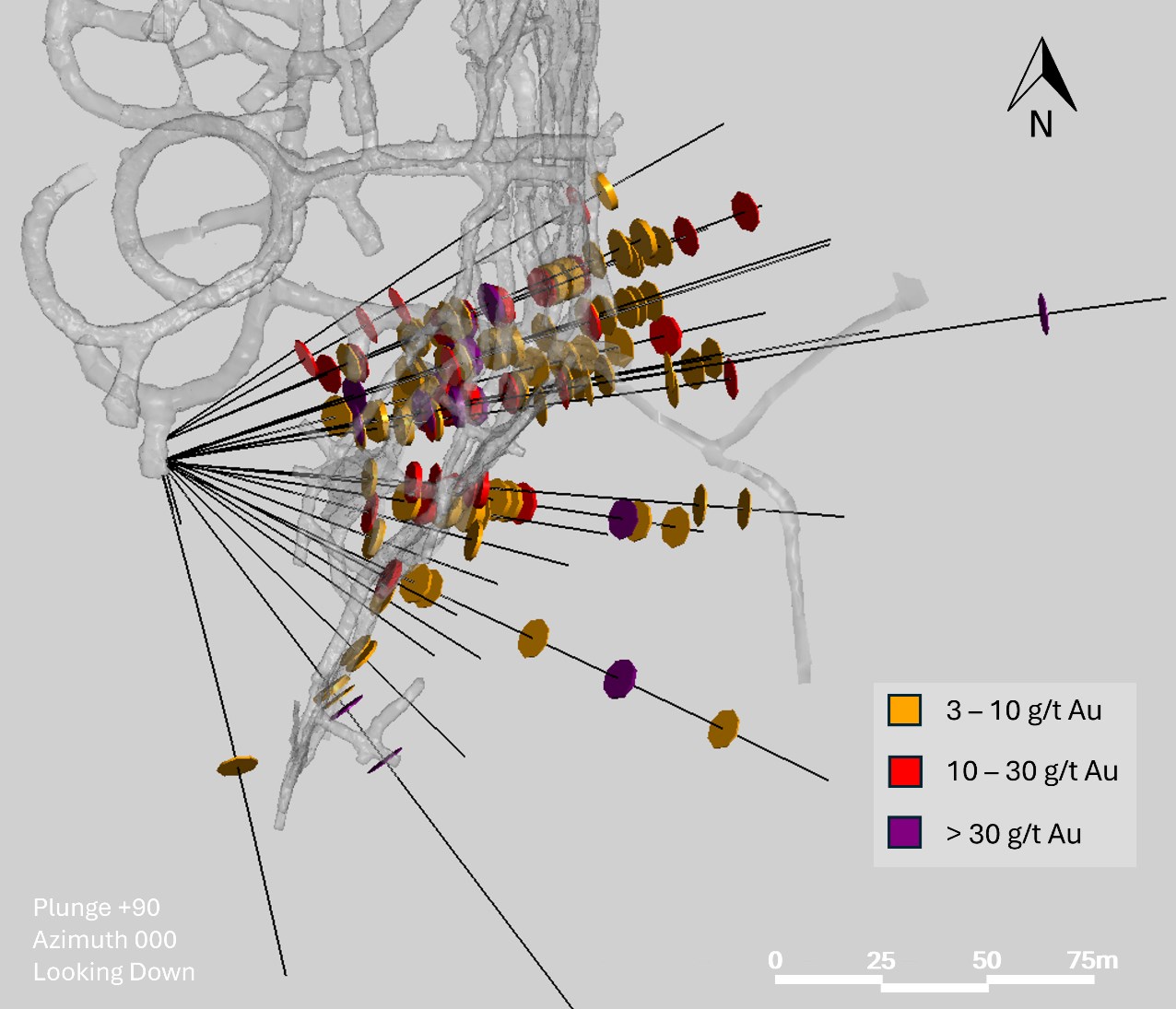
The drilling reported in this news release targeted the down-dip extension of the Zone 5 lodes below current mine levels. All the drilling was conducted from one underground drill station and consisted of a fan of drillholes drilled on 15 m centers that was designed to infill a panel of the deposit approximately 130 m wide and 100 m tall. This area is targeted for mining within the next 6 to 12 months and represents an additional five levels of mining at Tuvatu.
The drillholes reported in this news release include multiple very high-grade gold assays over narrow widths, such as 267.95 g/t over 0.3 m, 168.25 g/t over 0.9 m, 179.52 g/t over 0.3 m, 126.49 g/t over 0.5 m, and 175.52 g/t over 0.4 m. These types of intersects are typical at Tuvatu as the deposit consists of high-grade narrow vein structures. The drillholes reported here were designed to intersect the mineralized lodes in a perpendicular to sub-perpendicular orientation such that the mineralized intervals approximate the true width of the mineralization. The purpose of the Zone 5 drill program is to enhance the mine model and inform stope design in advance of mining the target areas. Highlights of the Zone 5 drilling reported here are shown in Figure 2.
Figure 2. Zone 5 drilling with high-grade intercepts highlighted, 3.0 g/t gold cutoff, section view. Section view looking northwest with select high-grade intercepts highlighted. The drill holes shown here primarily targeted the down dip extension of the Zone 5 lodes below current underground workings shown in red. This area is targeted for mining within the next 6 to 12 months.
Figure 3. Zone 5 drilling with high-grade intercepts highlighted, 3.0 g/t gold cutoff, plan view. Plan view looking down with high-grade intercepts highlighted, underground workings shown in pale grey.
The drill holes reported in this news release are oriented approximately perpendicular to mineralization. The reported intercepts therefore approximate the true width of mineralization. The minimum mining width at Tuvatu is approximately 1.5 m. In reporting drillhole intercepts Lion One uses a grade composite cut-off of 3 g/t gold with <1 m internal dilution at <3 g/t. Drill hole intervals that are <3 g/t are below cutoff and are not included in Table 2.
Competent Person’s Statement
In accordance with National Instrument 43-101 – Standards of Disclosure for Mineral Projects (“NI 43- 101”), Melvyn Levrel, MAIG, Senior Geologist for Lion One Metals, is the Qualified Person for the Company and has reviewed and approved the technical and scientific content of this news release.
Lion One Laboratories / QAQC
Lion One adheres to rigorous QAQC procedures above and beyond basic regulatory guidelines in conducting its drilling, sampling, testing, and analyses. The Company operates its own geochemical assay laboratory and its own fleet of diamond drill rigs using PQ, HQ and NQ sized drill rods. The Lion One geochemical laboratory is accredited under the IANZ ISO/IEC 17025:2017 Standard – the international standard for testing and calibration of laboratories.
Diamond drill core samples are logged by Lion One personnel on site. Exploration diamond drill core is split by Lion One personnel on site, with half core samples sent for analysis and the other half core remaining on site. Grade control diamond drill core is whole core assayed. Core samples are delivered to the Lion One Laboratory for preparation and analysis. All samples are pulverized at the Lion One lab to 85% passing through 75 microns and gold analysis is carried out using fire assay with an AA finish. Samples that return grades greater than 10.00 g/t Au are re-analyzed by gravimetric method, which is considered more accurate for very high-grade samples.
Duplicates of 5% of samples with grades above 0.5 g/t Au are delivered to ALS Global Laboratories in Australia for check assay determinations using the same methods (Au-AA26 and Au-GRA22 where applicable). ALS also analyses 33 pathfinder elements by HF-HNO3-HClO4 acid digestion, HCl leach and ICP-AES (method ME-ICP61). The Lion One lab can test a range of up to 71 elements through Inductively Coupled Plasma Optical Emission Spectrometry (ICP-OES), but currently focuses on a suite of 29 important pathfinder elements with an aqua regia digest and ICP-OES finish.
About Lion One Metals Limited
Lion One Metals is an emerging Canadian gold producer headquartered in North Vancouver BC, with new operations established in late 2023 at its 100% owned Tuvatu Alkaline Gold Project in Fiji. The Tuvatu project comprises the high-grade Tuvatu Alkaline Gold Deposit, the Underground Gold Mine, the Pilot Plant, and the Assay Lab. The Company also has an extensive exploration license covering the entire Navilawa Caldera, which is host to multiple mineralized zones and highly prospective exploration targets.
On behalf of the Board of Directors, Walter Berukoff, Chairman & President
Neither the TSX-V nor its Regulation Service Provider accepts responsibility or the adequacy or accuracy of this release
This press release may contain statements that may be deemed to be “forward-looking statements” within the meaning of applicable Canadian securities legislation. All statements, other than statements of historical fact, included herein are forward-looking information. Generally, forward-looking information may be identified by the use of forward-looking terminology such as “plans”, “expects” or “does not expect”, “proposed”, “is expected”, “budget”, “scheduled”, “estimates”, “forecasts”, “intends”, “anticipates” or “does not anticipate”, or “believes”, or variations of such words and phrases, or by the use of words or phrases which state that certain actions, events or results may, could, would, or might occur or be achieved. This forward-looking information reflects Lion One Metals Limited’s current beliefs and is based on information currently available to Lion One Metals Limited and on assumptions Lion One Metals Limited believes are reasonable. These assumptions include, but are not limited to, the actual results of exploration projects being equivalent to or better than estimated results in technical reports, assessment reports, and other geological reports or prior exploration results. Forward-looking information is subject to known and unknown risks, uncertainties and other factors that may cause the actual results, level of activity, performance, or achievements of Lion One Metals Limited or its subsidiaries to be materially different from those expressed or implied by such forward-looking information. Such risks and other factors may include, but are not limited to: the stage development of Lion One Metals Limited, general business, economic, competitive, political and social uncertainties; the actual results of current research and development or operational activities; competition; uncertainty as to patent applications and intellectual property rights; product liability and lack of insurance; delay or failure to receive board or regulatory approvals; changes in legislation, including environmental legislation, affecting mining, timing and availability of external financing on acceptable terms; not realizing on the potential benefits of technology; conclusions of economic evaluations; and lack of qualified, skilled labor or loss of key individuals. Although Lion One Metals Limited has attempted to identify important factors that could cause actual results to differ materially from those contained in forward-looking information, there may be other factors that cause results not to be as anticipated, estimated, or intended. Accordingly, readers should not place undue reliance on forward-looking information. Lion One Metals Limited does not undertake to update any forward-looking information, except in accordance with applicable securities laws.
Appendix 1: Full Drill Results and Collar Information
Table 1. Collar coordinates for drillholes reported in this release. Coordinates are in Fiji map grid.
Hole ID
Easting
Northing
Elevation
Azimuth
Dip
Depth
TGC-0346
1876384
3920429
94
104.8
-16.9
102.2
TGC-0349
1876384
3920429
94
110.9
-15.3
86.9
TGC-0352
1876384
3920428
94
117.7
-15.6
80.5
TGC-0354
1876384
3920428
94
126.1
-15.0
80.5
TGC-0356
1876384
3920427
94
134.4
-14.3
101.4
TGC-0358
1876384
3920428
94
122.1
-23.9
95.5
TGC-0361
1876385
3920426
94
142.9
-4.5
350.1
TGC-0373
1876384
3920427
93
114.6
-42.0
230.5
TGC-0375
1876384
3920428
93
95.3
-42.8
181.3
TGC-0377
1876384
3920429
94
80.7
-17.5
140.4
TGC-0379
1876384
3920429
93
79.2
-37.7
170.8
TGC-0383
1876384
3920428
94
78.9
-11.3
242.1
TGC-0387
1876384
3920429
94
78.5
-25.1
146.7
TGC-0406
1876384
3920429
94
78.6
-32.6
200.2
TGC-0409
1876384
3920429
94
71.8
-21.0
175.8
TGC-0414
1876384
3920428
94
99.0
-36.2
131.2
TGC-0416
1876384
3920428
94
95.1
-17.0
167.5
TGC-0419
1876384
3920429
93
75.8
-45.1
205.5
TGC-0421
1876384
3920429
93
71.3
-32.0
11.3
TGC-0423
1876384
3920429
94
69.4
-32.0
11.5
TGC-0424
1876384
3920429
94
71.0
-32.1
191.3
TGC-0434
1876384
3920429
93
70.5
-38.0
161.5
TGC-0438
1876383
3920425
96
164.3
16.5
9.0
TGC-0440
1876384
3920425
97
164.4
22.0
12.6
TGC-0441
1876383
3920425
96
165.3
22.7
131.1
TGC-0445
1876384
3920434
94
60.3
-14.7
155.6
TGC-0447
1876384
3920433
94
67.2
-26.8
140.0
TGC-0449
1876384
3920433
93
67.7
-40.7
191.1
TGC-0451
1876384
3920433
94
67.9
-32.3
162.0
TGC-0456
1876384
3920434
93
55.9
-30.9
114.4
Table 2. Composite intervals from drillholes reported in this news release (composite grade >3.0 g/t Au, with <1 m internal dilution at <3.0 g/t Au).
Highlights Ongoing Support for Responsible Mining Development
VANCOUVER, British Columbia, Oct. 06, 2025 (GLOBE NEWSWIRE) — Apollo Silver Corp. (“Apollo Silver” or the “Company”) (TSX.V:APGO, OTCQB:APGOD, Frankfurt:6ZF) is pleased to announce that it was invited to participate in an industry luncheon with the San Bernardino County’s (the “County”) new Land Use Director, Miguel Figueroa, on September 30, 2025. The event was hosted by County Chair Dawn Rowe, and former Chairman Robert Lovingood, and brought together County and industry leaders to highlight the importance of mining as a driver of economic growth and innovation in the County.
With over 90 active mine sites, the County is recognized as California’s largest mining jurisdiction, with a long history of contributing to the state and national supply of silver and critical minerals, where US$60 billion of mineral reserves have been permitted in the last 15 years. The County’s leadership continues to demonstrate strong support for responsible mineral development, underscoring mining’s role in job creation, infrastructure, and investment.
“Our participation reflects Apollo Silver’s commitment to building strong relationships with local communities and San Bernardino County officials, as we advance the Calico Project in the historic Calico Mining District,” said Ross McElroy, President & CEO of Apollo Silver. “The County’s formal presentation highlighted the significant role the mining sector plays in supporting the local work force and economy, reaffirming that San Bernardino is open for business. We look forward to continued engagement with the County and contributing to its proud mining legacy.”
Situated near the town of Barstow, in San Bernardino County, Apollo Silver’s Calico Project builds on a proud mining legacy that once generated the equivalent of more than $2 billion in today’s dollars from silver and borax from the historic Calico mine. Today, Calico stands out as one of America’s most significant undeveloped primary silver projects and has the added benefit of being well endowed with barite and zinc, both important critical minerals. Notably, silver is included on the U.S. draft 2025 Critical Minerals List. The presence of these critical minerals enhances Calico’s strategic position in the permitting process. Additionally, the project is located largely on private land with vested mining rights, providing potential to further streamline its development.
ABOUT APOLLO SILVER CORP.
Apollo Silver is advancing one of the largest undeveloped primary silver projects in the U.S. The Calico Project hosts a large, bulk minable silver deposit with significant barite and zinc credits – recognized as critical minerals essential to the US energy, industrial and medical sectors. The Company also holds an option on the Cinco de Mayo Project in Chihuahua, Mexico, which is host to a major carbonate replacement (CRD) deposit that is both high-grade and large tonnage. Led by an experienced and award-winning management team, Apollo is well positioned to advance the assets and deliver value through exploration and development.
Neither the TSX Venture Exchange nor its Regulation Services Provider (as that term is defined in the policies of the TSX Venture Exchange) accepts responsibility for the adequacy or accuracy of this release.
Your vote is important no matter how many EMX Shares and/or stock options you hold.
The Board of Directors of EMX recommends that Securityholders vote FOR the Arrangement Resolution.
In light of the current Canada Post strike, Securityholders are strongly encouraged to cast their votes online or by telephone.
For assistance in voting, please contact Laurel Hill Advisory Group by phone at 1-877-452-7184 (toll-free in North America) or 1-416-304-0211 (collect, international), or by email at assistance@laurelhill.com.
Vancouver, British Columbia–(Newsfile Corp. – October 2, 2025) – EMX Royalty Corporation (NYSE American: EMX) (TSXV: EMX) (FSE: 6E9) (the “Company” or “EMX”) is pleased to announce today that in connection with the previously announced transaction (the “Arrangement“) with Elemental Altus Royalties Corp. (“Elemental Altus“) and 1554829 B.C. Ltd. (“Acquireco“), EMX has filed and commenced delivery of its notice of meeting, management information circular (the “Circular“) and related documents (collectively, the “Meeting Materials“) for the upcoming special meeting (the “Meeting“) of the holders of common shares of the Company (the “Shareholders“) and the holders of stock options of the Company (the “Optionholders“, and collectively with the Shareholders, the “Securityholders“).
Due to the Canada Post strike, the mailing and delivery of the Meeting Materials has been interrupted. In accordance with the terms of the Interim Order (as defined below) and in lieu of prepaid ordinary mail, this press release has been disseminated and an advertisement (the “Advertisement“) has been placed in today’s issue of The Globe and Mail newspaper.
EMX has implemented measures to ensure that the delivery or transmission of the proxies or other Meeting Materials by the Securityholders to EMX in relation to the Meeting may be made within the required time period and at no cost to the Securityholders, including by providing for the submission of proxies online or by telephone, as set out below.
Further, EMX has taken the following measures, at no cost to Securityholders, to ensure delivery or transmission of Meeting Materials to as many Securityholders as possible:
posted the Advertisement in The Globe and Mail newspaper;
couriered or emailed the Meeting Materials to all registered Shareholders in Canada;
couriered the Meeting Materials to beneficial Shareholders in Canada using a determined threshold;
emailed the Meeting Materials to Securityholders with available email addresses;
emailed intermediaries for further communication to beneficial Shareholders; and
disseminated this press release.
There is no anticipated interruption or delay in the delivery of the Meeting Materials to U.S. Securityholders.
In light of the current Canada Post strike, Securityholders are strongly encouraged to cast their votes online or by telephone.
The Meeting Materials can also be accessed under EMX’s profile on SEDAR+ at www.sedarplus.ca and on EDGAR at www.sec.gov, as well as on the Company’s website at https://emxroyalty.com/investors/special-meeting/. The Meeting Materials are also available for delivery to Securityholders without charge by email or by courier upon written request made to EMX (contact Laurel Hill per below).
The Arrangement and Meeting Details
On September 4, 2025, EMX, Elemental Altus and Acquireco entered into an arrangement agreement (the “Arrangement Agreement“), pursuant to which Elemental Altus has agreed to, indirectly through Acquireco, acquire all of the issued and outstanding common shares of EMX (“EMX Shares“) at an exchange ratio of 0.2822 Elemental Altus common shares (each, an “Elemental Altus Share“) for each EMX Share (the “Exchange Ratio“). Optionholders will receive replacement options of EMX, being exercisable to purchase from Elemental Altus a number of Elemental Altus Shares adjusted as to the number by the Exchange Ratio (rounded down to the nearest whole number of Elemental Altus Shares) and as to exercise price by the inverse of the Exchange Ratio (rounded up to the nearest whole cent). At the Meeting, Securityholders will be asked to consider, and if deemed advisable, to pass a special resolution (the “Arrangement Resolution“) to approve the Arrangement under Part 9, Division 5 of the Business Corporations Act (British Columbia).
EMX will hold the Meeting on November 4, 2025, at 10:00 a.m. (Vancouver time) at the offices of Cassels Brock & Blackwell LLP at Suite 2200, RBC Place, 885 West Georgia Street, Vancouver, British Columbia V6C 3E8. The Meeting can also be accessed via live webcast at meetnow.global/M2JX4WC. The record date for Securityholders entitled to notice of, and to attend and vote at, the Meeting is September 25, 2025. Only Securityholders who are present in person and entitled to vote at the Meeting are able to vote during the Meeting. Any Securityholder attending the Meeting via the live webcast will not be able to vote at the Meeting.
Interim Order
The Company is pleased to announce that the Supreme Court of British Columbia (the “Court“) has granted an interim order (the “Interim Order“) regarding the Arrangement which authorizes EMX to proceed with the Meeting and addresses other Meeting-related matters. A copy of the Interim Order is included in the Circular. Subject to receipt of the requisite approvals by Securityholders at the Meeting, it is expected that EMX will apply for a final order of the Court approving the Arrangement on November 7, 2025.
Reasons for the Arrangement and Board Recommendation
Top Quality, Globally Diversified Portfolio. The combined company will create a peer-leading revenue generating royalty company with combined revenue guidance of US$70 million in 2025 and analyst consensus revenue of US$80 million in 20261, underpinned by strong growth visibility.
Meaningful Scale. The combined company results in a larger, well capitalized entity with a lower cost of capital, positioned to pursue further accretive royalty opportunities in the market.
Future Growth. The combined company is expected to benefit from complementary management expertise, uniting Elemental Altus’ proven track record of accretive royalty acquisitions with EMX’s disciplined royalty generation and acquisition capabilities.
Support of Directors, Officers and Shareholders. The boards of directors of each of EMX and Elemental Altus (subject to abstentions where legally required) and the special committee of the board of directors of EMX have unanimously recommended support for the Arrangement. Additionally, the directors and senior officers and certain shareholders of each of EMX and Elemental Altus have entered into voting and support agreements pursuant to which they have agreed, among other things, to vote in favour of the Arrangement Resolution at the Meeting and in favour of certain resolutions at the special meeting of Elemental Altus shareholders to be held on November 4, 2025, as applicable.
Negotiated Transaction. The Arrangement Agreement is the result of a comprehensive negotiation process with respect to the key elements of the Arrangement Agreement and plan of arrangement, which includes terms and conditions that are reasonable in the judgment of the board of directors of EMX and the special committee of the board of directors of EMX. The Arrangement provides for a 21.5% premium on the 20 day volume weighted average price to Shareholders as of September 4, 2025 and management of EMX who will be taking on management positions with the combined company, including the CEO and CFO roles.
The Board of Directors (subject to abstentions where legally required) of EMX unanimously recommends that Securityholders vote FOR the Arrangement Resolution.
How to Vote
Registered Securityholders
Non-Registered Shareholders
EMX Shares and/or EMX options held in own name and represented by a physical certificate or DRS.
EMX Shares held with a broker, bank or other intermediary.
Dial the applicable number listed on the voting instruction form.
Securityholders are encouraged to read the Circular in its entirety and vote their EMX shares and/or EMX options as soon as possible ahead of the proxy voting deadline on October 31, 2025 at 10:00 a.m. (Vancouver time) (which deadline may be waived by EMX).
To ensure your vote is received in a timely manner, Securityholders are strongly encouraged to cast their votes online or by telephone. Securityholders who require voting assistance may contact EMX’s proxy solicitation agent, Laurel Hill Advisory Group at the contact information below. Additionally, Laurel Hill Advisory Group will reach out to Securityholders to assist with voting and utilize Broadridge’s QuickvoteTM offering to take votes directly over the phone from eligible beneficial Shareholders. Beneficial Shareholders who have not received their voting instruction form with their unique control number may contact their broker and request this number to vote online or contact Laurel Hill Advisory Group.
While the Canada Post strike is ongoing, registered Shareholders who wish to deposit their letters of transmittal, share certificates and other required documentation, as applicable, should use courier services or hand deliver such documentation to the depositary, Computershare Investor Services Inc., at 320 Bay Street, 14th Floor, Toronto, Ontario M5H 4A6.
Securityholder Questions
Securityholders who have any questions or require assistance with voting may contact Laurel Hill Advisory Group, EMX’s proxy solicitation agent and Securityholder communications advisor:
Laurel Hill Advisory Group Toll Free: 1-877-452-7184 (for Securityholders in North America) International: +1 416-304-0211 (for Securityholders outside Canada and the US) By Email: assistance@laurelhill.com
EMX is a precious and base metals royalty company. EMX’s investors are provided with discovery, development, and commodity price optionality, while limiting exposure to risks inherent to operating companies. The EMX Shares are listed on the NYSE American Exchange and TSX-V under the symbol “EMX”. Please see www.EMXroyalty.com for more information.
Cautionary Note Regarding Forward Looking Information
This press release may contain “forward-looking information” within the meaning of applicable Canadian securities laws and “forward-looking statements” within the meaning of the United States Private Securities Litigation Reform Act of 1995, (collectively, “forward-looking statements”) that reflect the Company’s current expectations and projections about its future results. These forward-looking statements may include statements regarding the Meeting; the mailing and filing of the Meeting Materials, including the Canada Post strike and its effect on the mailing of the Meeting Materials; the approval of the Arrangement by Securityholders; the application for a final order of the Court approving the Arrangement; timing for closing of the Arrangement; EMX and the combined company’s plans and expectations with respect to the proposed Arrangement; the accuracy of the pro forma financial position and outlook of the combined company following completion of the Arrangement; the expected benefits of the new board and management team of the combined company; and the anticipated impact of the Arrangement on the combined company’s results of operations, financial position, growth opportunities and competitive position. Any statements that express or involve discussions with respect to predictions, expectations, beliefs, plans, projections, objectives, assumptions or future events or performance (often, but not always, identified by words or phrases such as “expects,” “anticipates,” “believes,” “plans,” “projects,” “targets,” “schedules,” “forecasts,” “budget,” “estimates,” “assumes,” “intends,” “strategy,” “goals,” “objectives,” “potential,” “possible” or variations thereof or stating that certain actions, events, conditions or results “may,” “could,” “would,” “should,” “might” or “will” be taken, occur or be achieved, or the negative of any of these terms and similar expressions) are not statements of historical fact and may be forward-looking statements.
Forward-looking statements are subject to known and unknown risks, uncertainties and other important factors that may cause the actual results, level of activity, performance or achievements of the Company to be materially different from those expressed or implied by such forward-looking statements, including but not limited to: the possibility that Securityholders may not approve the Arrangement; the risk that any other condition to closing may not be satisfied or waived; the risk that the closing of the Arrangement might be delayed or not occur at all; the risk that the Court does not issue a final order approving the Arrangement; the risk that either EMX or Elemental Altus may terminate the Arrangement Agreement and either EMX or Elemental Altus is required to pay a termination fee to the other party; potential adverse reactions or changes to business or employee relationships of EMX or Elemental Altus, including those resulting from the announcement or completion of the Arrangement; the diversion of management time on Arrangement-related issues; the risk of tax consequences for Securityholders and Elemental Altus securityholders if the Arrangement does not qualify as a tax-deferred reorganization; the ultimate timing, outcome and results of integrating the operations of EMX and Elemental Altus; the effects of the business combination of EMX and Elemental Altus, including the combined company’s future financial condition, results, operations, strategy and plans; the ability of the combined company to realize anticipated synergies in the timeframe expected or at all; changes in capital markets and the ability of the combined company to finance its activities in the manner expected; the inability to satisfy the listing requirements to be listed on a U.S. stock exchange; the possibility that EMX or Elemental Altus fail to comply with applicable laws prior to the Arrangement which could subject the combined company to penalties; the risk that EMX or Elemental Altus may not receive the required Court, stock exchange and regulatory approvals to effect the Arrangement; the risk of any litigation relating to the Arrangement; the fact that business disruption may be greater than expected following the public announcement or consummation of the Arrangement; the risk that the combined company does not result in a larger, well capitalized entity with a lower cost of capital which could prevent the combined company from pursuing further accretive royalty opportunities in the market; the absence of control over mining operations from which the Company will receive royalties or stream interests from; and risks related to those mining operations and royalty and stream interests, including risks related to international operations, government and environmental regulation, actual results of current exploration activities, conclusions of economic evaluations and changes in project parameters as plans continue to be refined, risks in the marketability of minerals, fluctuations in the price of gold and other commodities, fluctuation in foreign exchange rates and interest rates, stock market volatility, as well as those factors discussed in the EMX risk factors listed in EMX’s Management’s Discussion and Analysis for the six months ended June 30, 2025 and its Annual Information Form dated March 12, 2025 filed under EMX’s profile on SEDAR+ at www.sedarplus.ca and on EDGAR at www.sec.gov.
EMX’s forward-looking statements are based on the applicable assumptions and factors management considers reasonable as of the date hereof, based on the information available to management at such time. Although the Company has attempted to identify important factors that could cause actual results to differ materially from the Company in forward-looking statements, there may be other factors that cause results not to be as anticipated, estimated or intended. There can be no assurance that such statements will prove to be accurate, as actual results and future events could differ materially from those anticipated in such statements. Accordingly, readers should not place undue reliance on forward-looking statements. The Company does not undertake to update any forward-looking statements that are contained or incorporated by reference, except in accordance with applicable securities laws.
1 Based on figures (i) with respect to EMX from National Bank Financial Inc. and as of August 12, 2025, and (ii) with respect to Elemental Altus from each of Raymond James Ltd. and National Bank Financial Inc. as of August 19, 2025 and from Canaccord Genuity Corp. as of May 26, 2025.
LONDON, Oct. 2, 2025 /PRNewswire/ — ACG announces that the net smelter return royalty agreement dated 17 July 2019 (the “Royalty Agreement“) originally entered into between Lidya Madencilik Sanayi ve Ticaret A.Ş. (which assigned its interest to ACG Holdco 1 Limited), Polimetal Madencilik Sanayi ve Ticaret A.Ş. (“Polimetal“) and Alacer Gold Madencilik A.Ş (which assigned its interest to EMX Royalty Corporation (“EMX“)) in respect of production at the Gediktepe mine was amended and restated (the “Amended Royalty Agreement“) on 30 September 2025. The amendment is the result of a consensual agreement with EMX on terms that are mutually beneficial to all parties.
Under the terms of the Amended Royalty Agreement and related documents:
With effect from 1 January 2026, the terms of the oxide and sulphide royalties have been simplified, with the oxide royalty percentage being decreased from 10% to 2.25% and the sulphide royalty percentage being increased from 2% to 2.25% on all sulphide production.
Each of ACG and Polimetal has been released from its obligations to make certain milestone payments (the “Milestone Payments“) linked to the commencement of sulphide commercial production at the Gediktepe mine (in an aggregate amount of US$ 6 million) to EMX in 2026.
The adjustment to the royalty terms will provide substantial benefits to the group as it forges ahead with the transition from oxide to sulphide production at the Gediktepe mine. In particular:
The amendments to the Royalty Agreement should result in a significant reduction in all in sustaining costs (AISC) on the remaining oxide ore produced at the Gediktepe mine from 2026.
The reduction in the high oxide royalty percentage and release of the obligation to make the Milestone Payments should considerably strengthen the group’s short term cash flows and enable it to increase its cash buffer in 2026 while the Gediktepe mine transition is completed.
The royalty percentage applicable to any future oxide production following a potential LOM extension at Gediktepe will decrease from 10% to 2.25%.
Patrick Henze, Chief Financial Officer of ACG said:
“We are very pleased to have completed the process of amending our royalty arrangements with EMX and believe that the amended royalty terms leave us well positioned to navigate the transition from oxide to sulphide production in the near term. We are thankful to EMX for its constructive and collaborative approach during this process and look forward to continuing our mutually beneficial partnership.”
Inside information
The information contained within this announcement is considered by the Company to constitute inside information as stipulated under the Market Abuse Regulation (EU) No.596/2014 (as it forms part of UK domestic law by virtue of the European Union (Withdrawal) Act 2018). On the publication of this announcement via a Regulatory Information Service, such information is now considered to be in the public domain.
Forward looking statements
This announcement may contain certain “forward-looking information” and “forward-looking statements” (collectively, “forward-looking statements“). Forward-looking statements are identified by their use of terms and phrases such as “believe”, “targets”, “expects”, “aim”, “anticipate”, “project”, “would”, “could”, “envisage”, “estimate”, “intend”, “may”, “plan”, “will” or the negative of those, variations or comparable expressions, including references to assumptions. The forward-looking statements in this announcement are based on current expectations and are subject to known and unknown risks and uncertainties that could cause actual results, performance and achievements to differ materially from any results, performance or achievements expressed or implied by such forward-looking statements. Factors that may cause actual results to differ materially from those expressed or implied by such forward looking statements. These forward-looking statements are based on numerous assumptions regarding the present and future business strategies of the Group and the environment in which it is and will operate in the future. All subsequent oral or written forward-looking statements attributed to the Company or any persons acting on its behalf are expressly qualified in their entirety by the cautionary statement above. Each forward-looking statement speaks only as of the date of this announcement. Except as required by applicable law, regulatory requirement, the UK Listing Rules and the Disclosure Guidance and Transparency Rules, neither the Company nor any other party intends to update or revise these forward-looking statements, whether as a result of new information, future events or otherwise.
The person responsible for the release of this information on behalf of the Company is Artem Volynets, Chief Executive Officer.
About the Company
ACG Metals is a company with a vision to consolidate the copper industry through a series of roll-up acquisitions, with best-in-class ESG and carbon footprint characteristics.
In September 2024, ACG successfully completed the acquisition of the Gediktepe Mine which is expected to transition to primary copper and zinc production from 2026 and will target annual steady-state copper equivalent production of 20-25 kt. Gediktepe produced 55koz of AuEq in 2024.
ACG’s team has extensive M&A experience built through decades spent at blue-chip multinationals in the sector. The team brings a significant network as well as a commitment to ESG principles and strong corporate governance.
VANCOUVER, British Columbia, October 1, 2025 – Apollo Silver Corp. (“Apollo Silver” or the “Company”) (TSX.V:APGO, OTCQB:APGOF, Frankfurt:6ZF0) is pleased to announce a non-brokered private placement offering of up to 5,800,000 units (the “Units”) of the Company at a price of $3.60 per Unit, for aggregate gross proceeds of up to $20,880,000 (the “Offering”).
Each Unit issued pursuant to the Offering will consist of one common share (a “Share”) in the capital of the Company and one common Share purchase warrant (a “Warrant”). Each Warrant entitles the holder thereof to purchase one Share at an exercise price of $5.50 for 24 months from the closing date of the Offering. The Warrants will be subject to an acceleration provision, such that if at any time after the date that is four months and one day after the closing, the Company’s Shares trade on the TSX Venture Exchange (the “TSXV”) at a closing price of $7.50 or greater per Share for a period of ten (10) consecutive trading days, the Company may accelerate the expiry of the Warrants by giving notice to the holders thereof and, in such case, the Warrant will expire on the thirtieth (30th) day after the date of such notice (the “Acceleration Provision”)
All securities issued in connection with the Offering will be subject to a four-month hold period from the date of closing. Finder’s fees may be payable on some or all of the funds raised, in accordance with the policies of the TSXV. The Company intends on using the net proceeds from the Offering to continue advancing the Calico Silver Project in San Bernardino, California; to support community relations initiatives at Cinco de Mayo Silver Project in Chihuahua, Mexico; to cover ongoing property maintenance costs at both projects; and for general corporate purposes.
Closing of the Offering is subject to regulatory approval including that of the TSXV.
The Shares have not been, and will not be, registered under the United States Securities Act of 1933, as amended (the “U.S. Securities Act”), or any U.S. state securities laws, and may not be offered or sold in the United States without registration under the U.S. Securities Act and all applicable state securities laws or compliance with the requirements of an applicable exemption therefrom. This news release shall not constitute an offer to sell or the solicitation of an offer to buy securities in the United States, nor shall there be any sale of these securities in any jurisdiction in which such offer, solicitation or sale would be unlawful.
About Apollo Silver Corp.
Apollo is advancing one of the largest undeveloped primary silver projects in the US. The Calico project hosts a large, bulk minable silver deposit with significant barite credits – a critical mineral essential to the US energy and medical sectors. The Company also holds an option on the Cinco de Mayo Project in Chihuahua, Mexico, which is host to a major carbonate replacement (CRD) deposit that is both high-grade and large tonnage. Led by an experienced and award-winning management team, Apollo is well positioned to advance the assets and deliver value through exploration and development.
Neither the TSX Venture Exchange nor its Regulation Services Provider (as that term is defined in the policies of the TSX Venture Exchange) accepts responsibility for the adequacy or accuracy of this release.
Cautionary Statement Regarding “Forward-Looking” Information
This news release includes “forward-looking statements” and “forward-looking information” within the meaning of Canadian securities legislation. All statements included in this news release, other than statements of historical fact, are forward-looking statements including, without limitation, statements with respect to the expected timing for completion of the Offering; and the intended use of proceeds from the Offering. Forward-looking statements include predictions, projections and forecasts and are often, but not always, identified by the use of words such as “anticipate”, “believe”, “plan”, “estimate”, “expect”, “potential”, “target”, “budget” and “intend” and statements that an event or result “may”, “will”, “should”, “could” or “might” occur or be achieved and other similar expressions and includes the negatives thereof.
Forward-looking statements are based on the reasonable assumptions, estimates, analysis, and opinions of the management of the Company made in light of its experience and its perception of trends, current conditions and expected developments, as well as other factors that management of the Company believes to be relevant and reasonable in the circumstances at the date that such statements are made. Forward-looking information is based on reasonable assumptions that have been made by the Company as at the date of such information and is subject to known and unknown risks, uncertainties and other factors that may have caused actual results, level of activity, performance or achievements of the Company to be materially different from those expressed or implied by such forward-looking information, including but not limited to: risks associated with mineral exploration and development; metal and mineral prices; availability of capital; accuracy of the Company’s projections and estimates; realization of mineral resource estimates, interest and exchange rates; competition; stock price fluctuations; availability of drilling equipment and access; actual results of current exploration activities; government regulation; political or economic developments; environmental risks; insurance risks; capital expenditures; operating or technical difficulties in connection with development activities; personnel relations; and changes in Project parameters as plans continue to be refined. Forward-looking statements are based on assumptions management believes to be reasonable, including but not limited to the price of silver, gold and barite; the demand for silver, gold and barite; the ability to carry on exploration and development activities; the timely receipt of any required approvals; the ability to obtain qualified personnel, equipment and services in a timely and cost-efficient manner; the ability to operate in a safe, efficient and effective matter; and the regulatory framework regarding environmental matters, and such other assumptions and factors as set out herein. Although the Company has attempted to identify important factors that could cause actual results to differ materially from those contained in forward-looking information, there may be other factors that cause results not to be as anticipated, estimated or intended. There can be no assurance that forward-looking statements will prove to be accurate and actual results, and future events could differ materially from those anticipated in such statements. Accordingly, readers should not place undue reliance on forward looking information contained herein, except in accordance with applicable securities laws. The forward-looking information contained herein is presented for the purpose of assisting investors in understanding the Company’s expected financial and operational performance and the Company’s plans and objectives and may not be appropriate for other purposes. The Company does not undertake to update any forward-looking information, except in accordance with applicable securities laws.
~ACQUISITION ADDS SUBSTANTIAL YUKON GOLD PROJECT TO COMPANY’S PORTFOLIO~
September 30, 2025 – Vancouver, BC – Blue Jay Gold Corp. (“Blue Jay” or the “Company”) is pleased to announce that it has completed the previously announced acquisition (the “Transaction”) of Tincorp Metals Inc.’s (TSXV: “TIN”; OTCQX: “TINFF”, “Tincorp”) wholly-owned subsidiary, Whitehorse Gold (Yukon) Corp. (“Whitehorse Gold”), effective September 29, 2025. Whitehorse Gold holds a 100% interest in the Skukum Gold Project (the “Project”) located in Yukon, Canada.
“Closing the Skukum Project acquisition is a defining step for Blue Jay,” said Geordie Mark, CEO of Blue Jay. “The Yukon is an incredible jurisdiction with excellent geological potential, supportive frameworks and partners, and enjoys a rich culture steeped in mining history. Skukum is a cornerstone asset for us, and as a former production site, we believe the area represents a meaningful opportunity for lower-risk discovery and project reinvigoration. Our near-term focus is to test the growth potential of the mineralized systems in and around underground development areas, and mature new targets to sustain project longevity. We are committed to upholding our responsibilities in a manner that supports long-term value creation while aligning with our disciplined approach to capital allocation and community partnership.”
Under the terms of the share purchase agreement between the parties (the “Agreement”), the total consideration payable by Blue Jay for the acquisition of the shares of Whitehorse Gold was structured as two payments: (i) at closing, Blue Jay issued 500,000 common shares of the Company and 250,000 common share purchase warrants (each, a “Warrant”) to Tincorp, having an aggregate value of $300,000; and (ii) $275,000, payable in cash and/or shares of the Company at Blue Jay’s election, is to be paid to Tincorp on the first anniversary of the closing date. Each Warrant entitles Tincorp to acquire one additional common share at an exercise price of $0.90 per share for a period of two years from the date of issuance, subject to certain acceleration provisions.
For more information regarding the acquisition, see our press release announced June 4, 2025, and available on SEDAR.com
About Blue Jay
Blue Jay Gold Corp. is a Canadian gold exploration company focused on growing and discovering resources within established brownfields regions in Canada. The Company has built a portfolio of projects in Canada in highly sought after Tier 1 mining jurisdictions. With our strategically located projects and a leadership team experienced in geology and capital markets, Blue Jay Gold will advance disciplined, modern exploration strategies across projects in known gold mineralized regions across Canada.
ON BEHALF OF BLUE JAY GOLD CORP. signed “Geordie Mark” Geordie Mark, CEO
This news release contains forward-looking statements and forward-looking information (collectively, “forward- looking statements”) within the meaning of applicable Canadian and U.S. securities legislation. All statements, other than statements of historical fact included in this release, including, without limitation, statements regarding the exploration and development potential of the Project, the potential of future payments under the Agreement and the preparation of a technical report are forward-looking statements.
Forward-looking statements are often, but not always, identified by words or phrases such as “expects”, “is expected”, “anticipates”, “believes”, “plans”, “projects”, “estimates”, “assumes”, “intends”, “strategies”, “targets”, “goals”, “forecasts”, “objectives”, “budgets”, “schedules”, “potential” or variations thereof or stating that certain actions, events or results “may”, “could”, “would”, “might” or “will” be taken, occur or be achieved, or the negative of any of these terms and similar expressions. These statements are based on the opinions, assumptions, factors and estimates of management considered reasonable as of the date such statements are made. Assumptions include, but are not limited to, the ability to obtain and maintain governmental approvals, permits, and licenses in connection with the Company’s planned development and exploration activities at the Company’s projects.
Forward-looking statements involve known and unknown risks, uncertainties and other factors which may cause actual results, performance or achievements to differ materially from those expressed or implied by such statements which involve the state of equity financing markets, volatility of market prices, and fluctuations in metal prices.
Although Blue Jay has attempted to identify important factors that could cause actual results to differ materially from those contained in forward-looking statements, there may be other factors that cause results to differ. Readers are cautioned not to place undue reliance on these statements, and Blue Jay undertakes no obligation to update or revise any forward-looking statements, except as required by applicable law.