Categories
Base Metals Energy Junior Mining Precious Metals

The ‘structural shift’ pushing gold higher in 2025

Gold (GC=F) prices are on track to achieve their eighth consecutive week of gains, with forecasts for further upside potentially reaching $3,100 per troy ounce by year-end. Daan Struyven, Goldman Sachs co-head of global commodities research, joins Market Domination hosts Julie Hyman and Alexandra Canal to discuss the details.

Struyven emphasizes how the shift in central bank behavior stems from Russia’s central bank reserves being frozen in 2022. This influenced investments in the US and Europe.

“It was a wake-up call to [emerging-market] EM central bank reserve managers because they realized that their assets would not necessarily be risk-free,” he explains. “So they have shifted part of their reserves to buying gold, an asset which cannot be frozen or confiscated.”

“We have seen a five-fold increase in the rhythm of gold purchases by central banks,” Struyven adds. “We think this is a structural shift, and we expect ongoing solid above-trend central bank purchases of gold to continue to push gold prices higher.”

Source: https://finance.yahoo.com/video/structural-shift-pushing-gold-higher-220821409.html

Categories
Base Metals Energy Exclusive Interviews

It’s Time to Buy Gold Now! – Maurice Jackson

In this insightful episode of Proven and Probable, host Maurice Jackson delves into the compelling reasons why now is an opportune time to invest in gold. He examines current economic indicators, market trends, and historical data that suggest a favorable environment for gold investments. Jackson also offers strategic insights on how to effectively incorporate gold into your investment portfolio.

Key Topics Discussed:

  • Impact of inflation and currency fluctuations on gold prices
  • Historical performance of gold during economic downturns
  • Strategies for diversifying portfolios with precious metals
  • Long-term benefits of holding gold assets

Whether you’re a seasoned investor or new to precious metals, this episode provides valuable perspectives to help you navigate the complexities of the current financial landscape.

Connect with Us:
Call Me Directly: 855.505.1900
Website: Proven and Probable
Twitter: @ProvenProbable
Facebook: Proven and Probable
Don’t forget to like, share, and subscribe for more expert insights on precious metals and resource investments.

Rumble

Categories
Base Metals Energy Junior Mining

Charted: Top Suppliers of Aluminum and Steel to the U.S.

Charted: Top U.S. Suppliers of Aluminum and Steel

This was originally posted on our Voronoi app. Download the app for free on iOS or Android and discover incredible data-driven charts from a variety of trusted sources.

U.S. President Donald Trump has imposed a 25% tariff on all steel and aluminum imports, marking one of the most discussed measures of his first month back in the White House.

But which countries are most affected by these tariffs?

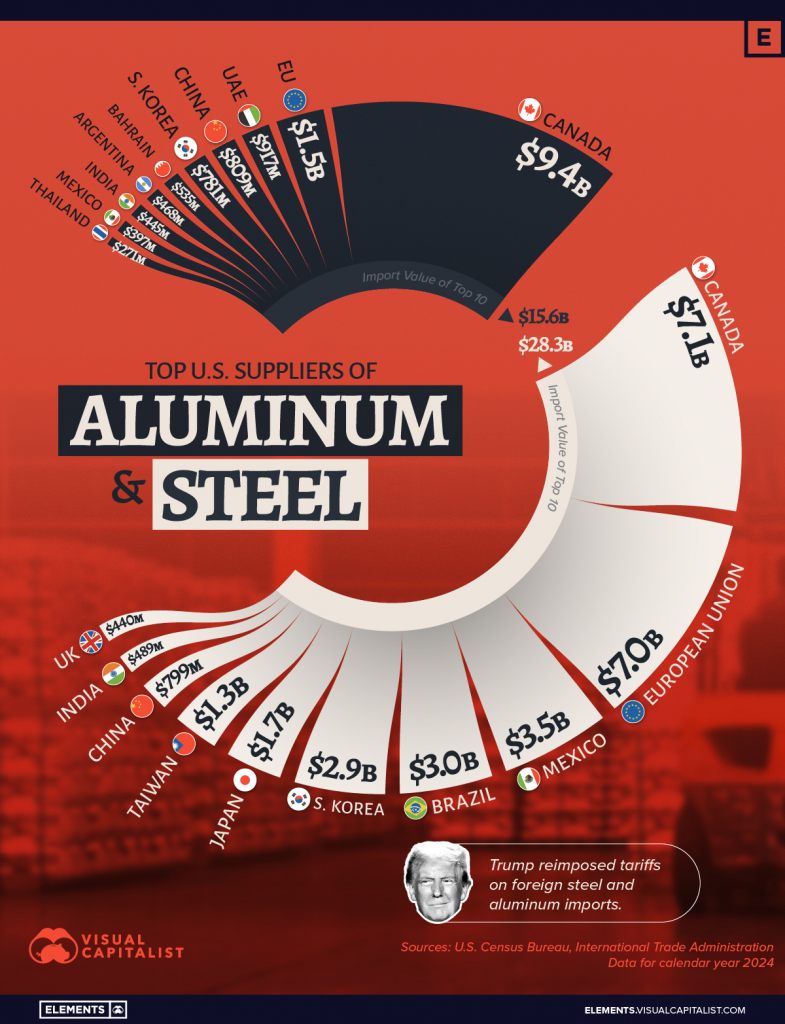
This map illustrates the top suppliers of aluminum and steel to the United States in 2024. The data comes from the U.S. Census Bureau.

Canada: The Largest Partner

Canada is by far the top supplier of both steel and aluminum to the United States. The neighboring country exported $9.4 billion worth of aluminum to the U.S. in 2024, significantly ahead of the second-largest exporter, the European Union, which exported $1.5 billion.

Canada also exported $7.1 billion worth of steel last year, compared to $7 billion from the European Union.

CountrySteel Imports (USD)Aluminum Imports (USD)
🇨🇦 Canada$7.1B$9.4B
🇲🇽 Mexico$3.5B$397M
🇧🇷 Brazil$3.0B
🇨🇳 China$799M$809M
🇹🇼 Taiwan$1.3B
🇰🇷 South Korea$2.9B$781M
🇩🇪 Germany$1.9B$318M
🇯🇵 Japan$1.7B
🇮🇳 India$489M$445M
🇪🇺 European Union$7B$1.5B
🇦🇪 UAE$917M
🇧🇭 Bahrain$535M
🇦🇷 Argentina$468M
🇹🇭 Thailand$271M
🇬🇧 UK$440M

Mexico, South Korea, and Brazil are also among the top suppliers of steel to the United States. Meanwhile, the country imports aluminum from other key partners, including China, the United Arab Emirates, South Korea, Bahrain, and Argentina.

A recent report by the Center for Strategic and International Studies (CSIS) noted that the U.S. produces less than 2% of the world’s primary aluminum.

https://elements.visualcapitalist.com/charted-top-suppliers-of-aluminum-and-steel-to-the-u-s/?mc_cid=a6f94fc979&mc_eid=5c5bffba2f

Categories
Base Metals Energy Junior Mining Precious Metals

Exclusive-Barrick Gold signs agreement with Mali to end mining dispute

Prospectors and Developers Association of Canada (PDAC) annual conference in Toronto · Reuters

(Reuters) – Canadian miner Barrick Gold has signed a new agreement with the Malian government to end an almost two-year-old dispute over its mining assets in the West African country, two people familiar with the developments told Reuters on Wednesday.

Barrick signed the agreement and now it is up to the Mali government to formally approve the deal, the sources told Reuters. An official announcement could come as early as Thursday.

As part of the new agreement, Barrick will pay 275 billion CFA or $438 million to the Mali government, in return for the release of detained employees, seized gold, and restarting the operations at the Loulo-Gounkoto mine.

Barrick did not respond to an email query by Reuters. A spokesperson for Mali’s mines ministry declined to comment.

The Toronto-based miner and Mali have been locked in a dispute since 2023 over the implementation of the West African country’s new mining code that gives Mali government a greater share in the country’s gold mine.

(Reporting by Divya Rajagopal, Giulia Paravicini and Portia Crowe, editing by Silvia Aloisi)

https://finance.yahoo.com/news/exclusive-barrick-gold-signs-agreement-184750893.html

Categories
Base Metals Energy Junior Mining Precious Metals

Exclusive: Trump prepares to change US CHIPS Act conditions, sources say

By Mike Stone, Fanny Potkin and Wen-Yee Lee

WASHINGTON/SINGAPORE/TAIPEI (Reuters) -The White House is seeking to renegotiate U.S. CHIPS and Science Act awards and has signaled delays to some upcoming semiconductor disbursements, two sources familiar with the matter told Reuters.

The people, along with a third source, said the new administration is reviewing the projects awarded under the 2022 law, meant to boost American domestic semiconductor output with $39 billion in subsidies.

Washington plans to renegotiate some of the deals after assessing and changing current requirements, according to the sources. The extent of the possible changes, and how they would affect agreements already finalized, was not immediately clear. It was not known whether any action has yet been taken.

“The CHIPS Program Office has told us that certain conditions that do not align with President (Donald) Trump’s executive orders and policies are now under review for all CHIPS Direct Funding Agreements,” GlobalWafers spokesperson Leah Peng said in a statement to Reuters.

Taiwan’s GlobalWafers, which said it has not been notified directly by Washington of any changes to the conditions or terms of their awards, is set to receive $406 million in U.S. government grants for projects in Texas and Missouri. The company is currently set to receive subsidies only after it achieves specific milestones later in 2025.

Illustration picture of semiconductor chips on a circuit board

Each award recipient has distinct terms and milestones in their agreements.

Four sources with knowledge of the discussions told Reuters that the White House is concerned about many of the terms underpinning the $39 billion Chips and Science Act industry subsidies.

Those encompass additional clauses, including requirements added into contracts by the administration of President Joe Biden, including that recipients must use unionized labor to build factories and help provide affordable childcare for factory workers.

The White House and the U.S. Department of Commerce did not immediately respond to requests for comment.

The Semiconductor Industry Association, a trade group representing the chip industry, has started asking members how the program could be improved.

But David Isaacs, vice president of government affairs for the group, said: “It’s important both the manufacturing incentives and research programs proceed without disruption, and we stand ready to work with Commerce Secretary Nominee (Howard) Lutnick and other members of the Trump administration to streamline the program’s requirements and achieve our shared goal of strengthening U.S. leadership in chip technology.”

Since taking office, Trump has issued a series of executive orders aimed at dismantling diversity, equity and inclusion programs across the federal government and the private sector.

One of the sources said the White House is also frustrated by companies that accepted CHIPS Act subsidies and then announced significant overseas expansion plans, including in China. The law allowed some investments in China.

Intel (INTC), for example, announced a $300 million investment in a Chinese assembly and test facility in October, after saying in March that it had won a major award under the CHIPS Act.

Many of the biggest recipients of the CHIPS Act funding – including Intel, TSMC (TSM), Samsung Electronics and SK Hynix – all have major manufacturing facilities in China.

Intel disclosed it had received two payments totaling $2.2 billion in funding from the CHIPS Act, but declined to comment.

A TSMC spokesperson said the company had received $1.5 billion in CHIPS Act monies before the new administration came in as per the milestone terms of its agreement.

The spokesperson declined comment on any possible changes to its agreement under Trump but said the company is continuing to engage with the Chips Program Office.

Samsung, SK Hynix and Hemlock Semiconductor declined to comment, while Bosch referred Reuters to the Chips Office. Micron and GlobalFoundries did not respond to requests for comment.

(Reporting by Mike Stone and Karen Freifeld in Washington, Fanny Potkin in Singapore, Wen-Yee Lee in Taipei and Stephen Nellis and Max Cherney in San FranciscoWriting by Stephen Nellis and Fanny Potkin; Editing by Chris Sanders and Matthew Lewis)

Source: https://finance.yahoo.com/news/nissan-ceo-says-it-will-be-difficult-to-survive-without-partnerships-after-honda-merger-collapses-184244494.html

Categories
Base Metals Energy Junior Mining Precious Metals

Analysis-As gold eyes glittering milestone, bear case also rises

Production at Krastsvetmet precious metals plant in Krasnoyarsk · Reuters

By Polina Devitt

LONDON (Reuters) – Gold prices have marched into uncharted territory as bulls latch on to economic uncertainty created by U.S. import tariff plans, but behind the prize of hitting a record $3,000 per ounce, some flags of a bear case are also being planted.

Bullion has had a storming start to 2025, smashing eight records to rise more than 10% by February 11. That followed its biggest annual gain in 14 years in 2024, on a heady mix of strong central bank purchases, geopolitical uncertainties and monetary policy easing.

Gold’s appeal as a haven from risk strengthened further as newly elected U.S. President Donald Trump turned to tariffs to aid struggling domestic industry, despite the risk of sparking a trade war.

When Trump raised tariffs on steel and aluminium this week, spot gold hit a record $2,942.70 per ounce.

“What we have seen is the change in the motive for safe-haven buying – from being driven by the Middle East uncertainty to the threat and realisation of tariffs,” said Philip Newman, managing director at consultancy Metals Focus.

The scale of last year’s growth, which started before the Federal Reserve started easing interest rates, was unexpected, with investors apparently willing to disregard the opportunity cost of holding zero-yielding gold. The market also often de-coupled from other usual headwinds such as a stronger dollar.

“Strikingly, gold was rallying as inflation eased, and it looked as though all of our understanding of how gold prices behaved was being challenged,” said independent analyst Ross Norman.

Gold bulls have been emboldened by concerns that U.S. tariff plans could affect gold supplies to the United States, where Comex gold futures trade.

As a result, the premium at which most-active U.S. gold futures trade over the London spot price – historically just a few dollars – saw wild volatility and widened to $40 per ounce just before Trump’s inauguration on January 20 and more than $60 during the inauguration week.

Market players sought to benefit from a lucrative arbitrage opportunity or to cover their existing Comex positions, with the premium attracting massive deliveries to Comex gold inventories. These have jumped by 18.6 million troy ounces, worth $54 billion, since late November.

As bullion market players in London – home to the world’s largest over-the-counter gold trading hub – rushed to borrow gold from central banks storing bullion in Bank of England vaults, the waiting time to load gold out of the BoE swelled.

Switzerland and Asia-focused hubs saw a jump in supplies to the U.S., and gold lease rates surged both in London and India.

ACTIVITY PREDICTED TO FADE

But by Tuesday, the Comex premium had narrowed to $28 per ounce, and even while residuary inflows to Comex gold stocks continue, traders and analysts expect the activity to fade.

“Following a surge of gold imports into New York, it seems likely that the dislocation between New York futures prices and the London OTC market is nearing an end,” said John Reade, senior market strategist at the World Gold Council.

“As the next few weeks pass, queues getting gold from the Bank of England’s vaults should diminish, easing an apparent shortage of liquidity in the London market.”

Nicky Shiels, head of metals strategy at MKS PAMP SA, said that while prices could break out towards $3,200, resolution of physical gold dislocations attributed to tariffs and potential structural changes including reduced risk appetite, reduced participation and reduced liquidity are increasingly bearish.

She said her firm’s average price forecast for 2025 would remain at $2,750, with no intention to revise forecasts up. “If anything, the recent structural developments these past months have strengthened the bear case for gold,” she said.

Further pointing to potential easing in the rally once the situation with tariffs becomes clear, jewellery demand has been depressed by high gold prices, with discounts offered in key markets India and China. [GOL/AS]

Cartier maker Richemont said in November it was having to be “extremely cautious” about passing on soaring gold prices in its pricing of watches and jewellery.

Emerging market central banks, according to BofA Securities, are at risk of reducing gold buying if domestic currencies weaken on the U.S. tariffs.

Physically backed gold exchange-traded funds, which store bullion for investors, have also been relatively quiet, seeing inflows in Europe-listed funds but outflows in North America in January.

From a technical perspective, gold has been in the overbought zone of its relative strength index since the start of February. And gold can meet strong resistance around big milestones like $3,000 – gold faltered just above the $2,000 level several times before a decisive break last year.

(Reporting by Polina Devitt; Additional reporting by Ashitha Shivaprasad; Editing by Veronica Brown and Jan Harvey)

https://finance.yahoo.com/news/analysis-gold-eyes-glittering-milestone-140527286.html

Categories
Base Metals Junior Mining Precious Metals

Consumer prices rose more than expected in January

New inflation data out Wednesday showed headline consumer prices rose more than forecast in January as core prices reversed last month’s easing with the Federal Reserve’s path forward in focus.

The latest data from the Bureau of Labor Statistics showed that the Consumer Price Index (CPI) increased 3.0% over the prior year in January, an uptick from December’s 2.9% annual gain in prices.

The index rose 0.5% over the previous month, the largest monthly headline increase since August 2023 and a slight acceleration from the 0.4% rise seen in December. Economists had expected a 0.3% increase.

Seasonal factors like higher fuel costs and continued stickiness in food inflation kept the headline figures elevated. Notably, the index for eggs increased 15.2%, the largest increase since June 2015. It accounted for about two thirds of the total monthly food at home increase, according to the BLS.

On a “core” basis, which strips out the more volatile costs of food and gas, prices in January climbed 0.4% over the prior month, higher than December’s 0.2% monthly gain and the largest monthly rise since April 2023.

Core prices rose 3.3% over last year, marking an uptick from the 3.2% seen in December, which was the first time since July that year-over-year core CPI showed a deceleration in price growth.

Core inflation has remained stubbornly elevated due to sticky costs for shelter and services like insurance and medical care. Shelter did show some signs of easing last month, rising 4.4% on an annual basis, the smallest 12-month increase in three years.

It was a different story for used car prices, which saw another strong uptick for the fourth consecutive month. The index rose 2.2% in January after a 1.2% increase in December and a 2% monthly gain in November.

UNITED STATES - FEBRUARY 11: Federal Reserve Chairman Jerome Powell testifies during the Senate Banking, Housing and Urban Affairs Committee hearing titled
UNITED STATES – FEBRUARY 11: Federal Reserve Chairman Jerome Powell testifies during the Senate Banking, Housing and Urban Affairs Committee hearing titled “The Semiannual Monetary Policy Report to the Congress,” in Hart building on Tuesday, February 11, 2025. (Tom Williams/CQ-Roll Call, Inc via Getty Images) · Tom Williams via Getty Images

Although inflation has been slowing, it has remained above the Federal Reserve’s 2% target on an annual basis with economists and Fed officials pointing to a “bumpy” road ahead.

“There’s no sugarcoating this. This is not this is not a good print,” Claudia Sahm, chief economist at New Century Advisors and former Federal Reserve economist, told Yahoo Finance’s Morning Brief program.

“The one thing to say is this is a familiar disappointment,” she continued, noting the start of a new year has previously contributed to upside surprises. “Having a hot print in January in recent years has been a common occurrence. It’s also been a common occurrence that’s dissipated as the year has gone on. So this isn’t a deal breaker for the year as a whole, but it is certainly not a good way to start things off.”

Seema Shah, chief global strategist at Principal Asset Management, agreed, adding “seasonality and one-off factors may have played some role in the upside surprise.”

However, “the combination of average earnings growth surprising to the upside last week, the supercore services inflation number moving sharply higher today, and the government’s policy agenda threatening to raise inflation expectations, is almost too convincing to dismiss,” she said.

Fed’s complicated path forward

The ascension of Donald Trump to the presidency has further muddied the inflation outlook, with economists arguing the US could face another inflation resurgence as Trump commits to a protectionist trade policy. That’s likely to complicate the central bank’s path forward for interest rates.

On Monday, President Trump announced global 25% tariffs on steel and aluminum imports, which will take effect on March 12. 25% tariffs on Mexico and Canada are set to come next month, while 10% duties on China have already been implemented.

Shortly after the release, traders scaled back expectations of a Fed rate cut, pricing in just one cut from the central bank this year. Stock futures also sold off on the news.

“The Fed is never going to overreact to one month of data,” Sahm said. “They’ve been telling us since December that they are in no hurry to adjust rates again and that will be reinforced today.”

“We’re back in the case of last year where we’re going to have to see months and months — getting out of the first quarter — of better inflation data before the Fed gets comfortable with it. So it really does push the timeline probably into the second half of the year [if] this ends up being the outlier.”

Alexandra Canal is a Senior Reporter at Yahoo Finance. Follow her on X @allie_canalLinkedIn, and email her at alexandra.canal@yahoofinance.com.

https://finance.yahoo.com/news/consumer-prices-rose-more-than-expected-in-january-133419198.html

Categories
Base Metals Energy Junior Mining Project Generators

F3 Encounters Encouraging Geology in Final Drillholes of 2024 Program

Kelowna, British Columbia–(Newsfile Corp. – February 12, 2025) – F3 Uranium Corp (TSXV: FUU) (OTCQB: FUUFF) (“F3” or “the Company“) is pleased to announce that persistent prospective geological characteristics were intersected in the last eight drill holes of the 2024 program focused on continued exploration and expansion of the B1 conductor and A1 extension, as well as further testing of the Harrison Fault area. Geochemistry and assay results from 25 drill holes from 2024 JR Zone and exploration drilling are still outstanding and will be incorporated into the 2025 drill planning and released as they come available.

B1 Conductor:

PLN24-188 tested the B1 conductor 120m north of PLN24-168 (currently the southernmost hole to intersect B1); the drillhole was lost in unconsolidated sand. Retested with hole PLN24-195 which intersected strong bleaching, clay and hematite alteration. PLN24-190 on line 3360S targeted between strong boron anomalies intersected in both PLN24-122 and PLN24-135. The hole intersected strong sandstone dissolution, graphitic faulting in basement and up to 420cps at 568.5m within a hematite altered fault zone. PLN24-193 attempted to test the Athabasca Sandstone above the B1 conductor in an area devoid of previous drilling. The hole intersected strong sandstone alteration and sulfides in the sandstone.

A1 Extension south of Harrison Fault:

PLN24-189 tested the A1 extension on line 3450S approximately 200m along strike south of radioactivity intersected in PLN24-187. The hole intersected 360cps at a depth of 419m and a strongly hematite, clay and sericite rich fault zone from 503.4-537.1m, interpreted to be the continuation of the A1 structure, extending the fault zone to nearly 620m south of Harrison Fault. PLN24-191 was abandoned prior to target depth due to excessive drillhole deviation.

Harrison Fault Area:

PLN24-192 tested the basement wedge along the Harrison Fault between holes PLN24-146 and PLN24-162. The hole successfully intersected the wedge and strong associated alteration, with the lower Athabasca Sandstone displaying strong alteration and dravite breccias (See Image 1). PLN24-194 was planned 100m northeast of hole PLN24-142, testing the Harrison Fault further to the northwest. The hole successfully intersected the fault zone from 266-335.5m containing strong graphite and sulphide alteration. The intersection of the Harrison Fault and the A1 and B1 conductors continues to display very encouraging alteration and large-scale complex structures supported by strong geochemistry, such as in drillhole PLN24-152. The area remains a high priority exploration target.

Map 1. Patterson Lake North, 2024 Scintillometer Results

To view an enhanced version of this graphic, please visit:
https://images.newsfilecorp.com/files/8110/240184_d88abf7e443e3af9_002full.jpg

Table 1. Drill Hole Summary and Handheld Spectrometer Results

To view an enhanced version of this graphic, please visit:
https://images.newsfilecorp.com/files/8110/240184_d88abf7e443e3af9_003full.jpg

Handheld spectrometer composite parameters:
1: Minimum Thickness of 0.5m
2: CPS Cut-Off of 300 counts per second
3: Maximum Internal Dilution of 2.
0m

Image 1: Brecciated Athabasca Sandstone in PLN24-192

To view an enhanced version of this graphic, please visit:
https://images.newsfilecorp.com/files/8110/240184_d88abf7e443e3af9_004full.jpg

Natural gamma radiation in the drill core that is reported in this news release was measured in counts per second (cps) using a handheld Radiation Solutions RS-125 scintillometer. The Company considers greater than 300 cps on the handheld spectrometer as anomalous, >10,000 cps as high grade and greater than 65,535 cps as off-scale. The reader is cautioned that scintillometer readings are not directly or uniformly related to uranium grades of the rock sample measured and should be used only as a preliminary indication of the presence of radioactive materials.

Samples from the drill core are split into half sections on site. Where possible, samples are standardized at 0.5m down-hole intervals. One-half of the split sample is sent to SRC Geoanalytical Laboratories (an SCC ISO/IEC 17025: 2005 Accredited Facility) in Saskatoon, SK while the other half remains on site for reference. Analysis includes a 63 element suite including boron by ICP-OES, uranium by ICP-MS and gold analysis by ICP-OES and/or AAS.

The Company considers uranium mineralization with assay results of greater than 1.0 weight % U3O8 as “high grade” and results greater than 20.0 weight % U3O8 as “ultra-high grade”.

All depth measurements reported are down-hole and true thicknesses are yet to be determined.

About the Patterson Lake North Property:

The Company’s 42,961-hectare 100% owned Patterson Lake North Project (PLN) is located just within the south-western edge of the Athabasca Basin in proximity to Paladin’s Triple R and NexGen Energy’s Arrow high-grade uranium deposits, an area poised to become the next major area of development for new uranium operations in northern Saskatchewan. The PLN Project consists of the 4,074-hectare Patterson Lake North Property, the 19,864-hectare Minto Property, and the 19,022-hectare Broach Property. All three properties comprising the PLN Project are accessed by Provincial Highway 955; the new JR Zone uranium discovery on the PLN property is located 23km northwest of Paladin’s Triple R deposit.

Qualified Person:

The technical information in this news release has been prepared in accordance with the Canadian regulatory requirements set out in National Instrument 43-101 and approved on behalf of the company by Raymond Ashley, P.Geo., President & COO of F3 Uranium Corp, a Qualified Person. Mr. Ashley has verified the data disclosed.

About F3 Uranium Corp.:

F3 Uranium is a uranium exploration company, focusing on the recently discovered high-grade JR Zone on its Patterson Lake North (PLN) Project in the Western Athabasca Basin. F3 Uranium currently has 3 properties in the Athabasca Basin: Patterson Lake North, Minto, and BroachThe western side of the Athabasca Basin, Saskatchewan, is home to some of the world’s largest high grade uranium deposits including Triple R and Arrow and poised to become the next major area of high grade uranium operations in the world.

Forward-Looking Statements

This news release contains certain forward-looking statements within the meaning of applicable securities laws. All statements that are not historical facts, including without limitation, statements regarding future estimates, plans, programs, forecasts, projections, objectives, assumptions, expectations or beliefs of future performance, including statements regarding the suitability of the Properties for mining exploration, future payments, issuance of shares and work commitment funds, entry into of a definitive option agreement respecting the Properties, are “forward-looking statements.” These forward-looking statements reflect the expectations or beliefs of management of the Company based on information currently available to it. Forward-looking statements are subject to a number of risks and uncertainties, including those detailed from time to time in filings made by the Company with securities regulatory authorities, which may cause actual outcomes to differ materially from those discussed in the forward-looking statements. These factors should be considered carefully and readers are cautioned not to place undue reliance on such forward-looking statements. The forward-looking statements and information contained in this news release are made as of the date hereof and the Company undertakes no obligation to update publicly or revise any forward-looking statements or information, whether as a result of new information, future events or otherwise, unless so required by applicable securities laws.

The TSX Venture Exchange and the Canadian Securities Exchange have not reviewed, approved or disapproved the contents of this press release, and do not accept responsibility for the adequacy or accuracy of this release.

F3 Uranium Corp.
750-1620 Dickson Avenue
Kelowna, BC V1Y9Y2

Contact Information
Investor Relations
Telephone: 778 484 8030
Email: ir@f3uranium.com

ON BEHALF OF THE BOARD
“Dev Randhawa”
Dev Randhawa, CEO

To view the source version of this press release, please visit https://www.newsfilecorp.com/release/240184

Categories
Base Metals Energy Junior Mining Project Generators

F3 Announces Exploration Programs at Broach and Minto Properties

Kelowna, British Columbia–(Newsfile Corp. – February 11, 2025) – F3 Uranium Corp (TSXV: FUU) (OTCQB: FUUFF) (“F3” or “the Company“) is pleased to announce that ground geophysical exploration programs have commenced on the Broach and Minto Properties. A total of 55 line km of Moving Loop TDEM ground EM will be undertaken on two grids of interest testing suspected conductive corridors previously identified by airborne surveys, and both parallel to the A1 conductor system which hosts the high grade JR Zone on the PLN property.

Minto Property: A4 Grid

14 line-km of MLTDEM ground geophysics testing an approximately 7,200m long conductive corridor identified by airborne MobileMT which was flown by F3 in 2023. F3 has one hole drilled on this grid in 2014; PLN14-021 intersected up to 44ppm uranium in basement, and 698ppm boron directly above the Athabasca Unconformity at 413m. Anomalous geochemistry and proximity to the Harrison fault in a corridor parallel to the A1 conductor make this grid a strong exploration target area.

Broach Property: PW Grid

41 line-km of MLTDEM ground geophysics covering a suspected conductive trend, approximately 12km south of, and parallel to the JR Zone. This particular area of the Broach property hosts thick discontinuous layers of conductive mudstones and these flat lying conductive units hampered the effectiveness of a previously flown airborne EM (VTEMmax) survey flown in 2014. Ground based geophysics is anticipated to effectively penetrate the conductive cover allowing for drill target generation. Due to its location near the interpreted Athabasca Basin boundary and the historic difficulty of exploring under conductive cover, this large area remains underexplored.

Sam Hartmann, Vice President Exploration, commented:

“We are excited with the prospect of upgrading the Broach and Minto properties to the drilling stage with this round of ground EM, which we anticipate assisting in reducing broader airborne conductivity responses to more precise conductor models for drill testing. At the A4 grid, where some historic ground EM coverage prompted us to drill a single hole in 2014, this new ground EM will give us an improved conductor model, in a strategic location near the projected confluence of the Harrison Fault with the A4 conductive corridor. At the PW grid, we are aiming to generate a conductivity model in an area where no previous airborne EM conductors have been clearly identified, near the margins of the Athabasca Basin in an area of very limited historical drilling. Identifying ground conductors near the present day margins of the basin is something that we are specifically interested in. Additionally, recent re-modelling of historic ground EM surveys south of Broach Lake has resulted in an additional target; the northeast trending BRS conductor. This suspected structure sits along favorable MT conductivity, and we look forward to upgrading the BRS conductor to the drilling stage as well with ground EM surveying.”

Map 1. Broach and Minto Properties, 2025 Exploration

To view an enhanced version of this graphic, please visit:
https://images.newsfilecorp.com/files/8110/240183_e1a7c21b142cbb01_002full.jpg

About the Patterson Lake North Project:

The Company’s 42,961-hectare 100% owned Patterson Lake North Project (PLN) is located just within the south-western edge of the Athabasca Basin in proximity to Fission Uranium’s Triple R and NexGen Energy’s Arrow high-grade world class uranium deposits which is poised to become the next major area of development for new uranium operations in northern Saskatchewan. The PLN Project consists of the 4,074-hectare Patterson Lake North Property, the 19,864-hectare Minto Property, and the 19,022-hectare Broach Property. All three properties comprising the PLN Project are accessed by Provincial Highway 955; the new JR Zone uranium discovery on the PLN property is located 23km northwest of Fission Uranium’s Triple R deposit.

Qualified Person:

The technical information in this news release has been prepared in accordance with the Canadian regulatory requirements set out in National Instrument 43-101 and approved on behalf of the company by Raymond Ashley, P.Geo., President & COO of F3 Uranium Corp, a Qualified Person. Mr. Ashley has verified the data disclosed.

About F3 Uranium Corp.:

F3 Uranium is a uranium exploration company, focusing on the recently discovered high-grade JR Zone on its Patterson Lake North (PLN) Project in the Western Athabasca Basin. F3 Uranium currently has 3 properties in the Athabasca Basin: Patterson Lake North, Minto, and BroachThe western side of the Athabasca Basin, Saskatchewan, is home to some of the world’s largest high grade uranium deposits including Triple R and Arrow and poised to become the next major area of high grade uranium operations in the world.

Forward Looking Statements

This news release contains certain forward-looking statements within the meaning of applicable securities laws. All statements that are not historical facts, including without limitation, statements regarding future estimates, plans, programs, forecasts, projections, objectives, assumptions, expectations or beliefs of future performance, including statements regarding the suitability of the Properties for mining exploration, future payments, issuance of shares and work commitment funds, entry into of a definitive option agreement respecting the Properties, are “forward-looking statements.” These forward-looking statements reflect the expectations or beliefs of management of the Company based on information currently available to it. Forward-looking statements are subject to a number of risks and uncertainties, including those detailed from time to time in filings made by the Company with securities regulatory authorities, which may cause actual outcomes to differ materially from those discussed in the forward-looking statements. These factors should be considered carefully and readers are cautioned not to place undue reliance on such forward-looking statements. The forward-looking statements and information contained in this news release are made as of the date hereof and the Company undertakes no obligation to update publicly or revise any forward-looking statements or information, whether as a result of new information, future events or otherwise, unless so required by applicable securities laws.

The TSX Venture Exchange and the Canadian Securities Exchange have not reviewed, approved or disapproved the contents of this press release, and do not accept responsibility for the adequacy or accuracy of this release.

F3 Uranium Corp.
750-1620 Dickson Avenue
Kelowna, BC V1Y9Y2

Contact Information
Investor Relations
Telephone: 778 484 8030
Email: ir@f3uranium.com

ON BEHALF OF THE BOARD
“Dev Randhawa”
Dev Randhawa, CEO

To view the source version of this press release, please visit https://www.newsfilecorp.com/release/240183

Categories
Base Metals Energy Junior Mining

Peabody Board Declares Dividend on Common Stock

ST. LOUIS, Feb. 6, 2025 /PRNewswire/ — Peabody (NYSE: BTU) announced today that its Board of Directors has declared a quarterly dividend on its common stock of $0.075 per share, payable on March 11, 2025 to stockholders of record on February 19, 2025.

Peabody is a leading coal producer, providing essential products for the production of affordable, reliable energy and steel. Our commitment to sustainability underpins everything we do and shapes our strategy for the future. For further information, visit PeabodyEnergy.com.

Contact:
Vic Svec
ir@peabodyenergy.com

Forward-Looking Statements

This press release contains forward-looking statements within the meaning of the securities laws. Forward-looking statements can be identified by the fact that they do not relate strictly to historical or current facts. They often include words or variation of words such as “expects,” “anticipates,” “intends,” “plans,” “believes,” “seeks,” “estimates,” “projects,” “forecasts,” “targets,” “would,” “will,” “should,” “goal,” “could” or “may” or other similar expressions. Forward-looking statements provide management’s current expectations or predictions of future conditions, events or results. All statements that address operating performance, events, or developments that Peabody expects will occur in the future are forward-looking statements. They may include estimates of sales and other operating performance targets, cost savings, capital expenditures, dividends, share repurchases, other expense items, actions relating to strategic initiatives, demand for the company’s products, liquidity, capital structure, market share, industry volume, other financial items, descriptions of management’s plans or objectives for future operations and descriptions of assumptions underlying any of the above. The declaration and payment of future quarterly dividends remains at the discretion of the Board of Directors and will depend on the Company’s financial results, cash flow and cash requirements, future prospects, and other factors deemed relevant by the Board. All forward-looking statements speak only as of the date they are made and reflect Peabody’s good faith beliefs, assumptions and expectations, but they are not guarantees of future performance or events. Furthermore, Peabody disclaims any obligation to publicly update or revise any forward-looking statement, except as required by law. By their nature, forward-looking statements are subject to risks and uncertainties that could cause actual results to differ materially from those suggested by the forward-looking statements. Factors that might cause such differences include, but are not limited to, a variety of economic, competitive and regulatory factors, many of which are beyond Peabody’s control, that are described in Peabody’s Annual Report on Form 10-K for the fiscal year ended Dec. 31, 2023 and Quarterly Report on Form 10-Q for the quarter ended June 30, 2024, and other factors that Peabody may describe from time to time in other filings with the SEC. You may get such filings for free at Peabody’s website at www.peabodyenergy.com. You should understand that it is not possible to predict or identify all such factors and, consequently, you should not consider any such list to be a complete set of all potential risks or uncertainties. 

Peabody. (PRNewsFoto/Peabody Energy)