Platinum prices have shot up as speculators bet that power outages at South African mines and rising demand from auto makers and the hydrogen industry will create supply shortages.
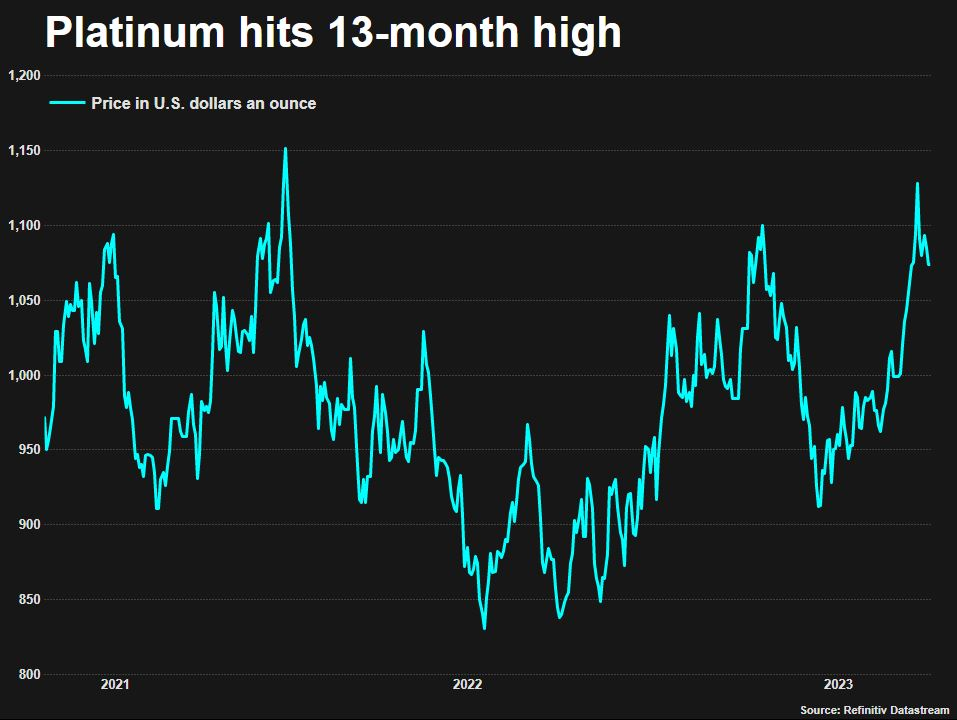
Platinum is used to neutralize harmful engine emissions, as well as in other industries and jewellery. Prices leaped from just above $900 an ounce in late February to $1,132.17 on April 21 — the highest in more than a year — before easing to around $1,050 by Tuesday.
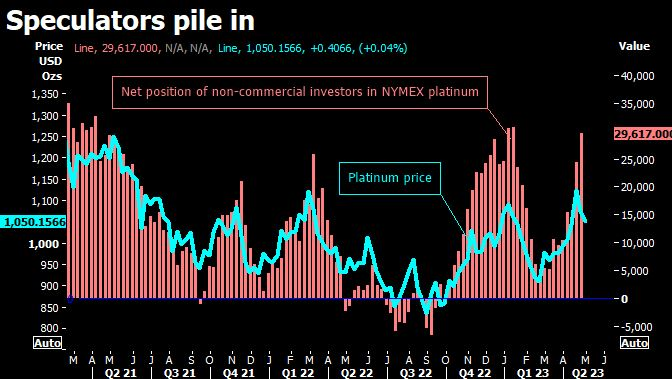
Speculative investors have expanded their net long position in NYMEX platinum futures to 1.5 million ounces from 145,000 ounces in late February, exchange data show.
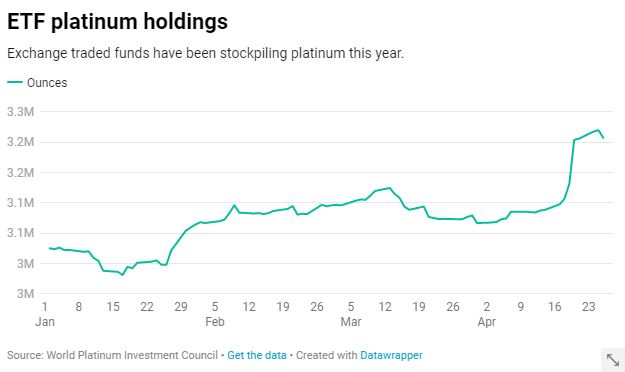
Exchange traded funds (ETFs) storing platinum for their shareholders meanwhile bought around 120,000 ounces in just a few days in late April, according to the World Platinum Investment Council (WPIC), which tracks funds.
Charting platinum prices and the net speculative position in NYMEX platinumExchange traded funds have increased their holdings of platinum
“We think this is the first year of serial deficits in the platinum market,” said Standard Chartered analyst Suki Cooper.
However, Cooper said prices could weaken in the short term before supply risks worsen later in the year.
South Africa produces 70-75% of mined platinum supply. Miners there have said rolling power cuts could cut their output by 5-15% this year, Cooper said, adding that Russian production may also disappoint.
“We’re now entering the winter period in South Africa and getting more frequent alerts on power outages,” she said. “The market is concerned.”
Demand from the auto industry — the biggest consumer of platinum — should rise by 8% this year as vehicle production increases, said StoneX analyst Rhona O’Connell.
O’Connell forecasts a 900,000 ounce deficit in the roughly 8 million ounce a year platinum market this year. The WPIC predicts a shortfall of around 500,000 ounces.
Investors also hope that large amounts of platinum will be used in the production and use of hydrogen.
But analysts at Macquarie said this could take years. “In our base case, the sector (across fuel cells and PEM electrolysers) would account for around 220,000 of demand in 2030 but be approaching 2 million ounces by 2040,” they wrote in a note.
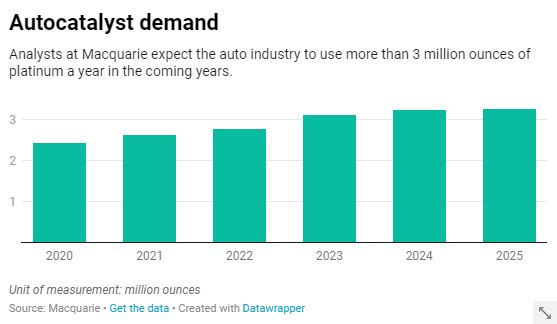
Analysts at Macquarie expect the auto industry to use more than 3 million ounces of platinum a year in the coming years.
Company invites individual and institutional investors, as well as advisors and analysts, to attend in person or online at VirtualInvestorConferences.com
VANCOUVER, British Columbia, May 02, 2023 (GLOBE NEWSWIRE) — Dolly Varden Silver Corporation (TSXV: DV) (OTC: DOLLF), based in Vancouver, BC., focused on silver and gold exploration, today announced that Shawn Khunkhun, CEO & Director, will present live at the Metals and Mining Hybrid Virtual Investor Conference, hosted by VirtualInvestorConferences.com, on May 11th, 2023.
DATE: May 11th TIME: 10:00am EST LINK:https://bit.ly/433RPaN Available for 1×1 meetings: May 11th, 2023.
This will be a live, interactive in-person and online event where investors are invited to ask the company questions in real-time. If attendees are not able to join the event live on the day of the conference, an archived webcast will also be made available after the event. If you would like to attend the conference in-person at OTC Markets New York office, please contact events@otcmarkets.com
It is recommended that online investors pre-register and run the online system check to expedite participation and receive event updates.
Dolly Varden Silver Corporation is a mineral exploration company focused on advancing its 100% held Kitsault Valley Project (which combines the Dolly Varden Project and the Homestake Ridge Project) located in the Golden Triangle of British Columbia, Canada, 25kms by road to tide water. The 163 sq. km. project hosts the high-grade silver and gold resources of Dolly Varden and Homestake Ridge along with the past producing Dolly Varden and Torbrit silver mines. It is considered to be prospective for hosting further precious metal deposits, being on the same structural and stratigraphic belts that host numerous other, on-trend, high-grade deposits, such as Eskay Creek and Brucejack. The Kitsault Valley Project also contains the Big Bulk property which is prospective for porphyry and skarn style copper and gold mineralization, similar to other such deposits in the region (Red Mountain, KSM, Red Chris).
About Virtual Investor Conferences®
Virtual Investor Conferences (VIC) is the leading proprietary investor conference series that provides an interactive forum for publicly traded companies to seamlessly present directly to investors.
Providing a real-time investor engagement solution, VIC is specifically designed to offer companies more efficient investor access. Replicating the components of an on-site investor conference, VIC offers companies enhanced capabilities to connect with investors, schedule targeted one-on-one meetings and enhance their presentations with dynamic video content. Accelerating the next level of investor engagement, Virtual Investor Conferences delivers leading investor communications to a global network of retail and institutional investors.
CONTACTS:
Dolly Varden Silver Corporation Shawn Khunkhun President & CEO +1 604 609 5137 sk@dollyvardensilver.com
Virtual Investor Conferences John M. Viglotti SVP Corporate Services, Investor Access OTC Markets Group (212) 220-2221 johnv@otcmarkets.com
Vancouver, British Columbia, May 2, 2023 (NYSE American: EMX; TSX Venture: EMX; Frankfurt: 6E9) – EMX Royalty Corporation (the “Company” or “EMX”) is pleased to announce the execution of an exploration and option agreement for EMX’s Yarrol and Mt Steadman Projects in Queensland, Australia (the “Projects”) to Many Peaks Gold (ASX:”MPG”). The agreement provides EMX with cash payments, additional equity interests in MPG and work commitments during a fifteen month option period. Upon exercise of the option EMX will receive additional payments of cash and shares of MPG along with annual advance royalty payments, royalty interests and other considerations.
The Yarrol Project contains zones of gold and copper mineralization in addition to newly discovered areas with cobalt-enriched manganese oxide mineralization and heavy mineral sands deposits (see Figures 1 and 2). The Mount Steadman Project contained historically defined zones of gold mineralization in addition to areas of historic gold mining activities (see Figures 1 and 3). Both projects were acquired by EMX as part of recent regional assessments of prospectivity in eastern Australia via purchase agreements with third parties, and then greatly expanded by EMX via filing of exploration license applications.
MPG is currently an EMX partner on the Company’s nearby Queensland Gold project. Together with the Queensland Gold project, the addition of Yarrol and Mt Steadman to MPG’s portfolio builds a substantial property package with a diverse suite of mineral deposits and occurrences in central Queensland.
Commercial Terms Overview: All terms in US Dollars unless otherwise indicated. Upon execution, MPG will make a cash payment of $150,000, issue 850,000 shares of MPG stock to EMX and 1,000,000 stock options, with each option being exercisable for one share of MPG at a price of AUD $0.34 for 36 months.
Neither the TSX Venture Exchange nor its Regulation Services Provider (as that term is defined in policies of the TSX Venture Exchange) accepts responsibility for the adequacy or accuracy of this release.
Forward-Looking Statements
This news release may contain “forward looking statements” that reflect the Company’s current expectations and projections about its future results. These forward-looking statements may include statements regarding perceived merit of properties, exploration results and budgets, mineral reserve and resource estimates, work programs, capital expenditures, timelines, strategic plans, market prices for precious and base metal, or other statements that are not statements of fact. When used in this news release, words such as “estimate,” “intend,” “expect,” “anticipate,” “will”, “believe”, “potential” and similar expressions are intended to identify forward-looking statements, which, by their very nature, are not guarantees of the Company’s future operational or financial performance, and are subject to risks and uncertainties and other factors that could cause the Company’s actual results, performance, prospects or opportunities to differ materially from those expressed in, or implied by, these forward-looking statements. These risks, uncertainties and factors may include, but are not limited to: unavailability of financing, failure to identify commercially viable mineral reserves, fluctuations in the market valuation for commodities, difficulties in obtaining required approvals for the development of a mineral project, increased regulatory compliance costs, expectations of project funding by joint venture partners and other factors.
Readers are cautioned not to place undue reliance on these forward-looking statements, which speak only as of the date of this news release or as of the date otherwise specifically indicated herein. Due to risks and uncertainties, including the risks and uncertainties identified in this news release, and other risk factors and forward-looking statements listed in the Company’s MD&A for the quarter ended December 31, 2022 (the “MD&A”), and the most recently filed Revised Annual Information Form (the “AIF”) for the year ended December 31, 2022, actual events may differ materially from current expectations. More information about the Company, including the MD&A, the AIF and financial statements of the Company, is available on SEDAR at www.sedar.com and on the SEC’s EDGAR website at www.sec.gov.
Figure 1. Location map for the Yarrol and Mt Steadman projects
Figure 2. Geological Map and Drill Hole Locations at Yarrol
Figure 3. Gold mineralization, historic soil anomalies and mine workings in the Chowey Goldfield, Mt Steadman Project
Historic soils results were collected by Probe Resources in 1995 and additional soils were collected by MGT Mining in 2019 to refine the anomaly.[6]
[6] Soil results are reported in MGT Mining Annual Report EPM 12834 for reporting period ending in December 2019. EMX has not performed sufficient work to verify the published assay data, and these data should not be relied upon until they can be confirmed. However, EMX considers the results to be reliable and relevant.
Burlington, Ontario–(Newsfile Corp. – April 27, 2023) – Silver Bullet Mines Corp. (TSXV: SBMI) (OTCQB: SBMCF) (‘SBMI’ or ‘the Company’) is pleased to provide an update on its first order for its silver products from a third-party (the “Purchaser”).
The first order, announced in detail on April 17, 2023, and the attendant USD$225,000 cash advance from the Purchaser empowers SBMI to fund the cost of processing the mineralized material from the Buckeye Mine without dilution to the shareholders. The Purchaser advises it carried out a detailed analysis of the silver dore bar sent earlier and advises it believes there are no material impurities in that bar. If the bar is representative of the silver to be delivered, SBMI would incur a minimal discount to spot prices and there would be no reduction in the amount payable to SBMI due to deleterious metals.
The current order is for 500 kg (17,600 ounces), and the Purchaser has indicated it intends to order that same amount per month for the foreseeable future. Each such monthly order would represent roughly USD$400,000 in revenue to SBMI at current spot price for silver.
The Debenture referred to in the April 17, 2023 press release would bear interest at the rate of 2% per month on the outstanding principal for one month, which interest begins to accrue after 30 days. If the conversion feature of the Debenture is triggered, the conversion price would be $0.22 per share.
There are approximately 2500 tons of mineralized material on surface at the Buckeye Mine site to be shipped to the mill on an as needed basis. Mining is ongoing. As per SBMI’s January 16, 2023 press release, SBMI is drifting along the vein to an area believed to contain higher grade mineralization (see page 8 of the Geologic Report dated January 8, 2021). At the current rate of mining that zone should be intercepted in approximately 4 weeks, although that timing may vary subject to the usual risks attendant on mining.
SBMI anticipates starting to process the current order this week by processing the material on hand at the mill/mine site, which has earlier returned high grades (see March 3, 2023 press release). Management believes the mill is operating at optimum efficiency.
Peter M. Clausi Silver Bullet Mines Corp., VP Capital Markets pclausi@brantcapital.ca +1 (416) 890-1232
Cautionary and Forward-Looking Statements
This news release contains certain statements that constitute forward-looking statements as they relate to SBMI and its subsidiaries. Forward-looking statements are not historical facts but represent management’s current expectation of future events, and can be identified by words such as “believe”, “expects”, “will”, “intends”, “plans”, “projects”, “anticipates”, “estimates”, “continues” and similar expressions. Although management believes that the expectations represented in such forward-looking statements are reasonable, there can be no assurance that they will prove to be correct.
By their nature, forward-looking statements include assumptions, and are subject to inherent risks and uncertainties that could cause actual future results, conditions, actions or events to differ materially from those in the forward-looking statements. If and when forward-looking statements are set out in this new release, SBMI will also set out the material risk factors or assumptions used to develop the forward-looking statements. Except as expressly required by applicable securities laws, SBMI assumes no obligation to update or revise any forward-looking statements. The future outcomes that relate to forward-looking statements may be influenced by many factors, including but not limited to: the impact of SARS CoV-2 or any other global virus; reliance on key personnel; the thoroughness of its QA/QA procedures; the continuity of the global supply chain for materials for SBMI to use in the production and processing of mineralized material; the presence of mineable economic mineralized material; shareholder and regulatory approvals; activities and attitudes of communities local to the location of the SBMI’s properties; risks of future legal proceedings; income tax matters; fires, floods and other natural phenomena; the rate of inflation; availability and terms of financing; distribution of securities; commodities pricing; currency movements, especially as between the USD and CDN; effect of market interest rates on price of securities; and, potential dilution. SARS CoV-2 and other potential global pathogens create risks that at this time are immeasurable and impossible to define.
The Best Video on Why and When to Buy and Sell Physical Precious Metals:
I’m a licensed broker for Miles Franklin Precious Metals Investments, The Only Online Dealer that is Licensed and Bonded Period! Where we provide unlimited options to expand your precious metals portfolio, from:
North Vancouver, British Columbia–(Newsfile Corp. – April 25, 2023) – Lion One Metals Limited (TSXV: LIO) (OTCQX: LOMLF) (ASX: LLO) (“Lion One” or the “Company”) reports significant new high-grade results from grade control drilling at the Company’s 100% owned Tuvatu Alkaline Gold Project in Fiji.
Following on the initial mining and extraction of the URA1 lode, the Company is here reporting new high-grade results from grade control drilling on the URW1 lode system, approximately 120m further east. Mining of URW1 is expected to begin over the next 2-4 weeks. Strike drive development on URW1 has commenced.
Highlights of new high-grade gold mineralization intersected by grade control drilling:
Multiple bonanza grade zones have been intersected including:
88.07g/t Au over 5.7m (including 1,396g/t Au over 0.3m) (TGC-0034)
27.52g/t Au over 5.55m (TUG-056)
20.93g/t Au over 7.2m (TGC-0003)
16.12g/t Au over 9.3m (TGC-0014)
16.48g/t Au over 9.6m (TGC-0002)
14.6g/t Au over 6.6m (TGC-0032)
14.97g/t Au over 5.4m (TGC-0018)
10.85g/t Au over 6.9m (TGC-0013)
Visible was gold observed in several drill holes.
Figure 1. Plan map showing the locations of the URA1 and URW1 lodes (in red) relative to the main Tuvatu decline. The gray outlines indicate planned development to reach the URW1 lodes.
Close spaced grade control drilling has resulted in much higher resolution of the lode arrays as compared to previous infill drilling, including the identification of bonanza grade (>50g/t Au) zones.
The tightened drill pattern will facilitate optimised development and extraction of high-grade gold mineralization from the URW1 lodes while minimizing dilution. High-grade gold mineralization extracted from the URW1 lode system will contribute significantly to the growing high-grade stockpile constituting the initial feed for the Company’s plant and processing facility, on schedule for start-up in Q4 2023.
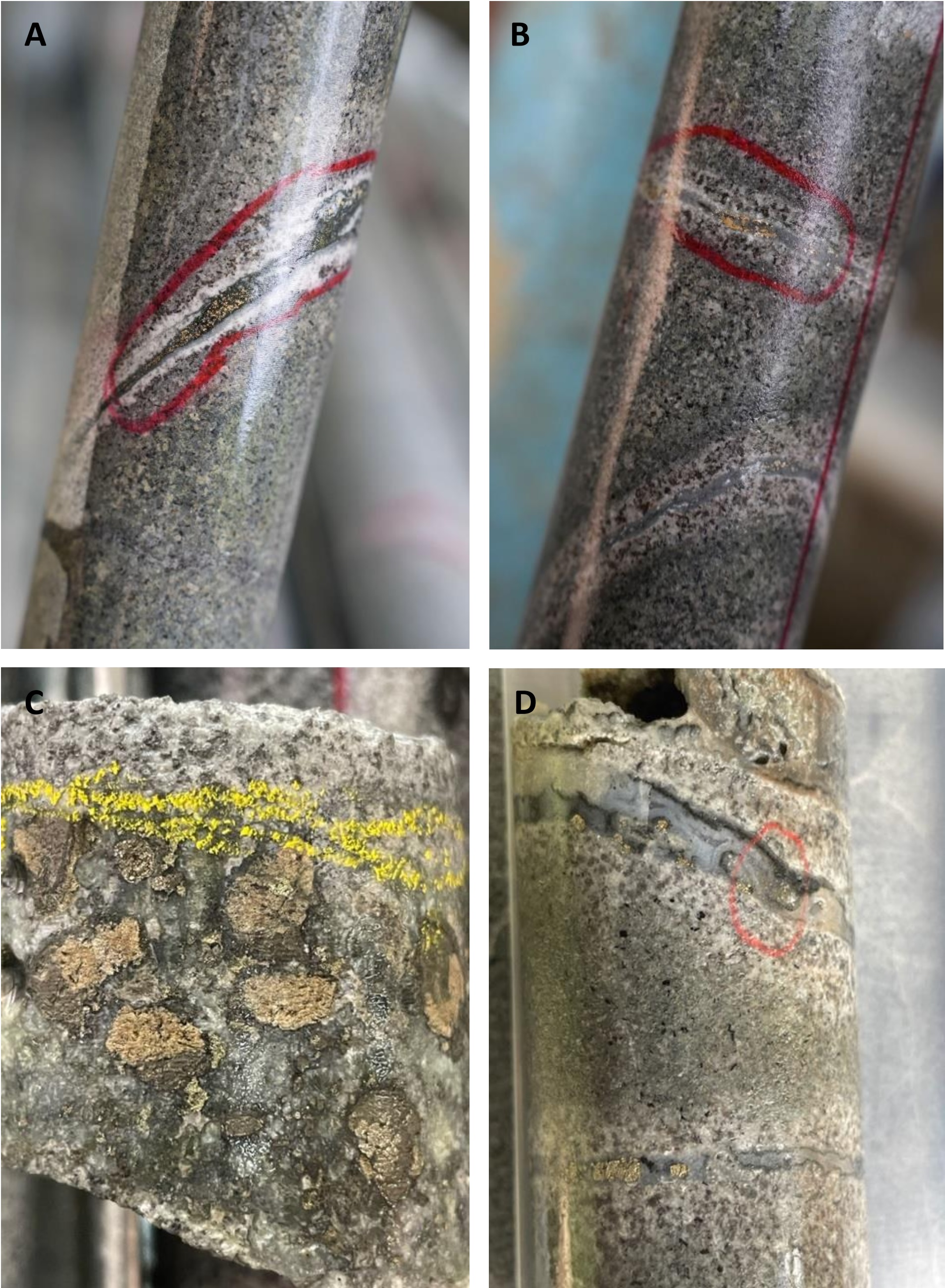
Mineralization Mineralization consists of abundant free gold, typically in association with light to dark gray chalcedonic quartz and roscoelite, locally accompanied by minor amounts of pyrite, sphalerite, galena and lesser chalcopyrite (Figure 3).
Figure 2. Long section view west of grade control drilling at URW1. Intersections >5m and 10g/t Au highlighted in red.
Figure 3. A) Coarse disseminated gold in a quartz-roscoelite veinlet, TGC-0034 67.5m. Sample returned 1396.3 g/t Au over 0.3m. B) Coarse gold in gray quartz veinlet, TGC-0034 81.6m. Sample returned 166.2 g/t Au over 0.9m. C) Coarse honey sphalerite rimmed by dark pyrite in variable light to dark gray quartz vein, TGC-0032 71.0m. Sample returned 112.9 g/t Au over 0.3m. D) Banded chalcedonic quartz-roscoelite-pyrite-fine native gold, TGC-0002 77.4m. Sample returned 44.3 g/t Au over 0.3m.
URW1 Lode System The URW1 lode system consists of narrow, high-grade to locally bonanza-grade vein arrays and vein swarms that strike approximately N-S and dip sub-vertically to steeply east and is located approximately 120m east of the URA1 lode (Figure 1, 2, 4).
As currently modelled based on earlier drilling, the URW1 lode measures approximately 300m in the NS-direction by approximately 300m of vertical extent, thus forming one of the major N-S trending lodes that have been recognized in this part of the Tuvatu deposit. The URW1 lode intersects with numerous flat-lying to moderately south-dipping EW veins referred to as the Murau lode system (Figure 4).
Grade control drilling has been conducted from both the new decline and the historic exploration adit (Figures 1 & 2). This drilling is targeting a 60m strike section of the URW1 system, within the >300m strike of the overall URW1 system. Detailed drilling of this nature is the first conducted at the project and has served to confirm both the location of structures and the extent of some of the higher-grade zones within the overall mineralized envelope. These bonanza zones (>50g/t Au * true width) have been intersected that show a considerably higher-grade than the previous wide-spaced resource drilling in the area. The high-grade zones are interpreted to relate to the intersection of the N-S URW1 lode with E-W striking structures such as the Murau lodes.
Figure 4. Plan view of 3D models illustrating the earlier interpretation of the URA1 and URW1 lodes (blue). The lighter pink shapes are the flat-lying stacked Murau lodes (left) and SKL lodes (right). Underground development is shown in red.
The URW1 lode system is interpreted as a series of parallel vein arrays.
This interpretation has come by way of a series of closely spaced grade control drill holes, drilled from two separate locations, east-directed drilling from the main decline, as well as west-directed drilling from the exploration decline (Figure 1). To date, a total of 34 diamond drill holes totalling approximately 3538m have been completed resulting in 5m to 10m spacing between adjacent holes covering a limited extent of the URW1 lode system. Despite the relatively limited size of the area drilled thus far, the grade control program has significantly increased the level of confidence in the geometry, widths, and grade distribution of the URW1 lodes, thereby allowing for detailed development planning.
Composited assay results for mineralized intervals interpreted as URW1 lodes in holes completed to date are presented in Table 1, with Tables 2 and 3 in the appendix containing full drill hole details. The URW1 lode system represents the next main area of mining and extraction of high-grade mineralization at Tuvatu. Development has commenced with first grade control and mapping expected shortly.
Table 1. Summary of composited drill results intersecting mineralization from the area of URW1 in this release. (TGC = new grade control drilling ordered by strongest intersections; TUDDH and TUG indicates previous exploration drilling (surface and underground) targeting this zone). For full results refer Table 2 in the appendix.
Hole ID
Grade (g/t Au)
Drill intersection width (m)
True Width (m)
TGC-0034
88.07
5.7
5.1
TUG-056
27.52
5.55
5.5
TGC-0003
20.93
7.2
6.5
TGC-0014
16.12
9.3
8.4
TGC-0002
16.48
9.6
8.2
TUG-058
100.21
0.85
0.85
TGC-0032
14.6
6.6
5.3
TGC-0018
14.97
5.4
4.9
TGC-0013
10.85
6.9
6.2
TGC-0011
11.04
5.4
4.6
TGC-0035
6.6
6.55
6.2
TGC-0019
11.57
3.6
3.4
TGC-0028
11.52
4.8
3.4
TGC-0031
8.86
5.1
4.1
TUDDH-350
21.11
2.7
1.7
TUDDH-349
14.37
9.73
2.4
TGC-0016
4.35
8.1
7.7
TUDDH-409
7.83
6.77
4.1
TGC-0005
10.14
3
2.4
TUDDH-219
8.33
14.15
2.9
TGC-0008
10.29
3
2.3
TUG-057
17.7
1.2
1.1
TURC-167
8.88
3
1.8
TGC-0009
4.58
3.6
3.2
TGC-0017
2.22
6.9
6.2
TGC-0036
5.16
3
2.3
TGC-0025
5.04
3
2.3
TGC-0029
1.6
3.3
2.6
TGC-0030
3.22
1.5
1.2
TGC-0015
2.39
1.8
1.4
TUDDH-225
0.73
0.9
0.9
TUG-123
0.32
0.95
0.8
TUDDH-075
0.84
0.35
0.25
TUG-125
0.2
0.54
0.3
About Tuvatu
The Tuvatu Alkaline Gold Project is located on the island of Viti Levu in Fiji. The January 2018 mineral resource for Tuvatu as disclosed in the technical report “Technical Report and Preliminary Economic Assessment for the Tuvatu Gold Project, Republic of Fiji”, dated September 25, 2020, and prepared by Mining Associates Pty Ltd of Brisbane Qld, comprises 1,007,000 tonnes indicated at 8.50 g/t Au (274,600 oz. Au) and 1,325,000 tonnes inferred at 9.0 g/t Au (384,000 oz. Au) at a cut-off grade of 3.0 g/t Au. The technical report is available on the Lion One website at www.liononemetals.com and on the SEDAR website at www.sedar.com.
Qualified Person In accordance with National Instrument 43-101 – Standards of Disclosure for Mineral Projects (“NI 43- 101”), Sergio Cattalani, P.Geo, Senior Vice President Exploration, is the Qualified Person for the Company and has reviewed and is responsible for the technical and scientific content of this news release.
QAQC Procedures Lion One adheres to rigorous QAQC procedures above and beyond basic regulatory guidelines in conducting its sampling, drilling, testing, and analyses. The Company utilizes its own fleet of diamond drill rigs, using PQ, HQ and NQ sized drill core rods. Drill core is logged and split by Lion One personnel on site. Samples are delivered to and analyzed at the Company’s geochemical and metallurgical laboratory in Fiji. Duplicates of all samples with grades above 0.5 g/t Au are both re-assayed at Lion One’s lab and delivered to ALS Global Laboratories in Australia (ALS) for check assay determinations. All samples for all high-grade intercepts are sent to ALS for check assays. All samples are pulverized to 85% passing through 75 microns. Gold analysis is carried out using fire assay with an AA finish. Samples that have returned grades greater than 10.00 g/t Au are then re-analyzed by gravimetric method. For samples that return greater than 0.50 g/t Au, repeat fire assay runs are carried out and repeated until a result is obtained that is within 10% of the original fire assay run. Lion One’s laboratory can also assay for a range of 71 other elements through Inductively Coupled Plasma Optical Emission Spectrometry (ICP-OES), but currently focuses on a suite of 9 important pathfinder elements. All duplicate anomalous samples are sent to ALS labs in Townsville QLD and are analyzed by the same methods (Au-AA26, and Au-GRA22 where applicable). ALS also analyses 33 pathfinder elements by HF-HNO3-HClO4 acid digestion, HCl leach and ICP-AES (method ME-ICP61).
About Lion One Metals Limited Lion One’s flagship asset is 100% owned, fully permitted high grade Tuvatu Alkaline Gold Project, located on the island of Viti Levu in Fiji. Lion One envisions a low-cost high-grade underground gold mining operation at Tuvatu coupled with exciting exploration upside inside its tenements covering the entire Navilawa Caldera, an underexplored yet highly prospective 7km diameter alkaline gold system. Lion One’s CEO Walter Berukoff leads an experienced team of explorers and mine builders and has owned or operated over 20 mines in 7 countries. As the founder and former CEO of Miramar Mines, Northern Orion, and La Mancha Resources, Walter is credited with building over $3 billion of value for shareholders.
On behalf of the Board of Directors of Lion One Metals Limited “Walter Berukoff“, Chairman and CEO
Neither the TSX Venture Exchange nor its Regulation Service Provider accepts responsibility for the adequacy or accuracy of this release
This press release may contain statements that may be deemed to be “forward-looking statements” within the meaning of applicable Canadian securities legislation. All statements, other than statements of historical fact, included herein are forward-looking information. Generally, forward-looking information may be identified by the use of forward-looking terminology such as “plans”, “expects” or “does not expect”, “proposed”, “is expected”, “budget”, “scheduled”, “estimates”, “forecasts”, “intends”, “anticipates” or “does not anticipate”, or “believes”, or variations of such words and phrases, or by the use of words or phrases which state that certain actions, events or results may, could, would, or might occur or be achieved. This forward-looking information reflects Lion One Metals Limited’s current beliefs and is based on information currently available to Lion One Metals Limited and on assumptions Lion One Metals Limited believes are reasonable. These assumptions include, but are not limited to, the actual results of exploration projects being equivalent to or better than estimated results in technical reports, assessment reports, and other geological reports or prior exploration results. Forward-looking information is subject to known and unknown risks, uncertainties and other factors that may cause the actual results, level of activity, performance or achievements of Lion One Metals Limited or its subsidiaries to be materially different from those expressed or implied by such forward-looking information. Such risks and other factors may include, but are not limited to: the stage development of Lion One Metals Limited, general business, economic, competitive, political and social uncertainties; the actual results of current research and development or operational activities; competition; uncertainty as to patent applications and intellectual property rights; product liability and lack of insurance; delay or failure to receive board or regulatory approvals; changes in legislation, including environmental legislation, affecting mining, timing and availability of external financing on acceptable terms; not realizing on the potential benefits of technology; conclusions of economic evaluations; and lack of qualified, skilled labour or loss of key individuals. Although Lion One Metals Limited has attempted to identify important factors that could cause actual results to differ materially from those contained in forward-looking information, there may be other factors that cause results not to be as anticipated, estimated or intended. Accordingly, readers should not place undue reliance on forward-looking information. Lion One Metals Limited does not undertake to update any forward-looking information, except in accordance with applicable securities laws.
Appendix 1: full drill results and drill details
Table 2. Composited results from grade control drillholes targeting the URW1 lodes
Hole ID
From (m)
To (m)
Interval (m)
Au (g/t)
TGC-0001
33.0
33.9
0.9
0.64
TGC-0002
77.1
77.4
0.3
44.25
TGC-0002
80.1
84.9
4.8
8.03
TGC-0002
including
80.1
82.2
2.1
11.60
TGC-0002
which includes
81.6
81.9
0.3
72.20
TGC-0002
and including
83.1
84.9
1.8
7.86
TGC-0002
89.4
97.5
8.1
13.07
TGC-0002
including
89.4
91.2
1.8
4.68
TGC-0002
including
92.1
97.5
5.4
17.97
TGC-0002
which includes
93.6
93.9
0.3
41.54
TGC-0002
and
93.9
94.2
0.3
45.40
TGC-0002
and
94.2
94.5
0.3
74.38
TGC-0002
and
94.5
94.8
0.3
38.43
TGC-0002
and
94.8
95.1
0.3
56.89
TGC-0002
100.2
103.8
3.6
7.93
TGC-0002
108.3
111.9
3.6
10.09
TGC-0002
including
108.3
109.2
0.9
4.05
TGC-0002
including
110.1
111.9
1.8
18.15
TGC-0002
which includes
111.0
111.3
0.3
77.72
TGC-0002
113.7
114.6
0.9
17.11
TGC-0003
52.5
53.4
0.9
2.79
TGC-0003
77.4
80.4
3.0
3.84
TGC-0003
including
77.4
77.7
0.3
5.34
TGC-0003
and
78.6
78.9
0.3
4.40
TGC-0003
and
79.2
79.5
0.3
27.18
TGC-0003
89.7
95.7
6.0
9.57
TGC-0003
including
89.7
93.3
3.6
14.63
TGC-0003
which includes
90.6
91.2
0.6
81.18
TGC-0003
98.0
99.2
1.2
0.95
TGC-0003
102.2
110.6
8.4
5.73
TGC-0003
including
102.2
107.0
4.8
7.97
TGC-0003
which includes
105.8
106.1
0.3
35.58
TGC-0003
and includes
107.3
108.5
1.2
6.84
TGC-0003
112.4
112.7
0.3
1.15
TGC-0003
115.1
116.0
0.9
59.85
TGC-0004
3.4
4.3
0.9
2.93
TGC-0005
75.3
75.9
0.6
2.11
TGC-0005
91.5
99.0
7.5
2.77
TGC-0005
including
93.3
94.2
0.9
10.67
TGC-0005
102.6
102.9
0.3
2.10
TGC-0005
104.1
104.7
0.6
21.01
TGC-0005
107.1
108.0
0.9
1.65
TGC-0005
109.8
110.4
0.6
0.78
TGC-0005
120.0
122.1
2.1
2.51
TGC-0005
including
121.8
122.1
0.3
14.83
TGC-0007
28.2
28.5
0.3
1.31
TGC-0008
74.8
76.9
2.1
10.51
TGC-0008
82.3
82.9
0.6
25.57
TGC-0008
94.0
94.3
0.3
4.20
TGC-0008
96.4
101.2
4.8
3.77
TGC-0008
including
96.4
98.5
2.1
3.73
TGC-0008
and
99.1
101.2
2.1
4.78
TGC-0008
105.1
105.7
0.6
2.78
TGC-0008
108.7
109.3
0.6
1.05
TGC-0008
110.8
111.4
0.6
2.16
TGC-0008
122.5
123.1
0.6
61.39
TGC-0009
18.6
21.3
2.7
0.91
TGC-0009
28.5
29.1
0.6
1.61
TGC-0009
30.9
31.5
0.6
8.33
TGC-0009
32.7
34.2
1.5
33.38
TGC-0009
49.5
49.8
0.3
10.54
TGC-0009
53.4
56.4
3.0
1.07
TGC-0009
61.2
61.5
0.3
1.97
TGC-0009
65.4
65.7
0.3
3.06
TGC-0009
66.9
67.8
0.9
6.10
TGC-0009
69.0
75.0
6.0
5.01
TGC-0009
including
69.6
70.2
0.6
4.66
TGC-0009
and
70.5
72.3
1.8
6.62
TGC-0009
and
72.9
73.5
0.6
6.80
TGC-0009
and
73.8
75.0
1.2
8.78
TGC-0009
76.5
78.0
1.5
0.97
TGC-0010
17.1
18.9
1.8
6.52
TGC-0010
including
17.1
17.4
0.3
37.04
TGC-0010
20.1
21.0
0.9
2.54
TGC-0010
23.4
30.3
6.9
2.67
TGC-0010
including
24.9
27.6
2.7
4.71
TGC-0010
36.0
36.9
0.9
8.92
TGC-0011
19.0
19.3
0.3
0.89
TGC-0011
22.3
23.8
1.5
7.56
TGC-0011
27.1
29.3
2.2
2.49
TGC-0011
including
27.1
28.0
0.9
5.34
TGC-0011
31.1
31.4
0.3
1.26
TGC-0011
32.6
35.3
2.7
7.64
TGC-0011
including
32.6
34.1
1.5
11.33
TGC-0011
and
34.4
35.3
0.9
4.04
TGC-0011
40.4
40.7
0.3
1.22
TGC-0011
52.7
53.3
0.6
1.91
TGC-0011
54.8
56.9
2.1
2.18
TGC-0011
58.7
59.9
1.2
2.62
TGC-0011
including
59.3
59.9
0.6
4.09
TGC-0011
63.2
66.5
3.3
2.68
TGC-0011
including
64.1
66.5
2.4
3.58
TGC-0011
68.6
75.8
7.2
6.72
TGC-0011
including
68.6
69.2
0.6
19.95
TGC-0011
which includes
68.9
69.2
0.3
37.28
TGC-0011
and
69.5
73.4
3.9
8.84
TGC-0011
which includes
71.0
71.3
0.3
59.70
TGC-0012
79.5
81.9
2.4
7.86
TGC-0012
including
79.5
79.8
0.3
59.46
TGC-0012
85.2
85.5
0.3
2.79
TGC-0012
87.3
88.5
1.2
5.11
TGC-0012
92.1
92.4
0.3
2.47
TGC-0012
98.4
99.6
1.2
1.32
TGC-0012
102.3
104.1
1.8
0.63
TGC-0012
105.9
106.2
0.3
4.67
TGC-0013
19.2
19.5
0.3
1.55
TGC-0013
23.1
23.7
0.6
1.28
TGC-0013
32.4
34.5
2.1
3.36
TGC-0013
including
32.4
33.0
0.6
6.97
TGC-0013
and
33.9
34.5
0.6
4.67
TGC-0013
42.9
43.5
0.6
1.16
TGC-0013
47.1
47.7
0.6
0.80
TGC-0013
50.4
51.3
0.9
13.58
TGC-0013
55.6
56.2
0.6
1.37
TGC-0013
67.6
70.3
2.7
5.70
TGC-0013
72.7
73.6
0.9
4.09
TGC-0013
75.1
79.3
4.2
11.03
TGC-0013
including
75.1
76.6
1.5
4.86
TGC-0013
and
77.2
78.1
0.9
8.51
TGC-0013
and
78.4
79.3
0.9
34.87
TGC-0013
which includes
78.7
79.3
0.6
49.52
TGC-0013
81.1
83.8
2.7
5.97
TGC-0013
94.3
97.6
3.3
1.21
TGC-0014
10.8
11.1
0.3
1.21
TGC-0014
19.2
19.5
0.3
1.03
TGC-0014
34.5
36.3
1.8
2.47
TGC-0014
including
34.5
35.4
0.9
3.38
TGC-0014
and
36.0
36.3
0.3
4.72
TGC-0014
42.6
42.9
0.3
3.21
TGC-0014
52.2
53.1
0.9
0.57
TGC-0014
56.1
56.4
0.3
1.69
TGC-0014
66.0
75.6
9.6
13.28
TGC-0014
including
66.0
66.9
0.9
54.81
TGC-0014
which includes
66.3
66.6
0.3
95.47
TGC-0014
and
66.6
66.9
0.3
67.96
TGC-0014
and
67.5
69.0
1.5
7.83
TGC-0014
and
69.3
72.6
3.3
9.89
TGC-0014
and
72.9
73.2
0.3
3.32
TGC-0014
and
74.1
75.0
0.9
32.29
TGC-0014
which includes
74.4
74.7
0.3
57.95
TGC-0014
and
74.7
75.0
0.3
38.34
TGC-0014
and
75.3
75.6
0.3
9.41
TGC-0014
80.7
84.6
3.9
7.69
TGC-0014
85.8
88.8
3.0
1.86
TGC-0014
92.4
95.1
2.7
1.10
TGC-0015
71.1
71.4
0.3
0.54
TGC-0015
87.3
87.9
0.6
2.17
TGC-0015
105.6
106.2
0.6
2.50
TGC-0016
38.7
43.5
4.8
6.22
TGC-0016
including
38.7
41.4
2.7
9.67
TGC-0016
which includes
40.8
41.1
0.3
45.75
TGC-0016
68.1
68.7
0.6
2.16
TGC-0016
70.8
71.4
0.6
2.55
TGC-0016
72.6
73.5
0.9
6.50
TGC-0016
81.0
83.4
2.4
14.23
TGC-0016
including
81.0
81.6
0.6
19.42
TGC-0016
and
81.9
83.4
1.5
14.99
TGC-0016
which includes
83.1
83.4
0.3
45.51
TGC-0016
84.6
85.5
0.9
1.86
TGC-0016
92.4
94.5
2.1
4.83
TGC-0016
95.7
97.8
2.1
3.58
TGC-0017
5.1
5.7
0.6
1.28
TGC-0017
17.4
17.7
0.3
4.32
TGC-0017
36.0
36.6
0.6
1.26
TGC-0017
38.7
44.1
5.4
9.39
TGC-0017
69.3
69.9
0.6
9.60
TGC-0017
72.3
73.8
1.5
3.03
TGC-0017
including
73.2
73.8
0.6
7.01
TGC-0017
76.8
77.4
0.6
65.63
TGC-0017
82.5
84.0
1.5
3.08
TGC-0018
78.9
79.5
0.6
0.92
TGC-0018
85.8
86.1
0.3
11.42
TGC-0018
88.5
90.6
2.1
5.67
TGC-0018
94.2
95.1
0.9
0.54
TGC-0018
96.3
97.2
0.9
0.63
TGC-0018
102.0
105.9
3.9
15.62
TGC-0018
109.2
111.0
1.8
2.74
TGC-0019
10.8
12.0
1.2
0.86
TGC-0019
13.8
16.5
2.7
2.31
TGC-0019
31.2
32.7
1.5
3.21
TGC-0019
40.2
45.0
4.8
16.05
TGC-0019
including
41.4
45.0
3.6
21.18
TGC-0019
which includes
42.6
42.9
0.3
49.70
TGC-0019
and
43.2
43.5
0.3
166.81
TGC-0019
51.0
52.2
1.2
2.60
TGC-0019
65.1
66.3
1.2
0.85
TGC-0019
70.5
79.8
9.3
4.92
TGC-0019
including
70.5
75.0
4.5
6.70
TGC-0019
and
75.3
76.5
1.2
7.69
TGC-0019
83.7
84.0
0.3
15.22
TGC-0019
95.7
96.9
1.2
9.13
TGC-0020
16.8
18.3
1.5
3.09
TGC-0020
24.3
26.4
2.1
0.92
TGC-0020
28.2
29.7
1.5
4.10
TGC-0021
4.4
5.0
0.6
1.40
TGC-0021
24.5
26.9
2.4
2.86
TGC-0021
including
24.5
25.4
0.9
6.34
TGC-0021
44.3
44.9
0.6
1.36
TGC-0021
74.0
74.3
0.3
0.65
TGC-0022
28.2
29.4
1.2
1.36
TGC-0022
54.6
54.9
0.3
1.04
TGC-0022
57.9
58.8
0.9
1.22
TGC-0022
66.9
70.5
3.6
2.31
TGC-0022
75.0
75.6
0.6
2.23
TGC-0023
90.2
90.8
0.6
1.71
TGC-0023
100.7
101.3
0.6
0.63
TGC-0024
13.8
14.4
0.6
0.50
TGC-0024
58.8
59.7
0.9
1.30
TGC-0024
65.4
65.7
0.3
0.54
TGC-0025
7.5
9.3
1.8
2.79
TGC-0025
including
7.5
8.4
0.9
5.22
TGC-0025
13.5
14.1
0.6
4.33
TGC-0025
15.6
16.5
0.9
0.68
TGC-0025
78.6
83.1
4.5
3.76
TGC-0025
including
78.6
79.2
0.6
4.69
TGC-0025
and
79.5
80.7
1.2
3.07
TGC-0025
and
81.0
83.1
2.1
4.91
TGC-0025
84.6
84.9
0.3
1.77
TGC-0025
87.0
87.3
0.3
6.55
TGC-0026
14.7
15.3
0.6
0.58
TGC-0026
28.8
29.7
0.9
2.28
TGC-0026
33.9
34.8
0.9
5.94
TGC-0026
39.9
40.8
0.9
10.20
TGC-0026
42.3
42.9
0.6
3.72
TGC-0026
71.7
72.0
0.3
0.65
TGC-0027
70.2
70.8
0.6
2.41
TGC-0027
80.7
82.2
1.5
3.75
TGC-0027
87.9
88.5
0.6
1.72
TGC-0027
93.6
94.2
0.6
2.46
TGC-0027
96.6
99.0
2.4
0.79
TGC-0027
104.4
105.9
1.5
4.98
TGC-0027
107.7
109.8
2.1
1.99
TGC-0027
including
109.5
109.8
0.3
11.28
TGC-0027
112.8
114.0
1.2
0.63
TGC-0028
8.7
9.6
0.9
1.02
TGC-0028
13.2
16.2
3.0
11.27
TGC-0028
78.0
78.9
0.9
0.63
TGC-0028
83.4
83.7
0.3
1.17
TGC-0028
85.2
85.8
0.6
0.55
TGC-0028
92.1
97.5
5.4
10.86
TGC-0028
including
92.1
93.6
1.5
26.67
TGC-0028
which includes
92.1
92.4
0.3
45.29
TGC-0028
and
92.4
92.7
0.3
72.80
TGC-0028
and
94.5
95.7
1.2
12.97
TGC-0028
and
96.6
97.5
0.9
3.44
TGC-0028
101.1
102.6
1.5
9.53
TGC-0029
14.7
16.2
1.5
10.82
TGC-0029
74.4
75.0
0.6
4.93
TGC-0029
83.7
86.7
3.0
1.00
TGC-0029
95.7
96.9
1.2
3.14
TGC-0030
18.0
19.2
1.2
56.88
TGC-0030
22.8
25.2
2.4
4.87
TGC-0030
including
24.0
25.2
1.2
9.62
TGC-0030
51.9
52.2
0.3
1.47
TGC-0030
54.6
54.9
0.3
3.60
TGC-0030
61.2
61.5
0.3
3.75
TGC-0030
71.4
72.0
0.6
20.01
TGC-0030
83.1
84.6
1.5
3.65
TGC-0030
88.8
92.4
3.6
0.97
TGC-0030
94.2
95.4
1.2
1.40
TGC-0031
13.5
20.4
6.9
6.60
TGC-0031
including
13.5
15.3
1.8
17.28
TGC-0031
which includes
14.1
14.7
0.6
34.62
TGC-0031
and
15.6
18.3
2.7
4.76
TGC-0031
and
19.2
19.5
0.3
3.25
TGC-0031
62.0
63.8
1.8
3.21
TGC-0031
including
62.9
63.8
0.9
5.88
TGC-0031
72.5
73.4
0.9
1.27
TGC-0031
74.9
75.8
0.9
6.93
TGC-0031
77.0
77.6
0.6
3.30
TGC-0031
82.4
85.1
2.7
3.12
TGC-0031
86.9
95.6
8.7
13.73
TGC-0031
including
86.9
89.9
3.0
10.80
TGC-0031
which includes
87.2
87.5
0.3
39.53
TGC-0031
and
87.5
87.8
0.3
36.62
TGC-0031
and including
90.5
91.1
0.6
28.85
TGC-0031
and
92.0
94.7
2.7
24.94
TGC-0031
which includes
92.6
92.9
0.3
116.56
TGC-0031
and
93.8
94.1
0.3
64.28
TGC-0031
and
95.3
95.6
0.3
6.90
TGC-0032
10.2
10.8
0.6
0.68
TGC-0032
18.0
18.3
0.3
32.02
TGC-0032
22.8
23.7
0.9
20.11
TGC-0032
52.2
52.8
0.6
2.66
TGC-0032
58.2
58.5
0.3
9.18
TGC-0032
69.6
72.0
2.4
19.46
TGC-0032
76.5
80.1
3.6
4.58
TGC-0032
85.2
87.3
2.1
14.59
TGC-0032
88.5
91.5
3.0
2.80
TGC-0032
including
88.5
89.7
1.2
5.59
TGC-0032
98.4
98.7
0.3
16.30
TGC-0032
106.2
107.1
0.9
41.62
TGC-0032
108.9
109.5
0.6
4.20
TGC-0034
21.6
23.7
2.1
24.84
TGC-0034
24.0
32.1
8.1
25.96
TGC-0034
including
24.0
24.9
0.9
14.30
TGC-0034
which includes
24.0
24.3
0.3
33.61
TGC-0034
and
25.2
32.1
6.9
28.61
TGC-0034
which includes
25.2
25.8
0.6
47.66
TGC-0034
and
30.3
30.6
0.3
59.31
TGC-0034
and
30.6
31.5
0.9
118.95
TGC-0034
56.1
56.4
0.3
0.90
TGC-0034
60.3
61.2
0.9
4.33
TGC-0034
66.3
69.9
3.6
120.76
TGC-0034
including
66.3
68.1
1.8
237.52
TGC-0034
which includes
67.5
67.8
0.3
1396.31
TGC-0034
and
69.0
69.9
0.9
7.92
TGC-0034
72.6
73.2
0.6
0.61
TGC-0034
74.7
75.6
0.9
5.70
TGC-0034
80.7
83.1
2.4
22.46
TGC-0034
including
81.6
82.5
0.9
57.46
TGC-0034
which includes
81.6
81.9
0.3
166.16
TGC-0034
and
82.8
83.1
0.3
4.25
TGC-0034
86.1
90.3
4.2
3.06
TGC-0034
including
88.8
90.3
1.5
7.06
TGC-0034
91.5
91.8
0.3
1.42
TGC-0034
93.0
94.2
1.2
1.06
TGC-0034
95.4
99.9
4.5
3.10
TGC-0034
including
98.7
99.9
1.2
9.10
TGC-0035
33.0
33.6
0.6
8.28
TGC-0035
36.0
37.5
1.5
6.21
TGC-0035
39.3
40.5
1.2
10.55
TGC-0035
48.0
51.9
3.9
4.33
TGC-0035
including
50.1
51.9
1.8
8.72
TGC-0035
which includes
51.0
51.3
0.3
46.28
TGC-0035
53.7
54.3
0.6
1.71
TGC-0035
56.1
65.1
9.0
3.70
TGC-0035
including
61.5
62.1
0.6
7.65
TGC-0035
and
62.7
63.9
1.2
11.80
TGC-0035
which includes
63.0
63.3
0.3
31.89
TGC-0035
and including
64.2
65.1
0.9
11.36
TGC-0035
67.5
72.9
5.4
3.44
TGC-0035
including
69.0
72.9
3.9
4.03
TGC-0035
74.7
77.7
3.0
4.38
TGC-0035
78.9
82.5
3.6
2.54
TGC-0035
including
80.1
82.5
2.4
3.24
TGC-0035
91.5
92.7
1.2
1.16
TGC-0036
11.4
12.0
0.6
2.50
TGC-0036
18.0
19.2
1.2
4.08
TGC-0036
52.5
53.4
0.9
0.74
TGC-0036
57.3
59.7
2.4
51.58
TGC-0036
70.5
71.4
0.9
11.52
TGC-0036
86.1
88.2
2.1
2.43
TGC-0036
including
87.0
88.2
1.2
3.84
TGC-0036
95.1
98.4
3.3
0.83
Table 3. Collar coordinates and dates of completion for grade control drillholes reported in this release. Coordinates are in Fiji map grid.
Two reconnaissance holes were drilled eastwards from Pad 6 at the Apollo system to test the potential for high grade mineralization at the eastern contact zone where the inter-mineral breccia and the host porphyry vein stockwork meet. Based on prior observations, the concept to be proved was that the contact zone forms a trap for the accumulation of excess metal driven by the location where the late-stage carbonate base metal veins enter the system. The scout hole, APC-41, was drilled obliquely to the contact and was not optimally situated to fully test the zone. Based on the logging of that hole, APC-42 was then appropriately drilled orthogonal to the contact zone.
APC-42, which expanded the overall dimensions of the Apollo system modestly to the southwest intersected high-grade gold-silver-copper mineralization from surface over a broad interval with the highest accumulation (grams X metres) of oxide material encountered to date as follows:
APC-41, which was drilled at a suboptimal angle, also intercepted high-grade mineralization from surface with a robust oxide zone as follows:
Six additional holes have been completed at the Apollo system with assay results expected in the near term. All six holes intersected cumulative mineralization over varying yet significant downhole drill lengths. Three drill rigs are operating on site with a fourth rig expected to begin operating prior the end of Q2, 2023.
Ari Sussman, Executive Chairman commented: “This new step-out drilling into the eastern area of the Apollo system has outlined a new and important high-grade zone where extensive quartz stockwork veining has resulted in an abundance of high-grade metal being trapped at the interface between breccia and porphyry. A drill hole from Pad 10, located northeast from Pad 6, is underway to test this new high-grade zone along the contact to the northeast. The surprises at Apollo continue to be positive and I am confident that not only will the Apollo porphyry system continue to grow with further exploratory drilling but that we will make new discoveries in the near term by remaining aggressive with our drilling.”
TORONTO, April 25, 2023 /CNW/ – Collective Mining Ltd. (TSXV: CNL) (OTCQX: CNLMF) (“Collective” or the “Company”) is pleased to announce assay results from a further two drill holes completed within the Apollo porphyry system (“Apollo”) at the Guayabales project located in Caldas, Colombia. Apollo is a high-grade, bulk tonnage copper-silver-gold system, which owes its excellent metal endowment to an older copper-silver and gold porphyry system being overprinted by younger precious metal rich, carbonate base metal vein systems (intermediate sulphidation porphyry veins) within a magmatic, hydrothermal inter-mineral breccia body currently measuring 395 metres x 385 metres x 915 metres and open for expansion.
To watch a short video of David Reading, Special Advisor to Collective Mining, speak about the assay results announced today, please click here.
Details (See Table 1 and Figures 1-4)
The Phase II drilling program of 2023 is advancing on schedule with thirteen holes completed and results announced. A further six holes have been drilled and await assay results from the lab. The objectives of the 2023 program is to define the high-grade mineralization and dimensions of the Apollo porphyry system near surface, expand the size of the system through step-out and directional drilling and drill test multiple new targets generated through grassroot exploration. Since the announcement of the discovery hole at Apollo in June 2022, a total of 44 drill holes (approximately 18,400 metres) have been completed and assayed.
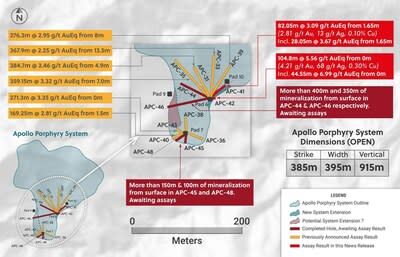
This press release announces results from two exploratory holes drilled eastwards from Pad 6 and designed to test the contact zone between the porphyry and inter-mineral breccia. The first hole, APC-41, was drilled to the northeast at a shallow angle and was suboptimal in design as it was drilled oblique to the contact zone. Based on the understanding gained from the first hole, APC-42 was drilled steeply due east and intercepted the contact zone at an orthogonal angle. Assay results and geological observations for both holes are summarized below:
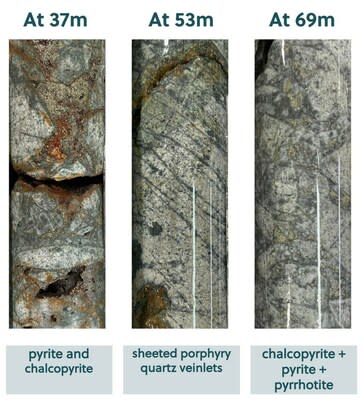
APC-42 was drilled steeply to the east from surface at Pad 6 to a maximum downhole depth of 126.3 metres. The mineralized interval includes 44.55 metres of combined saprolite and saprock with iron oxides formed from the oxidation of the sulphides hosted within the matrix of the breccia and within veins. Below the oxidized zone, the intercept passes into fresh rock with a sulphide composition of 0.5% chalcopyrite, 1.5% pyrite and pyrrhotite (up to 0.5%). One of the characteristic features of this intercept is the fact that it passes through a contact zone between breccia and porphyry. This zone contains both mineralized breccia and a stockwork of sulphide bearing quartz and carbonate veins within the adjacent porphyry material, all of which are associated with intense sericite alteration. Finally, the footwall zone of the porphyry is well altered and hosts mineralization associated with disseminated pyrite and quartz-pyrite veins with assay results as follows:
104.8 metres @ 5.56 g/t gold equivalent (consisting of 4.21 g/t gold, 68 g/t silver and 0.3% copper) including:
This intercept is followed by 19.35 metres @ 0.33 g/t gold equivalent from 106.95 metres downhole and is hosted within quartz diorite porphyry.
APC-41 was drilled to the northeast from Pad 6 to a maximum downhole depth of 162.4 metres and was designed to test the contact zone between breccia and porphyry. The mineralized interval starts at 1.65 metres depth below the overburden and intersects 28.05 metres of combined saprolite and saprock with iron oxides formed from the oxidation of the sulphides hosted within the matrix of the breccia and within veins. Below the oxide zone, the intercept passes into fresh rock consisting of quartz diorite breccia with a matrix of chalcopyrite (0.2%), pyrite (up to 2%) and 0.1% pyrrhotite before exiting the breccia and entering into mineralized quartz diorite porphyry. As in APC-42, the contact zone is characterized by a stockwork of sulphide bearing quartz and carbonate, porphyry veins associated with intense sericite alteration. The sericite is overprinting earlier potassium alteration (biotite). Finally, the footwall porphyry is altered and hosts mineralization associated with disseminated pyrite and quartz-pyrite veins with assay results as follows:
82.1 metres @ 3.09 g/t gold equivalent (consisting of 2.81 g/t gold, 13 g/t silver and 0.1% copper) including:
This intercept is followed by a lower grade intercept of 57 metres @ 0.34 g/t gold equivalent from 83.7 metres downhole and is hosted within quartz diorite porphyry.
Six additional holes have been completed at the Apollo system with assay results expected in the near term. All holes intersected bulk tonnage mineralization over core length of up to more than 500 metres. APC-45 and APC-48 were shorter holes drilled from Pad 7, designed to test the contact zone between the inter-mineral breccia and porphyry host rock in the southern portion of the deposit. APC-44 and APC-46 were longer holes drilled from Pad 6 as part of the fan pattern of drilling to assess the shallow mineralization in the central area of the system. APC-49 was a deeper hole drilled to the northwest from Pad 6 and APC-47 was drilled eastwards from Pad 4.
The Company presently has three diamond drill rigs operating at the Apollo project with a fourth rig expected to begin operating prior to the end of Q2, 2023. Additional assay results are expected in the near term.
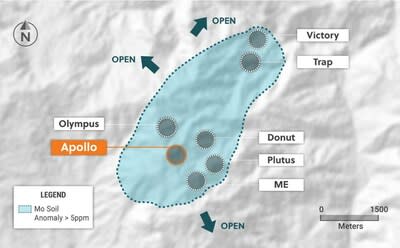
The Apollo target area, as defined to date by surface mapping, rock sampling and copper and molybdenum soil geochemistry, covers a 1,000 metres X 1,200 metres area, and represents a large and unusually high-grade Cu-Ag-Au porphyry system. Mineralizations styles include early-stage porphyry veins, inter-mineral breccia mineralization and multiple zones of porphyry related late stage, sheeted, carbonate-base metal veins with high gold and silver grades. The Apollo target area is still expanding as the Company’s geologists have found multiple additional outcrop areas with porphyry veining, breccia, and late stage, sheeted, carbonate base metal veins.
Table 1: Assay Results
Hole #
From(am)
To(am)
InterceptInterval (am)
Au(g/t)
Ag(g/t)
Cu%
MO%
Sauté(g/t)*
Cue(%)*
Zone
APC-41
1.65
83.70
82.05
2.81
13
0.10
0.002
3.09
1.65
Interlinearly Breccia
Inc**
1.65
29.70
28.05
3.44
15
0.07
0.001
3.67
Oxidation zone
83.70
140.70
57.00
0.24
3
0.34
Porphyry Host Rock
APC-42
0.00
104.80
104.80
4.21
68
0.30
0.001
5.56
2.97
Interlinearly Breccia
Inc**
0.00
44.55
44.55
6.48
37
0.10
0.001
6.99
Oxidation zone
84.80
104.80
20.00
6.26
24
0.10
0.002
6.59
Interlinearly Breccia
APC-42
106.95
126.30
19.35
0.26
3
0.33
Porphyry Host Rock
*Sauté (g/t) is calculated as follows: (Au (g/t) x 0.97) + (Ag g/t x 0.016 x 0.88) + (Cu (%) x 1.87 x 0.90)+ (MO (%)*11.43 x 0.85) and Cue (%) is calculated as follows: (Cu (%) x 0.90) + (Au (g/t) x 0.51 x 0.97) + (Ag (g/t) x 0.009 x 0.88)+ (MO(%)x 6.10 x 0.85) utilizing metal prices of Cu – US$4.10/lb, Ag – $24/oz MO – US$25.00/lb and Au – US$1,500/oz and recovery rates of 97% for Au, 88% for Ag, 85% for MO, and 90% for Cu. Recovery rate assumptions are speculative as limited metallurgical work has been completed to date. A 0.2 g/t Sauté cut-off grade was employed with no more than 15% internal dilution. True widths are unknown, and grades are uncut.
(**) Zone of Oxidation
Figure 1: Plan View of Drilling Highlighting Assay Results of APC-41 and APC-42 (CNW Group/Collective Mining Ltd.)
Figure 4: Plan View of the Guayabales Project Highlighting the Apollo Target Area (CNW Group/Collective Mining Ltd.)
About Collective Mining Ltd.
To see our latest corporate presentation and related information, please visit www.collectivemining.com
Founded by the team that developed and sold Continental Gold Inc. to Fijian Mining for approximately $2 billion in enterprise value, Collective Mining is a copper, silver, and gold exploration company with projects in Caldas, Colombia. The Company has options to acquire 100% interests in two projects located directly within an established mining camp with ten fully permitted and operating mines.
The Company’s flagship project, Guayabales, is anchored by the Apollo target, which hosts the large-scale, bulk-tonnage and high-grade copper-silver-gold Apollo porphyry system. The Company’s near-term objective is to drill the shallow portion of the porphyry system while continuing to expand the overall dimensions of the system, which remains open in all directions.
Management, insiders and close family and friends own nearly 45% of the outstanding shares of the Company and as a result, are fully aligned with shareholders. The Company is listed on the TSXV under the trading symbol “CNL” and on the OTCQX under the trading symbol “CNLMF”.
Qualified Person (AP) and NI43-101 Disclosure
David Jo Reading is the designated Qualified Person for this news release within the meaning of National Instrument 43-101 (“NI 43-101”) and has reviewed and verified that the technical information contained herein is accurate and approves of the written disclosure of same. Mr. Reading has an MS in Economic Geology and is a Fellow of the Institute of Materials, Minerals and Mining and of the Society of Economic Geology (SE).
Technical Information
Rock, soils and core samples have been prepared and analyzed at SS laboratory facilities in Medallion, Colombia and Lima, Peru. Blanks, duplicates, and certified reference standards are inserted into the sample stream to monitor laboratory performance. Crush rejects and pulps are kept and stored in a secured storage facility for future assay verification. No capping has been applied to sample composites. The Company utilizes a rigorous, industry-standard QUA/AC program.
Information Contact:
Follow Executive Chairman Ari Sussman (@Ariski73) and Collective Mining (@CollectiveMini1) on Twitter.
FORWARD-LOOKING STATEMENTS
This news release contains certain forward-looking statements, including, but not limited to, statements about the drill programs, including timing of results, and Collective’s future and intentions. Wherever possible, words such as “may”, “will”, “should”, “could”, “expect”, “plan”, “intend”, “anticipate”, “believe”, “estimate”, “predict” or “potential” or the negative or other variations of these words, or similar words or phrases, have been used to identify these forward-looking statements. These statements reflect management’s current beliefs and are based on information currently available to management as at the date hereof.
Forward-looking statements involve significant risk, uncertainties, and assumptions. Many factors could cause actual results, performance, or achievements to differ materially from the results discussed or implied in the forward-looking statements. These factors should be considered carefully, and readers should not place undue reliance on the forward-looking statements. Although the forward-looking statements contained in this news release are based upon what management believes to be reasonable assumptions, Collective cannot assure readers that actual results will be consistent with these forward-looking statements. These forward-looking statements are made as of the date of this news release, and Collective assumes no obligation to update or revise them to reflect new events or circumstances, except as required by law.
Neither the TSXV nor its Regulation Services Provider (as that term is defined in the policies of the TSXV) accepts responsibility for the adequacy or accuracy of this news release.
Collective Mining Logo (CNW Group/Collective Mining Ltd.)
Vancouver, British Columbia–(Newsfile Corp. – April 24, 2023) – Dolly Varden Silver Corporation (TSXV: DV) (OTCQX: DOLLF) (the “Company” or “Dolly Varden“) announces the 2023 Exploration Plans for the Kitsault Valley Project, which includes the Dolly Varden Silver property and Homestake Ridge Gold Silver property. A total of 40,000 to 45,000m of drilling is planned to build upon last year’s successes through further step outs following high grade silver and gold mineralization at the Wolf and Homestake Ridge deposits, as well as appropriately spaced exploration holes to allow the inclusion of new mineralization drilled over the past three drilling programs to be include in an updated Mineral Resource Estimate.
“2022 was a breakthrough exploration season at Dolly Varden Silver’s Kitsault Valley project. It hosts one of the largest, undeveloped high grade precious metals project in Western Canada. With the wide, high-grade silver intercepts in significant step-out holes from the Wolf and Homestake Silver deposits, coupled with the highest grade gold intercepts drilled in all of the Golden Triangle in 2022 from the Homestake Main deposit, we eagerly await the start of this season’s drilling. We are continuing our successful strategy of expanding current Resources, while also testing new exploration targets for discovery. The company has over $26 million in the treasury, positioning our exploration team with a tremendous opportunity to create value with the drill bit,” said Shawn Khunkhun, President and CEO of Dolly Varden Silver.
Figure 1. Kitsault Valley trend with 2023 exploration drilling targets
Drilling allocated to the Wolf Deposit expansion will focus on both infill drilling of the wide-spaced intercepts from 2022 to be included in an upcoming resource estimate, as well as further step out holes in both the southwest, north and east directions where high grade silver mineralization remains open. Two intercepts from the Wolf Vein drilled in 2022 at the furthest strike extents of the vein, are approximately 825 meters apart. The deposit is wide open for expansion along strike and to depth.
Wolf Vein furthest Northeast: DV22-329: 1,499 g/t Ag, 1.89 %Pb, 0.46% Zn over 15.94 meters (8.77 meters estimated true width), including 23,997 g/t Ag, 1.24% Pb, 0.34% Zn over 0.35 meters (0.19m estimated true width).
Wolf Vein furthest Southwest: DV22-320: 321g/t Ag, 0.84 %Pb, 0.84% Zn over 12.85 meters (6.81 meters estimated true width) including 664 g/t Ag, 1.24% Pb, 3.54% Zn over 1.63 meters (0.86 meters estimated true width).
Figure 2. Wolf Vein Long Section outlining 2023 exploration drill targets
Similar step out drilling will follow up on high grade silver mineralization at the Kitsol Vein, where drill hole DV22-323 demonstrated the continuity of steeply plunging, high-grade silver mineralization with results of 301g/t Ag, 0.23 %Pb, 0.56% Zn over 15.00 meters (9.60 meters estimated true width) including 434 g/t Ag, 0.41% Pb, 0.69% Zn over 5.90 meters (3.78 meters estimated true width).
Homestake Ridge: Main and Silver
The 2023 exploration drilling at the Homestake deposits are influenced by the structural information gained from the infill drilling at Main where two main plunge directions have been identified; a shallow, northerly plunge and a steep southerly plunge, where NE-SW structures crosscut the main Homestake trend. The planned drilling will target the down plunge extensions of higher grade and wider zones of gold mineralization such as 2022 drill hole HR22-333 which intersected 46.31 g/t Au, 70 g/t Ag and 0.19% Cu over 25.00 meters including 1,145 g/t Au, 826 g/t Ag and 0.51% Cu over 0.48 meters core length.
Drilling at Homestake Silver will prioritize step out holes where 2022 expansion drilling had success at the southern extent, with HR22-362, a 200 meter step out that intersected 1,252 g/t Ag, 0.81 g/t Au and 0.14% Cu over 2.50 meters, including 3,330 g/t Ag, 0.75 g/t Au and 0.38% Cu over 0.75m.
Discovery Focused Exploration
The Moose Vein is a 2023 exploration drill target, testing an historic prospect with small exploration adit from the 1920s. It is located 1,500 meters north of the Wolf Deposit within the Potassic alteration halo associated with the Torbrit, Dolly Varden and Wolf silver deposits to the south. The Moose vein strikes east-west, similar to the Dolly Varden Vein, hosting silver grades and mineralization styles similar to areas of the Wolf vein, proximal to the high-grade plunge zone. The depth extent and projected extension of the Mooise Vein under the mid-valley sediment cap will be tested in the 2023 program.
Several blind drill targets under the 5.4 kilometer long mid-valley sediment cover will be better defined for later summer drill testing, after a planned ground IP survey is completed
Additional exploration targets will include parallel structural zones to the west of Homestake Main trend, coincident with a broad gold in soils anomalous zone overlying a quartz-sericite-pyrite alteration zone.
Qualified Person
Rob van Egmond, P.Geo. Vice-President Exploration for Dolly Varden Silver, the “Qualified Person” as defined by NI43-101 has reviewed, validated and approved the scientific and technical information contained in this news release and supervises the ongoing exploration program at the Dolly Varden Project.
About Dolly Varden Silver Corporation
Dolly Varden Silver Corporation is a mineral exploration company focused on advancing its 100% held Kitsault Valley Project (which combines the Dolly Varden Project and the Homestake Ridge Project) located in the Golden Triangle of British Columbia, Canada, 25kms by road to tide water. The 163 sq. km. project hosts the high-grade silver and gold resources of Dolly Varden and Homestake Ridge along with the past producing Dolly Varden and Torbrit silver mines. It is considered to be prospective for hosting further precious metal deposits, being on the same structural and stratigraphic belts that host numerous other, on-trend, high-grade deposits, such as Eskay Creek and Brucejack. The Kitsault Valley Project also contains the Big Bulk property which is prospective for porphyry and skarn style copper and gold mineralization, similar to other such deposits in the region (Red Mountain, KSM, Red Chris).
Forward-Looking Statements
This release may contain forward-looking statements or forward-looking information under applicable Canadian securities legislation that may not be based on historical fact, including, without limitation, statements containing the words “believe”, “may”, “plan”, “will”, “estimate”, “continue”, “anticipate”, “intend”, “expect”, “potential”, and similar expressions. Forward-looking statements involve known and unknown risks, uncertainties, and other factors which may cause the actual results, performance, or achievements of Dolly Varden to be materially different from any future results, performance, or achievements expressed or implied by the forward-looking statements. Forward-looking statements or information in this release relates to, among other things, the results of previous field work and programs and the continued operations of the current exploration program, interpretation of the nature of the mineralization at the project and that that the mineralization on the project is similar to Eskay and Brucejack, results of the mineral resource estimate on the project, the potential to grow the project, the potential to expand the mineralization and our beliefs about the unexplored portion of the property.
These forward-looking statements are based on management’s current expectations and beliefs and assume, among other things, the ability of the Company to successfully pursue its current development plans, that future sources of funding will be available to the company, that relevant commodity prices will remain at levels that are economically viable for the Company and that the Company will receive relevant permits in a timely manner in order to enable its operations, but given the uncertainties, assumptions and risks, readers are cautioned not to place undue reliance on such forward-looking statements or information. The Company disclaims any obligation to update, or to publicly announce, any such statements, events or developments except as required by law.
For additional information on risks and uncertainties, see the Company’s most recently filed annual management discussion & analysis (“MD&A“) and management information circular dated January 21, 2022 (the “Circular“), both of which are available on SEDAR at www.sedar.com. The risk factors identified in the MD&A and the Circular are not intended to represent a complete list of factors that could affect the Company.
Neither the TSX Venture Exchange nor its Regulation Services Provider (as that term is defined in the policies of the TSX-V) accepts responsibility for the adequacy or accuracy of this news release.
Vancouver, British Columbia–(Newsfile Corp. – April 20, 2023) – Goldshore Resources Inc. (TSXV: GSHR) (OTCQB: GSHRF) (FSE: 8X00) (“Goldshore” or the “Company“), is pleased to announce assay results from its recently completed drill program at the Moss Lake Project in Northwest Ontario, Canada (the “Moss Gold Project“).
Highlights:
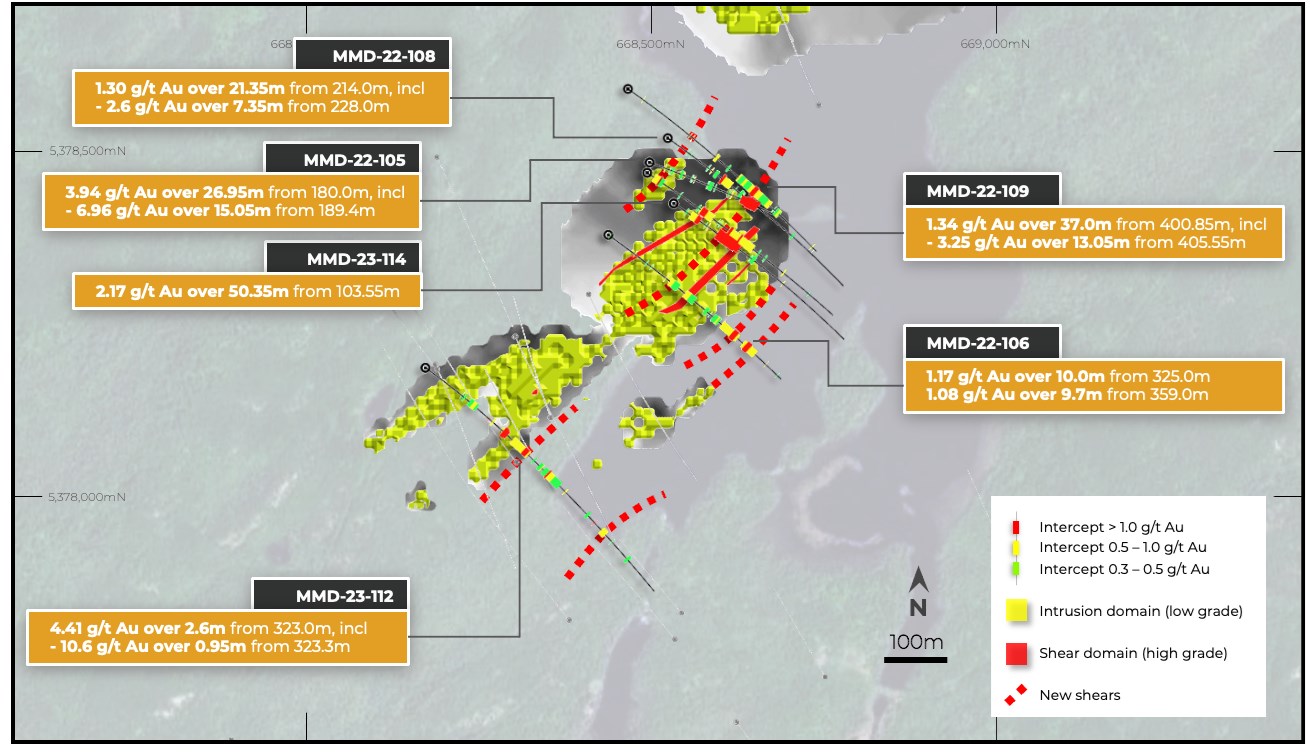
Results from seven holes testing the extension of the Southwest Zone toward the Main Zone have delineated a new high-grade lens, including visible gold, northeast of the Southwest Zone resource that extends from surface to at least 250 meters depth with best intercepts of:
6.96 g/t Au over 15.05m from 189.4m depth in MMD-22-105, including
54.4 g/t Au over 1.6m from 189.4m
2.17 g/t Au over 50.35m from 103.55m depth in MMD-23-114, including
3.47 g/t Au over 26.05m from 120.35m
1.30 g/t Au over 21.35m from 214m depth in MMD-22-108, including
2.60 g/t Au over 7.35 from 228.0m
These drill results prove that the Southwest Zone is a continuation of the Main Zone and not a fault offset as previously interpreted. They also show that the Southwest Zone extends to depth and is potentially as large as the Main Zone.
With drilling recently completed, the Company is preparing an updated mineral resource expected in May. The updated resource will use data from an additional 72 holes compared to the November 2022 resource. Mineralization in the resource area remains open in multiple directions.
President and CEO Brett Richards stated: “These results continue to support our belief that the size and scale of the Moss Gold Project is much larger and continues to be open at all directions, along strike both to the northeast and southwest, as well as our understanding of lateral mineralized targets to the south-east of the Southwest Zone and the Main Zone. For now, we have halted the program to step back; understand the quantum of this resource, and prepare for a mineral resource update in early May, we can now see a viable path to a meaningful project PEA (preliminary economic analysis). We look forward to those results in the coming months, as we start to plan for an infill drilling program working towards a pre-feasibility study in the future.”
Technical Overview
Figure 1 shows the location of the drill holes in this press release and Figure 2 shows a close up of the drilled area with significant intercepts. Figure 3 is a typical section through hole MMD-22-105, -108 and -109. Table 1 shows the significant intercepts. Table 2 shows the drill hole locations.
Figure 1: Location of drill holes in this release relative to the November 2022 resource model and $1500 open pit shell constraint
Figure 2: insert close up of Southwest Zone with significant intercepts relative to the November 2022 resource model and $1500 open pit shell constraint
Figure 3: Drill section through holes MMD-22-105, -108 and -109 showing the significant expansion of the mineralized model beneath the November 2022 resource model and $1500 open pit shell constraint, which should add to mineral resources in the upcoming update
Continued infill of the Southwest Zone has delineated a new continuous high-grade structure over a 250m strike length from near surface to 200m depth immediately northeast of the historical Southwest Zone. Holes MMD-22-105, -108, -109 and MMD-23-113, and -114 intersected this structure along with previously released holes MMD-22-031, -042, -063, and -064. The newly understood zone orientation was tested against the phase 1 drill results and confirmed the continuity of the high-grade structures controlling the mineralization.
The mineralized zone occurs within an albitite+hematite altered diorite intrusion complex cut by closely spaced, texturally destructive sericite+chlorite+carbonate altered shears. Additional shearing, and subsequent alteration, is seen extending into the neighboring intermediate volcanics but is poorly mineralized.
The gold mineralization appears more nuggety than elsewhere in the deposit with a greater portion of the mineralization attributed to pyrite±chalcopyrite bearing quartz-carbonate veins within the sheared intervals. Mineralization includes visible gold (Figure 4). Several very high-grade intercepts include:
54.4 g/t Au over 1.6m from 189.4m depth in MMD-22-105
11.3 g/t Au over 0.5m from 147.7m depth in MMD-22-108 and
11.5 g/t Au over 0.7m from 232.35m
10.6 g/t Au over 0.95m from 323.3m depth in MMD-23-112
19.0 g/t Au over 0.65m from 54m depth in MMD-23-114 and
22.9 g/t Au over 1m from 128m depth and
14.4 g/t Au over 1m from 137m depth
Holes MMD-22-109 and MMD-23-113 intersected the high-grade structure but encountered lesser vein mineralization resulting in more modest grade intercepts including:
0.44 g/t Au over 81.2m from 298.8m depth in MMD-22-109, including
1.08 g/t Au over 8.60m from 335.35m
0.63 g/t Au over 29.5m from 129.55m depth in MMD-23-113, including
4.76 g/t Au over 2.0m from 140.0m and
0.51 g/t Au over 58m from 204.0m depth, including
1.92 g/t Au over 4.0m from 205.0m and
1.84 g/t Au over 3.0m from 229.0m
Holes MMD-22-106, and MMD-23-112 were focused on infilling the drill spacing of the existing Southwest Zone. All three holes intercepted broad zones of mineralization hosted primarily within altered granodiorite containing narrow higher grade shear zones. Best intercepts include:
0.47 g/t Au over 63m from 277m depth in MMD-22-106
0.61 g/t Au over 41.25m from 232m depth in MMD-23-112
0.39 g/t Au over 53.5m from 301m depth in MMD-23-112
Figure 1: Visible gold flake within a quartz-carbonate-pyrite vein at 190.42m (1.6m @ 54.4 g/t Au) in MMD-22-105 within the sheared, altered intrusion of the Southwest zone. Note that this photo is not intended to be representative of broader mineralization on the Moss Lake Gold Project.
Pete Flindell, VP Exploration for Goldshore, said, “These results show that the Southwest Zone is much larger and better mineralized than historical drillholes suggested; and is potentially as large as the Main Zone. We await the results from the final batch of assays that are expected to provide critical infill beneath the heart of the Southwest Zone.”
Table 1: Significant downhole gold intercepts
HOLEID
FROM
TO
LENGTH (m)
TRUE WIDTH (m)
CUT GRADE (g/t Au)
UNCUT GRADE (g/t Au)
MMD-22-105
45.00
48.00
3.00
2.3
0.33
0.33
62.00
66.45
4.45
3.5
0.34
0.34
117.55
125.00
7.45
6.0
0.38
0.38
189.40
204.45
15.05
12.5
3.64
6.96
including
189.40
191.00
1.60
1.3
30.0
54.4
MMD-22-106
165.00
187.00
22.00
15.7
0.33
0.33
204.20
229.00
24.80
18.0
0.50
0.50
256.00
263.00
7.00
5.2
0.34
0.34
277.00
292.40
15.40
11.5
0.37
0.37
299.20
340.00
40.80
30.9
0.59
0.59
including
325.00
335.00
10.00
7.6
1.17
1.17
353.15
384.00
30.85
23.9
0.61
0.61
including
359.00
368.70
9.70
7.5
1.08
1.08
MMD-22-108
126.55
133.15
6.60
4.7
0.36
0.36
143.55
168.00
24.45
17.6
0.62
0.62
including
143.55
148.20
4.65
3.3
1.99
1.99
including
147.70
148.20
0.50
0.4
11.3
11.3
190.80
196.25
5.45
4.0
0.31
0.31
214.00
235.35
21.35
15.9
1.30
1.30
including
215.40
218.00
2.60
1.9
1.10
1.10
and
228.00
235.35
7.35
5.5
2.60
2.60
including
232.35
233.05
0.70
0.5
11.5
11.5
319.00
322.15
3.15
2.5
0.37
0.37
MMD-22-109
238.35
244.00
5.65
4.1
0.52
0.52
271.00
274.00
3.00
2.2
0.37
0.37
298.80
380.00
81.20
61.2
0.44
0.44
including
335.35
343.95
8.60
6.5
1.08
1.08
395.10
404.65
9.55
7.4
0.39
0.39
MMD-23-112
103.35
106.85
3.50
2.5
0.38
0.38
118.00
138.00
20.00
14.3
0.39
0.39
179.00
182.00
3.00
2.2
0.57
0.57
207.00
218.90
11.90
8.9
1.17
1.17
including
207.00
215.00
8.00
6.0
1.63
1.63
232.00
273.25
41.25
31.5
0.61
0.61
287.10
290.10
3.00
2.3
0.33
0.33
301.00
309.00
8.00
6.3
0.32
0.32
313.00
354.05
41.05
32.8
0.42
0.42
including
323.00
325.60
2.60
2.1
4.41
4.41
including
323.30
324.25
0.95
0.8
10.6
10.6
368.00
370.00
2.00
1.6
0.71
0.71
423.85
428.50
4.65
3.8
0.33
0.33
462.00
472.75
10.75
9.0
0.56
0.56
526.80
532.00
5.20
4.4
0.37
0.37
MMD-23-113
18.00
42.00
24.00
16.2
0.42
0.42
including
31.00
34.00
3.00
2.0
1.55
1.55
129.55
132.00
2.45
1.8
0.41
0.41
136.00
165.50
29.50
21.6
0.63
0.63
including
140.00
142.00
2.00
1.5
4.76
4.76
204.00
262.00
58.00
44.5
0.51
0.51
including
205.00
209.00
4.00
3.0
1.92
1.92
and
229.00
232.00
3.00
2.3
1.84
1.84
274.00
276.00
2.00
1.6
0.33
0.33
289.00
291.00
2.00
1.6
0.31
0.31
332.00
334.30
2.30
1.8
0.82
0.82
MMD-23-114
30.00
32.25
2.25
1.7
0.33
0.33
40.65
62.65
22.00
16.3
0.78
0.78
including
54.00
54.65
0.65
0.5
19.0
19.0
103.55
153.90
50.35
38.8
2.17
2.17
including
120.35
146.40
42.85
20.0
3.47
3.47
including
128.00
129.00
1.00
0.8
22.9
22.9
and
137.00
138.00
1.00
0.8
14.4
14.4
183.00
189.85
6.85
5.4
0.36
0.36
Intersections calculated above a 0.3 g/t Au cut off with a top cut of 30 g/t Au and a maximum internal waste interval of 10 metres. Shaded intervals are intersections calculated above a 1.0 g/t Au cut off. Intervals in bold are those with a grade thickness factor exceeding 20 gram x metres / tonne gold. True widths are approximate and assume a subvertical body.
Table 2: Location of drill holes in this press release
HOLE
EAST
NORTH
RL
AZIMUTH
DIP
EOH
MMD-22-105
668,498
5,378,484
438
110°
-41°
249
MMD-22-106
668,438
5,378,379
440
126°
-50°
450
MMD-22-108
668,524
5,378,519
437
125°
-50°
450
MMD-22-109
668,466
5,378,591
427
125°
-51°
501
MMD-23-112
668,172
5,378,186
443
125°
-50°
600
MMD-23-113
668,494
5,378,469
438
126°
-50°
450
MMD-23-114
668,533
5,378,424
428
123°
-44°
402
Analytical and QA/QC Procedures
All samples were sent to ALS Geochemistry in Thunder Bay for preparation and analysis was performed in the ALS Vancouver analytical facility. ALS is accredited by the Standards Council of Canada (SCC) for the Accreditation of Mineral Analysis Testing Laboratories and CAN-P-4E ISO/IEC 17025. Samples were analyzed for gold via fire assay with an AA finish (“Au-AA23”) and 48 pathfinder elements via ICP-MS after four-acid digestion (“ME-MS61”). Samples that assayed over 10 ppm Au were re-run via fire assay with a gravimetric finish (“Au-GRA21”).
In addition to ALS quality assurance / quality control (“QA/QC”) protocols, Goldshore has implemented a quality control program for all samples collected through the drilling program. The quality control program was designed by a qualified and independent third party, with a focus on the quality of analytical results for gold. Analytical results are received, imported to our secure on-line database and evaluated to meet our established guidelines to ensure that all sample batches pass industry best practice for analytical quality control. Certified reference materials are considered acceptable if values returned are within three standard deviations of the certified value reported by the manufacture of the material. In addition to the certified reference material, certified blank material is included in the sample stream to monitor contamination during sample preparation. Blank material results are assessed based on the returned gold result being less than ten times the quoted lower detection limit of the analytical method. The results of the on-going analytical quality control program are evaluated and reported to Goldshore by Orix Geoscience Inc.
About Goldshore
Goldshore is an emerging junior gold development company, and owns 100% of the Moss Gold Project located in Ontario. Wesdome is currently a large shareholder of Goldshore with an approximate 22% equity position in the Company. Well-financed and supported by an industry-leading management group, board of directors and advisory board, Goldshore is positioned to advance the Moss Gold Project through the next stages of exploration and development.
Peter Flindell, P.Geo., MAusIMM, MAIG, Vice President – Exploration of the Company, a qualified person under NI 43-101 has approved the scientific and technical information contained in this news release.
Neither the TSXV nor its Regulation Services Provider (as that term is defined in the policies of the TSXV) accepts responsibility for the adequacy or accuracy of this release.
For More Information – Please Contact:
Brett A. Richards President, Chief Executive Officer and Director Goldshore Resources Inc.
This news release contains statements that constitute “forward-looking statements.” Such forward-looking statements involve known and unknown risks, uncertainties and other factors that may cause the Company’s actual results, performance or achievements, or developments to differ materially from the anticipated results, performance or achievements expressed or implied by such forward-looking statements. Forward-looking statements are statements that are not historical facts and are generally, but not always, identified by the words “expects,” “plans,” “anticipates,” “believes,” “intends,” “estimates,” “projects,” “potential” and similar expressions, or that events or conditions “will,” “would,” “may,” “could” or “should” occur.
Forward-looking statements in this news release include, among others, statements relating to expectations regarding the exploration and development of the Moss Lake Gold Project, the release of an updated mineral resource estimate and preliminary economic assessment, and other statements that are not historical facts. By their nature, forward-looking statements involve known and unknown risks, uncertainties and other factors which may cause our actual results, performance or achievements, or other future events, to be materially different from any future results, performance or achievements expressed or implied by such forward-looking statements. Such factors and risks include, among others: the Company may require additional financing from time to time in order to continue its operations which may not be available when needed or on acceptable terms and conditions acceptable; compliance with extensive government regulation; domestic and foreign laws and regulations could adversely affect the Company’s business and results of operations; the stock markets have experienced volatility that often has been unrelated to the performance of companies and these fluctuations may adversely affect the price of the Company’s securities, regardless of its operating performance; and the impact of COVID-19.
The forward-looking information contained in this news release represents the expectations of the Company as of the date of this news release and, accordingly, is subject to change after such date. Readers should not place undue importance on forward-looking information and should not rely upon this information as of any other date. The Company undertakes no obligation to update these forward-looking statements in the event that management’s beliefs, estimates or opinions, or other factors, should change.
Exploration fieldwork has identified six well mineralized and outcropping porphyry and related style targets within a 400 metre radius of the Apollo system with assay results for soil and rock samples as follows:
Surface mapping at all six targets has outlined the same style of porphyry mineralization as the Apollo system, namely altered porphyry with vein stockwork, inter-mineral breccia with oxide followed by sulphides in the matrix and overprinting late-stage porphyry veins (“CBM Veins”).
Although the amount of rock and soil exposure in the sampling radius covering each of the six target areas is limited due to vegetation, historical landslides and volcanic ash cover, the scale of the areas and tenor of the assay results are similar to the original outcrop of the Apollo system. The Company estimates that there is no more than 5% rock exposure anywhere at the Guayabales project.
For comparison, the outcrop of the Apollo porphyry system prior to drilling only measured 10 metres in diameter. Subsequent drilling has outlined a porphyry system that to date measures 150 metres by 130 metres at surface, which then expands in dimensions quickly at depth to up to 500 metres wide and remains open.
Surface sampling was carried out in oxidized material and if the oxidation zone shares similar characteristics to the Apollo system, the copper and silver grades have been reduced by leaching. Recent drill results from Pad 6 and Pad 7 at Apollo corroborates this assertion.
A fourth drill rig is being mobilized to the project and is expected to initiate testing of the six new targets in late Q2, 2023.
Six additional holes have been completed at the Apollo system with assay results expected in the near term. APC-41, APC-42 and APC-45 are shorter holes designed to test the contact zones between the inter-mineral breccia and porphyry host rock in search of higher-grade sub zones. APC-44 and APC 46 are longer holes (up to 425 metres in mineralization) drilled from Pad 6 as part of a fan pattern to assess the shallow mineralization in this area and APC-47 is an exploratory hole drilled to the east from Pad 4 to test for mineralization beginning from below surface.
Ari Sussman, Executive Chairman commented: “The discovery of these new mineralized porphyry outcrops around Apollo are both exciting and significant for the Company. The original discovery outcrop of Apollo only covered a 10 metre radius and subsequent drilling has demonstrated that Apollo has the morphology of an inverted carrot with limited surface expression. This fact puts these new targets into perspective and highlights that the Apollo area is highly prospective for further exploration. We only found these new outcrops because of various recently excavated tracks emplaced to service and supply the drilling pads. I am looking forward to new drill rigs turning at these targets in the near term.”
TORONTO, April 18, 2023 /CNW/ – Collective Mining Ltd. (TSXV: CNL) (OTCQX: CNLMF) (“Collective” or the “Company”) is pleased to announce exploration results from six newly generate porphyry and related style targets located within the Apollo target area at the Guayabales project located in Caldas, Colombia. The Apollo porphyry system is a high-grade, bulk tonnage copper-silver-gold system, which owes its excellent metal endowment to an older copper-silver and gold porphyry system being overprinted by younger precious metal rich, carbonate base metal vein systems (intermediate sulphidation porphyry veins) within a magmatic, hydrothermal inter-mineral breccia body currently measuring 395 metres x 385 metres x 915 metres and open for expansion.
Details (See Table 1 and Figures 1-3)
Exploration fieldwork has identified six target areas with outcropping porphyry style mineralization which are located within a 400 metre radius of the Apollo porphyry system. These new targets were generated by geological mapping, soil sampling and most importantly the emplacement of new tracks to enable supplies and equipment to be transported to the current drill pads in the area. Two key characteristics pertinent to understanding the potential impact of the targets and their associated metal values in rock and soil are as follows:
A.
Collectively, the targets consist of all the same mineralization styles observed in the Apollo system, namely early-stage porphyry style with various porphyry veinlets, inter-mineral breccia, and late stage CBM veins which host higher values of gold and silver. The copper values range between 31 ppm and 1,410 ppm and reflect leaching of copper and silver due to surface oxidation. The leaching of copper in oxides at Apollo has been observed in all oxidized material drilled from Pad 6 and Pad 7. Copper values near surface in these drill holes display very similar grades to those observed in the six outcrops outlined in this release. Gold values range from 0.18 g/t to 8.29 g/t and silver values from 0.2 g/t to 346 g/t with variation in both cases related to the mineralization styles encountered.
B.
Cognizance must be taken of the surface area and 3D morphology of the Apollo porphyry system when assessing these new porphyry outcrops. The original Apollo discovery outcrop was only 10 metres in diameter and was the only exposure identified prior to the drilling of discovery hole APC-1. The discovery outcrop had gold, silver, and copper values in the ranges of 0.07 to 4.1 g/t gold, 1.9 to 29 g/t silver and 377 to 1,023 ppm copper. After the erection of multiple drill pads, another two outcrop areas were located at Apollo following the construction of various tracks which were emplaced to service the various drill rigs with equipment and supplies. There is only approximately 5% outcrop exposure at the Guayabales project due to the dense vegetation and the covering of primary rock surfaces by historic landslide fill and young volcanic ash. Furthermore, drilling at the Apollo deposit has demonstrated that the surface expression is relatively small with a maximum known diameter at present of 150 metres whereas at depth this expands quickly to a known diameter of up to 500 metres. The deposit is still open in all directions.
The following brief descriptions and data are summarized for each outcrop target:
Target 1:
This target is located 200 metres west of the Apollo outcrop area. This outcrop has dimensions of 20 metres by 3 metres and hosts early-stage porphyry mineralization as well as clast supported crackle breccia with an iron oxide matrix cement of 3% to 5% in volume. Drusy quartz veining is superimposed on the breccia. Pervasive and strong sericite alteration overprints the rock exposures. Gold grades range from 1.13 g/t to 0.34 g/t with silver ranging from 0.2 g/t to 6.6 g/t and copper in the range of 90 ppm to 224 ppm.
Target 2:
This target is located 300 metres northeast of the Apollo system, has outcrop dimensions of 120 metres by 60 metres and contains a couple of historical and shallow artisanal mines. Geological mapping has identified altered porphyry hosting angular breccia with quartz diorite clasts. The matrix of the breccia has total sulphides of up to 5% which is predominantly pyrite with some chalcopyrite. CBM veinlets overprint the breccia and trend NW and EW. Alteration is strong and defined by sericite and chlorite. Gold values range from 8.29 g/t to 1.51 g/t, silver from 10 g/t to 346 g/t and copper from 72 ppm to 362 ppm.
Target 3:
Target 3 is located 300 metres east-northeast of the Apollo system and has outcrop dimensions of 15 metres by 3 metres. The outcrop area hosts angular breccia with quartz diorite clasts with an iron oxide cement (1%-2%) after sulphides. Strong Sericite-chlorite alteration is observed. The target has subsequently been expanded to 75 metres by 170 metres by anomalous gold in soil values. Rock samples range from 0.18 g/t to 0.63 g/t gold, silver ranges from 2 g/t to 68 g/t and copper from 43 ppm to 277 ppm.
Target 4:
This target is located 250 metres east of the Apollo system with dimensions measuring 20 metres x 4 metres and host crackle breccia of diorite composition and altered porphyry rocks. Breccia cement hosts 2%-3% iron oxide after sulphide while both the porphyry and breccia units are overprinted by CBM veinlets. Strong sericite alteration is observed in the outcrop. The target has been expanded to 150 metres by 100 metres by anomalous gold in soil values. Rock samples range from 0.90 to 4.31 g/t gold, 1 g/t to 56 g/t silver and copper ranges from 125 ppm to 323 ppm.
Target 5:
This target area is located 100 metres due east of the Apollo system and has dimensions measuring 15 metres by 10 metres. Geology observed includes altered porphyry, angular breccia and late stage CBM veinlets. The breccia matrix hosts 3%-5% iron oxides after sulphide with strong sericitic alteration. Anomalous soil sample results for gold have expanded the target area to 200 metres by 100 metres. Rock samples range from 0.56 g/t to 5.59 g/t gold, 6 g/t to 70 g/t silver and copper ranges from 477 ppm to 833 ppm.
Target 6:
This target area is located 400 metres due southeast of the Apollo system and outcrops over a 30 metre diameter area. The outcrop hosts angular, polymictic, clast supported breccia (diorite and quartz diorite) and altered porphyry with quartz veinlets. The matrix cement hosts visible sulphides of 3%-5% and consists of chalcopyrite, sphalerite, galena and pyrite. Rock samples range from 0.39 g/t to 1.07 g/t gold, 6 g/t to 20 g/t silver and copper ranges from 32 ppm to 1,410 ppm.
Update on Apollo Drilling Progress
The Phase II drilling program of 2023 is advancing on schedule with thirteen holes completed and a further six holes in the lab awaiting assay results. Since the discovery of the Apollo porphyry system was announced in June 2022, a total of 44 drill holes (approximately 18,978 metres) have been completed and assayed.
Six additional holes have been completed from the three current drill pads with assay results expected in the near term. APC-44 and APC-46 are long holes drilled in westerly direction with continuous visual mineralization of up to 425 metres. APC-41, APC-42 and APC-45 are shorter holes designed to test the contact zones between breccia and porphyry in potentially higher-grade areas. APC-47 is an exploratory hole drilled to the east from Pad 4. Assay results are expected in the near term.
The Company presently has three diamond drill rigs operating at the Apollo project and additional assay results are expected in the near term.
The Apollo target area, as defined to date by surface mapping, rock sampling and copper and molybdenum soil geochemistry, covers a 1,000 metres X 1,200 metres area, and represents a large and unusually high-grade Cu-Ag-Au porphyry system. Mineralization styles include early-stage porphyry veins, inter-mineral breccia mineralization and multiple zones of porphyry related late stage, sheeted, carbonate-base metal veins with high gold and silver grades. The Apollo target area is still expanding as the Company’s geologists have found multiple additional outcrop areas with porphyry veining, breccia, and late stage, sheeted, carbonate base metal veins.
Table 1: Assay Results for Sampling Undertaken on Targets 1 to 6 in the Apollo Target Area
Target #
Sample Type
Au (g/t)
Ag (g/t)
Cu (ppm)
Target 1
Rock
0.43
0.2
90.1
Target 1
Rock
0.34
0.2
104.8
Target 1
Rock
0.88
1.8
154.0
Target 1
Rock
0.91
0.6
121.1
Target 1
Rock
1.13
6.6
224.3
Target 2
Rock
1.51
10.3
71.8
Target 2
Rock
7.06
46.6
146.0
Target 2
Rock
4.10
78.0
254.0
Target 2
Rock
4.55
19.8
309.0
Target 2
Rock
8.29
345.6
424.5
Target 2
Rock
6.55
217.2
362.0
Target 3
Rock
0.18
3.4
155.9
Target 3
Soil
0.43
67.7
43.0
Target 3
Soil
0.63
2.2
277.0
Target 4
Rock
2.97
35.6
322.9
Target 4
Soil
0.90
1.3
131.1
Target 4
Soil
2.88
56.0
198.2
Target 4
Soil
4.31
1.2
124.6
Target 4
Rock
1.28
27.9
186.5
Target 5
Rock
5.59
57.5
833.1
Target 5
Rock
2.70
69.7
539.6
Target 5
Rock
2.41
32.7
507.7
Target 5
Soil
0.56
5.6
477.0
Target 6
Rock
0.60
19.8
1410.0
Target 6
Rock
0.39
15.8
217.3
Target 6
Rock
0.95
16.4
41.9
Target 6
Rock
0.65
6.0
31.5
Target 6
Rock
1.07
13.1
132.3
Note: The values on the table correspond to rock chip and soil samples and should not be relied upon as being representative of average grades anticipated in any future resource estimate or mining scenario. Sample grades are uncapped and do not represent true width of the mineralization.
Rock and Soil samples have been prepared and analyzed at SGS laboratory facilities in Medellin, Colombia and Lima, Peru. Blanks, duplicates, and certified reference standards are inserted into the sample stream to monitor laboratory performance. Crush rejects and pulps are kept and stored in a secured storage facility for future assay verification. No capping has been applied to sample composites. The Company utilizes a rigorous, industry-standard QA/QC program.
Figure 1: Location and Assay Results of Rock and Soil Samples Taken From the Six Newly Generated Porphyry and Related Style Targets Surrounding the Apollo System (CNW Group/Collective Mining Ltd.)
Figure 2: Plan View of the Guayabales Project Highlighting the Apollo Target Area (CNW Group/Collective Mining Ltd.)
Figure 3: Angular and Crackle Breccia in Target 6 (CNW Group/Collective Mining Ltd.)
About Collective Mining Ltd.
To see our latest corporate presentation and related information, please visit www.collectivemining.com
Founded by the team that developed and sold Continental Gold Inc. to Zijin Mining for approximately $2 billion in enterprise value, Collective Mining is a copper, silver, and gold exploration company with projects in Caldas, Colombia. The Company has options to acquire 100% interests in two projects located directly within an established mining camp with ten fully permitted and operating mines.
The Company’s flagship project, Guayabales, is anchored by the Apollo target, which hosts the large-scale, bulk-tonnage and high-grade copper-silver-gold Apollo porphyry system. The Company’s near-term objective is to drill the shallow portion of the porphyry system while continuing to expansion the overall dimensions of the system, which remains open in all directions.
Management, insiders and close family and friends own nearly 45% of the outstanding shares of the Company and as a result, are fully aligned with shareholders. The Company is listed on the TSXV under the trading symbol “CNL” and on the OTCQX under the trading symbol “CNLMF”.
Qualified Person (QP) and NI43-101 Disclosure
David J Reading is the designated Qualified Person for this news release within the meaning of National Instrument 43-101 (“NI 43-101”) and has reviewed and verified that the technical information contained herein is accurate and approves of the written disclosure of same. Mr. Reading has an MSc in Economic Geology and is a Fellow of the Institute of Materials, Minerals and Mining and of the Society of Economic Geology (SEG).
Technical Information
Rock, soils and core samples have been prepared and analyzed at SGS laboratory facilities in Medellin, Colombia and Lima, Peru. Blanks, duplicates, and certified reference standards are inserted into the sample stream to monitor laboratory performance. Crush rejects and pulps are kept and stored in a secured storage facility for future assay verification. No capping has been applied to sample composites. The Company utilizes a rigorous, industry-standard QA/QC program.
Information Contact:
Follow Executive Chairman Ari Sussman (@Ariski) and Collective Mining (@CollectiveMini1) on Twitter.
FORWARD-LOOKING STATEMENTS
This news release contains certain forward-looking statements, including, but not limited to, statements about the drill programs, including timing of results, and Collective’s future and intentions. Wherever possible, words such as “may”, “will”, “should”, “could”, “expect”, “plan”, “intend”, “anticipate”, “believe”, “estimate”, “predict” or “potential” or the negative or other variations of these words, or similar words or phrases, have been used to identify these forward-looking statements. These statements reflect management’s current beliefs and are based on information currently available to management as at the date hereof.
Forward-looking statements involve significant risk, uncertainties, and assumptions. Many factors could cause actual results, performance, or achievements to differ materially from the results discussed or implied in the forward-looking statements. These factors should be considered carefully, and readers should not place undue reliance on the forward-looking statements. Although the forward-looking statements contained in this news release are based upon what management believes to be reasonable assumptions, Collective cannot assure readers that actual results will be consistent with these forward-looking statements. These forward-looking statements are made as of the date of this news release, and Collective assumes no obligation to update or revise them to reflect new events or circumstances, except as required by law.
Neither the TSXV nor its Regulation Services Provider (as that term is defined in the policies of the TSXV) accepts responsibility for the adequacy or accuracy of this news release.
Collective Mining Logo (CNW Group/Collective Mining Ltd.)