Vancouver, British Columbia, July 22, 2021 (NYSE American: EMX; TSX Venture: EMX; Frankfurt: 6E9) – EMX Royalty Corporation (the “Company” or “EMX”) is pleased to announce the the execution of an agreement for the sale of its Svärdsjö polymetallic project (the “Project”) in Sweden to District Metals Corp. (TSX-V: DMX) (“District”). The agreement provides the Company with additional share equity in DMX that brings EMX’s ownership of District to 9.9%, annual advance royalty payments, a 2.5% Net Smelter Returns (“NSR”) royalty interest in the Project, and other consideration.
The Svärdsjö Project is located in the prolific Bergslagen mining region of southern Sweden, nearby District’s Tomtebo and Trollberget polymetallic VMS projects, which are also EMX royalty properties (see Figure 1). The Svärdsjö Project hosts multiple zones of polymetallic (copper-zinc-lead-silver-gold) volcanogenic massive sulfide (“VMS”) and carbonate replacement (“CRD”) style mineralization and is located in the vicinity of the historic Falun VMS mine and Boliden AB’s active Garpenberg mine, one of the largest and most efficient underground polymetallic mines in the world.
Svärdsjö has been the site of historical mining activity for over 500 years, with production continuing through to 1989. Most recently, Boliden AB explored and drilled extensively in the area from 2009 until 2019. Historical production records indicate that much of the production came prior to 1972 and focussed on silver rich copper-zinc-lead mineralization developed as zones of replacement in carbonate host rocks. These styles of mineralization are similar to that seen in the nearby Garpenberg mine. Seewww.EMXroyalty.comfor further information on the Project.
The agreement with District represents another example of EMX’s execution of the royalty generation aspect of its business model. Although not available when first recognized during regional assessments, Svärdsjö remained on an EMX “watch list” for several years until coming available in 2020, when EMX quickly moved to secure the opportunity. EMX looks forward to working closely with District to further advance the Project.
Commercial Terms Overview. In accordance with the agreement, District will acquire a 100% interest in the Project subject to the following terms (all dollar amounts in CAD):
Upon closing, EMX will transfer the Svärdsjö exploration license to District.
Upon closing, EMX will receive $35,000 in cash and 1,400,000 common shares of DMX that increases EMX’s equity ownership in DMX to 9.9% (on a non-diluted basis).
EMX will receive a 2.5% NSR royalty interest in the Project. On or before the sixth anniversary after closing, DMX has the option to purchase 0.5% of the NSR on the Project by paying EMX $2,000,000.
EMX will receive annual advance royalty (“AAR”) payments of $25,000 for the Project commencing on the third anniversary of the closing, with the AAR payment increasing by $10,000 per year until reaching $75,000.
Payments of $275,000, payable in cash or shares of DMX, will be made to EMX upon the achievement of certain milestones, and District will be responsible for fulfilling work commitments on the Project.
To maintain its interest in the Project, within five years of the closing of the transaction, DMX will also: (i) spend a minimum of $1,000,000 on Project work expenditures with a minimum of $150,000 spent each year, and (ii) complete a minimum of 3,500 m of drilling.
Closing is subject to approval by the TSX Venture Exchange.
Overview of the Svärdsjö Project. The Project comprises 1,037 hectares within the prolific Bergslagen mining region in southern Sweden. In the Project area, copper-zinc-lead-silver-gold VMS and carbonate replacement style mineralization are associated with mid-Proterozoic age volcanic belts (refer to Figure 1). The Project is situated within a three-hour drive of Stockholm-Arlanda airport and has excellent year-round access, as well as nearby rail and power lines.
Mineralization at Svärdsjö is primarily developed as polymetallic sulfide replacements in dolomitic carbonate units accompanied by skarn minerals. Bodies of mineralization are enveloped within broader alteration zones typical of VMS systems, which in the case of Svärdsjö, provide well documented vectors that can be used to guide further exploration.
Historical production primarily came from three mining areas, which includes Kompanimalmen (“Company Ore”), Mellangruvan (“Middle Mine”), and Norramalmen (“Northern Ore”), with several of the historical zones remaining open and poorly explored at depth. Most recently, exploration between 2009-2019 delineated new lenses of mineralization to the west and southwest of the historical mining areas1. These, and other underexplored areas of the project will be targets for further exploration.
In addition, several additional exploration targets exist on the project, either defined by untested geophysical anomalies, or based upon trends of historical prospects and occurrences.
Notes on nearby mines and deposits. The nearby mines and deposits discussed in this news release provide context for EMX’s Project, which occurs in a similar geologic setting, but this is not necessarily indicative that the Project hosts similar mineralization.
Dr. Eric P. Jensen, CPG, a Qualified Person as defined by National Instrument 43-101 and employee of the Company, has reviewed, verified and approved the disclosure of the technical information contained in this news release.
About EMX. EMX is a precious, base and battery metals royalty company. EMX’s investors are provided with discovery, development, and commodity price optionality, while limiting exposure to risks inherent to operating companies. The Company’s common shares are listed on the NYSE American Exchange and TSX Venture Exchange under the symbol EMX. Please see www.EMXroyalty.com for more information.
For further information contact:
David M. Cole President and Chief Executive Officer Phone: (303) 979-6666 Dave@EMXroyalty.com
Scott Close Director of Investor Relations Phone: (303) 973-8585 SClose@EMXroyalty.com
Neither the TSX Venture Exchange nor its Regulation Services Provider (as that term is defined in policies of the TSX Venture Exchange) accepts responsibility for the adequacy or accuracy of this release.
Forward-Looking Statements This news release may contain “forward looking statements” that reflect the Company’s current expectations and projections about its future results. These forward-looking statements may include statements regarding perceived merit of properties, exploration results and budgets, mineral reserves and resource estimates, work programs, capital expenditures, timelines, strategic plans, market prices for precious and base metal, or other statements that are not statements of fact. When used in this news release, words such as “estimate,” “intend,” “expect,” “anticipate,” “will”, “believe”, “potential”, “upside” and similar expressions are intended to identify forward-looking statements, which, by their very nature, are not guarantees of the Company’s future operational or financial performance, and are subject to risks and uncertainties and other factors that could cause the Company’s actual results, performance, prospects or opportunities to differ materially from those expressed in, or implied by, these forward-looking statements. These risks, uncertainties and factors may include, but are not limited to: unavailability of financing, failure to identify commercially viable mineral reserves, fluctuations in the market valuation for commodities, difficulties in obtaining required approvals for the development of a mineral project, increased regulatory compliance costs, expectations of project funding by joint venture partners and other factors.
Readers are cautioned not to place undue reliance on these forward-looking statements, which speak only as of the date of this news release or as of the date otherwise specifically indicated herein. Due to risks and uncertainties, including the risks and uncertainties identified in this news release, and other risk factors and forward-looking statements listed in the Company’s MD&A for the year ended March 31, 2021 (the “MD&A”), and the most recently filed Annual Information Form (the “AIF”) for the year ended December 31, 2020, actual events may differ materially from current expectations. More information about the Company, including the MD&A, the AIF and financial statements of the Company, is available on SEDAR at www.sedar.com and on the SEC’s EDGAR website at www.sec.gov.
1 A. Fahlvik, 2018: Hydrothermal alteration and lithogeochemical marker units at the Svärdsjö Zn-Pb-Cu deposit, Bergslagen, Sweden, and their implication for exploration.
Figure 1. Location map, major geologic features and mineral occurrences in the Svärdsjö area.
Explore the topics mentioned in this articleMy WatchlistMy WatchlistView my watchlists
VANCOUVER, BC / ACCESSWIRE / July 22, 2021 / Granite Creek Copper Ltd. (TSX.V:GCX)(OTCQB:GCXXF) (“Granite Creek” or the “Company“) is pleased to announce the first tranche of assays from Phase 1 of the Company’s 2021 drilling program on its 100%-owned Carmacks project. This recently completed first phase consisted of nineteen diamond drill holes, totalling 6355 meters, focused on the existing resource area with the goals of strengthening confidence in the resource model, evaluating opportunities for resource expansion and/or upgrading the sulphide portion of Zones 1 and 2000S from an inferred to indicated resource, and evaluating continuity of mineralization in Zone 13 (Figure 1).
Granite Creek President & CEO, Tim Johnson, commented, “The Company is extremely pleased with the progress of 2021 exploration program at Carmacks. A Phase 3 drilling program is under development and projected to commence in mid-August of this year. The addition of this third stage would expand the overall 2021 campaign to include a total of 10,000 meters of diamond drilling as well as 3000m of reverse circulation drilling. We expect this program will significantly expand the total contained metal on the project, resulting in a substantially and form the basis for a new Preliminary Economic Assessment.”
Table 1 – Highlights from first tranche of 2021 Diamond Drill Assays at the Carmacks Project
** Copper equivalent (Cu Eq) values assume Cu $3.35/lb, Au $1600/oz, Ag $24/oz, Mo $12/lb and 100% recovery. *Weighted average intercepts shown. Estimated true widths vary but, based on geological interpretation of cross-sections, are estimated to be typically 60-70% of the intersected widths. † Zone has poor recovery
Figure 1 – Carmacks Copper Project Plan View
Zone 1
Eight holes were drilled in Zone 1 with the objective of increasing confidence in the inferred portion of the sulfide resource of this zone as well as evaluating the southern down-dip continuation of the inferred resource (Figure 2). The drilling was successful in achieving its objectives of delineating the depth extent of mineralization, expanding the mineralization below the current resource model and confirming the grade and anticipated thickness in the inferred portion of the sulphide resource in this zone.
Table 2 – Zone 1 mineral resource[1]
Category
Tonnes (000’s)
Cu (%)
Acid soluble Cu (%)
Sulphide Cu (%)
Au (g/t)
Ag (g/t)
Measure & IndicatedOxide
11,980,000
1.07
0.86
0.21
0.46
4.58
Inferred Oxide
90,000
0.73
0.53
0.20
.13
1.81
Measure & IndicatedSulfide
4,340,000
0.75
0.03
0.72
0.22
2.33
Inferred Sulfide
4,031,000
0.71
0.01
0.70
.18
1.90
1 Mineral resource prepared by Dr. Gilles Arseneau, P.Geo., reported in JDS Energy and Mining Inc 2017 Ni 43-101 [1] JDS Energy and Mining. Feb 9, 2017. NI 43-101 Preliminary Economic Assessment Technical Report on the Carmacks Project, Yukon, Canada., with updated resource for Zones 2000S, 12 and 13 as reported in April 9, 2018 by Copper North Mining.
While the Preliminary Economic Assessment (“PEA”) published in 2017(1,2) only looked at the oxide material in Zones 1,4 & 7, work being conducted by Sedgman and Mining Plus (see news release dated May 18, 2021) is looking at various scenarios to process the sulfide portion of Zone 1 and other sulfide zones of the deposit building a basis for an updated PEA that would include both oxide and sulfide ore.
Figure 2– Long section of Zone 1 looking west
Zone 2000S
Zone 2000S, originally discovered in 2006 as the result of an IP survey, has the potential to add tonnage in the sulfide domain of resource category. The mineral resource on this zone is shown in Table 3, which was based on a 0.25% total copper grade cut-off.1 Six diamond drillholes were drilled in this zone are part of the first phase of drilling with the intent of evaluating the continuation of bornite-chalcopyrite mineralization down dip. The drilling was very successful in not only confirming the continuation of the high grade bornite-chalcopyrite mineralization but also extending mineralization well below the current block model as well as encountering significant molybdenite mineralization A technical hole (CRM21-018) was drilled subparallel to the mineralization to evaluate the geological concept of a southern W-E striking fault which post-dates and offsets mineralization.
Table 3 – Zone 2000S mineral resources1
Category
Tonnes (000’s)
Cu (%)
Acid soluble Cu (%)
Sulphide Cu (%)
Au (g/t)
Ag (g/t)
Measure & IndicatedOxide
410,878
0.64
0.49
0.14
0.23
3.15
Inferred Oxide
266,894
0.57
0.34
0.24
0.14
2.66
Measure & IndicatedSulfide
740,000
0.70
0.07
0.63
0.17
3.28
Inferred Sulfide
636,000
0.73
0.05
0.68
0.18
3.50
1Mineral resource prepared by Dr. Gilles Arseneau, P.Geo., reported in JDS Energy and Mining Inc 2017 Ni 43-101 [1] JDS Energy and Mining. Feb 9, 2017. NI 43-101 Preliminary Economic Assessment Technical Report on the Carmacks Project, Yukon, Canada., with updated resource for Zones 2000S, 12 and 13 as reported in April 9, 2018 by Copper North Mining.
Figure 3 – Long section of 2000S
Zone 13
Three diamond drill holes were completed in Zone 13 with the intent of evaluating the northern continuity of sulfide mineralization, along strike and to infill an open area of the block model. Within 1000m of Zone 1, Zone 13 has the potential to add both oxide and sulfide resources to an updated mine plan. The sulfide portion remains open along strike and at depth. All assay results from Zone 13 are pending.
COVID-19 Protocols
Granite Creek has worked closely with the Yukon government to develop a COVID-19 safety plan that enables the Company to implement an effective work plan while maintaining the highest degree of safety of our workers and surrounding communities. The Company strictly adheres to mandates put in place by health authorities at the Federal and Territorial government level and hold the health and safety of our workers, and the citizens of the communities in which work in the highest regard.
[1] JDS Energy and Mining. Feb 9, 2017. NI 43-101 Preliminary Economic Assessment Technical Report on the Carmacks Project, Yukon, Canada. Contained metal based on 23.76 million tonnes of NI 43-101 compliant resources in the Measured and Indicated categories grading 0.85% Cu, 0.31 g/t Au, 3.14 g/t Ag.
[2] Arseneau Consulting Services, 2016 Independent Technical Report on the Carmacks Copper Project, Yukon, Canada.
About Granite Creek Copper
Granite Creek, a member of the Metallic Group of Companies, is a Canadian exploration company focused on the 176 square kilometer Carmacks project in the Minto copper district of Canada’s Yukon Territory. The project is on trend with the high-grade Minto copper-gold mine, operated by Minto Explorations Ltd, to the north and features excellent access to infrastructure with the nearby paved Yukon Highway 2, along with grid power within 12 km. More information about Granite Creek Copper can be viewed on the Company’s website at www.gcxcopper.com.
FOR FURTHER INFORMATION PLEASE CONTACT:
Timothy Johnson, President & CEO Telephone: 1 (604) 235-1982 Toll Free: 1 (888) 361-3494 E-mail: info@gcxcopper.com Website: www.gcxcopper.com
Qualified Person
Ms. Debbie James, P.Geo., a qualified person for the purposes of National Instrument 43-101, has reviewed and approved the technical disclosure contained in this news release.
Quality Control and Quality Assurance
Quality assurance and quality control procedures include the systematic insertion of duplicate, blank and standard samples, making up 12% of the sample stream. Drill core samples were sawn in half, labelled, placed in sealed bags and shipped directly to the Bureau Veritas preparation laboratory in Whitehorse. All geochemical analyses were performed by Bureau Veritas in Vancouver. Copper and silver analysis was performed by four-acid digestion with an ICP-ES finish. Non-sulphide copper was determined through a sulphuric acid leach with an AAS finish. Gold was analyzed by igniting a 15 g sample followed by an aqua regia digestion with an ICP-MS finish.
Forward-Looking Statements
This news release includes certain statements that may be deemed “forward-looking statements”. All statements in this release, other than statements of historical facts including, without limitation, statements regarding potential mineralization, historic production, estimation of mineral resources, the realization of mineral resource estimates, interpretation of prior exploration and potential exploration results, the timing and success of exploration activities generally, the timing and results of future resource estimates, permitting time lines, metal prices and currency exchange rates, availability of capital, government regulation of exploration operations, environmental risks, reclamation, title, and future plans and objectives of the company are forward-looking statements that involve various risks and uncertainties. Although Granite Creek Copper believes the expectations expressed in such forward-looking statements are based on reasonable assumptions, such statements are not guarantees of future performance and actual results or developments may differ materially from those in the forward-looking statements. Forward-looking statements are based on a number of material factors and assumptions. Factors that could cause actual results to differ materially from those in forward-looking statements include failure to obtain necessary approvals, unsuccessful exploration results, changes in project parameters as plans continue to be refined, results of future resource estimates, future metal prices, availability of capital and financing on acceptable terms, general economic, market or business conditions, risks associated with regulatory changes, defects in title, availability of personnel, materials and equipment on a timely basis, accidents or equipment breakdowns, uninsured risks, delays in receiving government approvals, unanticipated environmental impacts on operations and costs to remedy same, and other exploration or other risks detailed herein and from time to time in the filings made by the companies with securities regulators. Readers are cautioned that mineral resources that are not mineral reserves do not have demonstrated economic viability. Mineral exploration and development of mines is an inherently risky business. Accordingly, the actual events may differ materially from those projected in the forward-looking statements. For more information on Granite Creek Copper and the risks and challenges of their businesses, investors should review their annual filings that are available at www.sedar.com.
Neither the TSX Venture Exchange nor its Regulation Services Provider (as that term is defined in the policies of the TSX Venture Exchange) accepts responsibility for the adequacy or accuracy of this release.
Labrador Gold Corp.Wed, July 21, 2021, 8:00 AMIn this article:
Figure 1
Big Vein Plan Map.
Big Vein Plan Map.
Figure 2
High-grade gold intercept in Hole K-21-31. Note photo is not intended to be representative of gold mineralization in Hole K-21-31.
Figure 3
Core photo of Hole K-21-31 from 0.0 to 12.86m showing high grade intersection. Note that this photo is not intended to be representative of mineralization in hole K-21-31.
TORONTO, July 21, 2021 (GLOBE NEWSWIRE) — Labrador Gold Corp. (TSX.V:LAB | OTCQX:NKOSF | FNR: 2N6) (“LabGold” or the “Company”) is pleased to announce further high-grade intercepts of near surface gold mineralization from its 100% controlled Kingsway project near Gander, Newfoundland. The Kingsway project is located in the highly prospective central Newfoundland gold belt.
The high-grade intersections are from holes K-21-29 and -31 that contain fine particles of visible gold in quartz vein that is typically vuggy, locally contains stylolites, and is similar to quartz veins containing high grade gold intersections reported previously (see news release dated June 3, 2021). Hole K-21-31 intersected 276.56 g/t Au over 0.5 metres which represents a “metal factor” (grade x width) of 138.28 g/t Au x m*, the highest value yet on the Kingsway Property. A second intersection in hole K-21-31 intersected 13.14g/t Au over 0.65m from 54.5m. Hole K-21-29 intersected two mineralized zones a near surface zone grading 16.44g/t over 0.5m and a deeper zone starting at 49.35m downhole grading 37.72g/t over 0.21m. A summary of the high-grade intersections, as well as other holes with assays received to date, are given in Table 1 below. *width used to calculate metal factor is downhole width as there is insufficient information to calculate true width.
Table 1. Assay highlights
Hole
From (m)
To (m)
Length (m)
Au (g/t)
K-21-31**
10.5
11
0.5
276.56
And**
54.5
55.15
0.65
13.14
K-21-29**
8
8.5
0.5
16.44
And**
49.35
49.56
0.21
37.72
K-21-20
20
21
1
1.03
K-21-19
8
19
11
1.03
and
46.5
49
2.5
1.09
and
124
130
6
1.87
including
125.5
128.5
3
3.83
K-21-18
11
12
1
1.14
and
138.23
142
3.77
2.03
K-21-17
55
55.6
0.6
1.51
K-21-16
10.5
16.5
6
0.98
and
106.5
107.5
1
1.2
K-21-15
6.5
16
9.5
0.95
and
24
28
4
0.69
and
36
40
4
1.93
and
51.5
55.6
4.1
0.75
and
102
103
1
1.08
K-21-13
25
59.5
34.5
0.97
inc.
43
55
12
1.46
incl.
48.5
51
2.5
2.05
**Interval contains visible gold. All intersections are downhole length as there is insufficient Information to calculate true width.
“The Big Vein target continues to deliver near surface high grade gold mineralization shown by the grade x width value of 138.28 g/t Au x m in Hole-21-31, the highest value obtained so far from the Kingsway drilling,” said Roger Moss, President and CEO of the Company. “In addition to the drilling at Big Vein, our field crews continue to develop targets along the entire 12km strike length of Appleton Fault Zone covered by the property, including within the quartz vein corridor.”
The Big Vein target is an auriferous quartz vein exposed at surface that has been traced over 400 metres at surface along the Appleton Fault Zone. It lies within a larger northeast-southwest trending “quartz vein corridor” that stretches for over 7.5 kilometres as currently outlined with potential for expansion along the 12km strike length of the Appleton Fault Zone in both directions. Gold mineralization observed at Big Vein includes six occurrences of visible gold, assays of samples from which range from 1.87g/t to 1,065g/t gold. The visible gold is typically hosted in annealed and vuggy gray quartz, that is locally stylolitic with vugs often containing euhedral quartz infilling features characteristic of epizonal gold deposits.
The current drill program, recently increased to 50,000 metres, has only tested Big Vein over approximately 100 metres of strike length of the 400m surface exposure and to vertical depths of 50 metres. However, drilling has already produced visible gold in six drill holes giving high grade intercepts as well as wide areas of gold mineralization associated with significant quartz veining and sulphide mineralization including arsenopyrite, pyrite and possible boulangerite noted along vein margins and as strong disseminations in the surrounding wall rocks.
QA/QC
True widths of the reported intersections have yet to be calculated. Assays are uncut. Samples of HQ split core are securely stored prior to shipping to Eastern Analytical Laboratory in Springdale, Newfoundland for assay. Eastern Analytical is an ISO/IEC17025 accredited laboratory. Samples are routinely analyzed for gold by standard 30g fire assay with ICP (inductively coupled plasma) finish with samples containing visible gold assayed by metallic screen/fire assay. The company submits blanks and certified reference standards at a rate of approximately 5% of the total samples in each batch.
Qualified Person
bGold, a Qualified Person in accordance with Canadian regulatory requirements as set out in NI 43-101, has read and approved the scientific and technical information that forms the basis for the disclosure contained in this release.
The Company gratefully acknowledges the Newfoundland and Labrador Ministry of Natural Resources’ Junior Exploration Assistance (JEA) Program for its financial support for exploration of the Kingsway property.
About Labrador Gold Labrador Gold is a Canadian based mineral exploration
Roger Moss, PhD., P.Geo., President and CEO of La company focused on the acquisition and exploration of prospective gold projects in Eastern Canada.
In early March 2020, Labrador Gold acquired the option to earn a 100% interest in the Kingsway project in the Gander area of Newfoundland. The three licenses comprising the Kingsway project cover approximately 16km of the Appleton fault zone which is associated with gold occurrences in the region, including the New Found Gold discovery. Infrastructure in the area is excellent located just 18km from the town of Gander with road access to the project, nearby electricity and abundant local water. LabGold recently increased its 20,000 metre diamond drill program to 50,000 metres targeting high-grade epizonal gold mineralization following encouraging early results. The Company has approximately $36 million in working capital and is well funded to carry out the planned program.
The Hopedale property covers much of the Hunt River and Florence Lake greenstone belts that stretch over 80 km. The belts are typical of greenstone belts around the world but have been underexplored by comparison. Initial work by Labrador Gold during 2017 show gold anomalies in soils and lake sediments over a 3 kilometre section of the northern portion of the Florence Lake greenstone belt in the vicinity of the known Thurber Dog gold showing where grab samples assayed up to 7.8g/t gold. In addition, anomalous gold in soil and lake sediment samples occur over approximately 40 kilometres along the southern section of the greenstone belt (see news release dated January 25th 2018 for more details). Labrador Gold now controls approximately 57km strike length of the Florence Lake Greenstone Belt.
The Company has 150,577,206 common shares issued and outstanding and trades on the TSX Venture Exchange under the symbol LAB.
Neither TSX Venture Exchange nor its Regulation Services Provider (as that term is defined in policies of the TSX Venture Exchange) accepts responsibility for the adequacy or accuracy of this release.
Forward-Looking Statements: This news release contains forward-looking statements that involve risks and uncertainties, which may cause actual results to differ materially from the statements made. When used in this document, the words “may”, “would”, “could”, “will”, “intend”, “plan”, “anticipate”, “believe”, “estimate”, “expect” and similar expressions are intended to identify forward-looking statements. Such statements reflect our current views with respect to future events and are subject to risks and uncertainties. Many factors could cause our actual results to differ materially from the statements made, including those factors discussed in filings made by us with the Canadian securities regulatory authorities. Should one or more of these risks and uncertainties, such as actual results of current exploration programs, the general risks associated with the mining industry, the price of gold and other metals, currency and interest rate fluctuations, increased competition and general economic and market factors, occur or should assumptions underlying the forward looking statements prove incorrect, actual results may vary materially from those described herein as intended, planned, anticipated, or expected. We do not intend and do not assume any obligation to update these forward-looking statements, except as required by law. Shareholders are cautioned not to put undue reliance on such forward-looking statements.
VANCOUVER, BC / ACCESSWIRE / July 20, 2021 / Group Ten Metals Inc. (TSXV:PGE)(OTCQB:PGEZF)(FSE:5D32) (the “Company” or “Group Ten”) announces the arrival of the second drill rig at the Company’s flagship Stillwater West platinum group element, nickel, copper, cobalt, and gold (“PGE-Ni-Cu-Co + Au”) project in Montana, USA, and provides an update on progress of the planned 10,000 meter 2021 drill campaign. Drilling is now underway in the Chrome Mountain target area (see Figure 1), and a second rig will be installed in the Camp target area this week.
Picture 1
Figure 1 – Drilling in progress in the Chrome Mountain target area, Stillwater West PGE-Ni-Cu-Co + Au project
The primary objective of the 2021 program is: 1) the expansion of existing drill-defined kilometer-scale nickel and copper sulphide mineralization, enriched in palladium, platinum, rhodium, gold and cobalt, at the advanced Chrome Mountain, Camp and Iron Mountain target areas; and 2) step-out testing of adjacent priority targets identified in the 2020 Induced Polarization (“IP”) survey (see Figure 2 and April 19, 2021 news release). In addition, an expanded IP geophysical survey, mapping and prospecting programs are planned as part of this season’s program, with the aim of advancing earlier-stage targets to drill-ready status across Stillwater West’s 32-kilometer strike length.
Michael Rowley, President and CEO, commented, “We are very pleased to have initiated our most extensive drill campaign to date at Stillwater West, and to be accelerating advancement of the project towards its potential to become a major source of low-carbon battery, green, and precious metals in a premier US mining district. The 2021 campaign will focus on the most advanced target areas with the objective of expanding the initial resource estimates that are now in progress with release targeted for this summer. Our work to date, combined with the large, productive, and metal-rich nature of the district, highlights the terrific scale and expansion potential of the Stillwater West project. We look forward to further announcements in the near term.”
Figure 2 – Drilling in progress in the Chrome Mountain target area, Stillwater West PGE-Ni-Cu-Co + Au project
About Stillwater West
Group Ten is rapidly advancing the Stillwater West PGE-Ni-Cu-Co + Au project towards becoming a world-class source of low-carbon, sulphide-hosted nickel, copper, and cobalt, critical to the electrification movement, as well as key catalytic metals including platinum, palladium and rhodium used in catalytic converters, fuel cells, and the production of green hydrogen. Stillwater West positions Group Ten as the second-largest landholder in the Stillwater Complex, with a 100%-owned position adjoining and adjacent to Sibanye-Stillwater PGE mines in south-central Montana, USA1. The Stillwater Complex is recognized as one of the top regions in the world for PGE-Ni-Cu-Co mineralization, alongside the Bushveld Complex and Great Dyke in southern Africa, which are similar layered intrusions. The J-M Reef, and other PGE-enriched sulphide horizons in the Stillwater Complex, share many similarities with the highly prolific Merensky and UG2 Reefs in the Bushveld Complex. Group Ten’s work in the lower Stillwater Complex has demonstrated the presence of large-scale disseminated and high-sulphide battery metals and PGE mineralization, similar to the Platreef in the Bushveld Complex2. Drill campaigns by the Company, complemented by a substantial historic drill database, are driving 3D models of Platreef-style mineralization in the five most advanced target areas, three of which are expected to become formal mineral resources by mid-2021. Multiple earlier-stage Platreef-style and reef-type targets are being advanced across the rest of the 32-kilometer length of the project based on strong correlations seen in soil and rock geochemistry, geophysical surveys, geologic mapping, and drilling.
About Group Ten Metals Inc.
Group Ten Metals Inc. is a TSX-V-listed Canadian mineral exploration company focused on the development of high-quality platinum, palladium, nickel, copper, cobalt, and gold exploration assets in top North American mining jurisdictions. The Company’s core asset is the Stillwater West PGE-Ni-Cu-Co + Au project adjacent to Sibanye-Stillwater’s high-grade PGE mines in Montana, USA. Group Ten also holds the high-grade Black Lake-Drayton Gold project adjacent to Treasury Metals’ development-stage Goliath Gold Complex in northwest Ontario, and the Kluane PGE-Ni-Cu-Co project on trend with Nickel Creek Platinum‘s Wellgreen deposit in Canada‘s Yukon Territory.
About the Metallic Group of Companies
The Metallic Group is a collaboration of leading precious and base metals exploration companies, with a portfolio of large, brownfield assets in established mining districts adjacent to some of the industry’s highest-grade producers of silver and gold, platinum and palladium, and copper. Member companies include Metallic Minerals in the Yukon’s high-grade Keno Hill silver district and La Plata silver-gold-copper district of Colorado, Group Ten Metals in the Stillwater PGM-nickel-copper district of Montana, and Granite Creek Copper in the Yukon’s Minto copper district. The founders and team members of the Metallic Group include highly successful explorationists formerly with some of the industry’s leading explorers/developers and major producers. With this expertise, the companies are undertaking a systematic approach to exploration using new models and technologies to facilitate discoveries in these proven, but under-explored, mining districts. The Metallic Group is headquartered in Vancouver, BC, Canada, and its member companies are listed on the Toronto Venture, US OTC, and Frankfurt stock exchanges.
Forward Looking Statements: This news release includes certain statements that may be deemed “forward-looking statements”. All statements in this release, other than statements of historical facts including, without limitation, statements regarding potential mineralization, historic production, estimation of mineral resources, the realization of mineral resource estimates, interpretation of prior exploration and potential exploration results, the timing and success of exploration activities generally, the timing of the timing and results of future resource estimates, permitting time lines, metal prices and currency exchange rates, availability of capital, government regulation of exploration operations, environmental risks, reclamation, titlefuture driling actiivities and the locations of such drilling, and future plans and objectives of the company are forward-looking statements that involve various risks and uncertainties. Although Group Ten believes the expectations expressed in such forward-looking statements are based on reasonable assumptions, such statements are not guarantees of future performance and actual results or developments may differ materially from those in the forward-looking statements. Forward-looking statements are based on a number of material factors and assumptions. Factors that could cause actual results to differ materially from those in forward-looking statements include failure to obtain necessary approvals, unsuccessful exploration results, changes in project parameters as plans continue to be refined, results of future resource estimates, future metal prices, availability of capital and financing on acceptable terms, general economic, market or business conditions, risks associated with regulatory changes, defects in title, availability of personnel, materials and equipment on a timely basis, accidents or equipment breakdowns, uninsured risks, delays in receiving government approvals, unanticipated environmental impacts on operations and costs to remedy same, and other exploration or other risks detailed herein and from time to time in the filings made by the companies with securities regulators. Readers are cautioned that mineral resources that are not mineral reserves do not have demonstrated economic viability. Mineral exploration and development of mines is an inherently risky business. Accordingly, the actual events may differ materially from those projected in the forward-looking statements. For more information on Group Ten and the risks and challenges of their businesses, investors should review their annual filings that are available at www.sedar.com.
Neither the TSX Venture Exchange nor its Regulation Services Provider (as that term is defined in the policies of the TSX Venture Exchange) accepts responsibility for the adequacy or accuracy of this release.
Maurice Jackson: Joining us for a conversation is Dan Weir, the CEO of Copper Bullet Mines.
It is a pleasure to be speaking with you today to discuss the opportunity before us in Copper Bullet Mines. Before we delve into company specifics, Mr. Weir, please introduce Copper Bullet Mines and the opportunity the company presents to shareholders.
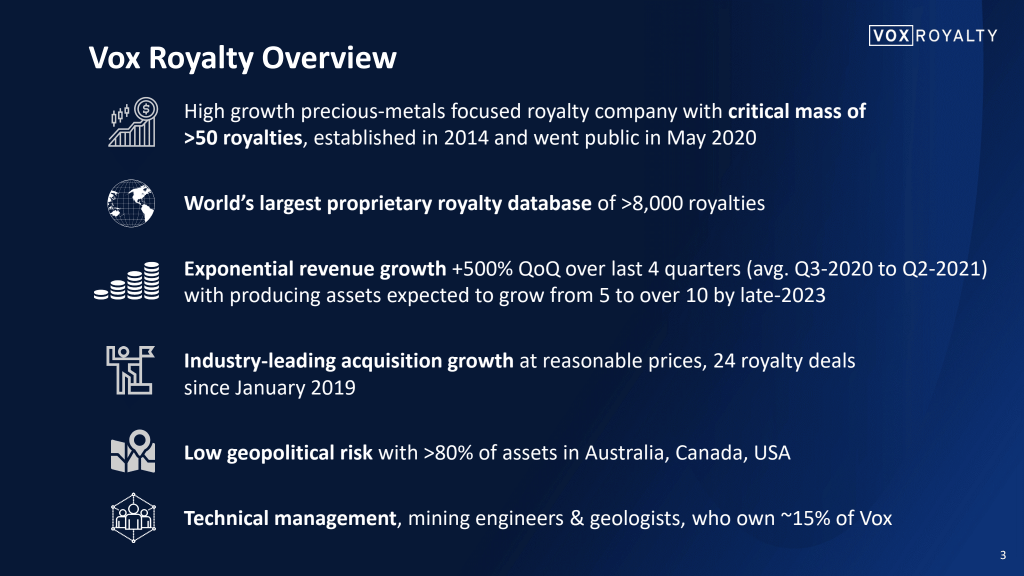
Dan Weir: Copper Bullet Mines is a new company we plan to take it public in the next 12 months. It’s run by a bunch of experienced mining guys. We have currently three geologists involved in the company. We have multiple engineers, mining engineers, metallurgical engineers, process engineers, guys that know how to mine. We have decided to focus on the Western United States.
Maurice Jackson: This may very well be the “Golden Age for Copper,” as many believe that copper is the new oil. Mr. Weir, please provide us with an overview of the supply and demand of copper.
Dan Weir: Yes, it’s very interesting. You’ve got Goldman Sachs and several companies have come out; Goldman Sachs uses the term “copper is the new oil.” If you look at a comparison, a combustible gasoline or diesel-burning vehicle has about 48 pounds of copper in it, but a Tesla or an electric vehicle has 183 pounds of copper in it. So, you can see here that it can be four, five times as much copper in an electric vehicle. So that’s just one aspect of it. Let alone the fact that we have to go across all over around the world building stations to recharge our electric vehicles, and our houses are all wired with copper wiring. More and more people are putting solar panels on their house. That means more wires, more copper is needed for that. Again, I look at Africa and only about 50% of Africa has electricity to people’s homes. That’s being built out as we move along. Other people call this is the “golden age for copper,” and I agree 100%.
Maurice Jackson: The value proposition of copper is quite compelling. Now, it’s early days for Copper Bullet Mines as the company’s currently private looking to go public. How does Copper Bullet Mines plan to meet the global demand for copper?
Dan Weir: We plan to focus on the western region of the United States. Currently, we are in what we call the copper triangle, which is in Arizona. Last month we purchased our first project the Copper Springs Project, which took about six months to put it all together. And that first project has historical resources, but we’re also looking for other assets. We are currently right now bidding on some producing assets. I can’t get into any details on those right now because we’re under confidentiality agreements, but we are looking for those types of assets, near-term type producing assets or producing assets, or something that has historical resources that we can bring up to a new resource by twinning holes. So, our focus and what we really would want to do is buy producing assets.
Maurice Jackson: Let’s go on site and find out more. Sir, take us to the “Copper Triangle” of Arizona and get us acquainted with the Copper Springs Project along with some of your neighbors.
Dan Weir: The Copper Springs Project is in the Copper Triangle, which is about one hour east of Phoenix. Some our neighbors in the Copper Triangle are the largest mining companies in the world, such as Rio Tinto, BHP, KGHM, Capstone and Asarco, which is owned by Grupo Mexico, and Freeport-McMoRan. We are surrounded by some of the largest mining companies in the world with mines in this area or are building a mine. And what I mean by building a mine, as an example, Rio Tinto and BHP, are spending billions of dollars to build the Resolution Mine. It will be one of the largest copper mines in North America when it’s completed. The Copper Springs Project is less than 12 kilometers away from the Resolution Mine.
Just to the north of us is Freeport-McMoRan. It has a copper smelter. There are only currently three, well, sort of three large copper smelters in the United States and one smaller one. Two of them just happened to be in the Copper Triangle, one with Freeport, just north of us, and the second at the bottom of the triangle owned by Asarco, and it’s called the Hayden Smelter. That smelter is being shut down. In the near future, the United States, is only going to have two full-sized copper smelters. One here, one up at Bingham Canyon in Utah, and then a small one in the Texas area. The Copper Triangle is probably the premier place in all of North America where you’re seeing copper production. And guess what? We’re right in the heart of the Copper Triangle.
Maurice Jackson: The Copper Springs is a shallow enrichment mineralization project with the historical resource, which is currently non-compliant to 43-101 standards. Provide us with some context and what is the plan moving forward to become 43-101 compliant?
Dan Weir: Over the last 50 to 60 years, there have been many different groups who have owned this project or optioned this project and have gone in and drilled at calculated resources on the Copper Springs Project. Companies like Kerr-McGee, Humble, American Copper, and most recently in around 2010, there was a small junior company called Toro Resources that had the project. And I must add to that, they had parts of the project. It wasn’t until I was able to come in here and put all of the claims together in this area. There were three groups that I had to work with. The groups had the claims. They had a package of eight claims that sat right in the middle of the claim block, and they have owned these claims since 1924. Their great grandfather had staked them, owned them in the family all that time. And this is the first time since the ’50s that this project has all been put together with all these claim packages under one option.
I’m not trying to pat myself on the back too much, but it was a lot of work, and it’s been a great experience putting this whole package together. Thus we now have a claim package of 126 claims over 2,600 acres. Our claim package that has had worked done over the years by some very large companies. Anglo-America recently visited the project in the last number of years. They say that this thing has huge potential, that we could be looking at similar to some of the others in the Copper Triangle, like Pinto Valley.
I’m not saying that that’s what we’re going to get. I believe from the data that we’ve looked at that we have a historical resource now, with 40 million tonnes grading around the 0.4% range. I’ve read several reports. Again, I can’t guarantee this, that there is potential here to be sort of 100 to 200 million tons. Let’s put that in some perspective. Even if we have 40 million tonnes and we have success twinning the historical holes, 40 million tonnes grading 0.4% is about 320 million pounds of copper.
The price of copper recently went up to the $4.60, $4.70 range. It’s pulled back in a little bit, but let’s use $4. It’s currently trading I think today at $4.25. Let’s call it $4. Multiply $4 times 320 million pounds of copper, you’re somewhere around $1.2 to $1.3 billion worth of copper sitting on this property right now. Now, again, there’s a lot of work to do. We’ll have to figure out recovery rates. We’ll have to figure out all sorts of things that go along with that. But I’m just throwing some big numbers out here because it does have some historical resources on here, and we believe that those historical resources are good. Again, until we do the drilling on here and twinned a bunch of these holes and bring it up to 43-101 standards, and do wish to be responsible with my words, these are just hypotheticals at the present.
Maurice Jackson: Sticking with the historical resource, please walk us through some of the historical drill locations.
Dan Weir: As I mentioned, several different groups drilled over time, including Kerr-McGee, Phelps Dodge, some different groups have kind of come in and out of this project. Some people will look at a project and go, “Well, these guys drilled and they didn’t find anything.” Well, they did find a lot. You talk to certain geologists or people that had been around the mining industry for a long time and one discovers that to put a project into production, there may have been about five or six junior companies, maybe a couple of larger companies that have done all of the resource studies and looked at it at so many different ways, and then you’re likely going to have one or two guys before it goes into production.
It’s very typical of these types of projects that you have multiple different people over time that will pick up claims. They’ll do some drilling, maybe they ran out of money, maybe the copper price dropped, all sorts of things. But I can tell you that in this area, as I mentioned, I’m the first one since the 1950s that’s been able to put this whole package together, and we have a lot of the old data that we can go on model, go back and drill and build a resource on the back of that.
Maurice Jackson: What can you tell us about the genetic and the exploration model?
Dan Weir: Another great thing is around 2011, several people went out and mapped the Copper Springs Project. We have talked to the geologists and some of them are PhD-type geologists who have gone out and done a lot of mapping on this project. Most of the work has been done in one area. There’s a massive area sort of on the east side of the deposit that has huge potential. And these guys have gone out and done a bunch of the mapping and again agree that there’s massive potential. And there has been very little activity on the east side of the deposit. The non-compliant historical was produced mainly from the west region of the deposit of 40 million tonnes grading about 0.4%, but there’s been very little work done on three-quarters of the project. We are confident that these is a much larger potential before on the Copper Spring Project. And again, I can’t guarantee this. I do believe that we can get too much higher numbers than 40 million tonnes.
Maurice Jackson: To coincide with mapping, I see that a geophysics study was completed in 2007. Now, will this suffice for a drill targeting, or is there a plan to conduct another survey, or do you plan to twin the historical holes?
Dan Weir: Yes we will twin some of the holes. We will do a lot more geophysics over the property. You can see from some of the maps, it was only done in the one area where they did most of the drilling. We do want to go back in here and want to do a lot more geophysics over that. Geophysics is a cheap way to do exploration. Remember that drilling is very expensive, so anything that you can do to pinpoint where you want to put those drills helps the geologists pinpoint exactly where we want to put the drill in the ground.
Maurice Jackson: Let’s discuss some important topics germane to your project. Are you fully permitted?
Dan Weir: The simple answer is no. There’s a lot of work to do over the next couple of years on here. We have to go out and get permits from the BLM [Bureau of Land Management] and the Forest Service to begin our drill program of twinning the holes. That should take to get the drill permits about six months. But as we’re applying for those permits, we can be doing a lot of the mapping work, IP work, as we decide exactly where we want to drill those holes. There’s lots of work to do here.
One thing I’m going to add here, Maurice, I mentioned earlier that we’re looking at buying some other properties, producing mines, one of them in Arizona. If we’re able to buy one of those mines, it’s close enough that we think we can just truck the ore from this property over to the operating mine, and utilize a lot of the infrastructure there. And it’s fully permitted and is in production. If we can take some of the ore from here and move it over to a producing mine, it should expedite the permitting process from the Forest Service to start mining because you’re not having to worry so much about leach pads and other things. Again, I can’t guarantee that that’s exactly what’s going to happen, but it is one model that we’ve been looking at.
Maurice Jackson: Is the Copper Springs Project 100% owned?
Dan Weir: We have optioned the project. It is an eight-year option process in which we have annual full cash payments, which most of the financing is backend loaded. So, from the first number of years, they are not onerous. And we have to do a certain amount of exploration work on the project. It is a great deal for us to move forward on this.
Maurice Jackson: What are the company’s goals and what strategy will the company use to accomplish its stated goals?
Dan Weir: I used to work for a brokerage firm on Bay Street or Wall Street for several years. I spent 12 years working at one of the top brokerage firms in all of Canada. When I left that firm, I spent another three years running the institutional sales desk for another firm. I have experience working on Bay Street or Wall Street and have been involved in financing mining companies.
One of the companies that we did a lot of work with, and I can remember doing the IPO for it in 2004, was a company called Quadra. When Quadra started, they bought one mine in Nevada called the Robinson Mine. They then took some of the cash flow that they were doing from that mine and then expanded out and started buying all sorts of other mines, not only the U.S. and into Chile. Then they went and bought another full company called FNX Mining. Maybe many of the people that will read this will remember Quadra or FNX. Ultimately, they sold it to a Polish company called KGHM for $2.5 billion. I’m not saying that we can do that, but that’s the type of model that we want to work on for this company.
I would love to be able to buy an operating mine. Again, as I said, we are bidding on several assets that are currently in operations, or that mines are in operation. If we can take that cash flow and everything else from that and start to build a company out, that’s really what I want to do. My chairman of the board is a gentleman named Daryl Hodges. He is a geologist. He worked all over the world for Falconbridge, including places like Norilsk in Russia looking for nickel, copper. He understands and gets that he and I are aligned; that’s what we want to build in this company. We want to buy assets that are in production or close to production. We also want to have some exploration plays like Copper Springs, the first one that we bought here, and grow and build a company. That is exactly what we want to do.
Maurice Jackson: We’ve discussed the good. Let’s address the bad. What can go wrong and what are your action plans to mitigate that wrong?
Dan Weir: We all know, anybody in the mining business, that mining is very cyclical. There can be ups and downs. I believe that the copper cycle here is going to be here for quite a while. Number one, because as we start to electrify more and more of the world, you’re going to see the demand for copper continue to increase. As we buy and drive more and more electric vehicles, you’re going to see big copper demand increase. In a lot of places in the world, Chile, as well as others, the copper grades continue to fall off at most of the mines around the world. Us focusing on places like Arizona to mitigate some of the risks, even Chile that produces most of the copper in the world is considering increasing some of its royalty rates. You’ve got Peru. They’re going through an election cycle here right now. We don’t know exactly what’s going to happen.
Peru and Chile produce the majority of the world’s copper. Therefore, we are focusing on places like Nevada and Arizona. Now, could things change in the United States? Could it get more difficult to get permits? That is always a risk. But I believe, and even if you look at the Fraser Institute, they rate the top two jurisdictions in the world to look at mining are Nevada and Arizona. And that is exactly where we want to focus, right in the heart of the Copper Triangle in Arizona. One hour outside Phoenix with infrastructure, with people that know mining, understand mining, and we can work and get highly skilled people. It’s a huge opportunity for us. But again, you’ve got to look at cycles, and mining can be very cyclical so that can cause big problems.
Maurice Jackson: Speaking of high-skilled people, Mr. Weir, please introduce us to your board of directors and management team, and what skill sets do they bring to Copper Bullet Mines?
Dan Weir: I mentioned earlier, Mr. Daryl Hodges. I mentioned earlier, too, that we have three geologists working with us; Daryl, we have another advisor to us, a gentleman named Herb Deurr. Herb is involved in some other junior publicly traded companies here in Canada. He lives in Reno. He is a prospector and a geologist and a brilliant guy. He has claims all over the United States, and even Puerto Rico. He’s been developing a project there as well. I’ve got engineers, like Keith Minty is a guy that built up North American Palladium, which now has been bought by Impala. We have Rich Warner as an advisor. He lives in Zurich. He’s Canadian, but lives in Zurich, works for some very high-end companies over in the Zurich area, and knows the mining industry, has worked in the mining industry all his life.
And again, our board right now, we have Doug Harris. He’s an accountant. He’s also the CFO of three other junior mining companies. So, we have the people. We also recently picked up another geologist who was the chief geologist of a mine in the Globe Miami area, right in the heart of the Copper Triangle. We have been talking to several permit experts that will likely come on board with this as we move forward here, too. We have been able to put together an absolutely amazing team who understand copper, who know copper, who have built mines, who have built processing plants, are PhD-type guys in metallurgy and metallurgical engineering. We have an amazing group of people that know how to do this.
Maurice Jackson: Who is Dan Weir and what makes them qualified for the task at hand?
Dan Weir: Again, as I mentioned, I spent several years working on Bay Street/Wall Street. I’ve spent the last 10 years working for mining companies. I’ve been on the board of directors of zinc and copper companies. I’ve been around the mining industry. I know the mining industry, but I also know that I’ve got to bring the right people with me. So, I see myself more of as a conductor of an orchestra in bringing all the right people together. I’m not a geologist, but I know a little bit about geology. But I know that I’ve got to bring the right people around me, the engineers, and everybody else to put this all together. So, we have a bunch of guys that are very hardworking, willing to roll up their sleeves, and have a lot of experience in the mining industry. And I consider myself one of those people as well.
It’s going to be interesting over the next couple of months as we go through the bidding process on some of these production assets, but right now we want to raise a million dollars as the seed round and then we will likely raise money at much higher prices.
Maurice Jackson: Mr. Weir, for readers who want to get more information on Copper Bullet Mines, please share the contact details.
Dan Weir: I may be reached at 416-720-0754. Or you can email me anytime at danweir@bulletmines.com.
Maurice Jackson: Last question, sir, what did I forget to ask?
Dan Weir: Well, Maurice, in some of the last projects that you and I have worked on together, you’ve traveled down to see some of the deposits. I think the next thing for you to do is come on down to Arizona and let’s go see the property because I’m sure you’re going to be very, very impressed with the property and the area inside the Copper Triangle. Seeing some of those smelters and some of the producing mines in the area, I think you’ll be very, very impressed. So, you know what? Ask me to get you on an airplane and get you down there, and over the next month or so, we will do that.
Maurice Jackson: Mr. Weir, it’s been a pleasure speaking with you today. Wishing you and Copper Bullet Mines the absolute best, sir.
And as a reminder, I am a licensed representative to buy and sell precious metals through Miles Franklin Precious Metals Investments, where we have several options to expand your precious metals portfolio, from physical delivery of gold, silver, platinum, palladium, and rhodium, to offshore depositories, and precious metals IRA’s. Give me a call at 855.505.1900 or you may email: Maurice@MilesFranklin.com. Finally, please subscribe to www.provenandprobable.com, where we provide: Mining Insights and Bullion Sales, subscription is free.
Maurice Jackson is the founder of Proven and Probable, a site that aims to enrich its subscribers through education in precious metals and junior mining companies that will enrich the world.
VANCOUVER, BC / ACCESSWIRE / July 20, 2021 / Metallic Minerals (TSX.V:MMG |OTCQB:MMNGF) (“Metallic Minerals“, or the “Company“) is pleased to announce the start of the first phase of drilling of up to 2,000 meters at the La Plata silver-gold-copper project in southwest Colorado along with an update on exploration activities to date. This initial diamond core drill program is designed to test and confirm mineralization in the central porphyry system, which hosts an historical resource estimate, as the first steps toward developing a new NI 43-101 compliant resource estimate.
The road accessible La Plata project covers 33 km2 approximately 26 km northwest of Durango, Colorado within the historic high-grade La Plata mining district located at the southwest end of the prolific Colorado Mineral Belt. Mineralization is related to a large-scale precious-metals-rich porphyry copper system with associated high-grade silver and gold epithermal vein and replacement deposits.
Project Highlights
Drilling to date within the central porphyry system has defined a northeast trending, near vertical zone of copper-silver-gold mineralization covering an area of at least 3 km by 1 km with over 1 km of vertical relief that remains open to expansion along trend and to depth with excellent potential for additional discoveries (see Figure 1).
Surrounding the central porphyry system is an associated high-grade silver and gold-rich epithermal system measuring at least 8 km by 2 km that hosts 56 identified vein, replacement, and breccia structures.
Historical production from some of these high-grade structures exceeded 1,000 grams per tonne (“g/t”) silver and over 15 g/t gold with some of the richest deposits delivering true bonanza grades for silver and gold1.
Drill hole LP-03 intersected 395 m of porphyry style mineralization grading 0.57% copper equivalent (0.51% Cu, 6.3 g/t Ag, and 0.017 g/t Au) including 108 m grading 0.75% copper equivalent (0.65% Cu, 7.7 g/t Ag and 0.034 g/t Au) starting from surface and with the hole ending in mineralization.
Exploration in 2021 is designed to expand known zones of mineralization and to advance a new NI 43-101 compliant resource estimate for the central porphyry system.
Project History
The La Plata district has a long and rich history of mining with the first silver deposits discovered in the 1700s by Spanish explorers. High-grade silver and gold production has been documented from the 1870s through the early 1940s from vein structures, replacement bodies and breccia zones at over 90 individual mines and prospects1. From the 1950s to 1970s, major miners including Rio Tinto (Bear Creek) and Freeport-McMoRan (Phelps Dodge) explored in the La Plata district focusing on the significant potential for bulk-tonnage disseminated and stockwork hosted mineralization2. Freeport-McMoRan retained ownership of claims in the district until 2002 when they sold their holdings to the current underlying vendors during the lows of the last metal price cycle.
A total of 54 drill holes totaling 14,400 m have been drilled on the property since the 1950s which confirm the presence of large-scale, multi-phase porphyry system with significant silver, gold and copper (see Table 1). This large-scale mineralized system is associated with a 10 km2 strongly magnetic signature with intense hydrothermal alteration.
Metallic Minerals is the first company to complete significant exploration on the La Plata project in nearly 50 years applying modern technologies and deposit modeling techniques. The Company sees the potential to rapidly extend the size of the known mineralized system and to identify and expand the higher-grade zones within the broader porphyry and epithermal mineralized zones.
Fieldwork completed by Metallic Minerals at La Plata to date has focused on resampling of drill core and underground sampling, surface mapping, and soil sampling. In addition, the Company has flown airborne resistivity and magnetics, completed a preliminary ground-based induced polarization survey and analysis of multi-spectral remote sensing data to establish mineralized anomalies and domains for the various styles of mineralization. This work has identified at least 25 anomalous targets within four broader target zones showing excellent potential to extend resources outside of the main historically recognized mineralized areas.
Allard Zone
Drilling to date on the Allard zone within the central porphyry system has defined a northeast trending zone of copper-silver-gold mineralization that begins at surface and continues to a depth of at least 850 m and more than a kilometer of strike. Recent underground chip channel sampling by Metallic Minerals within the Allard tunnel has confirmed a true width of 98.2 m grading 0.55% Cu Eq. across the zone including 61.6 m grading 0.65% Cu Eq. Historical drill hole LP-03 intersected 395 m of porphyry style mineralization grading 0.57% copper equivalent (0.51% Cu, 6.3 g/t Ag, and 0.017 g/t Au) including 108 m grading 0.75% copper equivalent (0.65% Cu, 7.7 g/t Ag and 0.034 g/t Au) starting at surface with the hole ending in mineralization.
Copper Hill Zone
Copper Hill is one of several additional parallel zones of copper and precious metals mineralization have been intersected in drilling, located 1.5 km to the southeast of the Allard zone it is also associated with significant platinum and palladium mineralization. The Company completed systematic analyses of unsampled core from the Copper Hill target area which returned significant results in an area with little previous drilling. Two zones of copper and precious metals mineralization were encountered in this drilling with an upper zone grading 0.27% Cu Eq. over 207 m and a lower zone of mineralization grading 0.44% Cu Eq. over 44 m with associated gold, platinum, and palladium mineralization. The Copper Hill target area represents a significant platinum group element-enriched copper mineralized target more than a kilometer vertically below the high-grade surface mining at the Copper Hill prospect and is completely outside of the historic resource area.
Figure 1– La Plata Long Section
Greg Johnson, President and CEO of Metallic Minerals, stated, “Metallic is the first company to complete significant exploration on the La Plata silver-gold-copper project in nearly 50 years and we are very excited to be kicking off this inaugural drill campaign. Our work to date has confirmed the multi-kilometer scale of the mineralized porphyry and epithermal system at La Plata through surface sampling, geophysics and satellite based remote sensing. This initial work has demonstrated the potential for the La Plata system to be much larger than previously recognized, with excellent potential to expand zones of known mineralization and to make new discoveries. We have begun 3D modelling of drilling and geophysical data with the objective of advancing towards a NI 43-101 compliant resource estimate for the project. We look forward to providing additional updates on drilling and modelling work in coming weeks and months at La Plata, as well as updates from our on-going work on the high-grade Keno Silver project and alluvial projects in the Klondike Gold district.”
Table 1 – Highlight significant mineralized drill and underground sample results from La Plata porphyry system
Hole ID
From m
To m
Width
CuEq.%
Cu %
Au g/t
Ag g/t
Pt g/t
Pd g/t
LP-01
0.0
854.4
854.4
1, 2
0.26
1
2
Including
573.9
828.4
254.5
1, 2
0.41
1
2
Including
623.0
638.2
15.2
0.45
0.36
0.034
6.86
3,5
Including
743.7
764.4
20.7
1, 2
1.15
1
2
LP-03
1.5
396.8
395.3
0.56
0.51
1
6.26
3, 5
Including
1.5
109.1
107.6
0.72
0.65
1
7.69
3, 5
Including
172.8
199.9
27.1
0.86
0.76
1
11.54
3, 5
LP-04
1.5
304.8
303.3
0.44
0.40
1
4.68
3, 5
Including
4.6
102.8
98.2
0.74
0.69
1
5.74
3, 5
Including
69.5
102.7
33.2
0.94
0.86
1
8.70
3, 5
C-01
1.1
416.9
415.8
1, 2
0.26
1
2
Including
299.3
363
63.7
1, 2
0.42
1
2
CA-03
0.0
304.8
304.8
1, 2
0.39
1
2
HEN-02
0
76.4
76.4
0.5
0.31
0.229
4.35
5
HEN-04
0.0
91.9
91.9
0.76
0.36
0.520
5.50
5
95-1
680.2
887.5
207.3
0.27
0.21
0.030
2.14
0.03
0.02
5
995.2
1039.4
44.2
0.44
0.15
0.030
1.46
0.14
0.10
5
1005.9
1027.2
21.3
0.5
0.21
0.047
2.05
0.19
0.16
5
Allard UG
48.6
146..8
98.2
0.55
0.46
0.030
4.76
4, 5
Including
51.7
113.3
61.6
0.65
0.55
0.030
5.55
4, 5
Table notes: 1 – incomplete gold assay data; 2 – incomplete silver assay data; 3 – gold and silver assay data from sample composites 6.1 to 12.2 m in length; 4 – Allard tunnel sawn channel samples collected in 2020; 5 – Cu Eq. % calculated using $3.25 lbs. Cu, $1,650/oz Au, $20/oz Ag, $1,000/oz Pt and $2,000/oz Pd in US$.
OTC Metals and Mining Virtual Conference
Metallic Minerals will be presenting at the upcoming Green Energy and Precious Metals Investor Conference hosted by OTC Markets on July 29 at 2:30pm ET. Chairman & CEO, Greg Johnson, will provide a comprehensive overview of the Company, including an update on 2021 exploration activities to date and upcoming newsflow, followed by a Q&A. To register, click here.
Foot notes: 1) Eckel, USGS Prof Paper 219, Geology and Ore Deposits of the La Plata Mining District, 1949; 2) Bear Creek Mining (now Rio Tinto), Humble Oil (now Exxon) and Phelps Dodge (now Freeport-McMoRan) company reports; 3) Christoffersen, Geological report on the Allard deposit, La Plata Mining District, Durango, Colorado, 2005.
About Metallic Minerals
Metallic Minerals Corp. is a growth-stage exploration company, focused on high-grade silver and gold projects in underexplored, brownfields mining districts of North America. Our objective is to create shareholder value through a systematic, entrepreneurial approach to exploration in the Keno Hill silver district, La Plata silver-gold-copper district, and Klondike gold district through new discoveries and advancing resources to development. Metallic Minerals has consolidated the second-largest land position in the historic Keno Hill silver district of Canada’s Yukon Territory, directly adjacent to Alexco Resource Corp’s operations, with nearly 300 million ounces of high-grade silver in past-production and current M&I resources. In addition, exploration at the recently acquired La Plata silver-gold-copper project in southwestern Colorado is targeting a silver and gold-enriched copper porphyry and adjacent high-grade silver and gold epithermal systems. The Company also continues to add new production royalty leases on its holdings in the Klondike gold district in the Yukon. All three districts have seen significant mineral production and have existing infrastructure, including power and road access. Metallic Minerals is led by a team with a track record of discovery and exploration success on several major precious and base metal deposits, as well as having large-scale development, permitting and project financing expertise.
About the Metallic Group of Companies
The Metallic Group is a collaboration of leading precious and base metals exploration companies, with a portfolio of large, brownfields assets in established mining districts adjacent to some of the industry’s highest-grade producers of silver and gold, platinum and palladium, and copper. Member companies include Metallic Minerals in the Yukon’s high-grade Keno Hill silver district and La Plata silver-gold-copper district of Colorado, Group Ten Metals in the Stillwater PGM-nickel-copper district of Montana, and Granite Creek Copper in the Yukon’s Minto copper district. The founders and team members of the Metallic Group include highly successful explorationists formerly with some of the industry’s leading explorer/developers and major producers. With this expertise, the companies are undertaking a systematic approach to exploration using new models and technologies to facilitate discoveries in these proven, but under-explored, mining districts. The Metallic Group is headquartered in Vancouver, BC, Canada, and its member companies are listed on the Toronto Venture, US OTC, and Frankfurt stock exchanges.
Forward Looking Statements: This news release includes certain statements that may be deemed “forward-looking statements”. All statements in this release, other than statements of historical facts including, without limitation, statements regarding potential mineralization, historic production, estimation of mineral resources, the realization of mineral resource estimates, interpretation of prior exploration and potential exploration results, the timing and success of exploration activities generally, the timing and results of future resource estimates, permitting time lines, metal prices and currency exchange rates, availability of capital, government regulation of exploration operations, environmental risks, reclamation, title, and future plans and objectives of the company are forward-looking statements that involve various risks and uncertainties. Although Metallic Minerals believes the expectations expressed in such forward-looking statements are based on reasonable assumptions, such statements are not guarantees of future performance and actual results or developments may differ materially from those in the forward-looking statements. Forward-looking statements are based on a number of material factors and assumptions. Factors that could cause actual results to differ materially from those in forward-looking statements include failure to obtain necessary approvals, unsuccessful exploration results, changes in project parameters as plans continue to be refined, results of future resource estimates, future metal prices, availability of capital and financing on acceptable terms, general economic, market or business conditions, risks associated with regulatory changes, defects in title, availability of personnel, materials and equipment on a timely basis, accidents or equipment breakdowns, uninsured risks, delays in receiving government approvals, unanticipated environmental impacts on operations and costs to remedy same, and other exploration or other risks detailed herein and from time to time in the filings made by the companies with securities regulators. Readers are cautioned that mineral resources that are not mineral reserves do not have demonstrated economic viability. Mineral exploration and development of mines is an inherently risky business. Accordingly, the actual events may differ materially from those projected in the forward-looking statements. For more information on Group Ten and the risks and challenges of their businesses, investors should review their annual filings that are available at www.sedar.com
Neither the TSX Venture Exchange nor its Regulation Services Provider (as that term is defined in the policies of the TSX Venture Exchange) accepts responsibility for the adequacy or accuracy of this release.
Vancouver, British Columbia – (July 13, 2021) – Rover Metals Corp. (TSXV: ROVR) (OTCQB: ROVMF) (FRA:4X0) (“Rover” or the “Company”) Rover has now received its first batch of rush assays for its first diamond drill hole CL-21-10 from its summer campaign. Rover is reporting an average grade of 5.71 g/t Au over 3.4 meters (true width). The Company is still waiting on assays for over 10 meters of hole CL-21-10. The reported grades are 90% higher than historic hole DDH-88-61 that was drilled at a similar location in the Beaver Zone in the 1980s. New hole CL-21-10 is a 400 meter step-out to the previously defined Arrow Zone that reported 32 meters of 13.6 g/t Au in Q4-2020.
Judson Culter, CEO of Rover Metals states, “the Phase 2 Exploration Drill Program was planned to target historic zones on the Cabin Gold property that carried sulfide rich historic results. We’re very pleased that the preliminary results of our program at the historic Beaver Zone are proving that high-sulfides continue to be associated with high-grade gold. The fact that we continue to increase the average gold grades across the property shows the exploration potential of the Cabin Gold Project. Additionally, we’re reporting true width intercepts of 3.4 meters at hole CL-21-10 due to the angle of the sulfide intercepts. It’s still early in the program, and we remain very optimistic on defining an additional zone comparable to the Arrow Zone. The historic Andrew South Zone is also being targeted in this summer’s drill program.”
For further information, please contact: Email: info@rovermetals.com Phone: +1 (778) 754-2617
Statement Regarding Forward-Looking Information
This news release contains statements that constitute “forward-looking statements.” Such forward-looking statements involve known and unknown risks, uncertainties and other factors that may cause Rover’s actual results, performance or achievements, or developments in the industry to differ materially from the anticipated results, performance or achievements expressed or implied by such forward-looking statements. Forward-looking statements are statements that are not historical facts and are generally, but not always, identified by the words “expects,” “plans,” “anticipates,” “believes,” “intends,” “estimates,” “projects,” “potential” and similar expressions, or that events or conditions “will,” “would,” “may,” “could” or “should” occur. There can be no assurance that such statements be prove to be accurate. Actual results and future events could differ materially from those anticipated in such statements, and readers are cautioned not to place undue reliance on these forward-looking statements. Any factor could cause actual results to differ materially from Rover’s expectations. Rover undertakes no obligation to update these forward-looking statements in the event that management’s beliefs, estimates or opinions, or other factors, should change.
THE FORWARD-LOOKING INFORMATION CONTAINED IN THIS NEWS RELEASE REPRESENTS THE EXPECTATIONS OF THE COMPANY AS OF THE DATE OF THIS NEWS RELEASE AND, ACCORDINGLY, IS SUBJECT TO CHANGE AFTER SUCH DATE. READERS SHOULD NOT PLACE UNDUE IMPORTANCE ON FORWARD-LOOKING INFORMATION AND SHOULD NOT RELY UPON THIS INFORMATION AS OF ANY OTHER DATE. WHILE THE COMPANY MAY ELECT TO, IT DOES NOT UNDERTAKE TO UPDATE THIS INFORMATION AT ANY PARTICULAR TIME EXCEPT AS REQUIRED IN ACCORDANCE WITH APPLICABLE LAWS.
VANCOUVER, British Columbia, July 15, 2021 (GLOBE NEWSWIRE) — Lakewood Exploration (CSE: LWD / OTC: LWDEF) (“Lakewood” or the “Company”) is pleased to announce results from a sampling program at the Company’s newly acquired past-producing Silver Strand Mine located in the storied Coeur d’Alene Mining District of Idaho.
A total of 14 rock chip samples were collected from altered and mineralized surface and underground exposures. Two grab samples were collected to verify high grade silver and gold values from a previous sampling program from which a sample reported 1,669 grams per tonne (g/t) silver (Ag) and 9.77 g/t Gold (Au) (See June 28, 2021 News Release). Assays from the two verification samples PN614015 and PN614014 returned 2,744.91 g/t Ag & 4.80 g/t Au and 238.29 g/t Silver & 3.60 g/t Gold, respectively.
Lakewood President, Morgan Lekstrom stated: “These high-grade underground sampling results suggest to us that the potential for substantial high-grade mineralization is present at Silver Strand. Obtaining gold and silver values from reconnaissance surface sampling 1 km to the southeast of Silver Strand is also highly encouraging and demonstrates the potential to outline a significantly more extensive vein system within our expanded property package.”
Twelve surface rock chip samples were collected along road cuts and logging trails immediately to the southeast of the Silver Strand property prompting additional claim staking. The surface samples consist of quartz-FeOx veins and veinlet zones, consistent with known mineralization at Silver Strand, and indicate that these mineralized zones continue for approximately 1 km to the southeast. Sample results range from 1.71 g/t Ag to 8.23 g/t Ag with anomalous gold up to 0.21 g/t Au. These new surface results along trend provide the Company with new key data that will support efforts to vector towards higher-grade Au-Ag mineralization along strike, in addition to the potential depth extensions below the shallow historical mining at Silver Strand.
The samples were analyzed by Chris Christopherson of CCI laboratory, in Smelterville, Idaho. Samples were analyzed by fire assay methods with a gravimetric finish for gold and silver.
Qualified Person
Technical aspects of this press release have been reviewed and approved under the supervision of Philip Mulholland, P.Geo. Mr. Mulholland is a Qualified Person (QP) under National Instrument 43-101 Standards of Disclosure for Mineral Projects.
About Lakewood Exploration
Lakewood Exploration is a junior resource company that controls the Lacy Gold Project in British Columbia, Canada, and the past-producing Silver Strand Mine in the Coeur d’Alene Mining District in Idaho, USA. The Company is rapidly advancing towards an initial drill program at Silver Strand with the aim of defining a large silver resource within a belt that has produced more than 1.2 billion ounces of silver to-date. Geologic studies indicate that the Silver Strand Mine is hosted by the Revett formation, suggesting the potential for significant down dip extensions as demonstrated by other major mines in the district. Previous operators were solely interested in developing the known shallow mineralization, with the mine’s lowest level extending only 90 metres below surface. Lakewood strives to become a multi-mine silver producer.
*Mineralization hosted on adjacent and/or nearby properties is not necessarily indicative of mineralization hosted on the Company’s property.
On Behalf of the Board of Lakewood Exploration Inc.
Morgan Lekstrom
President
Corporate Office: 551 Howe Street, Vancouver, British Columbia V6C 2C2, Canada
The CSE has neither approved nor disapproved the contents of this news release. Neither the CSE nor its Regulation Services Provider (as that term is defined in the policies of the CSE) accepts responsibility for the adequacy or accuracy of this release.
Vancouver, British Columbia–(Newsfile Corp. – July 15, 2021) – Riverside Resources Inc. (TSXV: RRI) (OTCQB: RVSDF) (FSE: 5YY) (“Riverside” or the “Company”) is pleased to announce that an additional US$5,400,000 in exploration funding is being granted to advance four (4) previously generated copper projects as part of the expanding copper exploration program with BHP in Sonora, Mexico (see Figure 1 below). This new funding of at least US$5,400,000 is in addition to the US$1,300,000 allocated for the next generative phase of exploration work, which began two months ago on May 15th, 2021. Program funding highlights for the new project-focused funding are summarized below:
Drilling funding has been allocated for the Chuin Project, including an initial 4,500 metres (“m”) of drilling to test three geophysical centres within the Chinalito Target area.
Drilling funding budgeted for the Palofierro Project, including 4,500 m stratigraphic core drilling to cut bedrock beneath post-mineral cover and test for Laramide aged porphyry potential.
Geophysics funding designated for a close spaced MT (Magneto-telluric) Survey at Sinoquipe, designed to uncover conductive bodies (i.e., potential porphyry copper deposits) underneath post-mineral conglomerate cover.
Geophysics funding budgeted for a broadly spaced MT Survey and geophysical targeting at Peñitas which will lead toward drill targeting.
The permitting process for drilling at Chuin and Palofierro is already underway. The MT Survey’s at Sinoquipe and Peñitas are expected to commence after contractors are secured and the results from the deep geophysics work has the potential to lead to further drilling programs based on results.
Riverside’s President & CEO, John-Mark Staude : “We are pleased to work closely with BHP’s geoscientists and their exploration group as the porphyry copper targets we have identified continue to progress towards drilling. These projects and corresponding exploration campaigns expose our shareholders to incredible upside and catalysts that have the potential to create significant value for the Company. Riverside and BHP recently completed a weeklong technical field trip, which culminated with the approval by BHP of this additional US$5.4Million in exploration funding. In total, the additional budget allocation brings Riverside’s 2021 funding for copper exploration to over US$6.7M. We see excellent potential for continued growth in the well-endowed and under-explored southern extension of the Arizona-Sonora world class porphyry copper belt.“
These four projects include the previously highlighted: Chuin, Palofierro, Sinoquipe, and Peñitas properties (see press release dated June 21, 2021). The projects have now been approved for full funding to move toward drilling on the Chuin and Palofierro projects and deep geophysics on the Sinoquipe and Peñitas projects which would lead toward additional drill decisions in the near future and will be ongoing for a third consecutive year (see press release dated May 27, 2021). Sinoquipe and Peñitas will be progressed with geophysical studies similar to those done at Chuin and Palofierro where BHP and Riverside are preparing targets for upcoming drill programs.
Figure 1: BHP Riverside Exploration area for copper and portfolio of projects owned by Riverside and BHP/Riverside Program
Chuin Project: Funding of 4,500 m of core drilling to test the main Magneto-telluric (MT) anomalies discovered through last year’s funding. This first phase of drilling is focused on 3 geophysical centers identified at the Chinalito Target, which if successful could trigger an expanded drilling program as a Defined Project (“DP”) as outlined in the reference terms of the Exploration Funding Agreement (“EFA”). Environmental permitting for drilling is being progressed. Chinalito remains the priority copper target for Riverside.
Palofierro Project: Funding of 4,500 m of stratigraphic core drilling to probe bedrock beneath the post-mineral units and evaluate the basement geology for Laramide style porphyry Cu potential to the east of the Opodepe Mo-Cu porphyry district and west of exposed high sulfidation and upper-level porphyry copper geology where the Riverside-BHP target area is covered by post-Laramide gravel. This target area is defined by combining gravity survey results with geological mapping of the margins of the Rayon, Sonora Tertiary pediment, with the Company having found positive indicators for potential porphyry system at the margins of the basin and exploration data vectoring toward underneath the post-mineral cover. Environmental permitting for drilling is in progress.
Sinoquipe Project: Funding of an extensive and close-spaced MT survey which includes over 250 stations and is expected to start in late July 2021 pending weather and contractor availability. The interpreted target at Sinoquipe is a porphyry copper system projected under varying thickness of post-mineral conglomerate and possibly some Tertiary volcanics, where both margins of the basin show compiled geological evidence that indicates large potential for porphyry copper underneath the gravels. The purpose of this survey is to find conductive bodies that will potentially turn into drill targets in the coming months. This work builds on the 2021 field programs of sampling, mapping and targeting that remain on-going.
Peñitas: Funding of an open-spaced MT survey that comprises 150 stations to cover multiple target areas already identified with geological mapping and geochemical sampling. Similar to Sinoquipe, Peñitas has multiple targets that are projected under post-mineral cover and the aim of the survey is to detect large conductive bodies that would eventually generate geophysical drill targets.
Qualified Person & QA/QC:
The scientific and technical data contained in this news release pertaining to the BHP Exploration Financing Agreement was reviewed and approved by Freeman Smith, P.Geo, a non-independent qualified person to Riverside Resources, who is responsible for ensuring that the geologic information provided in this news release is accurate and who acts as a “qualified person” under National Instrument 43-101 Standards of Disclosure for Mineral Projects.
About Riverside Resources Inc.:
Riverside is a well-funded exploration company driven by value generation and discovery. The Company has over $4M in cash, no debt and less than 72M shares outstanding with a strong portfolio of gold-silver and copper assets and royalties in North America. Riverside has extensive experience and knowledge operating in Mexico and Canada and leverages its large database to generate a portfolio of prospective mineral properties. In addition to Riverside’s own exploration spending, the Company also strives to diversify risk by securing joint-venture and spin-out partnerships to advance multiple assets simultaneously and create more chances for discovery. Riverside has properties available for option, with information available on the Company’s website at www.rivres.com.
ON BEHALF OF RIVERSIDE RESOURCES INC.
“John-Mark Staude”
Dr. John-Mark Staude, President & CEO
For additional information contact:
John-Mark Staude President, CEO Riverside Resources Inc. info@rivres.com Phone: (778) 327-6671 Fax: (778) 327-6675 Web: www.rivres.com
Certain statements in this press release may be considered forward-looking information. These statements can be identified by the use of forward-looking terminology (e.g., “expect”,” estimates”, “intends”, “anticipates”, “believes”, “plans”). Such information involves known and unknown risks — including the availability of funds, the results of financing and exploration activities, the interpretation of exploration results and other geological data, or unanticipated costs and expenses and other risks identified by Riverside in its public securities filings that may cause actual events to differ materially from current expectations. Readers are cautioned not to place undue reliance on these forward-looking statements, which speak only as of the date of this press release.
Neither the TSX Venture Exchange nor its Regulation Services Provider (as that term is defined in the policies of the TSX Venture Exchange) accepts responsibility for the adequacy or accuracy of this release.