Joining us for a conversation is David Cole, the CEO of EMX Royalty (NYSE: EMX | TSX.V: EMX), the Royalty Generator.
Maurice Jackson:
Honored to have you with us today sir, as you have some breaking news for shareholders, as EMX Royalty has just consummated a watershed moment with the announcement of the Royalty Portfolio purchase agreement with SSR Mining (Press Release). Mr. Cole, thank you for allowing me to be the first to say congratulations’ sir on a significant milestone on what may be the biggest company event in the history of EMX Royalty.
David Cole:
We are very pleased with this transaction, pleased to have SSR Mining as a shareholder in the company, and it’s been a pleasure to work with them.
Maurice Jackson:
Let’s get right into the press release, the EMX Royalty acquisition consists of 18 geographically diverse royalties with 4 royalty assets at advanced stages of project development. Please provide us with the details of the Royalty Purchase Agreement with SSR Mining.
David Cole:
Well, we’re paying $66 million upfront for this portfolio, $33 million in share capital, and $33 million in cash, which are deferred payments depending upon the performance of the Yenipazar net profit interest royalty in Turkey. Those deferred payments accumulate up to $34 million, but that’s not until that asset cashflows $20 million. We’re pleased with respect to how this is designed. This gives SSR Mining a nice chunk of equity in the EMX which is one of the key things that they were looking for when they chose us to sell the Royalty Portfolio.
Maurice Jackson:
What type of value creation will EMX derive from this transaction and how will it impact the synergies with the existing EMX initiatives around the world?
David Cole:
One of the key things here is immediate large cash flow. The Gediktepe mine which is at the final stages of construction and should be in production within a month or two has a high-grade oxide cap that’s gold enriched with a 10% NSR and we’ll see immediate gold royalty income over double-digit millions of dollars per annum from that royalty right out of the gate. We’re very, very pleased with that so this really propels at the top of our pyramid forward, which is something that we’ve been working on for some time as we’ve discussed previously, with respect to Synergies with our existing portfolio, and one of the reasons why we were able to grab this is because of our relationships in Turkey and our comfort with Lydia as an operator there. And that gave us an edge with respect to working with SSR to accomplish this deal.
Maurice Jackson:
One of the key aspects of this transaction along with all of EMX Royalties is something you’ve covered with us and that is the value proposition of embedded optionality, which is just icing on the cake for each of your royalty properties. Can you please elaborate on the virtues of embedded optionality within royalties?
David Cole:
It’s one of my favorite topics and it’s the reason why royalties traded such premium valuations is because of all the embedded optionality, commodity price optionality, discovery optionality, engineering advancement optionality, et cetera, et cetera. And mining districts have a history of giving and giving and it’s always to the benefit of the royalty holder and no cost to the royalty holder. So that’s why royalties are so dear and I will point out that royalty companies that have large numbers of royalties trade at a much higher valuation per royalty than royalty companies, so the lower number of royalties, this is a phenomenon that’s existed in the royalty sector now for some time. Where the portfolio effect impacts the overall valuation of that portfolio and that’s because of this multiplicative optionality of the entire portfolio. You never know where the big success is going to come from years out.
David Cole:
As you know our goal here is to continue to grow this portfolio through organic methods which we’re good at and have had a track record for 18 years of doing, but also through acquisition. And we’ve been challenged quite honestly, to accomplish big creative acquisitions because it’s a competitive space. That we’ve been very patient. We stood at the plate and they kept throwing more pitches at us and we found one to hit and hit it out of the park.
Maurice Jackson:
Great way to put it, sir. I referenced a watershed moment. Where does today’s press release rank with the relation to the Malmyzh and/or the Timok?
David Cole:
Well, that’s interesting certainly the value proposition of the Timok acquisition is unbeatable because we paid $200,000 Canadian dollars for a royalty that’s going to pay hundreds of millions. So that one’s astonishing, but that had to do with the fact that we were in that district and understood what was going on there very early in the history of the discovery and were able to acquire that royalty early on thanks to our geologic understanding of the region. That’s a tough one to compare. With respect to the Malmyzh transaction that was a fantastic deal that cashed-up EMX and put us in a position where we could do this deal.
David Cole:
And step-by-step we’re building this company. Very pleased with these transactions. Malmyzh was super accretive for us. As you know, we booked $67 million US dollars out of that deal and have put those monies to excellent work. This being the top example. You and other folks have asked me many, many, many times, “What are you going to do with the money, Dave, what are you going to do with the money”? We just kept looking and turning down opportunities and losing sales processes because our bids weren’t as high as our competitors until the right one came along. And one of the key aspects that made this deal happen, as I mentioned, is the fact that SSR specifically wants to be a shareholder in EMX. And I’ve said before that the right transaction that’ll really advance this company is going to be one where the major companies selling their royalties understand the value proposition that EMX offers and want to be a contributor, want to be a member of the team.
Maurice Jackson:
Speaking of the Timok, which is a company making event in and of itself, what are the latest developments there?
David Cole:
It’s going into production. I do believe that they had a couple of delays. So they were originally talking about an opening ceremony in June. I believe that’s been pushed back to August at this point, maybe September, but that’s still ahead of the original schedule. The Chinese have been very aggressive. It’s advancing into production.
Maurice Jackson:
Leaving the property bank Mr. Cole, please provide us with the capital structure for EMX royalty.
David Cole:
Well, we’re sitting here today with $84 million shares issued and outstanding and few over $90 million shares fully diluted. That’s not including the shares that we will issue to SSR, which on a pro forma basis will be approximately 12% of the company. So that’ll push us up towards the 95 issued outstanding and over a hundred million fully diluted at the completion of this transaction, which should hopefully occur within four to five weeks in my opinion. Sitting here today with about $30 million US dollars in cash, of course, those monies get paid to SSR as part of this transaction as well.
David Cole:
We have about $20 million in tradable securities and long-term investments in our portfolio as well and no debt at this time. However, we will be taking on a small $10 million debt from Sprott. We appreciate their support as a capital partner for EMX. They’ve helped us out in the past as well. That puts us in a situation where even though we’re putting out USD $33 million to SSR for this transaction, thanks to Sprott we’ll still have a nice cushion here with respect to money in the treasury to continually advance our organic growth, which is our job one, as you know.
Maurice Jackson:
Just for the record, ladies, and gentlemen, I plan to match my bullion purchases with shares and EMX royalty. I believe the company has the potential to melt-up. And I’m talking about the stock price of course. The stock price, in my opinion, is at a fire sale. And that is Maurice Jackson’s opinion, but not really just my opinion, Mr. Cole, you and I both know some of the most prominent names in the natural resource space. They share the same sentiment about EMX royalty.
David Cole:
Happy to have those guys on as contributors.
Maurice Jackson:
Yes, sir. In closing, what would you like to say to shareholders?
David Cole:
EMX Royalty is in a situation here today where the Bayla royalty of 4% royalty on the lead, zinc, silver mine in Turkey is coming into production. Zijin is advancing the Timok project towards production, of course, Leeville in the background that pays every month. And we have an immense amount of optionality within our pyramid is bubbling up towards the top. And these names I’m throwing out are just examples of that. We’ve talked about the potential for this to become a cash cow over time. We’ve just poured fuel on the fire. We put gasoline on the fire here with this one and the Gediktepe 10% NSR and the oxide gold cap will just propel our gold income in the company here substantially over the next three years. We’re very excited.
Maurice Jackson:
Mr. Cole, for readers that want to get more information about EMX royalty please share the website address.
David Cole:
www.emxroyalty.com -The contact details for myself, Scott Close, and Isabel Belger managing European investor relations, and Scott here in North America are embedded in the website and on the press release feel free to reach out to us.
Maurice Jackson:
Mr. Cole, it’s been a pleasure speaking with you, wishing you and EMX royalty the absolute best, sir.
David Cole:
Thank you, Maurice. Always appreciate your support.
Maurice Jackson:
And as a reminder, I am a licensed representative to buy and sell precious metals through Miles Franklin Precious Metals Investments, where we have several options to expand your precious metals portfolio, from physical delivery of gold, silver, platinum, palladium, and rhodium, to offshore depositories, and precious metals IRA’s. Give me a call at 855.505.1900 or you may email: Maurice@MilesFranklin.com. Finally, please subscribe to www.provenandprobable.com, where we provide: Mining Insights and Bullion Sales, subscription is free.
CNN Chile featured Hot Chili in a recent story about the Company’s exploration activity in the country, including their discovery of copper and gold at the Cortadera Project. Learn more about Hot Chili: https://www.hotchili.net.au/ ASX: HCH OTCQB: HHLKF
Joining us for conversation is Morgan Lekstrom, the president of Lakewood Exploration (CSE: LWD: OTC: LWDEF). It’s great to have you join us today to share the latest developments on Lakewood Exploration and the exciting flagship Silver Strand, which has the makings of becoming the next pure silver play in the United States. Before we begin, Mr. Lekstrom, please introduce us to Lakewood Exploration and the opportunity the company presents to shareholders.
Morgan Lekstrom:
Lakewood is a new silver company. We’re a pure silver play. We are looking at our flagship asset in Idaho, the Silver Strand Mine. It was a past-producing mine, and we are looking to go in there, explore it, put the ore body to depth. It was mined at a very shallow depth, only 90 meters. There’s so much potential there. It was held in by a bunch of feuding parties back in the day. The whole land package has never been consolidated like what we’ve done.
Morgan Lekstrom:
And by consolidating this land package, we’re able to get a five-and-a-half-kilometer strike put together, and which allows us the opportunity to explore the area. From what we’re seeing on the surface and in the underground, and we’ll talk about those news releases later, it looks very promising to have a large, large resource and payoff for shareholders, but also near-term production potential, which is the pillar of what we are looking to accomplish at Lakewood.
Morgan Lekstrom:
Lakewood Exploration is looking for that large exploration payoff, near-term production potential, but also acquisitions at the same time that fit that model. We do have a triple-pronged approach and our big concentration right now is on that large exploration payoff at Silver Strand.
Maurice:
The value proposition is quite compelling. Let’s go on-site. Mr. Lekstrom, please introduce us to your flagship Silver Strand and acquaint us with the region and some of your neighbors.
Morgan Lekstrom:
Silver Strand is our flagship mine. It’s in Idaho, in the Silver Valley-Coeur d’Alene, which is one of the most prolific areas on the planet for silver. The region has produced nearly 1.3 billion ounces of silver. Companies such as Hecla and Coeur have their start there. You also have the deep mines within the region, the Lucky Friday Mine, Galena, and Sunshine respectively.
Morgan Lekstrom:
There are not a lot of regions in the world that have extracted as much silver as the Silver Valley-Coeur d’Alene. The Silver Strand is one of the last, I would say, unexplored assets in this area. This is such an exciting opportunity for us. As a pure silver company, we look forward to putting this to depth. Our neighbors in the valley have mines go down to 2,000 meters. We have only scratched the surface, as the Silver Strand is at 90 meters of the original workings.
Morgan Lekstrom:
We’re going to start drilling the Silver Strand, with an emphasis to start pushing that ore body down to prove it. The unique thing about Silver Strand too is that we have something called a gold credit. What that means is there’s a portion of the ore that comes out that has gold in it. And unlike the rest of the mines around the area, this is actually very high-grade gold. What we’d consider higher-grade, which is 5 grams a tonne of what we’re looking at is 5 to even 10 grams a tonne.
Morgan Lekstrom:
To put that into terms, most mines are built on 1 gram a tonne or less. Silver mines. Most mines are built on 100, 200 grams a tone. We’re seeing anywhere from 300 to 2,700 grams a ton out of Silver Strand (Press Release), and this is just the top. If anything is proven in this area, the deeper you go, the better the grade. We’re looking forward to running our exploration program and getting going on this.
Maurice:
The Silver Strand has a historical resource. What is the exploration plan and timeline moving forward to have a complaint NI 43-101?
Morgan Lekstrom:
We’re currently working on our 43-101 in the background, and we plan update the market by the end of summer. We are looking to run the first-stage of our exploration program, as we’ve been saying, by the end of late summer. We’re working on our plans right now. I work all the time with our geology team and making sure we’re looking at the right area and the right mix of geology. We don’t want to do things in an unmethodical way.
Morgan Lekstrom:
In our latest announcement, we were proud to convey that we brought on Rob Burk (Press Release), which is just a tremendous value add for us. Ron is an exceptional geologist and exceptional exploration leader. He’s worked for some huge companies like Centerra Minnig and TecK Resources. Having calls with Ron and having that advisor in the background has helped us already hone in on what we’re looking at in terms of exploration. Also, how we can make the Silver Strand resource 43-101 compliant, build it out and make it a huge discovery. The upside potential of this resource is massive. I mean, if anything from that area, I mean, anything as an indicator, it’s there, in my opinion.
Maurice:
Having the intellectual capital of someone like Mr. Burk doesn’t show up on the balance sheet, but those are the accretive moves that a company has to make to achieve success. Now that we know the plan, let’s test the ‘Proof of Concept’ to date. Since our inaugural interview two months ago, Lakewood Exploration has had some exceptional sample grades. What can you share with us?
Morgan Lekstrom:
Absolutely. As stated earlier, we just announced 2,744 grams a tonne (Press Release). Keep in mind, most mines are built on 100 to 200 grams a tonne silver. We’re getting that from our existing underground, which everyone said, “Oh, it’s been mined out.” Our geologists go in there with new techniques, new technology. They take chip samples in areas, and it’s just a key indicator for us that there’s that high-grade mineralization. We’re seeing it on the surface as well.
Morgan Lekstrom:
There are outcrops all over the place. Having the ability to walk along this 5.5 kilometers strike length has helped us and help build the Silver Strand story out, along with the upside potential of this resource. Being able to walk on ground that hasn’t been walked up to our Burnt Cabin asset gives us confidence that we may be onto something very intriguing. And if anything that is shown by our results of that between 1,700 and 2,700 grams a ton just from chip samples, there’s a huge potential here.
Maurice:
Certainly sounds like it is. Well, let me ask you this, were the sample grades a surprise, or is this what the team had expected?
Morgan Lekstrom:
You expect good results, or you hope for good results. But honestly, I wasn’t expecting to see 2,700 grams a ton right away off a chip sample. It was unexpected, but it was also encouraging. These high grades reaffirmed to the team in the background that we’re doing the right thing. We’re looking in the right areas. And that when we begin the first phase of our exploration program, we’re going to be looking in the right area.
Morgan Lekstrom:
We have something a lot of companies don’t have, which is that existing underground, the ability to go in the historical mining there that was just hand to mouth small scale. We have the ability to blow this resource out big and score some value for the shareholders.
Maurice:
Multilayer question here, and you referenced drilling, what activity is currently being conducted on-site, and is the goal to twin the historic holes?
Morgan Lekstrom:
I can’t provide the full details on that currently, as we are finalizing the plans, and then we’ll have a news release around that. But I can tell you that we’re looking at extending the current non-43-101 compliant resource to depth, to use the words you used, to ‘Proof of Concept’, which is more than a concept for us. We want to show that identity between the mineralization we’re seeing on the surface, the gold credit, see how far that goes, and we also want to get this thing to depth.
Morgan Lekstrom:
Like I said before, a lot of these mines in the area go down to like 2,000 meters, and we’re only at 90. For us, it’s all about drilling and getting down there and chasing that resource down.
Maurice:
Before we leave the site, what is the next unanswered question for Lakewood Exploration? When can we expect a response, and what will determine success?
Morgan Lekstrom:
I’d say the next unanswered question for Lakewood is, what’s in the pipeline as far as acquisitions? And all I can say on that is stay tuned. What’s going on at Silver Strand for drilling? We’re looking forward to drilling in the late summer. Plus, we’re adding very, very competent, meaningful people to our team.
Morgan Lekstrom:
My background as a mine builder, I’ve worked all over the world building mines for large companies, small companies. It changes the dynamic of the team when you have geologists, amazing capital markets people, and mine building folks in the mix. We do have what it takes to take something through exploration, make the resource huge, and build it. That’s a very unique position for us and for the mining industry.
Maurice:
Yes, sir. The synergies complement one another with Lakewood Exploration. You have experts with a proven pedigree of success. You were brought on board recently, as well as Mr. Burk, and who else was added to the team, sir?
Morgan Lekstrom:
We have Lawrence Roulston. We have Ron Burk, like you mentioned. Myself. We have Kristina Pillon. She’s our head of IR. She’s unbelievable in what she does as well. And just lots of energy in our team so far. We’re going to add a lot more people in the right time and the right positions.
Morgan Lekstrom:
We added our chief geologist, I can’t forget him, Phil Mulholland. Phil is an exceptional geologist with a proven track record in the Western US, in Idaho as well. He’s worked all around the Coeur d’Alene area. He’s worked all over Montana. He’s worked for big companies like Barrick. I just can’t say enough good things about Phil and his dedication to the profession, but also to the Silver Strand project. The ideas that flow, we’re just approaching it with a very unique and new technology.
Morgan Lekstrom:
And Phil’s the right person to be working with that side of it, his ideas and the crew, between him and Ron and how we all communicate together. We have Joness Lang in the background too who’s an also a proven capital markets expertthere and he’s senior VP for Maple gold.
Maurice:
Switching gears, let’s look at some numbers. Mr. Lekstrom, please provide the capital structure for Lakewood Exploration.
Morgan Lekstrom:
We have about 33.8 million shares out. We have about 7.5 million share free trading right now. We’ve got 7.5 million warrants out, and we’ve had a very good run so far. Very successful. I think we’re hitting all the right tunes and all the right notes with our capital structure. It’s very tightly held. We’re in a very good place from a capitalization standpoint and a treasury standpoint. We just raised 3.5 million dollars with 14 million shares. We are well-positioned to execute and to execute on exactly what we’re saying and won’t need more capital anytime soon.
Maurice:
You’re also rewarding shareholders. Speaking of the market cap, Lakewood Exploration has been on a roll. Since our inaugural interview on May 31st, the stock was trading at $.29, and since has moved up to $.76. Congratulations, sir.
Morgan Lekstrom:
Thanks, Maurice. It’s exciting and positive to see the markets responding to the Silver Strand and the Lakewood story, but also to the capital structure and how this whole company has been structured is important to a shareholder to know that there is a lot of room to grow, but it’s also tightly held. It’s not just a large vehicle of shares out everywhere. We’re making sure that we have the ability to bring the value of the shareholders in a meaningful way.
Maurice:
And speaking of shareholders, I am a proud shareholder, by the way.
Morgan Lekstrom:
Oh, thank you.
Maurice:
Honored. Before we close, Mr. Lekstrom, what would you like to say to shareholders?
Morgan Lekstrom:
And I know I said this earlier, be on the lookout for the execution of our three-pronged approach on the acquisition side, stay tuned.
Maurice:
Looking forward to it. What keeps you up at night that we don’t know about?
Morgan Lekstrom:
I’ve been on many projects around the world, and there’s been a lot of times I’ve been kept up late at night for reasons I don’t want to go into it. But here with Lakewood Exploration and the Silver Strand. I’m not kept up at night because we have such a competent team. We have such good leadership in the right places. If there is something, we work it out right away. We have enough credible experience around us to solve challenges and not to delay. It’s a unique position as a company, but even for me to be the president of the company to have that ability to lean on technical experts like Ron Burk, to lean on our VP of exploration Lawrence Roulston when we need to and collaborate and have those great conversations. It’s unique.
Maurice:
Last question, what did I forget to ask?
Morgan Lekstrom:
As much as I say, we’re in the makings of a great mining company, I just remind people that silver is one of these commodities that isn’t just a hedge. It’s used in manufacturing. It’s used in making of video cards for cryptocurrency mining. It’s used in making a semiconductor. It’s used in making the microchips through silver pace.
Morgan Lekstrom:
This is not a commodity to be taken lightly. If the historic proves anything, we’re underperforming compared to our other commodities. I think there’s a big opportunity here. I’m a silver bull, but I think proven from the technology side and the market side, I think we’re onto something amazing here. Lakewood is getting positioned and we are positioned to take advantage of that for our shareholders.
Maurice:
Mr. Lekstrom, for someone that wants to learn more about Lakewood Exploration, please provide those contact details one more time.
Morgan Lekstrom:
Take a look at our website, www.lakewoodexploration.com. If you go to the bottom, Kristina Pillon’s phone number and email are there. She’s fantastic to speak with, if any questions need to be relayed up to me, she can do that.
Maurice:
Hands down, I have to give it to you, your corporate deck is amazing. It’s the best I’ve seen ever. I’d encourage anyone to go to the website. Take a look at their corporate presentation. They’ve put a tremendous amount of effort and it shows. All right. Mr. Lekstrom, it’s been a pleasure speaking with you, sir. Wishing you and Lakewood Expiration the absolute best.
Morgan Lekstrom:
Thanks, Maurice. You too.
Maurice Jackson:
And as a reminder, I am a licensed representative to buy and sell precious metals through Miles Franklin Precious Metals Investments, where we have several options to expand your precious metals portfolio, from physical delivery of gold, silver, platinum, palladium, and rhodium, to offshore depositories, and precious metals IRA’s. Give me a call at 855.505.1900 or you may email: Maurice@MilesFranklin.com. Finally, please subscribe to www.provenandprobable.com, where we provide: Mining Insights and Bullion Sales, subscription is free.
Joining us for a conversation is Greg Johnson, the CEO of Metallic Minerals (TSX.V: MMG | OTCQB: MMNGF). Sir, we are thrilled to have you back as Metallic Minerals has several exciting developments to provide shareholders. Before we begin, Mr. Johnson, please introduce us to Metallic Minerals and the opportunity the company presents to shareholders.
Greg Johnson:
Metallic Minerals is a silver-focused exploration and development stage company. We are a member of the Metallic Group of Companies. Many of us were part of the original founding of NovaGold. The group is backed by renowned resource investors, such as Eric Sprott. We started putting together the Metallic Group at the bottom of the metal price cycle. Our focus was on brownfields, past-producing, high-potential districts with MMG being focused on silver. Over the past five years, we’ve acquired and explored three exceptional assets, including our flagship Keno Silver Project, the La Plata Project, and our Klondike Royalty Portfolio.
Maurice Jackson:
Speaking of Colorado, sir, take us onsite to the La Plata Silver-Gold-Copper Project located just outside of Durango, as Metallic Minerals has just announced the commencement of its initial drill campaign on the La Plata, which is the first significant exploration in over 50 years in the historic high-grade La Plata Mining District. Before we get into the press release, Mr. Johnson, please acquaint us more with the La Plata Project and the value proposition before us.
Greg Johnson:
So we’re pretty excited about this. We see this as an amazing opportunity. The La Plata Project is a high-grade silver and gold district originally discovered in the 1700s with over 90 different mines and prospects that were developed from the 1800s to about the 1940s, all of these producing bonanza-grade silver and gold. Major miners such as, Rio Tinto and Freeport, have come into the district in the 1950s, recognizing the bulk-tonnage potential in the central part of this precious metals-rich porphyry system. This system is a lot like the Galore Creek Project that was operated by NovaGold and our team was part of driving the success, that was recently sold to Teck and Newmont. Our team is particularly excited about applying our new modern toolkit to this opportunity in this historic high-grade district.
Maurice Jackson:
Metallic Minerals is embarking on Phase One of your 2021 drill program on the La Plata, which will be 2,000 meters of diamond drilling on the central porphyry, which hosts the historic resource. What is the goal for this campaign? And can you talk about the historical resource and what it looks like?
How will Metallic Minerals measure success for this drill program and when can the market expect results?
Greg Johnson:
What we’re looking for here is to confirm the past work, which was done by really high-quality players like Rio Tinto and Freeport, with the potential to be able to not only show what they did, but to build on that and show significant expansion. We should start to see results coming out over the next couple of months with continued 3D modeling going into the fall with an objective, ultimately, of delivering an inaugural 43-101 resource on this project.
Maurice Jackson:
Leaving Colorado, let’s visit Metallic Minerals’ flagship Keno Silver Project, which is adjacent to Alexco Resources, located in the historic silver-rich Keno Silver District of the Yukon in Canada. Back in April, Metallic Minerals announced a high-grade silver intersect with 4.1 meters resulting in 2,536 grams per tonnes silver equivalent. That has now been followed up with a 10,000-meter drill program. How are things coming along and are there any updates that you can pass along to us?
Greg Johnson:
This is an exciting program. Our exploration program kicked off this year in June with the first drill. We’re looking to add a second here. This is going to be one of our largest programs to date on the Keno Silver Project with 10,000 meters planned on multiple targets and following up on the success from last year. In addition, we’re running a deep IP geophysical survey across the large targets on the eastern part of the district, which could start to give us a sense of scale and potential on those discoveries from last year’s program.
That historic resource indicates that we have the potential for a multi-billion pound copper system with tens of millions of ounces of silver. And that historic resource doesn’t include any of the work surrounding the area in the high-grade epithermal silver-gold structures that were the focus of historic mining.
Maurice Jackson:
When can we expect results from the drill program and what will determine success?
Greg Johnson:
Results should start coming out any time and continue over the next several months and well into the fall. What we’re hoping to do here is to build and expand on the areas we’ve already identified mineralization, both in terms of the high-grade systems and the bulk tonnage, and to continue to build towards that inaugural resource estimate for the project.
Maurice Jackson:
Finally, let’s discuss the highly innovative Klondike alluvial gold properties in the Yukon. Do you have any updates there?
Greg Johnson:
We were pleased actually to see significant progress on the Alluvial Gold Portfolio. This is in the historic Klondike Gold Fields, which produced over 20 million ounces historically. And today that production is from these large-scale, modern open-pit operations. We’ve had major drill campaigns completed by a couple of our operators this spring and going into the summer. The next steps here are the initiation of bulk-sample processing, which is like test mining of the ground. And from that work, we could potentially see two or three of the blocks advance quickly to commercial gold production, including the potential for the first significant production royalties to Metallic Minerals this year from gold produced on those projects.
Maurice Jackson:
Oh, that sounds exciting. All right. Leaving the project sites, what is the next significant milestone for Metallic Minerals?
Greg Johnson:
With three active programs, we’ve got a lot of activity that I would expect to see strong news flow coming from each of the projects. Each one of them has kind of its milestones, but drilling, geophysical results, and then, ultimately, culminating in initial resource estimates and potentially gold production from the Alluvial Portfolio.
Maurice Jackson:
Let’s look at some numbers. Sir, please provide us the capital structure for Metallic Minerals.
Greg Johnson:
The company is well structured. 126 million shares outstanding. No debt. Got about 6 million in cash and significant in-the-money warrants that could bring in as much as another $12 million for the next year. We’re well-positioned to carry out this year’s program and we’re well-positioned into 2022 for follow-up programs.
Maurice Jackson:
In closing, Mr. Johnson, what would you like to say to shareholders?
Greg Johnson:
I think it’s worth talking about the current markets for precious metals and particularly how it fits in with the historic seasonality for the sector. We believe that a major bottom in the commodity and precious metal sector was put in, in that 2016 to 2020 period and that we’re now in the very early stages of a multi-year commodity cycle. I believe it has the potential to eclipse the last cycle that ran from 2001 to 2011. Typically, during these decade-long cycles, we’re going to get extended, healthy consolidations that can take significant periods to resolve. Gold and silver equities have been consolidating since August of last year. On top of that, we’re currently in what’s typically the weakest seasonal period for silver and gold with the strongest period generally starting in the fall.
The next steps here are the initiation of bulk-sample processing, which is like test mining of the ground. And from that work, we could potentially see two or three of the blocks advance quickly to commercial gold production, including the potential for the first significant production royalties to Metallic Minerals this year from gold produced on those projects.
Greg Johnson:
I think this presents an opportunity for astute investors to be picking up shares of high-quality, precious-metal companies at terrific values. With such long recent consolidations, but such very bullish fundamentals, I think we’re winding the spring here for a very bullish period ahead with likely another five to ten years of bull markets still to come. I should mention that with over 30,000 meters of drilling underway in the three Metallic Group of Companies, this gives investors exceptional exposure to silver, battery metals, and copper in what is looking to be an exceptional time in the marketplace for people to be picking up value in our group.
Maurice Jackson:
Mr. Johnson, last question and that is, what did I forget to ask?
Greg Johnson:
I think this has been an amazingly comprehensive coverage and interview. I would recommend that if investors have questions that they go to our website, which is mmgsilver.com, or give us a call and the numbers listed on that website. We’re happy always to talk with investors and to answer questions.
Maurice Jackson:
Mr. Johnson, it has been a pleasure speaking with you. Wishing you and Metallic Minerals the absolute best, sir.
Greg Johnson:
Thanks a lot. Been a pleasure to be back with you.
Maurice Jackson:
And as a reminder, I am a licensed representative to buy and sell precious metals through Miles Franklin Precious Metals Investments, where we have several options to expand your precious metals portfolio, from physical delivery of gold, silver, platinum, palladium, and rhodium, to offshore depositories, and precious metals IRA’s. Give me a call at 855.505.1900 or you may email: Maurice@MilesFranklin.com. Finally, please subscribe to www.provenandprobable.com, where we provide: Mining Insights and Bullion Sales, subscription is free.
Maurice Jackson: Joining us for a conversation is Dan Weir, the CEO of Copper Bullet Mines.
It is a pleasure to be speaking with you today to discuss the opportunity before us in Copper Bullet Mines. Before we delve into company specifics, Mr. Weir, please introduce Copper Bullet Mines and the opportunity the company presents to shareholders.
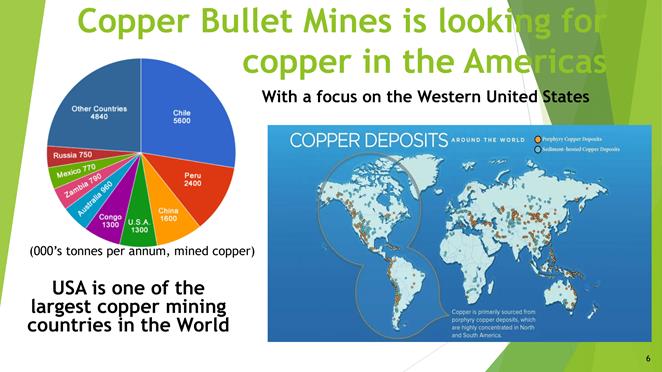
Dan Weir: Copper Bullet Mines is a new company we plan to take it public in the next 12 months. It’s run by a bunch of experienced mining guys. We have currently three geologists involved in the company. We have multiple engineers, mining engineers, metallurgical engineers, process engineers, guys that know how to mine. We have decided to focus on the Western United States.
Maurice Jackson: This may very well be the “Golden Age for Copper,” as many believe that copper is the new oil. Mr. Weir, please provide us with an overview of the supply and demand of copper.
Dan Weir: Yes, it’s very interesting. You’ve got Goldman Sachs and several companies have come out; Goldman Sachs uses the term “copper is the new oil.” If you look at a comparison, a combustible gasoline or diesel-burning vehicle has about 48 pounds of copper in it, but a Tesla or an electric vehicle has 183 pounds of copper in it. So, you can see here that it can be four, five times as much copper in an electric vehicle. So that’s just one aspect of it. Let alone the fact that we have to go across all over around the world building stations to recharge our electric vehicles, and our houses are all wired with copper wiring. More and more people are putting solar panels on their house. That means more wires, more copper is needed for that. Again, I look at Africa and only about 50% of Africa has electricity to people’s homes. That’s being built out as we move along. Other people call this is the “golden age for copper,” and I agree 100%.
Maurice Jackson: The value proposition of copper is quite compelling. Now, it’s early days for Copper Bullet Mines as the company’s currently private looking to go public. How does Copper Bullet Mines plan to meet the global demand for copper?
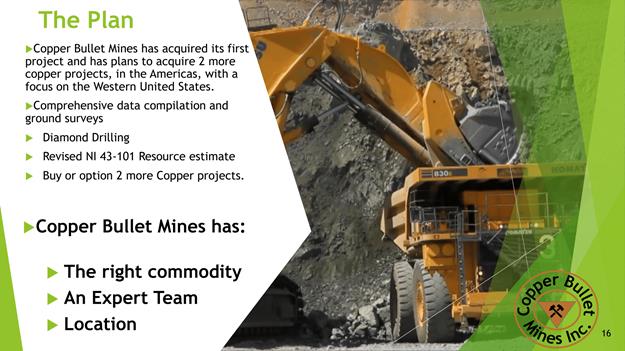
Dan Weir: We plan to focus on the western region of the United States. Currently, we are in what we call the copper triangle, which is in Arizona. Last month we purchased our first project the Copper Springs Project, which took about six months to put it all together. And that first project has historical resources, but we’re also looking for other assets. We are currently right now bidding on some producing assets. I can’t get into any details on those right now because we’re under confidentiality agreements, but we are looking for those types of assets, near-term type producing assets or producing assets, or something that has historical resources that we can bring up to a new resource by twinning holes. So, our focus and what we really would want to do is buy producing assets.
Maurice Jackson: Let’s go on site and find out more. Sir, take us to the “Copper Triangle” of Arizona and get us acquainted with the Copper Springs Project along with some of your neighbors.
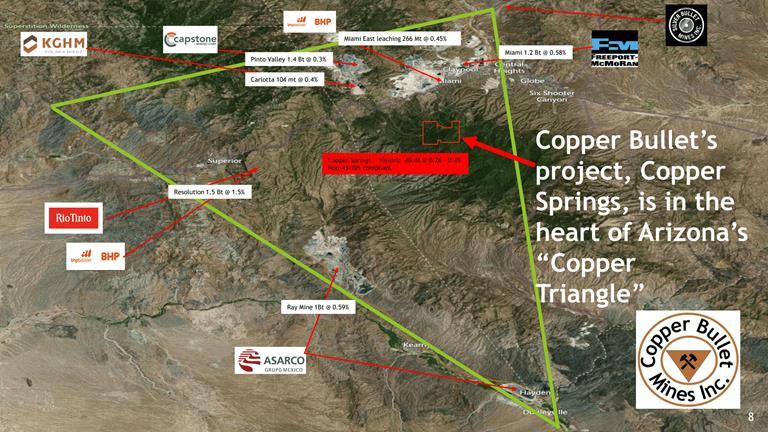
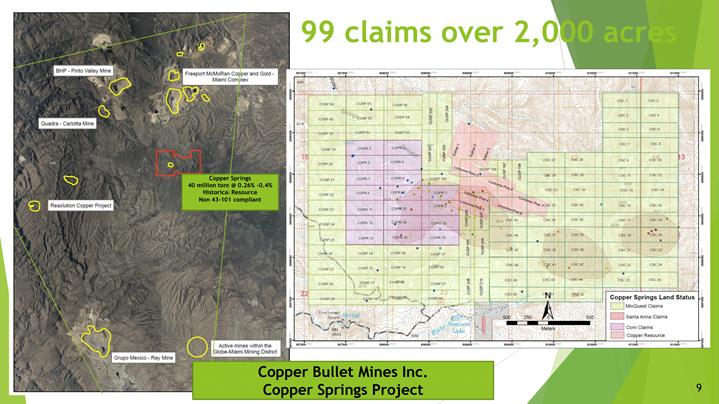
Dan Weir: The Copper Springs Project is in the Copper Triangle, which is about one hour east of Phoenix. Some our neighbors in the Copper Triangle are the largest mining companies in the world, such as Rio Tinto, BHP, KGHM, Capstone and Asarco, which is owned by Grupo Mexico, and Freeport-McMoRan. We are surrounded by some of the largest mining companies in the world with mines in this area or are building a mine. And what I mean by building a mine, as an example, Rio Tinto and BHP, are spending billions of dollars to build the Resolution Mine. It will be one of the largest copper mines in North America when it’s completed. The Copper Springs Project is less than 12 kilometers away from the Resolution Mine.
Just to the north of us is Freeport-McMoRan. It has a copper smelter. There are only currently three, well, sort of three large copper smelters in the United States and one smaller one. Two of them just happened to be in the Copper Triangle, one with Freeport, just north of us, and the second at the bottom of the triangle owned by Asarco, and it’s called the Hayden Smelter. That smelter is being shut down. In the near future, the United States, is only going to have two full-sized copper smelters. One here, one up at Bingham Canyon in Utah, and then a small one in the Texas area. The Copper Triangle is probably the premier place in all of North America where you’re seeing copper production. And guess what? We’re right in the heart of the Copper Triangle.
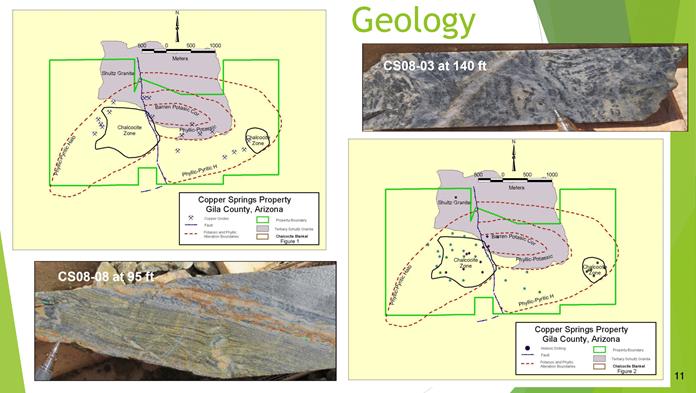
Maurice Jackson: The Copper Springs is a shallow enrichment mineralization project with the historical resource, which is currently non-compliant to 43-101 standards. Provide us with some context and what is the plan moving forward to become 43-101 compliant?
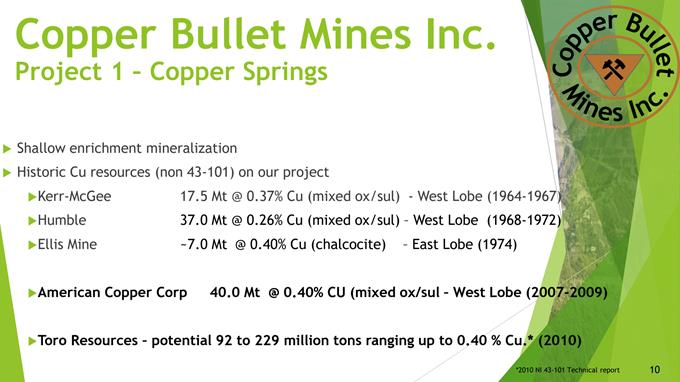
Dan Weir: Over the last 50 to 60 years, there have been many different groups who have owned this project or optioned this project and have gone in and drilled at calculated resources on the Copper Springs Project. Companies like Kerr-McGee, Humble, American Copper, and most recently in around 2010, there was a small junior company called Toro Resources that had the project. And I must add to that, they had parts of the project. It wasn’t until I was able to come in here and put all of the claims together in this area. There were three groups that I had to work with. The groups had the claims. They had a package of eight claims that sat right in the middle of the claim block, and they have owned these claims since 1924. Their great grandfather had staked them, owned them in the family all that time. And this is the first time since the ’50s that this project has all been put together with all these claim packages under one option.
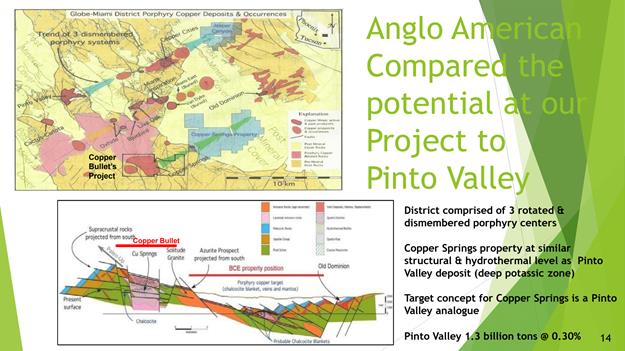
I’m not trying to pat myself on the back too much, but it was a lot of work, and it’s been a great experience putting this whole package together. Thus we now have a claim package of 126 claims over 2,600 acres. Our claim package that has had worked done over the years by some very large companies. Anglo-America recently visited the project in the last number of years. They say that this thing has huge potential, that we could be looking at similar to some of the others in the Copper Triangle, like Pinto Valley.
I’m not saying that that’s what we’re going to get. I believe from the data that we’ve looked at that we have a historical resource now, with 40 million tonnes grading around the 0.4% range. I’ve read several reports. Again, I can’t guarantee this, that there is potential here to be sort of 100 to 200 million tons. Let’s put that in some perspective. Even if we have 40 million tonnes and we have success twinning the historical holes, 40 million tonnes grading 0.4% is about 320 million pounds of copper.
The price of copper recently went up to the $4.60, $4.70 range. It’s pulled back in a little bit, but let’s use $4. It’s currently trading I think today at $4.25. Let’s call it $4. Multiply $4 times 320 million pounds of copper, you’re somewhere around $1.2 to $1.3 billion worth of copper sitting on this property right now. Now, again, there’s a lot of work to do. We’ll have to figure out recovery rates. We’ll have to figure out all sorts of things that go along with that. But I’m just throwing some big numbers out here because it does have some historical resources on here, and we believe that those historical resources are good. Again, until we do the drilling on here and twinned a bunch of these holes and bring it up to 43-101 standards, and do wish to be responsible with my words, these are just hypotheticals at the present.
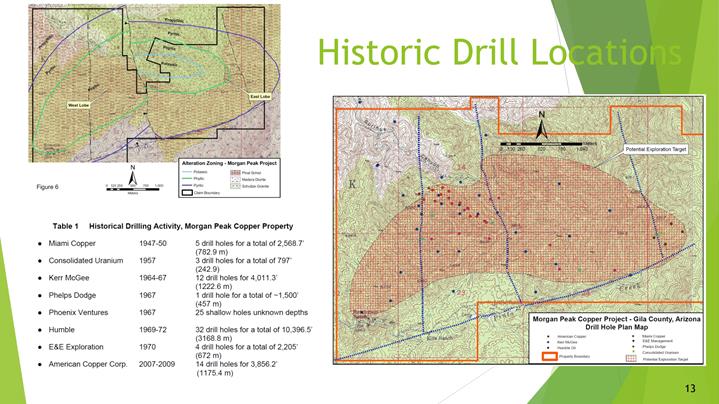
Maurice Jackson: Sticking with the historical resource, please walk us through some of the historical drill locations.
Dan Weir: As I mentioned, several different groups drilled over time, including Kerr-McGee, Phelps Dodge, some different groups have kind of come in and out of this project. Some people will look at a project and go, “Well, these guys drilled and they didn’t find anything.” Well, they did find a lot. You talk to certain geologists or people that had been around the mining industry for a long time and one discovers that to put a project into production, there may have been about five or six junior companies, maybe a couple of larger companies that have done all of the resource studies and looked at it at so many different ways, and then you’re likely going to have one or two guys before it goes into production.
It’s very typical of these types of projects that you have multiple different people over time that will pick up claims. They’ll do some drilling, maybe they ran out of money, maybe the copper price dropped, all sorts of things. But I can tell you that in this area, as I mentioned, I’m the first one since the 1950s that’s been able to put this whole package together, and we have a lot of the old data that we can go on model, go back and drill and build a resource on the back of that.
Maurice Jackson: What can you tell us about the genetic and the exploration model?
Dan Weir: Another great thing is around 2011, several people went out and mapped the Copper Springs Project. We have talked to the geologists and some of them are PhD-type geologists who have gone out and done a lot of mapping on this project. Most of the work has been done in one area. There’s a massive area sort of on the east side of the deposit that has huge potential. And these guys have gone out and done a bunch of the mapping and again agree that there’s massive potential. And there has been very little activity on the east side of the deposit. The non-compliant historical was produced mainly from the west region of the deposit of 40 million tonnes grading about 0.4%, but there’s been very little work done on three-quarters of the project. We are confident that these is a much larger potential before on the Copper Spring Project. And again, I can’t guarantee this. I do believe that we can get too much higher numbers than 40 million tonnes.
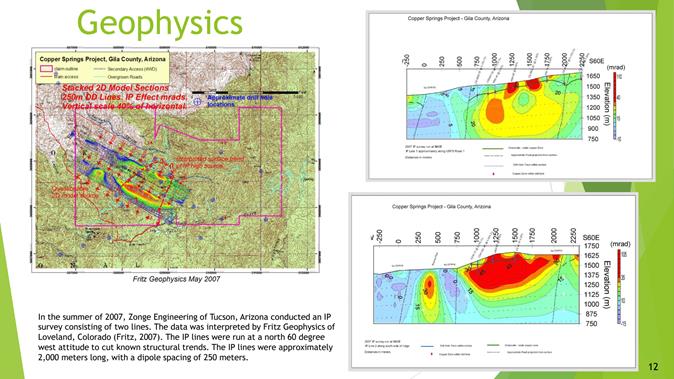
Maurice Jackson: To coincide with mapping, I see that a geophysics study was completed in 2007. Now, will this suffice for a drill targeting, or is there a plan to conduct another survey, or do you plan to twin the historical holes?
Dan Weir: Yes we will twin some of the holes. We will do a lot more geophysics over the property. You can see from some of the maps, it was only done in the one area where they did most of the drilling. We do want to go back in here and want to do a lot more geophysics over that. Geophysics is a cheap way to do exploration. Remember that drilling is very expensive, so anything that you can do to pinpoint where you want to put those drills helps the geologists pinpoint exactly where we want to put the drill in the ground.
Maurice Jackson: Let’s discuss some important topics germane to your project. Are you fully permitted?
Dan Weir: The simple answer is no. There’s a lot of work to do over the next couple of years on here. We have to go out and get permits from the BLM [Bureau of Land Management] and the Forest Service to begin our drill program of twinning the holes. That should take to get the drill permits about six months. But as we’re applying for those permits, we can be doing a lot of the mapping work, IP work, as we decide exactly where we want to drill those holes. There’s lots of work to do here.
One thing I’m going to add here, Maurice, I mentioned earlier that we’re looking at buying some other properties, producing mines, one of them in Arizona. If we’re able to buy one of those mines, it’s close enough that we think we can just truck the ore from this property over to the operating mine, and utilize a lot of the infrastructure there. And it’s fully permitted and is in production. If we can take some of the ore from here and move it over to a producing mine, it should expedite the permitting process from the Forest Service to start mining because you’re not having to worry so much about leach pads and other things. Again, I can’t guarantee that that’s exactly what’s going to happen, but it is one model that we’ve been looking at.
Maurice Jackson: Is the Copper Springs Project 100% owned?
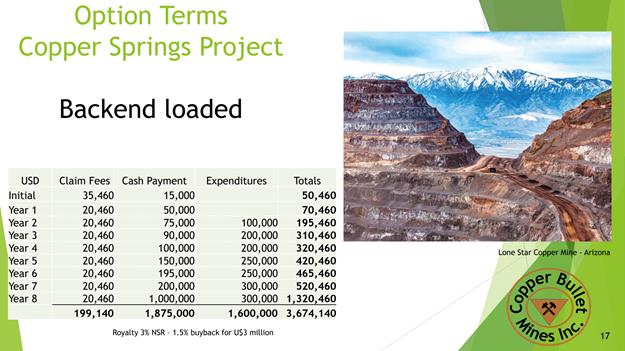
Dan Weir: We have optioned the project. It is an eight-year option process in which we have annual full cash payments, which most of the financing is backend loaded. So, from the first number of years, they are not onerous. And we have to do a certain amount of exploration work on the project. It is a great deal for us to move forward on this.
Maurice Jackson: What are the company’s goals and what strategy will the company use to accomplish its stated goals?
Dan Weir: I used to work for a brokerage firm on Bay Street or Wall Street for several years. I spent 12 years working at one of the top brokerage firms in all of Canada. When I left that firm, I spent another three years running the institutional sales desk for another firm. I have experience working on Bay Street or Wall Street and have been involved in financing mining companies.
One of the companies that we did a lot of work with, and I can remember doing the IPO for it in 2004, was a company called Quadra. When Quadra started, they bought one mine in Nevada called the Robinson Mine. They then took some of the cash flow that they were doing from that mine and then expanded out and started buying all sorts of other mines, not only the U.S. and into Chile. Then they went and bought another full company called FNX Mining. Maybe many of the people that will read this will remember Quadra or FNX. Ultimately, they sold it to a Polish company called KGHM for $2.5 billion. I’m not saying that we can do that, but that’s the type of model that we want to work on for this company.
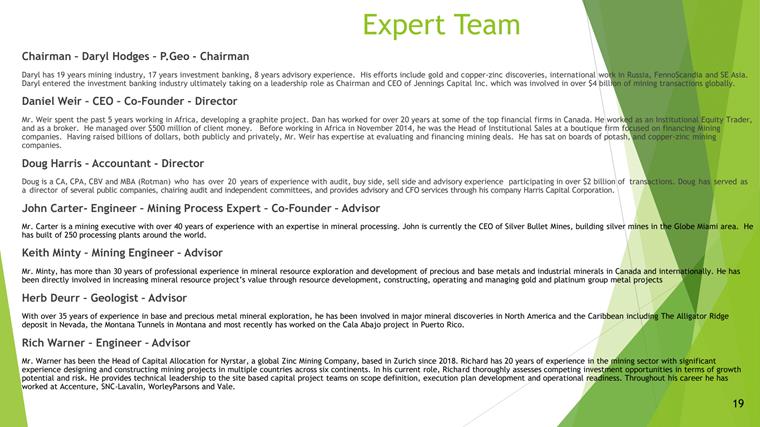
I would love to be able to buy an operating mine. Again, as I said, we are bidding on several assets that are currently in operations, or that mines are in operation. If we can take that cash flow and everything else from that and start to build a company out, that’s really what I want to do. My chairman of the board is a gentleman named Daryl Hodges. He is a geologist. He worked all over the world for Falconbridge, including places like Norilsk in Russia looking for nickel, copper. He understands and gets that he and I are aligned; that’s what we want to build in this company. We want to buy assets that are in production or close to production. We also want to have some exploration plays like Copper Springs, the first one that we bought here, and grow and build a company. That is exactly what we want to do.
Maurice Jackson: We’ve discussed the good. Let’s address the bad. What can go wrong and what are your action plans to mitigate that wrong?
Dan Weir: We all know, anybody in the mining business, that mining is very cyclical. There can be ups and downs. I believe that the copper cycle here is going to be here for quite a while. Number one, because as we start to electrify more and more of the world, you’re going to see the demand for copper continue to increase. As we buy and drive more and more electric vehicles, you’re going to see big copper demand increase. In a lot of places in the world, Chile, as well as others, the copper grades continue to fall off at most of the mines around the world. Us focusing on places like Arizona to mitigate some of the risks, even Chile that produces most of the copper in the world is considering increasing some of its royalty rates. You’ve got Peru. They’re going through an election cycle here right now. We don’t know exactly what’s going to happen.
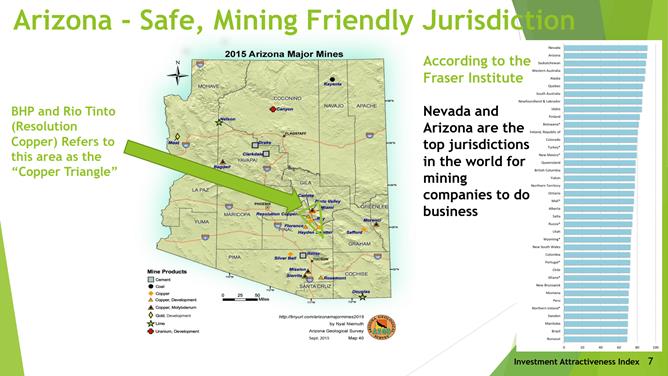
Peru and Chile produce the majority of the world’s copper. Therefore, we are focusing on places like Nevada and Arizona. Now, could things change in the United States? Could it get more difficult to get permits? That is always a risk. But I believe, and even if you look at the Fraser Institute, they rate the top two jurisdictions in the world to look at mining are Nevada and Arizona. And that is exactly where we want to focus, right in the heart of the Copper Triangle in Arizona. One hour outside Phoenix with infrastructure, with people that know mining, understand mining, and we can work and get highly skilled people. It’s a huge opportunity for us. But again, you’ve got to look at cycles, and mining can be very cyclical so that can cause big problems.
Maurice Jackson: Speaking of high-skilled people, Mr. Weir, please introduce us to your board of directors and management team, and what skill sets do they bring to Copper Bullet Mines?
Dan Weir: I mentioned earlier, Mr. Daryl Hodges. I mentioned earlier, too, that we have three geologists working with us; Daryl, we have another advisor to us, a gentleman named Herb Deurr. Herb is involved in some other junior publicly traded companies here in Canada. He lives in Reno. He is a prospector and a geologist and a brilliant guy. He has claims all over the United States, and even Puerto Rico. He’s been developing a project there as well. I’ve got engineers, like Keith Minty is a guy that built up North American Palladium, which now has been bought by Impala. We have Rich Warner as an advisor. He lives in Zurich. He’s Canadian, but lives in Zurich, works for some very high-end companies over in the Zurich area, and knows the mining industry, has worked in the mining industry all his life.
And again, our board right now, we have Doug Harris. He’s an accountant. He’s also the CFO of three other junior mining companies. So, we have the people. We also recently picked up another geologist who was the chief geologist of a mine in the Globe Miami area, right in the heart of the Copper Triangle. We have been talking to several permit experts that will likely come on board with this as we move forward here, too. We have been able to put together an absolutely amazing team who understand copper, who know copper, who have built mines, who have built processing plants, are PhD-type guys in metallurgy and metallurgical engineering. We have an amazing group of people that know how to do this.
Maurice Jackson: Who is Dan Weir and what makes them qualified for the task at hand?
Dan Weir: Again, as I mentioned, I spent several years working on Bay Street/Wall Street. I’ve spent the last 10 years working for mining companies. I’ve been on the board of directors of zinc and copper companies. I’ve been around the mining industry. I know the mining industry, but I also know that I’ve got to bring the right people with me. So, I see myself more of as a conductor of an orchestra in bringing all the right people together. I’m not a geologist, but I know a little bit about geology. But I know that I’ve got to bring the right people around me, the engineers, and everybody else to put this all together. So, we have a bunch of guys that are very hardworking, willing to roll up their sleeves, and have a lot of experience in the mining industry. And I consider myself one of those people as well.
It’s going to be interesting over the next couple of months as we go through the bidding process on some of these production assets, but right now we want to raise a million dollars as the seed round and then we will likely raise money at much higher prices.
Maurice Jackson: Mr. Weir, for readers who want to get more information on Copper Bullet Mines, please share the contact details.
Dan Weir: I may be reached at 416-720-0754. Or you can email me anytime at danweir@bulletmines.com.
Maurice Jackson: Last question, sir, what did I forget to ask?
Dan Weir: Well, Maurice, in some of the last projects that you and I have worked on together, you’ve traveled down to see some of the deposits. I think the next thing for you to do is come on down to Arizona and let’s go see the property because I’m sure you’re going to be very, very impressed with the property and the area inside the Copper Triangle. Seeing some of those smelters and some of the producing mines in the area, I think you’ll be very, very impressed. So, you know what? Ask me to get you on an airplane and get you down there, and over the next month or so, we will do that.
Maurice Jackson: Mr. Weir, it’s been a pleasure speaking with you today. Wishing you and Copper Bullet Mines the absolute best, sir.
And as a reminder, I am a licensed representative to buy and sell precious metals through Miles Franklin Precious Metals Investments, where we have several options to expand your precious metals portfolio, from physical delivery of gold, silver, platinum, palladium, and rhodium, to offshore depositories, and precious metals IRA’s. Give me a call at 855.505.1900 or you may email: Maurice@MilesFranklin.com. Finally, please subscribe to www.provenandprobable.com, where we provide: Mining Insights and Bullion Sales, subscription is free.
Maurice Jackson is the founder of Proven and Probable, a site that aims to enrich its subscribers through education in precious metals and junior mining companies that will enrich the world.
Joining us for a conversation is Lawrence Roulston of Lakewood Exploration. Today the company has announced the acquisition of Silver Hammer Mining, which hosts the Silver Strand Mine located in Idaho. In conjunction with the acquisition, the company is also conducting a financing. Is this the next pure silver play? Find out right here!
The Silver Strand Project – The Silver Strand Mine has a 5.5km strike length in the Coeur d’ Alene mining district in Idaho. – Located in North Idaho’s Silver Valley along Interstate 90. – The district is known for its depth potential with numerous deposits and has produced over 1.2 billion ounces of silver.