VANCOUVER, BC / ACCESSWIRE / September 28, 2021 / NV Gold Corporation (TSXV:NVX)(OTCQB:NVGLF) (“NV Gold” or the “Company“) is pleased to announce that the Company has completed its IP Survey at its 100% owned Sandy Gold Project (“Sandy”), located within the Walker Lane, Lyon County, Nevada, USA. The Company’s objective was to delineate sulfide concentrations via the chargeability and lithologies / alteration via the resistivity (see Figure 1). The IP Survey results have led to the Company identifying various untested, potentially altered, and mineralized new targets to be drill-tested 1st Q of 2022.
Figure 1 – IP Lines over topography and 2021 drill hole locations. (Note that IP Lines in blue color were used to present the interpreted IP targets)
Previously announced Highlights
The Company completed its expanded program of 17 RC drill holes totaling 3,811 m (12,505 ft) in 1st Q of 2021.
The “maiden” RC (Reverse Circulation) drilling has encountered a large epithermal gold system. The alteration footprint at the surface has a strike length of 2.4 kilometers and a width of half a kilometer.
A surface rock chip sampling program completed at the Sandy Gold Project yielded positive gold values from anomalous to high grade. Of note, three samples yielded 11.3 g/t Au and 11.6 g/t Ag, 11.5 g/t Au and 14.1 g/t Ag, and 18.1 g/t Au and 43.2 g/t Ag.
All seventeen RC holes drilled intercepted anomalous gold and strong trace element geochemistry. Twelve holes were above a threshold of >3 meters @ >0.1 g/t Au. The best intercept was 22.9 meters @ 0.65 g/t Au from 29 meters to 51.9 meters (including 6.1 meters of 1.58 g/t Au at 38.1 meters) in SD-2 (see to Figure 1-3).
A Leapfrog model including all surface geochemistry and drill assays was completed 2nd Q of 2021; the model showed open, NW-plunging gold mineralization and trace-element geochemistry towards the newly “IP-interpreted” target zones (refer to press release June 23rd, 2021).
CONCLUSIONS AND NEXT STEPS
The IP survey delineates lithologies, structures and alteration over two specific areas within the Sandy property. Numerous areas of sulfide concentration are also interpreted, which do not exhibit strong lithologic controls, but locations of hydrothermal alteration proximal to feeder structures. Vein responses are noted on Lines 4 through 6, and 18 and 19 along a prominent structural zone traversing the southwest and northeast borders of both survey blocks. This zone also correlates with moderate to high chargeability anomalies (see Figure 2 & 3). A low resistivity feeder to the silica cap on Line 18 is also interpreted (see Figure 4). Drill testing of the various targets will be conducted 1st Q of 2022 following a complete technical review to include integration of the IP results with all other of the property data.
“Previously stated conclusions of Leapfrog modeling combined with the recent results and interpretations of the Induced Polarization (IP) Survey strongly support the presence of a mineralized epithermal gold system at Sandy! The 2021 “maiden” RC (reverse circulation) drilling program did not intersect any of the new targets, neither underneath the Southwestern Clay Cap nor below the Northeastern Silica Cap. However, given the fact that most of our RC holes returned “system-indicating” gold values suggests strong potential for higher grade gold when targeting the overlapping resistor and chargeability anomalies. Having chargeability numbers up to 47 msec is very indicative for elevated sulfide occurrences which could represent a sulfide halo adjacent to mineralized quartz-veins. I am excited to evaluate the new anomalies and target interpretations of the Southwest Clay Cap and Northeast Silica Cap in our 2nd Phase drilling campaign in 1st Q of 2022″,stated Thomas Klein, VP Exploration, NV Gold.
Figure 2 – Induced Polarization Survey: Inverted Chargeability and Resistivity Sections of Line 5. SD-2 which returned 22.9 meters @ 0.65 g/t Au starting at 29 meters appears to be drilled distal to the main chargeability and resistivity anomalies. (Note that drill holes are located in between IP Line 5 & 6 (refer to Figure 1)).
Figure 3 – Induced Polarization Survey: Inverted Chargeability and Resistivity Sections of Line 6. SD-2 which returned 22.9 meters @ 0.65 g/t Au starting at 29 meters appears to be drilled distal to the main chargeability and resistivity anomalies. (Note that drill holes are located in between IP Line 5 & 6 (refer to Figure 1)).
Figure 4 – Induced Polarization Survey: Inverted Chargeability and Resistivity Sections of Line 18. Note there was no drilling performed on this section (refer to Figure 1).
On behalf of the Board of Directors,
John E. Watson President & CEO
For further information, visit the Company’s website at www.nvgoldcorp.com or contact Freeform Communications at (604) 245-0054.
Neither the TSX Venture Exchange nor its Regulation Service Provider (as that term is defined in the policies of the TSX Venture Exchange) accepts responsibility for the adequacy or accuracy of this release.
Forward-Looking Statement
This news release includes certain forward-looking statements or information. All statements other than statements of historical fact included in this release, including, without limitation, statements regarding the extent and timing of the Company’s planned exploration activities, the interpretation of the IP Survey results as indicating areas of alteration, sulphides or vein or feeder structures and the potential of these to host elevated gold system and the dimensions of the strike length and width are forward-looking statements that involve various risks and uncertainties. There can be no assurance that such statements will prove to be accurate and actual results and future events could differ materially from those anticipated in such statements. Important factors that could cause actual results to differ materially from the Company’s plans or expectations include regulatory issues, market prices, availability of capital and financing, general economic, market or business conditions, timeliness of government or regulatory approvals, The Company disclaims any intention or obligation to update or revise any forward-looking statements whether because of new information, future events or otherwise, except as otherwise required by applicable securities legislation.
We are in the liquidity crisis that happens at the end of all roaring bull markets when the piper shows up at the door and demands to be paid. It’s something that both Bob Hoye and I have been predicting for months. Perhaps it will be laid at the feet of Evergrande but it really doesn’t matter. It was fated to happen and someone will always be blamed. The general stock market is about to start the biggest financial crash in history.
Think of the resource market in 2008 that topped in March and kept diving lower and lower into October and beyond. I did some research into the DSI of gold and silver back then. Gold hit a low of 11 and silver a DSI of 5 on September 11th of 2008. Remarkably gold and silver both hit 10 on September 16th of 2021. That should be a tradable low. And Monday September 20th is a full moon and that tends to mark both tops and bottoms. Look for an immediate but short-term bounce.
That is one of those good news-bad news deals though. We were undergoing a liquidity event in 2008 just as we are now. Everything was getting sold because they could sell it. That’s true today. What resource investors have to understand is that this is 100% temporary. Yes, shares are getting creamed but it will end and when the DOW and S&P are much lower, gold and resource stocks are going a lot higher. But gold and silver went sideways from September of 2008 for another four months. That could happen again.
So instead of whining about how low your stocks are, you need to be trimming the dead beats and putting in stink bids for the low hanging fruit. What you do over the next four months is literally going to make you rich or keep you poor. If you think this is a disaster, you are going to end up poor. If you understand what an incredible opportunity it is, you are going to be rich in a year. Bob Hoye says the time to buy gold shares will be November but I see a lot of low hanging fruit right now.
I have written a book a year for pretty much the last five or six years. They are especially valuable today because they will show you how to avoid being part of the crowd that always gets slaughtered.
If you have not read, Nobody Knows Anythingor Basic Investing in Resource Stocks you are being either penny wise and pound foolish or just plain stupid. I tell people how to make money. There isn’t any magic to it. You have to make yourself learn to buy low and sell high. Right now the mass of investors is in a panic and trying to figure out how to sell so they can catch the bottom. This is the bottom, you need to be buying, not selling and I tell you how. You can read both books for under $10. If I was a total idiot doing nothing more that putting words on a page it would still be worth spending $10 in the hope that something I say makes sense.
Frankly in 2008 there were hundreds of interesting crapshoots in the resource market. But they were just crapshoots and most of them died on the vine, as they should have. The quality of stocks today is ten times higher. I am going to cover some of my favorites but there are dozens of quality companies out there with real stories selling for pennies. Unlike any other time frame for investing that I am familiar with, you have to take a global point of view. We are in the end phase that happens after every roaring stupid bull market where people pay silly prices for NFTs of farts. We are going to transition from paper assets to real assets.
But it’s a liquidity crisis and values of what has been booming are going to plummet overnight. You have to buy what will be valuable, not what the crowd has been chasing. Gold and silver are about to have their day. While the $305 billion collapse of Evergrande will be blamed at first, we are going to learn just how many companies have been swimming naked as the tide goes out.
Figure out the companies you would like to own. Put in really stupid stink bids that you know can never be filled. They will be.
For certain, one of the greatest stories of this particular resource cycle is that of Eloro Resources (ELO-V) my last piece on them was six weeks ago. Eighteen months ago the shares were selling for $.175. They hit a high of $5.89 in February of this year and have since corrected to $3.29. That’s a 44% correction that is perfectly normal.
What I am going to say right now is not based on any inside information but rather is based on my visits to hundreds of projects. Actually both Tom Larsen and Quinton Hennigh are far more conservative than I am on Bolivia. They are also dead wrong. The Iska Iska polymetallic deposit is going to be one of the biggest silver deposits in the world. It almost certainly will be the biggest tin project. I have been telling both of them for months that this is far bigger than they think.
Both started out by thinking they would like to see a four hundred or five hundred million tonne project. And they are missing the forest because of all the trees in the way. It’s a caldera. That’s the heat source. The whole damned thing is mineralized. It will be two to three billion tonnes at least of $100 rock. So think $200 billion or $300 billion worth of metal in the ground. And I’m being conservative. That ought to be worth something.
Eloro has been crippled by how long it has taken assay labs to get results to them. By all rights, they have the money to support ten drills turning and that is what should happen but they are 3,000 assays behind because of Covid. When you drill you have to know what you are hitting to know which direction to move. In normal times Eloro would already have a billion dollar market cap. As it stands they are only worth $203 million today in spite of having $21 million in the bank.
There is a second way to own Eloro and that is through Cartier Iron (CFE-C). They own 2.12 million shares of Eloro worth an interesting $6.6 million as of last Friday. For the longest time that was pretty much their entire market value but they do have an interesting gold project in Newfoundland. There is a 10,000-meter drill program in progress on the Big Easy project now but obviously assays are the same problem as everywhere else in Canada.
I wrote a piece earlier in the year talking about both companies, Eloro and Cartier. It is probably worth reading. While the Big Easy drill program is a crapshoot, the 2.12 million-share position in Eloro is like having money in the bank.
Eskay Mining (ESK-V) is another home run out of the park that is still way below the radarscope for most investors. At their peril. Granted, it does have a market cap of $344 million today with enough cash to go into next year before having to do a raise. Like Eloro it is one of the most incredible stories of this cycle. Two years ago the shares were $.075. They hit a high of $3.15 in early February of 2021 when assays showed a major VMS discovery. But two years ago Eskay seemed like a ten year long wet dream of Mac Balkam. He carried the company on his back, convinced he had a deposit similar to that of the original Eskay Creek Mine.
He’s wrong of course. What Eskay Mining has is far bigger than the original Eskay Creek deposit. We have to have a lot more assay information before we know about the grade. The Eskay Creek mine was exceptional and the assay labs in Canada are quoting sixteen weeks for assays today thanks to the idiots in government and their panic over a bad flu season.
The original Eskay Creek Mine was a hit or miss affair with the discovery only taking place on the 109th hole. Mac brought in Quinton Hennigh as an advisor over 2 years ago and he put together a team headed by Dr. John DeDecker with help of some serious VMS people from the Colorado School of Mines. They have done things right this time and done a lot of serious technical work that seems to be showing a whole slew of VMS deposits larger than the original Eskay Creek.
All deposits share certain similarities with others of the same breed. Porphyries tend to be very big and low grade. VMS deposits were originally on the sea floor as black smokers. They tend to occur in clusters. Mac knew this and believed it for years but never had the technical team that could put it all together. Now they have.
The company is well financed into next year so all the assays will be in before they need to tap the market again. If investors will go to the Eskay website there are so many pictures and so much information that if they said more they would be violating 43-101 rules. You can look at VMS material and know what you have. They have more than two major discoveries. My biggest question is who will be the most valuable in two years time, New Found Gold or Eskay? Both are going to be worth multiples of a billion dollars.
New Found Gold (NFG-V) is about as simple a story as you will ever find. They have tonnes of high grade gold in Newfoundland with some of the highest-grade intercepts in the last twenty years. Their initial hole was a discovery hole with a 19.2-meter hole showing 92.9 grams of gold per tonne. The shares shot from $1.85 a year ago to an amazing $13.50 in June before beginning a perfectly normal fifty percent correction.
New Found Gold raised a bunch of money and started drilling a 200,000-meter drill program on their Queensway project in Newfoundland. The company has nine drill rigs turning and will be adding an additional rig shortly. If you do not understand the story you have not been paying attention to the resource market. Here is the last piece I did on the company.
The Swan Zone at the Fosterville gold mine in Australia helped to take Kirkland Lake Gold from a $2 billion dollar market cap at the time of the merger in 2017 to a high of $18 billion. The Swan Zone was deep, expensive to mine and only had just over three million ounces of gold. The Keats/Lotto Zones at Queensway are much closer to the surface, similar grades to that of Fosterville and a lot more gold than the Swan Zone. If you don’t own any shares of NFG you are going to be at the airport when your ship sails in.
With all these stocks that are now the low hanging fruit, you need to be looking for those who have been hammered the most. An almost identical story to that of New Found Gold and on the same mineralized trend is that of Labrador Gold (LAB-V). Lab Gold is in the midst of drilling a 10,000 meter drill program at their 100% owned Kingsway project immediately northeast of New Found Gold. Lab Gold has four drill rigs turning and is generating the same sort of high-grade intercepts as that of New Found Gold.
Labrador Gold was as low as $.30 in March of this year before assay results started flowing showing that they are on the same structure as New Found Gold. The shares shot higher with each release until they hit a high of $1.85 in June.
I started selling some of my shares that I bought in the last year and some I had bought years ago for about a dime. If you are trying to prove just how smart you are, go ahead and marry good stocks with high potential. You can watch them go up and down like a bride’s nighty and you don’t make anything. If on the other hand you buy stocks to make money, you have to learn how to trade them in and out. You will have that opportunity every year. LAB has had a five hundred percent range in the last six months. If you can’t make a profit on a stock with that sort of range, you are going about it in the wrong way.
Trade the damn stocks like baseball cards. They are like lottery tickets. To profit you have to buy low and sell high, unlike the weak hands that want to buy high and sell low.
I make the perfectly valid point in my books that if nothing else has changed on a stock that you have fallen in love with except the price, when it tumbles, instead of seeing it as a problem, treat it as an opportunity and buy more. Lab Gold is a screaming good deal after a 60% drop in three months.
Sokoman Resources (SIC-V) is located in Newfoundland but west of where Lab Gold and New Found Gold are drilling. They had really great drill results for years but weren’t doing a great job of telling their story and as a result got little respect from the market. They talked to me in March. I was as direct with them as I am with everyone else I deal with. If you don’t tell your story, you don’t have a story.
I wrote the company up and all I did was put the information out that was already available. There was no magic to my piece other than I did a better job of telling the story. The stock shot higher and touched $.78 in June before starting a similar correction of 60% as did Lab Gold. So officially as far as I am concerned, nothing has changed except the price and it is cheap today.
There are some times when buying a stock has the potential for getting you into serious legal problems. Such is the case of White Rock Minerals (WRM-AX, WRMCF-OTCBB). If White Rock got any cheaper and you bought shares, the Bobbies would be at your door shortly thereafter for stealing. No shit. This is the most absurdly under priced stock I have ever owned.
White Rock is an Australian listed company with OTCBB listed shares for American and Canadian investors. It has a pair of world class potential projects in Alaska including a VMS project with a $3.5 billion dollar rock in the ground 43-101 and a couple of interesting gold projects worth drilling the crap out of. Alas they signed up a drill contractor who thought he was a hooker and he screwed them royally.
You have a short 100-120 day work period in Alaska. Winter ends late and starts early. If you don’t have drills and crews in place by late June you are screwed for the year. The drill contractor brought the drills but only half the men he promised. While that’s a common story in the north this year, it has cost White Rock tens of millions of dollars in lost market cap. They aren’t producing much in the way of drill core to be sampled. In addition the assay labs are 4-6 months backed up so they may as well be tossing a dart at a dartboard to know where to drill. Since Alaska has been the primary focus, investors are throwing in the towel at exactly the time they should be throwing money at White Rock.
In addition, WRM merged with AuStar Gold in August this year to acquire the Woods Point Gold project in Victoria in Australia with 670 square kilometers of exploration potential. The project is near the Fosterville Mine owned and operated by Kirkland Lake Gold. It includes the former Morningstar Gold mine showing past production of over 800,000 ounces of gold at 26 grams gold per tonne. Currently White Rock has one drill turning underground. The core from the drilling shows visual gold. Australia has the same problem with assays as the US and Canada so results will trickle in over the next few months.
White Rock did come up with incredible drill results already from the Red Mountain silver/zinc/lead VMS in Alaska. On the 16th they released the first assay for this year showing 0.2m @ 11.9% Zinc (Zn), 2.8% lead (Pb), 0.9% Copper (Cu), 63g/t silver (Ag), and 0.2g/t gold (Au), from 184.8m down hole. This polymetallic suite of metals can also be summarized as a 17.5% Zinc equivalent grade. That’s not a wide intercept but it does indicate the strike extends further than they realized. Remember this project already has $3.5 billion worth of high grade gold in the ground.
White Rock has another Australian asset in the Mt Carrington gold and silver project with 352,000 ounces of gold and 23.2 million ounces of silver in a JORC resource. That should be worth something.
WRM has been crippled this year by a lack of obvious progress in Alaska. I’m not concerned, the gold and silver are still there regardless of the lack of progress on the assay side. The current drilling at Morningstar could cause an overnight rerating of the shares. As of right now White Rock has a market cap of about $39 million Aussie with somewhere around $12 million in cash. I was adding to my already very large position a week or so ago at $.24 USD and thought I was robbing a bank. It’s $.19 USD now some 20% cheaper in a week.
I’m not going to spend a lot of time talking about Novo Resources (NVO-V). I wrote a book nine months ago just before they poured the first gold bar at Nullagine. What Became of the Crow? has been very well received with some of the highest ratings I have ever seen on any book. In the book I talk about a flight I made delivering a Rockwell 685 aircraft to Lang Hancock in 1976. I had Hancock’s son in law with me on the flight and I had to put up with 85 hours of him talking about how the Pilbara had the world’s highest grade banded iron formation consisting of 30% of the entire world’s reserve of iron.
Quinton Hennigh came up with a theory that says gold precipitated out of salt water in exactly the same way as iron did around 2.8 billion years ago when single cell creatures began to produce oxygen and that changed the chemistry of the water. His work in the Pilbara over the past dozen years has pretty much proven his theory. If iron and gold each precipitated out of salt water about the same time under the same conditions, if you have the world’s biggest iron deposit in the Pilbara (and they do) by necessity you have to have the world’s biggest gold deposit.
Novo is producing gold today. With a market cap down to right at $500 million CAD it is cheaper with less risk than it has been for years.
The biggest problem in Australia right now is the price of iron and it has blown the entire economy up. It’s about to get way worse. Iron hit an all time high price of about $215 USD in May of this year. That has caused chaos for everyone doing exploration work or mining anything other than iron in the country. The iron companies were throwing money at everyone with two basic attributes. As long as they were warm and had a heartbeat they could earn upwards of $25,000 a month. And everyone thought that was just wonderful.
Labor has been a giant problem for every non-iron company in Australia. Novo has lost a lot of good people who ran over to the iron companies for higher wages. In addition, the iron companies raided every government agency to hire anyone who could spell ionr correctly. So permitting has slowed to a snail’s pace and labor turnover is literally out of control.
The liquidity event is not over, it has just begun and will be getting far worse sooner than anyone but Bob Hoye and me realize. But I suppose I should mention you now have a clue.
Lion One (LIO-V) in Fiji is well cashed up with $57 million in the bank, is permitted to begin construction of a mill and they have their own assay lab so they are not being held hostage by the failure of worldwide assay labs. But they were trying to run the project out of Perth since Australia has turned back into a prison colony. Prisoners don’t do a great job of running mining projects with the sole exception of they do a great job of busting up big rocks into small rocks.
Lion One has been trying to get two highly experienced exploration guys into Fiji for six months. I’ve flown through Fiji dozens of times. The people are industrious, hard working and intelligent. But they are not experienced in drilling and exploration without professional help and supervision. That exists now.
The guys got into the country a month ago and finished quarantine. Lion One now has six drills turning and I expect the shares to get back to all time highs in the next six months regardless of the giant crash we are in. They have millions of ounces of gold with a market cap of $172 million with $57 million in cash. I think Lion One is still my biggest position and I was buying shares at over $2. The shares are down 65% from their high but that isn’t going to last for long.
I-80 Gold (IAU-V) only went public in April at $2.36. It rocketed higher to $3.54 about ten days ago before dropping back to the current $2.52. The company has a $587 million market cap with a 770,000 ounces of high-grade gold deposit in the Granite Creek underground mine. IAU management is highly experienced in Nevada and is doing deals with other mining companies to combine resources.
Granite Creek has an average of +11 g/t gold but the material is refractory. I-80 plans on trucking the material over to an autoclave they control at Lone Tree.
In all categories and deposits, I-80 controls over 14 million ounces of gold. An almost $600 million market cap may seem expensive but that’s about $40 a resource ounce. It should probably be $120-$200 an ounce at the stage they are.
This year I-80 plans a 20,000-meter drill program at Granite Creek. The first assays came out three weeks ago and they were what the company hoped they would find, 51.1 meters of 6.8 g/t gold. Because the company has so many irons in the fire I highly suggest investors take a look at the company presentation because it is complicated to explain.
On occasion I do look at other companies that just resource companies. Someone came to me in the middle of the summer and wanted me to look at a young company that wants to use new technology to improve battery charging performance and behavior. I did and wrote about it. The company is called Neo Battery Materials (NBM-V). It went from about $.20 to $1.31 in a month. It continues to have extraordinary liquidity.
This is going to get a little technical.
It has been well known for years that to improve battery charging time and performance the battery manufacturers should use some form of silicon in the anodes. But the metal expands under charging and is not flexible. So companies are trying various forms of silicon nano particles or micro particles. The micro particles are eight to ten percent of the cost of the nano particles. NBM is achieving exceptional performance improvements through the use of micro particles while keeping their cost of production low. Such anodes stand to drive down battery costs on a dollar per kilowatt-hour basis that in turn will drive the cost of mass-market electrical vehicles lower.
The company is sending out samples on a daily basis of their proprietary silicon anodes to battery producers, the developers of solid-state batteries and automotive manufacturers. Since their initial tests are proving so productive NBM is planning upgrading a pilot plant to a semi-commercial facility with production of 120 tons of anodes per year that would supply anodes for up to forty thousand vehicles per year.
The next leg up in the lithium battery market will be the production of solid-state batteries. NBM has already achieved exceptional performance using a sulphides-based all solid-state electrolyte. This would also solve the flammability issues of current batteries in the market place.
NBM has some of the most experienced battery scientists in the world working with them with five patents already in hand. Similar companies in the silicon anode market place have market caps far higher than NBM’s $65 million. If you like the EV market, NBM offers attractive potential for price appreciation.
Goliath Resources (GOT-V) is another great stock that has gotten absolutely hammered in the last six weeks with the stock dropping from an all time high of $1.62 in August to $.76 on Friday for a 55% decline. I think that 100% of the issue is the criminal delay in assay results.
Company management has been posting a number of news releases giving the length of the intercept in terms of quartz-sulfide veining. And while in that neck of the woods that “should” be an accurate measure of grade potential $5 bucks and some quartz-sulfide veining “should” get you a small cup of coffee at Starbucks.
The Surebet Zone is in the Golden Triangle and actual assay results so far indicate a high degree of correlation between the sulfide veins and the actual gold and silver numbers. This is all part of a fully funded 6,000 meter drill program. In a liquidity crisis investors want, indeed, demand hard numbers. The price of the shares is back to where it was in May taking virtually all the risk out of buying the shares. And who knows, maybe assays will come in some day.
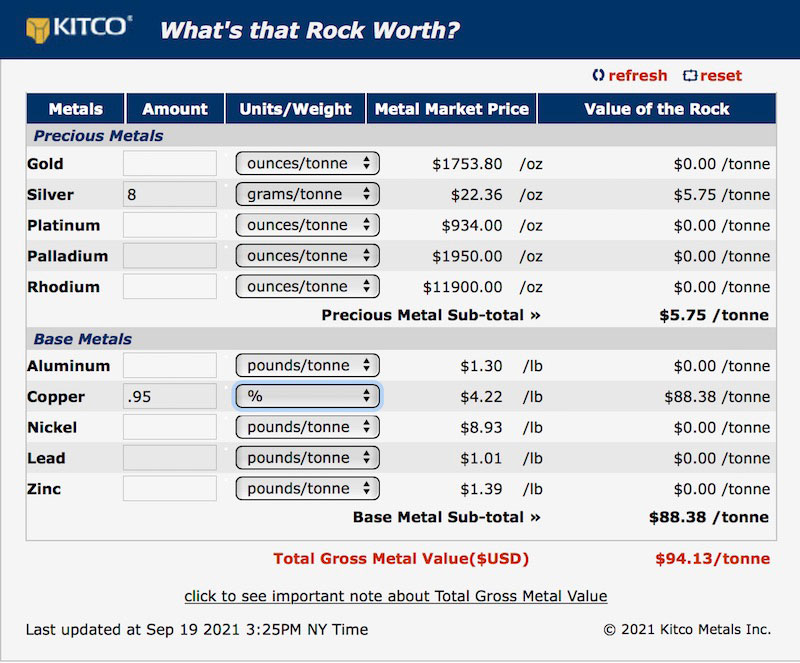
The next company, Solis (SLMN-V) is going to be a simple story to tell and for investors to understand. The company has an option on a copper project in Chile with a historic 10 million tonne resource of near surface high-grade copper/silver. At today’s prices that is worth $94.13 a tonne in USD or just short of a billion dollars.
(Click on image to enlarge)
The option calls for Solis to pay $5 million to the vendor over a four-year period and to invest $5 million in exploration over the same four years. That will get them 100% ownership subject to a 2% NSR. But Solis is not interested in a $940 million copper/silver project in Chile where the government just turned really stupid.
Solis believes the near surface mineralization comes from porphyry located about 300 meters down. Initial plans call for a 2,500 meter drill program on one of five different targets over a ten square km package identified with technical studies.
One of two things happens. They either hit what they are aiming for or they don’t. Should they hit the shares go to $500 million and current shareholders get rich. The market cap of the company today is $8.44 million. If you need me to work out the potential for you, you really should be investing in something safe like Evergrande or Tether.
Golden Lake (GLM-C) is another dead easy to understand company. The company has a $10 million market cap and is in the midst of a 6,000 meter drill program on their Jewel Ridge gold project in Nevada on the Eureka trend. Results to date show economic value of gold near surface.
Investors are not big fans of stocks found on the C-Exchange in a declining market but when the bull shows up again they get real popular. With a $10 million market cap and options on two highly potential projects, it’s a cheap lottery ticket.
Provenance Gold (PAU-V) is another story that is so cheap it screams, “Buy me. Buy me.” The market cap is a tiny $10 million; they have only 61 million shares outstanding. The company is operating in northern Nevada near the Idaho border. That’s interesting to me because company President Rauno Perttu (try bending your tongue around that Finnish origin name) believes the project is an analog of the Black Pine project just north of the border.
I have been to Black Pine twice and frankly I think the way they read the project is 100% correct. Given that Black Pine has a 2 million ounce gold resource starting at surface, a $10 million dollar company with a similar project is damned cheap. Liberty Gold has a market cap 26 times larger than Provenance.
Their primary project today is the White Rock oxide gold project. The project manager is Steve Craig and I have known him for years. He is one of the top geos in Nevada. Between Steve and Rauno, you have a first class management team. White Rock is one of those projects that everyone knows about but no one has ever gotten a real handle on. PAU management believes the project holds a near surface 3.2 by 1.6 oxide gold target. In the past operators were attempting to find the feeder structures.
Provenance theory holds that instead of trying to find the structures with blind drilling, they should simply drill serious stepout holes to define ounces. Last week they announced results from an 800-meter stepout hole showing 117 meters of gold mineralization starting from surface. The hole intercepted 85 meters of 0.369 g/t gold. Within that hole were higher-grade intervals of 0.778 g/t Au from 38 meters to 46 meters. In Nevada oxide gold of those grades is all economic. I believe those assays tend to prove their theory and there will be a lot more similar holes. That is exactly what Liberty Gold was finding at Black Pine.
This is one of the few stocks that has actually acted well over the past couple of months. It is so cheap that I took out a lottery ticket on it and bought some shares. If you buy stocks when they are cheap and sell them when they are dear, you can make a lot of money. It’s not rocket science.
The next six weeks is going to be incredibly dangerous and many people will be wiped out. I own most of these stocks and all of them are advertisers but the combination of a tiny DSI for gold and silver and a full moon on September 20th makes now an interesting time.
As always, I don’t share in your profit or your losses so you need to do your own due diligence. I am biased so take some responsibility for your own actions.
Thunder Bay, Ontario–(Newsfile Corp. – September 23, 2021) – Kesselrun Resources Ltd. (TSXV: KES) (OTC Pink: KSSRF) (“Kesselrun” or the “Company”) is pleased to provide the following drilling results on its Huronian Gold Project.
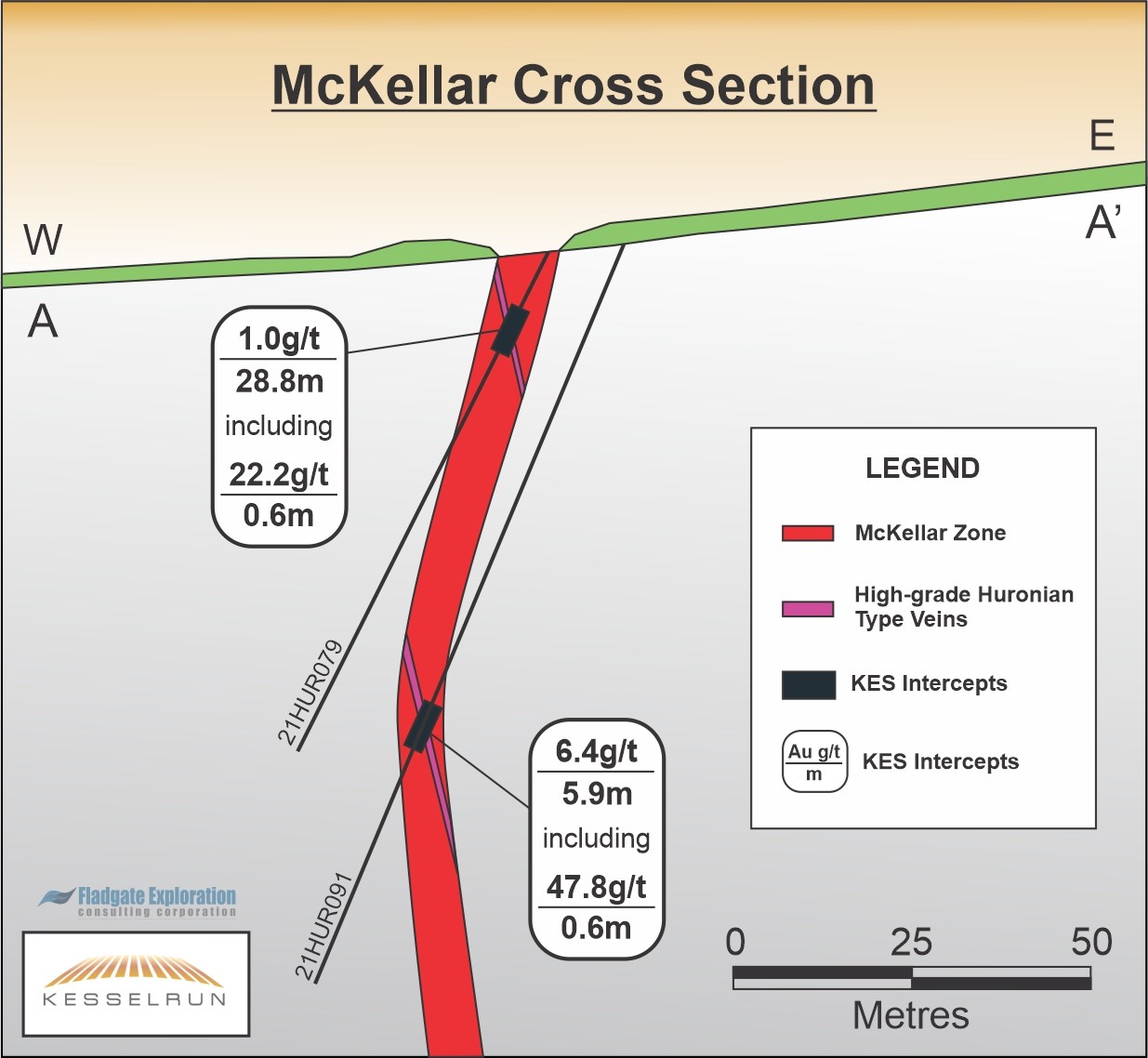
Continued drilling of the McKellar zone has been successful in confirming the continuity of the mineralization with the discovery of another high-grade structure. The zone has now been extended to over 500 metres in strike length and approximately 100 metres in depth. Further drilling is planned down plunge of these structures as well as along strike to the southwest.
Highlights
21HUR091 intercepted 47.8 g/t Au over 0.6 m within a 5.9 m wide zone which averaged 6.4 g/tAu
21HUR079 intercepted 22.2 g/t Au over 0.6 m within a 28.8 m wide zone which averaged 1.0 g/t Au
21HUR077 intercepted 13.7 g/t Au over 1.0 m as well as an 11.0 m wide zone averaged 0.7 g/t Au
21HUR076 intercepted 6.3 g/t Au over 1.5 m within a 19.4 m wide zone which averaged 1.1 g/t Au
Michael Thompson, P.Geo., President and CEO of the Company, commented, “Our drilling on the McKellar zone is proving our model of numerous high-grade structures within a wider zone of gold mineralization. Future drilling on McKellar will focus on extending those known high-grade structures at depth as well as building on the impressive 500 metres of strike length already outlined.”
The 2021 Huronian drill program is budgeted at 20,000 metres targeting the Fisher, Fisher North, McKellar and Huronian zones, all in close proximity along an approximate 1500 m strike length in the area of the historic Huronian Mine. The area also has tremendous potential for discovery of new wide zones of significant gold mineralization in light of the new revised mineralization model.
As of this news release, approximately 15,000 metres has been drilled of which the results from approximately 8,000 metres of drilling have been released.
Figure 4: Schematic Plan Map – McKellar Zone – Huronian Project
Table 1: Summary of Significant Drill Intercepts – Current News Release (1)
Hole ID
Zone
From (m)
To (m)
Interval (m)
Au (g/t)
21HUR076
McKellar
107.1
126.5
19.4
1.1
including
118.2
119.7
1.5
6.3
21HUR077
McKellar FW
8.2
9.2
1.0
13.7
McKellar
80.8
91.8
11.0
0.7
21HUR079
McKellar
3.0
31.8
28.8
1.0
including
3.0
3.6
0.6
22.2
21HUR088
McKellar
48.1
63.6
15.5
0.7
including
50.1
60.1
10.0
1.0
McKellar HW
163.6
164.5
0.9
6.6
21HUR090
McKellar
89.6
102.9
13.3
0.7
including
90.8
91.4
0.6
7.3
21HUR091
McKellar
50.1
56.0
5.9
6.4
including
51.8
52.4
0.6
47.8
21HUR092
McKellar
36.6
81.5
35.3
0.3
21HUR093
McKellar
14.7
54.9
40.2
0.3
including
50.2
51.0
0.8
6.7
(1)Widths are drill indicated core length as insufficient drilling has been undertaken to determine true widths at this time. Average grades are calculated with un-capped gold assays as insufficient drilling has been completed to determine capping levels for higher grade gold intercepts.
About the Huronian Gold Project
The 100% owned Huronian Gold Project hosts the past producing Huronian Mine, Northwestern Ontario’s first gold mine with an historic resource estimate of 44,592 oz Au at an average grade of 15.3 g/t Au in the indicated category and 501,377 oz Au at an average grade of 14.4 g/t Au in the inferred category. The resource estimate presented for the Huronian Project is historic in nature. Kesselrun Resources’ qualified person has not completed sufficient work to confirm the results of the historical resource. Kesselrun Resources is not treating this as a current mineral resource but is considering it relevant as a guide to future exploration and is included for reference purposes only. The historic resource was estimated by Minescape Exploration Inc. in 1998. Further drilling will be required by Kesselrun Resources to verify the historic estimate as current mineral resources.
As well, the Huronian Gold Project hosts the same lithological package of rocks, as interpreted from both Government of Ontario and Kesselrun Resources mapping, compilation and modelling, on strike from Wesdome Gold’s adjacent Moss Lake Gold Deposit with a resource estimate of 1,377,300 oz Au at an average grade of 1.1 g/t Au in the indicated category and 1,751,600 oz Au at an average grade of 1.1 g/t Au in the inferred category as outlined in their 2013 PEA2. Mineralization hosted on adjacent and/or nearby properties is not necessarily indicative of mineralization hosted on Kesselrun Resources’ property.
(2)Moss Lake Gold Mines (currently wholly owned subsidiary of Wesdome Gold) news releases February 20, 2013 and September 9, 2013.
On January 26, 2021, Wesdome announced that the Moss Lake Project would be purchased by Goldshore Resources Inc. (see Wesdome and Goldshore news releases dated January 26, 2021).
Qualified Person
Michael Thompson, P.Geo., President and CEO of Kesselrun, is the Qualified Person responsible for the project as defined by National Instrument 43-101 and has approved the technical information in this news release.
QAQC
Kesselrun has implemented a quality control program to comply with industry best practices for sampling, chain of custody and analyses. Certified gold reference standards, blanks and duplicates are inserted at the core processing site as part of the QA/QC program in addition to the control samples inserted by the lab. Samples are prepared and analyzed by Activation Laboratories in Thunder Bay. Samples are analyzed for gold using Fire Assay-AA techniques. Samples returning over 10 g/t gold are analyzed using Fire Assay-Gravimetric methods. Selected samples are also analyzed with a standard 1 kg metallic screen fire assay. All results reported herein have passed QA/QC protocols.
Health and Safety
The health and safety of our personnel and contractors is always top priority to Kesselrun. The current situation presents new challenges above and beyond what we normally face while working in the field. Kesselrun has implemented further measures to ensure the health and safety of all working on the Company’s projects.
About Kesselrun Resources Ltd.
Kesselrun Resources is a Thunder Bay, Ontario-based mineral exploration company focused on growth through property acquisitions and discoveries. Kesselrun’s management team possesses strong geological and exploration expertise in Northwest Ontario. For more information about Kesselrun Resources, please visit www.kesselrunresources.com.
Neither the TSX Venture Exchange nor its Regulation Services Provider (as that term is defined in the policies of the TSX Venture Exchange) accepts responsibility for the adequacy or accuracy of this news release.
Forward-Looking Statements – Certain information set forth in this news release may contain forward-looking statements that involve substantial known and unknown risks and uncertainties. These forward-looking statements are subject to numerous risks and uncertainties, certain of which are beyond the control of Kesselrun, including, but not limited to the impact of general economic conditions, industry conditions, volatility of commodity prices, dependence upon regulatory approvals, the execution of definitive documentation, the availability of financing and exploration risk. Readers are cautioned that the assumptions used in the preparation of such information, although considered reasonable at the time of preparation, may prove to be imprecise and, as such, undue reliance should not be placed on forward-looking statements.
Hot Chili Limited (ASX: HCH) (OTCQB: HHLKF) (“Hot Chili” or “Company”) is pleased to announce that it is preparing to commence drilling a series of large-scale exploration targets in parallel with resource expansion drilling at its Costa Fuego copper-gold development hub in Chile.
Highlights
Advanced Three-Dimensional (3D) Geochemical targeting,using multielement surface geochemical data, has been applied for the first time across Hot Chili’s consolidated Costa Fuego copper-gold development hub in Chile The 3D geochemical approach generated probability models which accurately mirrored existing copper resource models at both Cortadera and Productora Two, large-scale, 3D geochemical targets have been identified as high probability for immediate drill testing– Productora Central and Santiago Z – both considered potential game changers for Costa Fuego’s growing resource base Both new 3D geochemical targets are larger in size than the main porphyry (Cuerpo 3) at the Company’s Cortadera copper-gold discovery, where three drill rigs are currently operating to upgrade its maiden 451Mt resource A fourth drill rig is being secured to commence exploration drilling at Productora Central in Q4 this year and regulatory approval for drilling at Santiago Z is expected in December. Next assay results from resource expansion drilling at Cortadera expected shortly To access the announcement please click on the link below.
Logging core at Cortadera View looking SE across Productora – New, large 3D geochemical target set to be drilled in Q4 this year
Cortadera Copper Project Cortadera’s maiden Mineral Resource positions Hot Chili with the largest copper Mineral Resource and one of the largest gold Mineral Resources for an ASX-listed emerging company.
The Cortadera maiden Mineral Resource of 451Mt at 0.46% copper equivalent (CuEq) takes the total Mineral Resource estimate for Costa Fuego (Cortadera, Productora & El Fuego) to 724Mt at 0.48% CuEq for 2.9Mt copper, 2.7Moz gold, 9.9Moz Silver and 64kt molybdenum. Cortadera also contains a higher grade component of 104Mt at 0.74% CuEq, and this has strong potential to continue growing rapidly with further drilling.
TORONTO, Sept. 16, 2021 (GLOBE NEWSWIRE) — Labrador Gold Corp. (TSX.V:LAB | OTCQX:NKOSF | FNR: 2N6) (“LabGold” or the “Company”) is pleased to announce further high-grade intercepts of near surface gold mineralization along the Appleton Fault Zone at its 100% controlled Kingsway project near Gander, Newfoundland. These holes were drilled as part of the Company’s 50,000 metre drill program. The Kingsway project is located in the highly prospective central Newfoundland gold belt.
Three holes K-21-47, -48, and -49 all contained intervals grading more than 12g/t Au. Hole K-21-47 intersected 128.51 g/t Au over 1.12m from 168 metres in the HTC Zone which represents a “metal factor” (grade x width) of 143.9 g/t Au x m*. Hole K-21-48 intersected 35.7 g/t Au over 1.55m from 12.22m and hole K-21-49 intersected 9.6g/t Au over 10m from 51m, including 76.86g/t Au over 1m. Both intersections in holes K-21-48 and -49 are in the Big Vein Zone. A summary of the high-grade intersections, as well as other holes with assays recently received, are given in Table 1 below. *The width used to calculate metal factor is downhole width as there is insufficient information to calculate true width.
Table 1. Assay highlights
Hole ID
From
to
width
Au (g/t)
Zone
K-21-49
51
61
10
9.6
Big Vein
Including**
57
58
1
75.86
and
60
61
1
12.31
K-21-48
7
8
1
1.01
Big Vein
**
12.22
13.77
1.55
35.7
K-21-47
77
78
1
1.25
Big Vein
126.74
129
2.26
2.06
**
168
169.12
1.12
128.51
HTC
K-21-46
51
52
1
1.54
Big Vein
K-21-45
nsv
K-21-44
8
10
2
1.37
Big Vein
15
17
2
1.15
K-21-38
49
50
2
2.23
K-21-35
nsv
k-21-34
72
73
1
1.07
HTC
76
77
1
1.3
93
94
1
1
K-21-25
13.3
14.4
1.1
1
Big Vein
18
20
2
1.65
43
44
1
1.2
104
108
4
2.41
HTC
K-21-24
nsv
K-21-23
34
35
1
4.01
Big Vein
119
120
1
1.32
HTC
129
130
1
1.84
**Interval contains visible gold. nsv No significant values. All intersections are downhole length as there is insufficient Information to calculate true width.
“We continue to be encouraged by the high-grade gold mineralization intersected in the HTC Zone. The intersection in hole K-21-47 is the deepest of the +100 g/t Au x m intervals drilled to date,” said Roger Moss, President and CEO of the Company. “The two high-grade intercepts of 35.7g/t and 75.86g/t Au in the near surface Big Vein Zone are also significant, as they are approximately 150 metres apart and demonstrate that the high grades persist along strike to the southwest. Drilling continues to test this trend to the southwest.”
The Big Vein target is an auriferous quartz vein exposed at surface that has been traced over 400 metres at surface along the Appleton Fault Zone. It lies within a larger northeast-southwest trending “quartz vein corridor” that stretches for over 7.5 kilometres as currently outlined, with potential for expansion along the 12km strike length of the Appleton Fault Zone in both directions. Gold mineralization observed at Big Vein includes visible gold in quartz veins, assays of samples from which range from 1.87g/t to 1,065g/t gold. The visible gold is typically hosted in annealed and vuggy gray quartz, that is locally stylolitic with vugs often containing euhedral quartz infilling features characteristic of epizonal gold deposits.
The ongoing 50,000 metre drill program has tested Big Vein over approximately 200 metres of strike length of the 400m surface exposure and to vertical depths of 175 metres. Drilling has produced visible gold in 11 drill holes giving high grade intercepts as well as wide areas of gold mineralization associated with significant quartz veining and sulphide mineralization including arsenopyrite, pyrite and possible boulangerite noted along vein margins and as strong disseminations in the surrounding wall rocks.
Matthieu Lapointe has resigned as Vice President Exploration. We thank Matt for his guidance over the past year during which the Company made the significant high-grade epizonal gold discovery at Big Vein. We wish him all the best in his future endeavours.
QA/QC
True widths of the reported intersections have yet to be calculated. Assays are uncut. Samples of HQ split core are securely stored prior to shipping to Eastern Analytical Laboratory in Springdale, Newfoundland for assay. Eastern Analytical is an ISO/IEC17025 accredited laboratory. Samples are routinely analyzed for gold by standard 30g fire assay with ICP (inductively coupled plasma) finish with samples containing visible gold assayed by metallic screen/fire assay. The company submits blanks and certified reference standards at a rate of approximately 5% of the total samples in each batch.
Qualified Person
Roger Moss, PhD., P.Geo., President and CEO of LabGold, a Qualified Person in accordance with Canadian regulatory requirements as set out in NI 43-101, has read and approved the scientific and technical information that forms the basis for the disclosure contained in this release.
The Company gratefully acknowledges the Newfoundland and Labrador Ministry of Natural Resources’ Junior Exploration Assistance (JEA) Program for its financial support for exploration of the Kingsway property.
About Labrador Gold Labrador Gold is a Canadian based mineral exploration company focused on the acquisition and exploration of prospective gold projects in Eastern Canada.
In early March 2020, Labrador Gold acquired the option to earn a 100% interest in the Kingsway project in the Gander area of Newfoundland. The three licenses comprising the Kingsway project cover approximately 16km of the Appleton fault zone which is associated with gold occurrences in the region, including the New Found Gold discovery. Infrastructure in the area is excellent located just 18km from the town of Gander with road access to the project, nearby electricity and abundant local water. LabGold recently increased its 20,000 metre diamond drill program to 50,000 metres targeting high-grade epizonal gold mineralization following encouraging early results. The Company has approximately $35 million in working capital and is well funded to carry out the planned program.
The Hopedale property covers much of the Hunt River and Florence Lake greenstone belts that stretch over 80 km. The belts are typical of greenstone belts around the world but have been underexplored by comparison. Initial work by Labrador Gold during 2017 show gold anomalies in soils and lake sediments over a 3 kilometre section of the northern portion of the Florence Lake greenstone belt in the vicinity of the known Thurber Dog gold showing where grab samples assayed up to 7.8g/t gold. In addition, anomalous gold in soil and lake sediment samples occur over approximately 40 kilometres along the southern section of the greenstone belt (see news release dated January 25th 2018 for more details). Labrador Gold now controls approximately 57km strike length of the Florence Lake greenstone belt.
The Company has 152,885,539 common shares issued and outstanding and trades on the TSX Venture Exchange under the symbol LAB.
Neither TSX Venture Exchange nor its Regulation Services Provider (as that term is defined in policies of the TSX Venture Exchange) accepts responsibility for the adequacy or accuracy of this release.
Forward-Looking Statements: This news release contains forward-looking statements that involve risks and uncertainties, which may cause actual results to differ materially from the statements made. When used in this document, the words “may”, “would”, “could”, “will”, “intend”, “plan”, “anticipate”, “believe”, “estimate”, “expect” and similar expressions are intended to identify forward-looking statements. Such statements reflect our current views with respect to future events and are subject to risks and uncertainties. Many factors could cause our actual results to differ materially from the statements made, including those factors discussed in filings made by us with the Canadian securities regulatory authorities. Should one or more of these risks and uncertainties, such as actual results of current exploration programs, the general risks associated with the mining industry, the price of gold and other metals, currency and interest rate fluctuations, increased competition and general economic and market factors, occur or should assumptions underlying the forward-looking statements prove incorrect, actual results may vary materially from those described herein as intended, planned, anticipated, or expected. We do not intend and do not assume any obligation to update these forward-looking statements, except as required by law. Shareholders are cautioned not to put undue reliance on such forward-looking statements.
VANCOUVER, British Columbia, Sept. 15, 2021 (GLOBE NEWSWIRE) — Skyharbour Resources Ltd. (TSX-V: SYH) (OTCQB: SYHBF) (Frankfurt: SC1P) (the “Company”) is pleased to announce it has it has received an aggregate CAD $584,995 from the exercise of share purchase warrants and stock options since its news release dated August 11th, 2021. A total of 2,191,111 warrants and stock options have been exercised with a batch of options expiring on Sept. 29th.
The Company has also entered into an agreement with Think Inc. to provide strategic digital media and consulting services to the Company. Think Inc. delivers services to a diverse group of clients across North America, providing strategic digital media services, marketing and data analytic services. The Company and Think Inc. act at arm’s length. Under the terms of the agreement, Think Inc. will provide strategic digital media services including marketing services, news dissemination, data analytics services, content development, media buying and distribution, campaign reporting and optimization, as well as potentially attracting option / joint venture partners for business opportunities. The Company has agreed to pay Think Inc. a total initial cost of USD $300,000 over an expected 6-month period.
About Skyharbour Resources Ltd.:
Skyharbour holds an extensive portfolio of uranium exploration projects in Canada’s Athabasca Basin and is well positioned to benefit from improving uranium market fundamentals with six drill-ready projects covering over 250,000 hectares of land. Skyharbour has acquired from Denison Mines, a large strategic shareholder of the Company, a 100% interest in the Moore Uranium Project which is located 15 kilometres east of Denison’s Wheeler River project and 39 kilometres south of Cameco’s McArthur River uranium mine. Moore is an advanced stage uranium exploration property with high grade uranium mineralization at the Maverick Zone that returned drill results of up to 6.0% U3O8 over 5.9 metres including 20.8% U3O8 over 1.5 metres at a vertical depth of 265 metres. The Company is actively advancing the project through drill programs.
Skyharbour has a joint-venture with industry-leader Orano Canada Inc. at the Preston Project whereby Orano has earned a 51% interest in the project through exploration expenditures and cash payments. Skyharbour now owns a 24.5% interest in the Project. Skyharbour also has a joint-venture with Azincourt Energy at the East Preston Project whereby Azincourt has earned a 70% interest in the project through exploration expenditures, cash payments and share issuance. Skyharbour now owns a 15% interest in the Project. Preston and East Preston are large, geologically prospective properties proximal to Fission Uranium’s Triple R deposit as well as NexGen Energy’s Arrow deposit.
The Company also owns a 100% interest in the South Falcon Uranium Project on the eastern perimeter of the Basin, which contains a NI 43-101 inferred resource totaling 7.0 million pounds of U3O8 at 0.03% and 5.3 million pounds of ThO2 at 0.023%. Skyharbour has signed a Definitive Agreement with ASX-listed Valor Resources on the Hooke Lake (previously North Falcon Point) Uranium Project whereby Valor can earn-in 80% of the project through $3,500,000 in total exploration expenditures, $475,000 in total cash payments over three years and an initial share issuance.
Skyharbour’s goal is to maximize shareholder value through new mineral discoveries, committed long-term partnerships, and the advancement of exploration projects in geopolitically favourable jurisdictions.
The technical information in this news release has been prepared in accordance with the Canadian regulatory requirements set out in National Instrument 43-101 and reviewed and approved by Richard Kusmirski, P.Geo., M.Sc., Skyharbour’s Head Technical Advisor and a Director, as well as a Qualified Person.
To find out more about Skyharbour Resources Ltd. (TSX-V: SYH) visit the Company’s website at www.skyharbourltd.com.
SKYHARBOUR RESOURCES LTD.
“Jordan Trimble” ____________________________________ Jordan Trimble President and CEO
For further information contact myself or: Riley Trimble Corporate Development and Communications Skyharbour Resources Ltd. Telephone: 604-687-3376 Toll Free: 800-567-8181 Facsimile: 604-687-3119 Email: info@skyharbourltd.com
NEITHER THE TSX VENTURE EXCHANGE NOR ITS REGULATION SERVICES PROVIDER ACCEPTS RESPONSIBILITY FOR THE ADEQUACY OR ACCURACY OF THE CONTENT OF THIS NEWS RELEASE.
This release includes certain statements that may be deemed to be “forward-looking statements”. All statements in this release, other than statements of historical facts, that address events or developments that management of the Company expects, are forward-looking statements. Although management believes the expectations expressed in such forward-looking statements are based on reasonable assumptions, such statements are not guarantees of future performance, and actual results or developments may differ materially from those in the forward-looking statements. The Company undertakes no obligation to update these forward-looking statements if management’s beliefs, estimates or opinions, or other factors, should change. Factors that could cause actual results to differ materially from those in forward-looking statements, include market prices, exploration and development successes, continued availability of capital and financing, and general economic, market or business conditions. Please see the public filings of the Company at www.sedar.com for further information.
VANCOUVER, British Columbia, Sept. 14, 2021 (GLOBE NEWSWIRE) — Rover Metals Corp. (TSXV: ROVR) (OTCQB: ROVMF) (FRA:4X0) (“Rover” or the “Company”) is pleased to announce that Phase 2 Exploration Drilling is set to commence at the Up Town Gold project, NWT, Canada (60th parallel) on September 30, 2021.The Company has optioned a 75% interest in the project to Melius Capital Corp (“Melius Capital”). Melius Capital is seeking a public listing of its shares on the Canadian Securities Exchange (the “CSE”) in Q4-2021, and expects to change its name to Artic Fox Minerals. Eligible shareholders can find more information about the Melius Capital public listing here.
Up Town Gold Project
The Up Town Gold project is located on the outskirts of city limits of the city of Yellowknife. The Up Town Gold project is an Archean lode-gold prospect adjoining the historic 7.2 million ounces1 (0.564 ounces per tonne Au or 16 g/t Au) Giant Mine gold deposit in Yellowknife, Northwest Territories and Gold Terra Resources’ (TSXV: YGT) Yellowknife City Gold Project. The 3,227 hectare property hosts ten high-grade gold occurrences. Most work to date has been conducted at the Rod Vein which was drilled to a shallow depth in the 1960’s and mined on a small scale in 1979 by previous owners. Recent historic surface sampling at the Rod Vein returned grab samples up to 318 g/t Au and channel samples up to 1.20 m @ 17.27 g/t Au2. Drilling by Rover Metals in 2017 at the Rod Vein returned significant gold intersections in all of three holes drilled with best results of 5.4 m @ 4.28 g/t Au including 0.9 m @ 22.10 g/t Au (Rover Metals Press Release dated October 4, 2017). At the Fox South zone, a different style of wide, disseminated, shear zone hosted mineralization returned historic surface samples up to 30.3 g/t Au. Rover tested the Fox South zone with three drill holes in 2017 with best results of 7.1 m @ 0.62 g/t Au including 0.3 m @ 5.12 g/t Au.
Phase 2 Exploration Drill Program The north-east quadrant of the property, adjoining Gold Terra’s Yellowknife City Gold Project, to the north of the city of Yellowknife, has remained largely unexplored in recent years. The north-east quadrant is now the focus of the Phase 2 Exploration Drill program. Specifically, the No.1 Vein, the J-7 Vein, and the Big Vein have not seen any drilling since the 1960’s. In 1964, the No. 1 Vein reported a historic drill intersection of 34.3 g/t Au over 0.7 meters2. The J-7 Vein reported a drill intersection of 1.33 g/t over 1.77 meters2. Subsequent sampling by Manson Creek in 2012 at J-7 returned 2.1 meters @ 7.99 g/t Au from a chip sample and 6.3 meters @ 3.98 g/t Au (including 1.55 meters @ 15.74 g/t Au) from a sawn channel sample2. The Big Vein reported a 1963 drill intersection of 34.3 g/t Au over 0.7 meters2. Recent geophysics conducted in H1-2021 by Melius Capital has further helped to delineate the drill targets for each of the No.1 Vein, the J-7 Vein and the Big Vein.
Silke, R. 2009. The Operational History of Mines in the Northwest Territories, Canada. Tables 3,4,5,and 6 from pages 266, 269, and 270.
The Up Town Gold property contains eight principle showings documented in the NWT mineral showing database (NORMIN).
Historic property scale geochemical and geophysical surveys defined several large-scale structural corridors localizing the principal gold showings and parallel to the Giant Shear Zone in the Yellowknife Greenstone Belt. Mineralization at the Up Town Gold property is granitoid-hosted and belongs to the recently-recognized class of Archean granitoid-hosted lode gold deposits. Prominent examples include Woodcutters Goldfields in Australia; Buzwagi in Tanzania; Renabie, Cote Lake, Hammond Reef and Hasaga in Ontario; and several mines in the Bourlamarque Batholith in Quebec.
Judson Culter, CEO at Rover Metals, states “We are excited to see more gold exploration commence in and around Yellowknife Campbell Shear. The Yellowknife jurisdiction has really been heating up with several competing junior miners in the area recently disclosing multi-million-ounce gold resources. Last year, when Newmont optioned off some of its Con Mine claims to Gold Terra, there was a renewed sentiment of future economic growth in the mining sector for the city.”
Technical information in this news release has been approved by Raul Sanabria, M.Sc., P.Geo., Technical Advisor and shareholder of Rover Metals Corp. and a Qualified Person for the purposes of National Instrument 43-101.
Rover is a precious metals exploration company specialized in North American precious metal resources, that is currently advancing the gold potential of its existing projects in the Northwest Territories of Canada (60th parallel). The Company commenced Phase 2 Exploration at its 100% owned Cabin Gold Project in the summer of 2021, and exploration work continues at Cabin Gold through to the date of this release.
You can follow Rover on its social media channels:
ON BEHALF OF THE BOARD OF DIRECTORS “Judson Culter” Chief Executive Officer and Director
For further information, please contact: Email: info@rovermetals.com Phone: +1 (778) 754-2617
Statement Regarding Forward-Looking Information
This news release contains statements that constitute “forward-looking statements.” Such forward-looking statements involve known and unknown risks, uncertainties and other factors that may cause Rover’s actual results, performance or achievements, or developments in the industry to differ materially from the anticipated results, performance or achievements expressed or implied by such forward-looking statements. Forward-looking statements are statements that are not historical facts and are generally, but not always, identified by the words “expects,” “plans,” “anticipates,” “believes,” “intends,” “estimates,” “projects,” “potential” and similar expressions, or that events or conditions “will,” “would,” “may,” “could” or “should” occur. There can be no assurance that such statements be prove to be accurate. Actual results and future events could differ materially from those anticipated in such statements, and readers are cautioned not to place undue reliance on these forward-looking statements. Any factor could cause actual results to differ materially from Rover’s expectations. Rover undertakes no obligation to update these forward-looking statements in the event that management’s beliefs, estimates or opinions, or other factors, should change.
THE FORWARD-LOOKING INFORMATION CONTAINED IN THIS NEWS RELEASE REPRESENTS THE EXPECTATIONS OF THE COMPANY AS OF THE DATE OF THIS NEWS RELEASE AND, ACCORDINGLY, IS SUBJECT TO CHANGE AFTER SUCH DATE. READERS SHOULD NOT PLACE UNDUE IMPORTANCE ON FORWARD-LOOKING INFORMATION AND SHOULD NOT RELY UPON THIS INFORMATION AS OF ANY OTHER DATE. WHILE THE COMPANY MAY ELECT TO, IT DOES NOT UNDERTAKE TO UPDATE THIS INFORMATION AT ANY PARTICULAR TIME EXCEPT AS REQUIRED IN ACCORDANCE WITH APPLICABLE LAWS.
NEITHER THE TSX VENTURE EXCHANGE NOR ITS REGULATION PROVIDER (AS THAT TERM IS DEFINED IN THE POLICIES OF THE TSX VENTURE EXCHANGE) ACCEPTS RESPONSIBILITY FOR THE ADEQUACY OF THIS RELEASE.
Vancouver, British Columbia–(Newsfile Corp. – September 14, 2021) – EMX Royalty Corporation (NYSE American: EMX) (TSXV: EMX) (FSE: 6E9) (the “Company“, or “EMX“) is pleased to announce that it expects to receive an initial quarterly after-tax payment of approximately US$974,000 from the Company’s effective 0.418% net smelter return royalty (“NSR“) interest in the Caserones Copper-Molybdenum Mine (“Caserones“) in northern Chile. This payment to EMX, anticipated later this month, is based upon second quarter (“Q2”,i.e., April – June) royalty distributions for copper and molybdenum production.
As previously reported, EMX formed a 50%-50% strategic partnership with Altus Strategies Plc (“Altus“) (AIM: ALS; TSX Venture: ALTS; OTCQX: ALTUF) to acquire an effective 0.836% NSR royalty on Caserones (the “Caserones Royalty“) for US$68.2 million. EMX and Altus each control an effective 0.418% royalty interest after each contributed US$34.1 million towards the Caserones Royalty purchase price (see EMX news releases dated August 17, August 23, and September 3, 2021). The effective date of the Caserones Royalty acquisition was April 1, 2021, and as a result will include proceeds from Q2, 2021, thereby establishing immediate cash flow to EMX.
EMX’s effective royalty interest in the Caserones Royalty has secured a source of long-term proceeds from copper-molybdenum production in one of the world’s top copper mining regions.
Eric P. Jensen, CPG, a Qualified Person as defined by National Instrument 43-101 and an employee of the Company, has reviewed, verified, and approved the disclosure of the technical information contained in this news release.
About EMX. EMX is a precious, base and battery metals royalty company. EMX’s investors are provided with discovery, development, and commodity price optionality, while limiting exposure to risks inherent to operating companies. The Company’s common shares are listed on the NYSE American Exchange and TSX Venture Exchange under the symbol “EMX”, as well as on the Frankfurt exchange under the symbol “6E9”. Please see www.EMXroyalty.com for more information.
For further information contact:
David M. Cole President and Chief Executive Officer Phone: (303) 979-6666 Dave@EMXroyalty.com
Scott Close Director of Investor Relations Phone: (303) 973-8585 SClose@EMXroyalty.com
Neither the TSX-V nor its Regulation Services Provider (as that term is defined in policies of the TSX-V) accepts responsibility for the adequacy or accuracy of this release.
Forward-Looking Statements
This news release may contain “forward looking statements” that reflect the Company’s current expectations and projections about its future results. These forward-looking statements may include statements regarding completion of the second closing of the Caserones royalty purchase, , expected cash flows from EMX’s interest in the Caserones royalty, perceived merits of properties, exploration results and budgets, mineral reserves and resource estimates, work programs, capital expenditures, timelines, strategic plans, market prices for precious and base metal, or other statements that are not statements of fact. When used in this news release, words such as “estimate,” “intend,” “expect,” “anticipate,” “will”, “believe”, “potential”, “upside” and similar expressions are intended to identify forward-looking statements, which, by their very nature, are not guarantees of the Company’s future operational or financial performance, and are subject to risks and uncertainties and other factors that could cause the Company’s actual results, performance, prospects or opportunities to differ materially from those expressed in, or implied by, these forward-looking statements. These risks, uncertainties and factors may include, but are not limited to: failure of the vendors under the Share Purchase Agreement to perform their obligations, fluctuations in or problems with production from the Caserones mine, unavailability of financing, failure to identify commercially viable mineral reserves, fluctuations in the market valuation for commodities, difficulties in obtaining required approvals for the development of a mineral project, increased regulatory compliance costs, expectations of project funding by joint venture partners and other factors. It is possible EMX may not complete the transaction, as a result of failure to fulfill conditions of closing, unavailability of financing or for other reasons EMX cannot anticipate at this time.
Readers are cautioned not to place undue reliance on these forward-looking statements, which speak only as of the date of this news release or as of the date otherwise specifically indicated herein. Due to risks and uncertainties, including the risks and uncertainties identified in this news release, and other risk factors and forward-looking statements listed in the Company’s MD&A for the quarter ended June 30, 2021 and the year ended December 31, 2020 (the “MD&A”), and the most recently filed Revised Annual Information Form (the “AIF”) for the year ended December 31, 2020, actual events may differ materially from current expectations. More information about the Company, including the MD&A, the AIF and financial statements of the Company, is available on SEDAR at www.sedar.com and on the SEC’s EDGAR website at www.sec.gov.