VANCOUVER, British Columbia, July 14, 2022 (GLOBE NEWSWIRE) — Silver Hammer Mining Corp. (CSE: HAMR; OTCQB: HAMRF) (the “Company” or “Silver Hammer”) is pleased to announce that it has commenced an induced polarization (“IP”) resistivity survey at its past-producing Silver Strand Project in Idaho.
The IP/Resistivity technology can identify silicified quartz-hosted, sulfide-rich silver and gold mineralization up to 200 metres depth. The survey is intended to track the known mineralized zone laterally, as well as to search for parallel mineralized zones and will run concurrent with the upcoming drill program, which is expected to commence before the end of July.
The survey lines will extend 1.3 kilometres in length and data will be collected at 100 metre spaced stations with survey lines spaced 200 metres apart.https://embed.fireplace.yahoo.com/embed?ctrl=Monalixa&m_id=monalixa&m_mode=document&site=sports&os=android&pageContext=%257B%2522ctopid%2522%253A%25221542500%253B1480989%253B1481489%2522%252C%2522hashtag%2522%253A%25221542500%253B1480989%253B1481489%2522%252C%2522wiki_topics%2522%253A%2522Electrical_resistance_survey%253BBritish_Columbia%253BIdaho%2522%252C%2522lmsid%2522%253A%2522a0770000002m0AbAAI%2522%252C%2522revsp%2522%253A%2522globenewswire.com%2522%252C%2522lpstaid%2522%253A%25221c4e1ebc-6e17-3d1a-b6f3-760b074bfe72%2522%252C%2522pageContentType%2522%253A%2522story%2522%257D
The survey will be conducted by Big Sky Geophysics, and the data collected from the survey will be used in concert with data collected from a recent drone-supported magnetic survey to assess and enhance both underground and surface targets.
“The IP survey is yet another low-cost surface exploration method we are using to better understand the potential for a district-scale mineralized system at Silver Strand,” stated President and CEO Morgan Lekstrom. “The IP survey results will be analyzed together with our magnetics data to further refine surface drill targets as we work to ascertain the potential for mineralization along the 5.5 kilometre strike extent of the prospective Revett formation on the property, which is located within Idaho’s Silver Valley.”
Qualified Person
Technical aspects of this press release have been reviewed and approved by Philip Mulholland, a Certified Professional Geologist (CPG) with the American Institute of Professional Geologists, a contractor of the Company and the designated Qualified Person (QP) under National Instrument 43-101.
About Silver Hammer Mining Corp.
Silver Hammer Mining Corp. is a junior resource company advancing the flagship past-producing Silver Strand Mine in the Coeur d’Alene Mining District in Idaho, USA, as well both the Eliza Silver Project and the Silverton Silver Mine in one of the world’s most prolific mining jurisdictions in Nevada and the Lacy Gold Project in British Columbia, Canada. Silver Hammer’s primary focus is defining and developing silver deposits near past-producing mines that have not been adequately tested. The Company’s portfolio also provides exposure to copper and gold discoveries.
Disclaimer note: Mineralization hosted on adjacent and/or nearby properties is not necessarily indicative of mineralization hosted on the Company’s projects.
On Behalf of the Board of Silver Hammer Mining Corp.
Morgan Lekstrom President and CEO
Corporate Office: 551 Howe Street, Vancouver, British Columbia V6C 2C2, Canada
KELOWNA, BC / ACCESSWIRE / July 14, 2022 / Diamcor Mining Inc. (TSX-V.DMI), (OTCQB-DMIFF), (FRA:DC3A), (“Diamcor” or, the “Company”) announces today the results of its first tender and sale of rough diamonds recovered from the processing of quarry material from the Company’s Krone-Endora at Venetia Project (the “Project”) in the Company’s fiscal second quarter (“Fiscal Q2”) ending September 30, 2022. In this initial tender, the Company sold a total of 1,939.81 carats of rough diamonds, generating gross revenues of USD $478,391.90, resulting in an average price of USD $246.62 per carat.
The Company is also pleased to report the recovery of two gem quality rough diamonds in the specials category, a 59.25 carat and a 21.85 carat diamond, which have been delivered and are expected to be tendered in August of 2022.
We are very pleased with the results of this first tender and sale early in the current quarter and continue to see strong demand for our rough diamonds given their overall quality”, stated Mr. Dean Taylor, Diamcor CEO. “Our efforts continue to focus on increasing processing volumes, and the recovery of two large gem quality rough diamonds in the specials category from our recently upgraded facilities at this point is yet further confirmation of the Project’s potential for large high value gem quality rough diamonds”.
About Diamcor Mining Inc.
Diamcor Mining Inc. is a fully reporting publicly traded junior diamond mining company which is listed on the TSX Venture Exchange under the symbol V.DMI, and on the OTC QB International under the symbol DMIFF. The Company has a well-established operational and production history in South Africa and extensive prior experience supplying rough diamonds to the world market.
About the Tiffany & Co. Alliance
The Company has established a long-term strategic alliance and first right of refusal with Tiffany & Co. Canada, a subsidiary of world famous New York based Tiffany & Co., to purchase up to 100% of the future production of rough diamonds from the Krone-Endora at Venetia Project at then current prices to be determined by the parties on an ongoing basis. In conjunction with this first right of refusal, Tiffany & Co. Canada also provided the Company with financing to advance the Project. Tiffany & Co. is owned by Moet Hennessy Louis Vuitton SE (LVMH), a publicly traded company which is listed on the Paris Stock Exchange (Euronext) under the symbol LVMH and on the OTC under the symbol LVMHF. For additional information on Tiffany & Co., please visit their website at www.tiffany.com.https://embed.fireplace.yahoo.com/embed?ctrl=Monalixa&m_id=monalixa&m_mode=document&site=sports&os=android&pageContext=%257B%2522ctopid%2522%253A%25221542500%253B1577000%253B1480989%2522%252C%2522hashtag%2522%253A%25221542500%253B1577000%253B1480989%2522%252C%2522wiki_topics%2522%253A%2522TSX_Venture_Exchange%253BTiffany_%2526_Co.%253BCompany%253BThe_Project_(Australian_TV_program)%2522%252C%2522lmsid%2522%253A%2522a077000000LnOyOAAV%2522%252C%2522revsp%2522%253A%2522accesswire.ca%2522%252C%2522lpstaid%2522%253A%25222ab8513b-82cb-3ae3-b1e5-1b1fbcf4b204%2522%252C%2522pageContentType%2522%253A%2522story%2522%257D
About Krone-Endora at Venetia
In February 2011, Diamcor acquired the Krone-Endora at Venetia Project from De Beers Consolidated Mines Limited, consisting of the prospecting rights over the farms Krone 104 and Endora 66, which represent a combined surface area of approximately 5,888 hectares directly adjacent to De Beers’ flagship Venetia Diamond Mine in South Africa. On September 11, 2014, the Company announced that the South African Department of Mineral Resources had granted a Mining Right for the Krone-Endora at Venetia Project encompassing 657.71 hectares of the Project’s total area of 5,888 hectares. The Company has also submitted an application for a mining right over the remaining areas of the Project. The deposits which occur on the properties of Krone and Endora have been identified as a higher-grade “Alluvial” basal deposit which is covered by a lower-grade upper “Eluvial” deposit. The deposits are proposed to be the result of the direct-shift (in respect to the “Eluvial” deposit) and erosion (in respect to the “Alluvial” deposit) of material from the higher grounds of the adjacent Venetia Kimberlite areas. The deposits on Krone-Endora occur in two layers with a maximum total depth of approximately 15.0 metres from surface to bedrock, allowing for a very low-cost mining operation to be employed with the potential for near-term diamond production from a known high-quality source. Krone-Endora also benefits from the significant development of infrastructure and services already in place due to its location directly adjacent to the Venetia Mine.
Qualified Person Statement:
Mr. James P. Hawkins (B.Sc., P.Geo.), is Manager of Exploration & Special Projects for Diamcor Mining Inc., and the Qualified Person in accordance with National Instrument 43-101 responsible for overseeing the execution of Diamcor’s exploration programmes and a Member of the Association of Professional Engineers and Geoscientists of Alberta (“APEGA”). Mr. Hawkins has reviewed this press release and approved of its contents.
This press release contains certain forward-looking statements. While these forward-looking statements represent our best current judgement, they are subject to a variety of risks and uncertainties that are beyond the Company’s ability to control or predict and which could cause actual events or results to differ materially from those anticipated in such forward-looking statements. Further, the Company expressly disclaims any obligation to update any forward looking statements. Accordingly, readers should not place undue reliance on forward-looking statements.
WE SEEK SAFE HARBOUR
Neither TSX Venture Exchange nor its Regulation Services Provider (as that term is defined in policies of the TSX Venture Exchange) accepts responsibility for the adequacy or accuracy of this release.
Vancouver, British Columbia–(Newsfile Corp. – July 7, 2022) – Provenance Gold Corp. (CSE: PAU) (OTCQB: PVGDF) (the “Company” or “Provenance“) is pleased to announce that an initial NI 43-101 technical report has been completed on its White Rock Gold Property (the “Property“) in Nevada. The purpose of this report was to form a baseline for the Property and will be updated further in 2023 following a second drill program planned by the Company that is fully permitted. The planned drill program is being designed to expand upon significant zones of gold mineralization confirmed during the 2021 drill program.(1)
The following points are highlights of the technical report:
The Property is very large with gold mineralization being found over three-square kilometers that hosts gold in feeder structures, silicified limestones and silicified sandstones and shales.
The Property has on the surface to near surface gold mineralization over significant widths and thickness associated with a > 3.5 km2 alteration system, and affinities of both sediment-hosted low-sulfidation epithermal and Carlin styles of mineralization.
Significant exploration potential is found on undrilled or under-drilled portions of the property in 2021; including the newly recognized feeder structure on Central Ridge.
There is a strong correlation between the 2021 and historic assay values from twinned holes on the property, indicating the historic data is valid and can be relied upon for future exploration and evaluation.
The authors of the technical report recommend that the Property be advanced with a large drilling program, metallurgical test work and a thorough database audit in preparation for resource modeling.
Provenance’s Chairman Rauno Perttu said, “We are a junior mining company in the very enviable position of controlling two major gold projects, with both the White Rock and Eldorado properties. We plan to focus on these two projects, to advance them as quickly as we can.
Considering these positive developments, the Company has elected to discontinue its option agreement on the Mineral Hill silver property to better advance our flagship projects. Because we believe our Silver Bow property also has the potential to become another significant project, we plan to continue to also advance it in the belief that we will become a three-flagship property junior. I don’t know if there’s another junior out there in that position.”
NI 43-101 Technical Report
An NI 43-101 Technical Report entitled “Technical Report on the White Rock Property, Elko County, Nevada” has been completed and filed on behalf of the Company. The report was completed by Michael Dufresne, M.Sc., P.Geol., P.Geo. of Apex Geosciences Ltd. and Jodie Gibson, M.Sc., P.Geo. with an effective date of April 29, 2022. The purpose of the report was to summarize the geological setting; historic and current exploration and drilling data; and, ultimately, form the baseline for the project for future exploration, and potentially, resource estimation purposes. The authors noted that White Rock is a Property of Merit based on drilling results to date and appears to host a large alteration and gold mineralized system that is near surface and with significant thickness. The authors also recommended further exploration work on the project to better define the mineralization in term of grade, potential size and scale across the Property in advance of a mineral resource estimate. The recommendations included 1.) substantial infill and step-out drilling (up to 12,000m), 2.) metallurgical test work, and 3.) a thorough audit and validation of the historic and current drill hole and surface data. The technical report has been posted on the Company’s website and is available on SEDAR.
White Rock Project Summary
The White Rock Property consists of 258 lode mining claims covering a combined area of approximately 5,160 acres, located approximately 105 kilometers northeast of Wells, Elko County, Nevada. On June 12, 2020, Provenance, through its subsidiary Provenance Gold USA, entered into a four-year option agreement with Nevada Select Royalty Inc., an arm’s-length company that is a subsidiary of Gold Royalty Corp., a leading growth and America’s-focused precious metals royalty company which grants Provenance Gold USA the sole and exclusive right to purchase 100% of Gold Royalty’s right, title and interest to the Property.
The Property lies near the northern end of the basin and range geological province of the western United States and hosts gold mineralization and alteration patterns with similarities to low sulphidation epithermal deposits. Drilling by Provenance commenced in July 2021 and defined the stratigraphic and structural controls and grades within the extensive central area of sediment-hosted gold mineralization. The target mineralization extends across a 2.8 km by 1.3 km area centered on a complex dome structure that is believed to have formed on the upper plate of a system of thrust faults. In addition, drilling was intended to confirm results from historical drillholes that intersected numerous thick intervals of gold mineralization, while confirming Provenance’s new understanding of the structural and stratigraphic controls of the gold mineralization.
The drillhole assay results confirmed similar results to those achieved by past operators and confirmed the location of a newly recognized open-ended gold mineralization feeder structure that extends across the core mineralized area of 2.8 km in width and 1.3 km in length (WR-45) while bottoming out in mineralization. In addition to the newly identified plumbing structure, recent step-out drilling continued to expand the gold mineralization in several directions from drillhole WR-23, which returned an interval of 80 meters (265 feet) of gold mineralization. Large step-out drilling tested new areas including the Rhyolite Graben to the northwest, the Nose area to the south and the newly identified plumbing structure. The Rhyolite Graben, located to the northwest and west of hole WR-23 was tested with two holes. Both intercepted gold mineralization with hole WR-32 assaying 65.5 meters (215 feet) of 0.305 g/t gold which included 20 meters (65 feet) of 0.411 g/t gold. The hole bottomed out in mineralization at 115.8 meters (380 feet) and was lost. The importance of this intercept suggests that the host rocks in the graben will host gold mineralization and now become a substantial new target.
The Company was pleased to report that all 35 RC drill holes during its 2021 drill program intercepted gold mineralization. Provenance is currently planning the next stage of drilling at White Rock.
Qualified Person
Steven Craig, CPG, an independent consultant and qualified person as defined under National Instrument 43-101, has reviewed and approved the technical contents of this news release.
About Provenance Gold Corp.
Provenance Gold Corp. is a precious metals exploration company with a focus on gold and silver mineralization within North America. The Company currently holds interests in four properties, three in Nevada, and one in eastern Oregon, USA. For further information please visit the Company’s website at https://provenancegold.com or contact Rob Clark at rclark@provenancegold.com.
On behalf of the Board, Provenance Gold Corp. Rauno Perttu, Chief Executive Officer
Neither the Canadian Securities Exchange, nor its regulation services provider, accepts responsibility for the adequacy or accuracy of this press release. This news release may contain certain “Forward-Looking Statements” within the meaning of the United States Private Securities Litigation Reform Act of 1995 and applicable Canadian securities laws. When or if used in this news release, the words “anticipate”, “believe”, “estimate”, “expect”, “target, “plan”, “forecast”, “may”, “schedule” and similar words or expressions identify forward-looking statements or information. Such statements represent the Company’s current views with respect to future events and are necessarily based upon a number of assumptions and estimates that, while considered reasonable by the Company, are inherently subject to significant business, economic, competitive, political and social risks, contingencies and uncertainties. Many factors, both known and unknown, could cause results, performance or achievements to be materially different from the results, performance or achievements that are or may be expressed or implied by such forward-looking statements. The Company does not intend, and does not assume any obligation, to update these forward-looking statements or information to reflect changes in assumptions or changes in circumstances or any other events affecting such statements and information other than as required by applicable laws, rules and regulations.
(1)See the Company’s news release dated December 2, 2021. Available on SEDAR.
VANCOUVER, BC / ACCESSWIRE / July 7, 2022 / Stillwater Critical Minerals (formerly Group Ten Metals) (TSXV:PGE)(OTCQB:PGEZF)(FSE:5D32) (the “Company” or “SWCM”) today reports wide, high-grade intervals of nickel sulphide mineralization with palladium, platinum, rhodium, cobalt, copper and gold in a final tranche of first-pass drill results from the 14-hole resource expansion campaign completed at the Company’s flagship Stillwater West PGE-Ni-Cu-Co + Au project in Montana, USA. Additional rhodium results are pending.
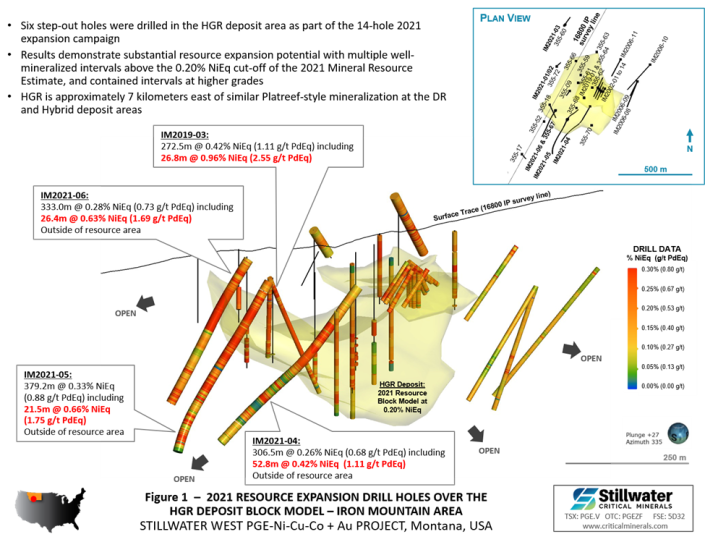
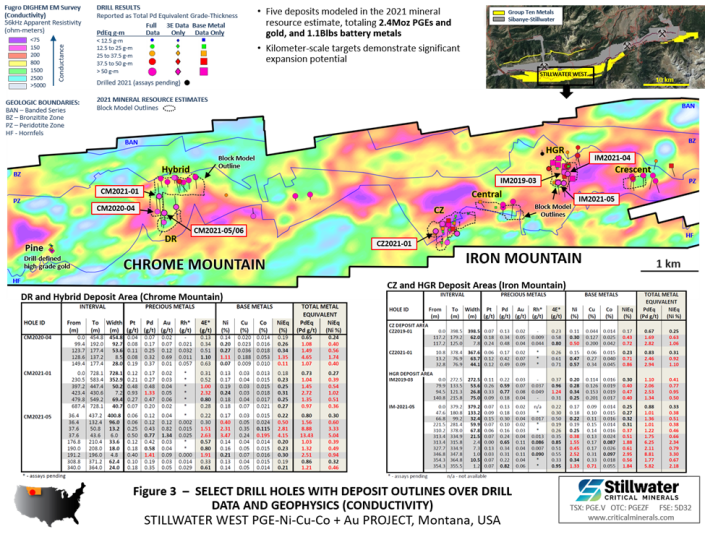
Results continue to support the Company’s priority objective of expanding the October 2021 inaugural mineral resource estimates with multiple wide and highly mineralized intervals returned in step-out drilling in six holes at the HGR deposit area at Iron Mountain (see Table 1 and Figure 1). Drilling in 2021 focused on resource expansion in three of the five deposit areas delineated by the 2021 estimates. Similar wide and well-mineralized intervals have now been reported from all three deposit areas as announced December 20, 2021, March 7, 2022, and May 3, 2022. Mineralization remains open to expansion along trend and at depth in all five deposit areas, which are set within 12 kilometers of the broader 32-kilometer-long land package in the lower Stillwater Igneous Complex (see Figure 2).
Highlights from six holes drilled in the HGR deposit area in 2021 include:
IM2021-05 returned379.2 meters of continuous battery and precious metal mineralization starting at surface and grading 0.33% Nickel Equivalent (“NiEq”), equal to 0.88 g/t Palladium Equivalent (“PdEq”), with successive contained higher-grade intervals including:
133.2 meters of 0.38% NiEq (1.01 g/t PdEq);
21.5 meters of 0.66% NiEq (1.75 g/t PdEq); and
7.3 meters of 0.79% NiEq (2.11 g/t PdEq) as 0.45% Ni, 0.51 g/t Pd+Pt+Au+Rh (“4E”), 0.17% Cu and 0.026% Co .
IM2021-05 is the second most highly mineralized drill hole ever recorded in the Stillwater district with a grade-thickness value of 334 gram-meter PdEq, after CM2021-01 which returned 530 gram-meter PdEq.
IM2021-06 returned 94.0 meters of 0.48% NiEq (1.28 g/t PdEq) within333.0 meters of continuous mineralization grading 0.28% NiEq (0.73 g/t PdEq). Additional contained intervals at higher grades include 26.4 meters of 0.63% NiEq (1.69 g/t PdEq) and 4.8 meters of 1.38 g/t 4E which includes 0.077 g/t Rh .
IM2021-04 , partially reported on March 7, 2022, returned 115.0 meters of 0.38% NiEq (1.02 g/t PdEq) within 306.5 meters of continuous mineralization grading 0.26% NiEq (0.68g/t PdEq). Additional contained intervals at higher grades include:
9.8 meters of high-grade PGE mineralization with 0.89% NiEq (2.38 g/t PdEq) as 1.54 g/t 4E including 1.02 g/t Pd, 0.39 g/t Pt, and 0.064 g/t Rh, along with base metal mineralization; and
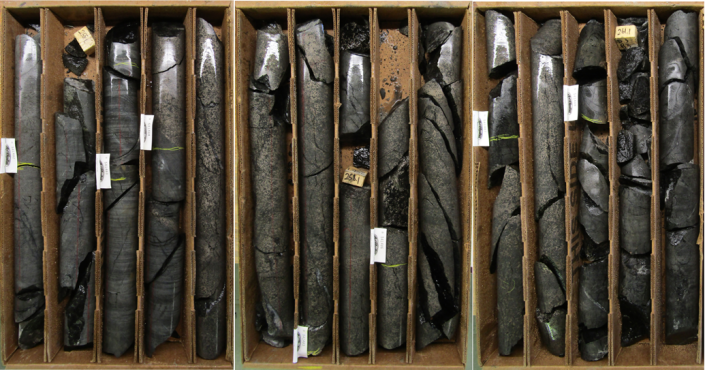
4.8 meters of high-grade battery metal mineralization with 1.47% NiEq (3.91 g/t PdEq) as 0.74% Ni, 0.65% Cu, 0.070% Co, plus 0.30 g/t 4E including 0.055 g/t Rh (see photo below).
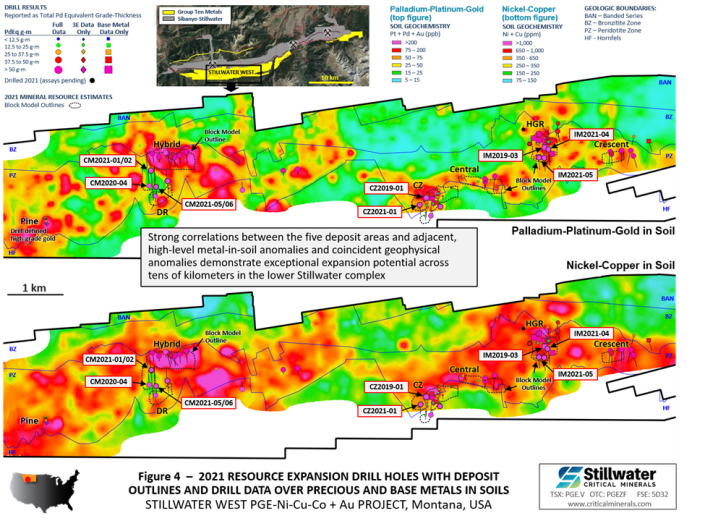
Drilling in the HGR deposit area in 2021 focused on step-out holes in the area of IM-2019-03 which returned 272.5 meters of 0.42% NiEq (1.11 g/t PdEq) including 26.8 meters of 0.96% NiEq (2.55 g/t PdEq) as 0.34% Ni, 0.15% Cu, 0.019% Co, 0.33 g/t Pt, 0.77 g/t Pd, 0.08 g/t Au, and 0.049 g/t Rh (see Figures 1 to 4).
These results, alongside results released May 3 and March 7, 2022, and December 20, 2021, demonstrate significant potential to expand the October 2021 mineral resource estimates with multiple long intervals at grades well above the 0.20% NiEq cut-off grade used in that study (see bolded assay values on Table 1). Potential is also shown to expand existing resources at higher cut-off grades, such as 0.35% and 0.50% NiEq (red values and shaded rows, respectively, on Table 1). Moreover, as shown in Figures 1 to 4, these results provide important intercepts in step-out drill holes located up to several hundred meters from the resource estimate block models.
Results also continue to highlight the potential for significant co-product rhodium values at Stillwater West, with drill samples in Iron Mountain holes IM2021-04, -05, and -06 returning up to 0.365 g/t Rh within the mineralized horizons. At recent values, rhodium trades at more than 16 times the value of platinum and seven times the value of palladium on a spot price basis at over US$14,000 per ounce. Sibanye-Stillwater, adjacent to Stillwater Critical Minerals’ Stillwater West project, is the primary US producer. Supply constraints for rhodium have supported rising prices since 2017.
Complete first-pass assay results have now been reported from all 14 holes drilled in 2021. Additional rhodium assays are pending on mineralized intervals.
Stillwater Critical Minerals, Thursday, July 7, 2022, Press release picture
Dr. Danie Grobler, Stillwater Critical Minerals’ Vice-President of Exploration, commented “Stillwater West continues to demonstrate significant equivalence with the Platreef deposits of the northern Bushveld Complex. Albie Brits and I are actively applying our combined four decades of Platreef experience in our new roles at Stillwater Critical Minerals with a priority on updating the geologic model to support planning and refining of drill targets for the next phase of follow-on work. Our current focus is to define detailed stratigraphic and structural controls within the 2021 Inferred Resource areas. We are also in the process of reviewing and prioritizing higher-grade pegmatoidal pyroxenite targets within the Stillwater stratigraphy that have not been fully tested.”
Michael Rowley, President and CEO, commented, “Results from the Iron Mountain drill campaign continue to demonstrate the remarkable potential for expansion of our inaugural mineral resource with multiple wide intercepts of battery and precious metals and contained intervals at successive higher grades. In particular our success in targeting Platreef-style nickel sulphide mineralization in step-out holes in the area of IM2019-03 shows excellent potential for resource growth, similar to our success in the DR and Hybrid deposit areas over seven kilometers to the west. We continue to see confirmation of a large mineralized system with an impressive endowment of eight of the commodities listed as critical by the US government. We look forward to further updates on our planned resource expansion, exploration priorities for 2022, and other news in the near term.”
Table 1 – Highlight Results from the 2021 Expansion Drill Campaign at the HGR Deposit Area
Stillwater Critical Minerals, Thursday, July 7, 2022, Press release picture
Highlighted significant mineralized intercepts are presented above. Grade-thickness values cover significant mineralized intervals with total palladium and nickel equivalent grade-thickness determined by multiplying the thickness of continuous mineralization (in meters) by the palladium equivalent grade (in grams/tonne) to provide gram-meter values (g-m) or by multiplying the nickel equivalent grade (in percent) to provide percent-meter values as shown. Total nickel and palladium equivalent calculations reflect total gross metal content using long term metal prices (all USD): $7.00/lb nickel (Ni), $3.50/lb copper (Cu), $20.00/lb cobalt (Co), $1,000/oz platinum (Pt), $1,800/oz palladium (Pd), and $1,600/oz gold (Au). Equivalent values have not been adjusted to reflect metallurgical recoveries. Total metal equivalent values include both base and precious metals. Intervals are reported as drilled widths and are believed to be representative of the actual width of mineralization.
About Stillwater West
Stillwater Critical Minerals is rapidly advancing the Stillwater West PGE-Ni-Cu-Co + Au project towards becoming a world-class source of low-carbon, sulphide-hosted nickel, copper, and cobalt, critical to the electrification movement, as well as key catalytic metals including platinum, palladium and rhodium used in catalytic converters, fuel cells, and the production of green hydrogen. Stillwater West positions SWCM as the second-largest landholder in the Stillwater Complex, with a 100%-owned position adjoining and adjacent to Sibanye-Stillwater’s PGE mines in south-central Montana, USA 1 . The Stillwater Complex is recognized as one of the top regions in the world for PGE-Ni-Cu-Co mineralization, alongside the Bushveld Complex and Great Dyke in southern Africa, which are similar layered intrusions. The J-M Reef, and other PGE-enriched sulphide horizons in the Stillwater Complex, share many similarities with the highly prolific Merensky and UG2 Reefs in the Bushveld Complex. SWCM’s work in the lower Stillwater Complex has demonstrated the presence of large-scale disseminated and high-sulphide battery metals and PGE mineralization, similar to the Platreef in the Bushveld Complex 2 . Drill campaigns by the Company, complemented by a substantial historic drill database, have delineated five deposits of Platreef-style mineralization across a core 12-kilometer span of the project, all of which are open for expansion into adjacent targets. Multiple earlier-stage Platreef-style and reef-type targets are also being advanced across the remainder of the 32-kilometer length of the project based on strong correlations seen in soil and rock geochemistry, geophysical surveys, geologic mapping, and drilling.
About Stillwater Critical Minerals Corp.
Stillwater Critical Minerals (TSX.V: PGE | OTCQB: PGEZF) is a mineral exploration company focused on its flagship Stillwater West PGE-Ni-Cu-Co + Au project in the iconic and famously productive Stillwater mining district in Montana, USA. With the recent addition of two renowned Bushveld and Platreef geologists to the team, the Company is well positioned to advance the next phase of large-scale critical mineral supply from this world-class American district, building on past production of nickel, copper, and chromium, and the on-going production of platinum group and other metals by neighbouring Sibanye-Stillwater. The Platreef-style nickel and copper sulphide deposits at Stillwater West contain a compelling suite of critical minerals and are open for expansion along trend and at depth, with an updated NI 43-101 mineral resource update expected in 2022.
Stillwater Critical Minerals also holds the high-grade Black Lake-Drayton Gold project adjacent to Treasury Metals’ development-stage Goliath Gold Complex in northwest Ontario, which is currently under an earn-in agreement with an option to joint venture whereby Heritage Mining may earn up to a 90% interest in the project by completing payments and work on the project. The Company also holds the Kluane PGE-Ni-Cu-Co project on trend with Nickel Creek Platinum‘s Wellgreen deposit in Canada‘s Yukon Territory.
About the Metallic Group of Companies
The Metallic Group is a collaboration of leading precious and base metals exploration companies, with a portfolio of large, brownfield assets in established mining districts adjacent to some of the industry’s highest-grade producers of silver and gold, platinum and palladium, and copper. Member companies include Metallic Minerals in the Yukon’s high-grade Keno Hill silver district and La Plata silver-gold-copper district of Colorado, Granite Creek Copper in the Yukon’s Minto copper district, and Stillwater Critical Minerals in the Stillwater PGM-nickel-copper district of Montana. The founders and team members of the Metallic Group include highly successful explorationists formerly with some of the industry’s leading explorers/developers and major producers. With this expertise, the companies are undertaking a systematic approach to exploration using new models and technologies to facilitate discoveries in these proven, but under-explored, mining districts. The Metallic Group is headquartered in Vancouver, BC, Canada, and its member companies are listed on the Toronto Venture, US OTC, and Frankfurt stock exchanges.
Note 1: References to adjoining properties are for illustrative purposes only and are not necessarily indicative of the exploration potential, extent or nature of mineralization or potential future results of the Company’s projects.
Note 2: Magmatic Ore Deposits in Layered Intrusions-Descriptive Model for Reef-Type PGE and Contact-Type Cu-Ni-PGE Deposits, Michael Zientek, USGS Open-File Report 2012-1010.
2021 drill core samples were analyzed by ACT Labs in Vancouver, B.C. Sample preparation: crush (< 7 kg) up to 80% passing 2 mm, riffle split (250 g) and pulverize (mild steel) to 95% passing 105 µm included cleaner sand. Gold, platinum, and palladium were analyzed by fire assay (1C-OES) with ICP finish. Selected major and trace elements were analyzed by peroxide fusion with 8-Peroxide ICP-OES finish to insure complete dissolution of resistate minerals. Following industry QA/QC standards, blanks, duplicate samples, and certified standards were also assayed.
Mr. Mike Ostenson, P.Geo., is the qualified person for the purposes of National Instrument 43-101, and he has reviewed and approved the technical disclosure contained in this news release.
Forward-Looking Statements
Forward Looking Statements: This news release includes certain statements that may be deemed “forward-looking statements”. All statements in this release, other than statements of historical facts including, without limitation, statements regarding potential mineralization, historic production, estimation of mineral resources, the realization of mineral resource estimates, interpretation of prior exploration and potential exploration results, the timing and success of exploration activities generally, the timing and results of future resource estimates, permitting time lines, metal prices and currency exchange rates, availability of capital, government regulation of exploration operations, environmental risks, reclamation, title, and future plans and objectives of the company are forward-looking statements that involve various risks and uncertainties. Although Stillwater Critical Minerals believes the expectations expressed in such forward-looking statements are based on reasonable assumptions, such statements are not guarantees of future performance and actual results or developments may differ materially from those in the forward-looking statements. Forward-looking statements are based on a number of material factors and assumptions. Factors that could cause actual results to differ materially from those in forward-looking statements include failure to obtain necessary approvals, unsuccessful exploration results, changes in project parameters as plans continue to be refined, results of future resource estimates, future metal prices, availability of capital and financing on acceptable terms, general economic, market or business conditions, risks associated with regulatory changes, defects in title, availability of personnel, materials and equipment on a timely basis, accidents or equipment breakdowns, uninsured risks, delays in receiving government approvals, unanticipated environmental impacts on operations and costs to remedy same, and other exploration or other risks detailed herein and from time to time in the filings made by the companies with securities regulators. Readers are cautioned that mineral resources that are not mineral reserves do not have demonstrated economic viability. Mineral exploration and development of mines is an inherently risky business. Accordingly, the actual events may differ materially from those projected in the forward-looking statements. For more information on Stillwater Critical Minerals and the risks and challenges of their businesses, investors should review their annual filings that are available at www.sedar.com .
Neither the TSX Venture Exchange nor its Regulation Services Provider (as that term is defined in the policies of the TSX Venture Exchange) accepts responsibility for the adequacy or accuracy of this release.
Stillwater Critical Minerals, Thursday, July 7, 2022, Press release pictureStillwater Critical Minerals, Thursday, July 7, 2022, Press release pictureStillwater Critical Minerals, Thursday, July 7, 2022, Press release pictureStillwater Critical Minerals, Thursday, July 7, 2022, Press release picture
NEW YORK, June 28, 2022 (GLOBE NEWSWIRE) — OTC Markets Group Inc. (OTCQX: OTCM), operator of regulated markets for trading 12,000 U.S. and international securities, today announced Collective Mining Ltd (TSX-V: CNL; OTCQX: CNLMF), an exploration and development company focused on identifying and exploring prospective mineral projects in South America, has qualified to trade on the OTCQX® Best Market. Collective Mining Ltd upgraded to OTCQX from the Pink® market.
Collective Mining Ltd begins trading today on OTCQX under the symbol “CNLMF.” U.S. investors can find current financial disclosure and Real-Time Level 2 quotes for the company on www.otcmarkets.com.
Upgrading to the OTCQX Market is an important step for companies seeking to provide transparent trading for their U.S. investors. For companies listed on a qualified international exchange, streamlined market standards enable them to utilize their home market reporting to make their information available in the U.S. To qualify for OTCQX, companies must meet high financial standards, follow best practice corporate governance and demonstrate compliance with applicable securities laws.
“We are pleased to reach the milestone of trading on OTCQX, as this will make it easier for our U.S. employees and investors to invest in Collective Mining by reducing the requirement of having a Canadian trading account,” said Ari Sussman, Executive Chairman of Collective.
Nauth LPC acted as the company’s OTCQX sponsor.https://embed.fireplace.yahoo.com/embed?ctrl=Monalixa&m_id=monalixa&m_mode=document&site=sports&os=android&pageContext=%257B%2522ctopid%2522%253A%25221542500%253B1577000%253B1580500%253B1480989%2522%252C%2522hashtag%2522%253A%25221542500%253B1577000%253B1580500%253B1480989%2522%252C%2522wiki_topics%2522%253A%2522OTC_Markets_Group%253BRegulated_market%253BZijin_Mining%253BUnited_States%253BSouth_America%2522%252C%2522lmsid%2522%253A%2522a0770000002m0AbAAI%2522%252C%2522revsp%2522%253A%2522globenewswire.com%2522%252C%2522lpstaid%2522%253A%2522701730ec-86cd-3dbe-9f98-d54d4e55d5c7%2522%252C%2522pageContentType%2522%253A%2522story%2522%257D
About Collective Mining Ltd
Collective Mining is an exploration and development company focused on identifying and exploring prospective mineral projects in South America. Founded by the team that developed and sold Continental Gold Inc. to Zijin Mining for approximately $2 billion in enterprise value, the mission of the Company is to repeat its past success in Colombia by making significant new mineral discoveries and advance the projects to production. Management, insiders and close family and friends own nearly 45% of the outstanding shares of the Company and as a result, are fully aligned with shareholders. Collective currently holds an option to earn up to a 100% interest in two projects located in Colombia. As a result of an aggressive exploration program on both the Guayabales and San Antonio projects, a total of eight major targets have been defined. The Company is fortuitous to have made significant grassroot discoveries at both projects with near-surface discovery holes at the Guayabales project yielding 302 metres at 1.11 g/t AuEq at the Olympus target, 163 metres at 1.3 g/t AuEq at the Donut target and 87.8 metres at 2.49 g/t AuEg at the Apollo target. At the San Antonio project, the Company intersected, from surface, 710 metres at 0.53 AuEq. (See press releases dated October 27th, 2021, November 15, 2021, March 15, 2022 and June 22, 2022 for AuEq calculations)
About OTC Markets Group Inc. OTC Markets Group Inc. (OTCQX: OTCM) operates regulated markets for trading 12,000 U.S. and international securities. Our data-driven disclosure standards form the foundation of our three public markets: OTCQX® Best Market, OTCQB® Venture Market and Pink® Open Market.
Our OTC Link® Alternative Trading Systems (ATSs) provide critical market infrastructure that broker-dealers rely on to facilitate trading. Our innovative model offers companies more efficient access to the U.S. financial markets.
OTC Link ATS, OTC Link ECN and OTC Link NQB are each an SEC regulated ATS, operated by OTC Link LLC, a FINRA and SEC registered broker-dealer, member SIPC.
To learn more about how we create better informed and more efficient markets, visit www.otcmarkets.com.
This release corrects and replaces the release disseminated June 23, 2022 at 9:40am ET. The release contained incorrect numbers in the table. Please see the full corrected release below.
VANCOUVER, BC / ACCESSWIRE / June 23, 2022 / (CSE:ROO)(OTC PINK:JNCCF)(Frankfurt:5VHA) – RooGold Inc. (“RooGold” or the “Issuer“).
RooGold is pleased to report that it has undertaken a preliminary rock chip sampling program at its 100% held Arthurs Seat Project Exploration Licence (EL) 9144 in the highly prospective New England Orogen in New South Wales, Australia.
Highlights
Successful landowner negotiations and access agreement established over key prospects at Arthurs Seat including McDonalds, Coxs and Murrays Mine.
A total of 274 rock chip samples were collected at historical prospects and along structural and geological contacts.
Significant hydrothermal alteration identified with multiple generations of mineralised quartz veins visible.
Visible silver-antimony mineralisation in quartz veins observed at Murrays and Co Mine and McDonalds Prospect.
Assay results received to date from 159 samples indicate widespread, low-level mineralisation along greisen altered granite – metasediment contacts and confirms the presence of a large hydrothermal mineral system.
115 assays are still pending from other key prospects.
Carlos Espinosa, Chief Executive Officer and a Director of RooGold commented, “RooGold has completed a successful, first pass rock chip sampling program at the Arthurs Seat Project, New South Wales. Preliminary assay results have been received and confirm low-level, widespread silver-antinomy geochemical anomalism within the project. Our field geologists have identified multiple sets of quartz veins at key prospects containing silver-antimony minerals and we look forward to receiving further assay results in the near term.”https://embed.fireplace.yahoo.com/embed?ctrl=Monalixa&m_id=monalixa&m_mode=document&site=sports&os=android&pageContext=%257B%2522ctopid%2522%253A%25221542500%253B1480989%253B1481489%2522%252C%2522hashtag%2522%253A%25221542500%253B1480989%253B1481489%2522%252C%2522wiki_topics%2522%253A%2522Arthurs_Seat%252C_Victoria%253BHunter-Bowen_orogeny%253BSampling_(music)%253BCarlos_Espinosa%253BProject_Exploration%253BSouth_Wales%253BSampling_(statistics)%253BMetasedimentary_rock%2522%252C%2522lmsid%2522%253A%2522a077000000LnOyOAAV%2522%252C%2522revsp%2522%253A%2522accesswire.ca%2522%252C%2522lpstaid%2522%253A%2522a87ff96a-bc83-3bf2-816f-97067f19d564%2522%252C%2522pageContentType%2522%253A%2522story%2522%257D
Arthurs Seat Project
The Arthurs Seat Project, comprised of Exploration License 9144 (“EL 9144”), is approximately 42 km² in area and is located in the northwestern region of the New England Orogen. The New England Orogen comprises island-arc and continental-arc gold-silver mineralized belts, which host extensive intrusion related polymetallic deposits. In the Southern New England Orogen, where Roo Golds projects are based, include the historic Conrad Silver Mine which produced approximately 3.5Moz Ag1, Webbs Silver deposit that contains JORC (2012) Mineral Resource Estimate Indicated and Inferred of 2.2Mt at 205 g/t Ag2 and the Hillgrove Au-Sb-W Mine with historic production of 720koz Au3.
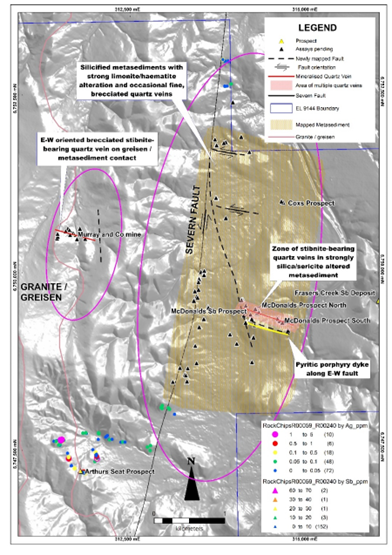
The Arthurs Seat project is centered on the regional Severn Thrust Fault and mineralized granitic/sandstone contact. The property includes 3 historical silver, tungsten and antimony mines and prospects. Mineralization is found in white quartz and tourmaline veins cutting the greisen altered granite – meta- sedimentary contact zone. This contact spans over 15 km strike length within the concession, historically mined for silver and tin ore. The contact target and associated mines remain unexplored in the subsurface since mining ended in 1890.
Elevated gold grades observed at the Cox gold/silver prospect are interpreted as related with the hanging wall of the deep-seated Severn Thrust Fault – potentially representing a robust 7 km long underexplored secondary target (Figure 1 and Figure 2).
The Murray and Co Mine is located on the western boundary of EL 9144 and was mined in the late 1890’s including the development of underground adits and shafts driven into silver and tin rich quartz and tourmaline veins, which intrude metasediments along the greisen altered granite contact, (Figure 3). Historical sampling of mullock heaps at the prospect returned grades of 1,085 g/t Ag and 1,400 ppm Sb (source: Magnum Exploration NL, GS1971/217).
Rock Chip Sampling Program
Two field trips were undertaken with a total of 274 rock chip samples collected at the Arthurs Seat Project (EL 9144) to confirm the results of historical sampling. Initial sampling focused on the Arthurs Seat historical prospect that is defined by the contact between the Permian Graman Monzogranite of the S-type Bundarra Supersuite and the metasediments of the Carboniferous Texas Beds of the Central Block.
Of the 159 rock chip samples, 154 samples returned anomalous silver showing low-level, widespread silver mineralisation across the sampling area ranging from 0.01 ppm Ag to 4.0 ppm Ag, see Figure 1 and Figure 2. The highest grade results were concentrated in the greisen altered granite hosting quartz veins at Arthurs Seat. The highest assay result received was 3.99 ppm Ag, 8,210 ppm As, 4.93 ppm Sb. 3.80 ppm W and 223 ppm Bi (Sample Number R00148) from a greisen altered granite with iron-oxide filled vugs after sulfides. The highest gold result returned was 0.11 ppm Au, 5.03% As, 165 ppm Bi, 2.36 ppm Ag from a highly sheared mafic rock (Sample Number R00147).
Table 1: Significant assay results from rock chip sampling program (>0.98 ppm Ag) from (R00059 – R00241) Arthurs Seat prospect, EL 9144.
Lithology
Sample ID
Easting MGA 94
Northing MGA94
RL
Au ppm
Ag ppm
As ppm
Bi ppm
Sb ppm
W ppm
Granite
R00148
311523
6747639
536
<0.01
3.99
8210
223
4.93
3.80
Qtz vein in granite
R00193
312030
6747383
497
<0.01
3.98
67.9
49
1.11
4.70
Qtz Vein
R00156
311519
6747646
536
<0.01
3.90
31600
559
7.39
2.70
Qtz Vein
R00161
311528
6747646
534
0.01
2.58
10500
213
12.7
1.40
Mafic / skarn mineralisation (?)
R00147
311522
6747636
536
0.11
2.36
50300
165
69.1
0.80
Greisen / Granite
R00187
311632
6747384
529
<0.01
2.34
2180
75.4
2.37
2.20
Qtz Vein
R00159
311522
6747641
536
0.01
2.18
14000
176
15.4
0.60
Granite
R00150
311522
6747640
536
<0.01
1.70
3700
219
2.81
3.50
Qtz Vein
R00162
311528
6747646
534
0.02
1.22
33400
39.2
67.2
1.30
Qtz Vein
R00164
311536
6747649
533
0.04
1.05
25800
54.3
39.6
1.10
Qtz Vein
R00158
311524
6747642
535
<0.01
0.99
5660
98.9
7.24
0.90
Qtz Vein
R00152
311524
6747640
536
<0.01
0.98
23200
309
7.48
0.30
The location of the rock chip samples and current assay results are indicated below in Figures 1 and 2.
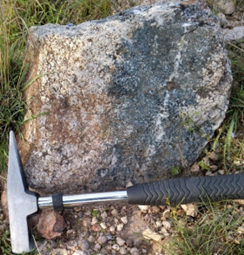
The Murray and Co mine was mapped as a subvertical, E-W trending zone of silicified ferruginous metasediments in contact with silica flooded quartz veins in greisenised granite. A 1 m zone of fine, brecciated, smokey, and gossanous quartz veins carrying stibnite, arsenopyrite, and pyrite was observed. Significant silica, sericite, and chlorite alteration of metasedimentary host rocks confirm the presence of a hydrothermal mineralizing system, Figure 4. Multiple generations of quartz veins were observed with primary, coarse bucky quartz, and secondary fine, smokey quartz veins carrying stibnite, arsenopyrite, and pyrite mineralisation.
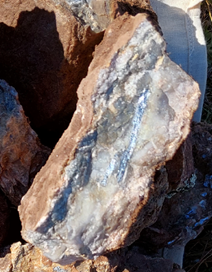
The McDonalds North prospect was mapped as an E-W trending zone of fine (1-3 mm) gossanous and stibnite-silver bearing quartz veins within a highly silicified metasediment host rock, Figure 5. Sub-horizontal bedding contained minor sulfides along the bedding plane. McDonalds South prospect is faulted and juxtaposed against a quartz-eye porphyry dyke containing arsenopyrite and pyrite intruded into strongly silica flooded metasediments. A number of E-W sinistral faults were mapped and represent possible conduits for the deposition of mineralizing fluids, Figure 6.
The remaining 115 samples collected at Murrays and Co Mine and McDonalds prospects have assay results pending from the laboratory.
RooGold Inc., Thursday, June 23, 2022, Press release pictureRooGold Inc., Thursday, June 23, 2022, Press release pictureRooGold Inc., Thursday, June 23, 2022, Press release pictureRooGold Inc., Thursday, June 23, 2022, Press release pictureRooGold Inc., Thursday, June 23, 2022, Press release pictureRooGold Inc., Thursday, June 23, 2022, Press release picture
Quality Assurance and Quality Control (QAQC) and Assay Procedures
A minimum of 3 kg per rock chip sample collected in sealed calico bags by the RooGold field team. Five calicos containing rock chips placed in a green plastic bag and each zip tied to ensure security. A total of 34 green bags were placed on heavy duty pallet, wrapped in heavy duty plastic wrap to ensure security and sent to ALS Geochemistry Labs (ALS) in Perth, Australia for assay testing. ALS is independent of RooGold and is certified to international quality standards through ISO/IEC 17025:2017 including ISO 9001:2015 and ISO 9002 specifications.
At ALS, rock chips underwent coarse crushing before fine crushing to 70% less than 2mm then riffle split off 1kg, followed by a pulverise split to better than 85% passing <75μm. Gold was measured by Fire Assay of 50g sample and AAS finish. Samples were also tested using a ME-ICP61 for 33 element suite by 4 acid digest, HCl leach and ICP-AES. Field blanks were inserted every 25 samples. Certified gold and base metal reference standards (CRM’s) were inserted every 13 samples. Assay results from certified standards received from the laboratory are required to be within 3σ from their Certified Reference Value. RooGold noted no issues with the CRM results, which met acceptable values.
Data Verification
Alexandra Bonner has verified all scientific and technical data disclosed in this news release including the rock chip locations, sampling procedures, and analytical data underlying the technical information disclosed. Specifically, Alexandra Bonner reviewed the original certified assay results from ALS and verified the assay summary table produced for these rock chip samples. Alexandra Bonner noted no errors or omissions during the data verification process. RooGold and Alexandra Bonner do not recognize any significant factors of sampling or recovery that could materially affect the accuracy or reliability of the rock chip assay data disclosed in this news release.
Qualified Person Statement
The scientific and technical information contained in this news release has been prepared and approved by Alexandra Bonner, Vice President of Exploration, who is a Qualified Person as defined in NI 43-101.
About RooGold Inc.
ROOGOLD is a Canadian based junior venture mineral exploration issuer which is uniquely positioned to be a dominant player in New South Wales, Australia, through a growth strategy focused on the consolidation and exploration of high potential, mineralized precious metals properties in this prolific region of Australia. Through its announced acquisitions of Southern Precious Metals Ltd., RooGold Ltd. and Aussie Precious Metals Corp. properties, RooGold commands a portfolio of 14 high-grade potential gold (10) and silver (4) concessions covering 2,696 km2 which have 139 historic mines and prospects.
This press release may contain forward-looking statements within the meaning of applicable securities law. Forward-looking statements are frequently characterized by words such as “plan”,”expect”, “project”, “intend”,”believe”, “anticipate”, “estimate” and other similarwords, or statements that certain eventsor conditions “may” or “will” occur.
Although the Issuer believes that the expectations reflected in applicable forward-looking statements are reasonable, therecan be no assurance that such expectations will prove to be correct. Such forward-looking statements are subjectto risks and uncertainties that may cause actual results, performance or developments to differ materially from those contained in such statements.
NEITHER THE CANADIAN SECURITIES EXCHANGE NOR ITS REGULATION SERVICES PROVIDER ACCEPTS RESPONSIBILITY FOR THE ADEQUACY OR ACCURACY OF THIS RELEASE.
In twenty-first-century America, ordinary people are at the mercy of well-paid, unelected government experts who wield vast power. That is, we live in the age of the technocrats: people who claim to have special wisdom that entitles them to control, manipulate, and manage society’s institutions using the coercive power of the state.
We’re told these people are “nonpolitical” and will use their impressive scientific knowledge to plan the economy, public health, public safety, or whatever goal the regime has decided the technocrats will be tasked with bringing about.
These people include central bankers, Supreme Court justices, “public health” bureaucrats, and Pentagon generals. The narrative is that these people are not there to represent the public or bow to political pressure. They’re just there to do “the right thing” as dictated by economic theory, biological sciences, legal theory, or the study of military tactics.
We’re also told that in order to allow these people to act as the purely well-meaning apolitical geniuses they are, we must give them their independence and not question their methods or conclusions.
We were exposed to this routine yet again last week as President Joe Biden announced he will “respect the Fed’s independence” and allow the central bankers to set monetary policy without any bothersome interference from the representatives of the taxpayers who pay all the bills and who primarily pay the price when central bankers make things worse. (Biden, of course, didn’t mention that central bankers have been spectacularly wrong about the inflation threat in recent years, with inflation rates hitting forty-year highs, economic growth going negative, and consumer credit piling up as families struggle to cope with the cost of living.)
Conveniently, Biden’s deferral to the Fed allows him to blame it later when economic conditions get even worse. Nonetheless, his placing the economy in the hands of alleged experts will no doubt appear laudable to many. This is because the public has long been taught by public schools and media outlets that government experts should have the leeway to exercise vast power in the name of “fixing” whatever problems society faces.
The Expert Class as a Tool for State Building
The success of this idea represents a great victory for progressive ideology. Progressives have long been committed to creating a special expert class as a means of building state power. In the United States, for example, the cult of expertise really began to take hold in the late nineteenth and early twentieth centuries, and it led directly to support for more government intervention in the private sector. As Maureen Flanagan notes in “Progressives and Progressivism in an Era of Reform,”
Social science expertise gave political Progressives a theoretical foundation for cautious proposals to create a more activist state…. Professional social scientists composed a tight circle of men who created a space between academia and government from which to advocate for reform. They addressed each other, trained their students to follow their ideas, and rarely spoke to the larger public.
These men founded new organizations—such as the American Economics Association—to promote this new class of experts and their plans for a more centrally planned society. Ultimately, the nature of the expert class was revolutionary. The new social scientists thought they knew better than the patricians, religious leaders, local representatives, and market actors who had long shaped local institutions. Instead,
Progressives were modernizers with a structural-instrumentalist agenda. They rejected reliance on older values and cultural norms to order society and sought to create a modern reordered society with political and economic institutions run by men qualified to apply fiscal expertise, businesslike efficiency, and modern scientific expertise to solve problems and save democracy. The emerging academic disciplines in the social sciences of economics, political economy and political science, and pragmatic education supplied the theoretical bases for this middle-class expert Progressivism.
The Progressive impulse for expertise-based rule was perhaps exemplified by the Progressive transportation planner Emory Johnson, who advocated for a strong federal executive branch that would be resistant to political pressure while relying on the supposedly “scientific” judgments of government planners and other bureaucrats. Johnson
explicitly took up the question of the role of expertise in the American state…. he maintained that success relied upon what he termed “executive functions.” He sought to empower the federal government’s executive branch as experts’ natural home.1
In the Progressive view, business leaders and machine politicians lacked a rational and broad view of the needs of society. In contrast, the government experts would approach society’s problems as scientists. Johnson felt this model already somewhat existed in the Department of War, where Johnson imagined the secretary of war was “quite free from political pressure and [relied] on the counsel of the engineers.” Johnson imagined that these science-minded bureaucrats could bring a “really economic and scientific application” of policy.2
“Disinterested” Central Planners
Johnson was part of a wave of experts and intellectuals attempting to develop “a new realm of state expertise” that favored apolitical technocrats who would plan the nation’s infrastructure and industry.2 Many historians have recognized that these efforts were fundamentally “state-building activities … [and that] their emergence marked and symbolized a watershed in which an often-undemocratic new politics of administration and interest groups displaced the nineteenth century’s partisan, locally oriented public life” (emphasis added).3
In short, these efforts sowed the seeds for the idealized technocracy we have today: unresponsive to the public and imbued with vast coercive power that continually displaces private discretion and private prerogatives.
Indeed, the Progressive devotion to expertise followed “the core pattern of Progressive politics,” which is “the redirection of decision making upward within bureaucracies.”4 Thus, in contrast to the populist political institutions of an earlier time, decision-making in the Progressive Era became more white-collar, more middle class—as opposed to the working-class party workers—and more hierarchical within bureaucracies directly controlled by the state’s executive agencies.
Although Progressives thought of themselves as the saviors of democracy, they nonetheless recognized the conflict between their professed democratic ideals and a reliance on experts:
[Progressives] reconciled the conflict between using hierarchical bureaucracy to seek efficiency and dispersing power to achieve equality by depicting bureaucratic systems as safeguards of public order…. Since authority flowed from supposedly disinterested facts and “scientific” expertise, bureaucratic systems were presented by their champions as objective, coherent, and essentially democratic structures.5
This idealized notion of the “disinterested expert” formed a key component of the Progressive agenda:
Progressive reformers proposed an antidote to the corruption of patronage politics, emphasizing disinterested experts and rationalized administration: a city council would appoint an executive officer, the city manager, who would in turn appoint qualified lieutenants to assist him. The rationalized and centralized bureaucracies presided over by city managers would be run “scientifically,” meaning objectively, insulated from patronage politics.6
Who Should Rule?
In many ways, then, this aspect of Progressive ideology turned the political agenda oflaissez-faire classical liberalism on its head. Liberals of the Jeffersonian and Jacksonian variety had sought to increase outside political influence in the policy-making process through elections and the appointment of party activists loyal to elected representatives. This was because liberals feared that an insulated class of government experts would function more in its own interests than those of the taxpayers.
The Progressives, however, imagined they could create a disinterested nonpolitical class of experts devoted only to objective science. The fundamental question, then, became who should rule: insulated experts or nonexpert representatives with closer ties to the taxpayers.
We can see today that the Progressives largely succeeded in granting far greater power to today’s technocratic class of experts. The technocrats are praised for their allegedly scientific focus, and we are told to respect their independence.
If the goal was ever to protect public checks on state power, however, this was always an unworkable ideal. By creating a special class of expert bureaucrats with decades-long careers within the regime itself, we are simply creating a new class of officials able to wield state power with little accountability. Anyone with a sufficiently critical view of state power could see the danger in this. Interestingly, it was anarcho-communist Mikhail Bakunin who recognized the impossibility of solving the problem of state power by putting scientific experts in charge. Such a move only represented a transfer of power from one group to another. Bakunin warned:
The State has always been the patrimony of some privileged class or other; a priestly class, an aristocratic class, a bourgeois class, and finally a bureaucratic class.
Moreover, state bureaucratic efforts to plan society from the center, Bakunin noted,
will demand an immense knowledge and many “heads overflowing with brains” in this government. It will be the reign of scientific intelligence, the most aristocratic, despotic, arrogant, and contemptuous of all regimes. There will be a new class, a new hierarchy of real and pretended scientists and scholars.
It is not necessary, of course, to have full-blown socialism to create this “new class.” The modern state with its mixed economy in most cases already has all the bureaucratic infrastructure necessary to make this a reality. As long as we defer to this ruling class of “scientists and scholars,” the Progressives have won.
1.Drew VandeCreek, “Emory Johnson and the Rise of Economic Expertise in the Progressive State, 1898-1913,” Journal of the Gilded Age and Progressive Era 17, no. 2 (April 2018): 276–96, esp. 279.
4.Heather A. Haveman, Srikanth Parachuri, and Hayagreeva Rao, “The Winds of Change: The Progressive Movement and the Bureaucratization of Thrift,” American Sociological Review 72, no. 1 (February 2007): 117–42, esp. 125.
Ryan McMaken (@ryanmcmaken) is a senior editor at the Mises Institute. Send him your article submissions for the Mises Wire and Power and Market, but read article guidelines first. Ryan has a bachelor’s degree in economics and a master’s degree in public policy and international relations from the University of Colorado. He was a housing economist for the State of Colorado. He is the author of Commie Cowboys: The Bourgeoisie and the Nation-State in the Western Genre.
Geological Plan Map showing Drilling in Santa Barbara and Porco Areas with Holes referred to in this release highlighted.
Figure 2
3D Location of > 90 g Ag eq/t Grade Shell Model for Santa Barbara relative to the 3D Magnetic Susceptibility Inverse Model. The high-grade likely feeder zone at Santa Barbara extends approximately 750m along strike, is 650m wide and extends to a depth of at least 750m. The deposit is open in all directions.
Figure 3
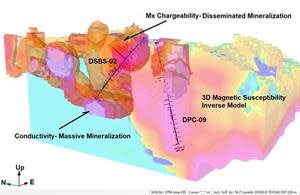
3D Model of Inverse Magnetic Susceptibility and BHIP Mx Chargeability and Conductivity, Iska Iska. Note that BHIP data is primarily only available in the Santa Barbara area.
Figure 4
Strong inverse magnetic susceptibility anomaly in the Porco Area that extends for approximately 1.6km along strike by 700m wide with a vertical extent of approximately 750m.
Hole DSBS-02 was drilled across the interpreted Santa Barbara feeder zone to a length of 1,023.4m, corresponding to a vertical depth of 745m. Notably, 67% of the overall length of this hole yielded reportable intersections which collectively average 100.42 g Ag eq/t.
Grade shell modelling in Leapfrog of the Santa Barbara Deposit indicates that, as of this date, drilling has defined a higher-grade zone >90 g Ag eq/t that is approximately 750m along strike, 650m wide and extends to a depth of at least 750m. This deposit remains open in all directions.
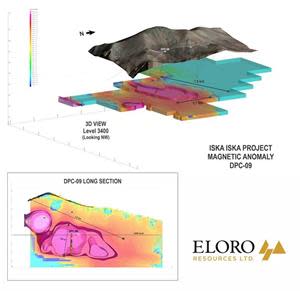
Hole DPC-09, the first of a series of holes to test the major inverse magnetic susceptibility anomaly in the Porco area, intersected 41 reportable mineralized intersections representing 29% of this 1,124.4m long hole that collectively average 94.73 g Ag eq/t. Significantly, the last reportable intersection near the bottom of this hole is higher in Ag and Sn with very low values of Zn and Pb. This is typical of what is seen in the Santa Barbara area in the transition from the Ag-Zn-Pb-Sn polymetallic mineralization to the more tin dominant mineralization at depth.
The coincidence of the magnetic inverse model with the chargeability/conductivity model from Bore Hole Induced Polarization (BHIP) surveys provides a powerful tool to outline very prospective drill targets. BHIP surveys to a depth of almost 1,000m show that the conductivity increases with depth at Santa Barbara, indicating that the potential feeder zone could be even more substantive.
TORONTO, June 14, 2022 (GLOBE NEWSWIRE) — Eloro Resources Ltd. (TSX-V: ELO; OTCQX: ELRRF; FSE: P2QM) (“Eloro”, or the “Company”) is pleased to announce assay results from an additional two (2) diamond drill holes from its on-going drilling program at the Iska Iska silver-tin polymetallic project in the Potosi Department, southern Bolivia. Hole DSBS-02 is a surface hole drilled due north at -300 from the south side of Santa Barbara across the higher-grade likely feeder zone. Hole DPC-09 is the first in a series of drill holes to test the extensive magnetic susceptibility anomaly in the Porco area in the southern part of the property. Four drills including three surface drills and one underground drill are focussed on completing drilling in the Santa Barbara Resource Definition Drilling Area. The underground drill is on its last hole and will be moved to surface to complete drill holes requested by Micon International Limited (“Micon”) to better define the preliminary open pit to be utilized for the maiden mineral resource estimate targeted for completion at the end of Q3.
Overall, the Company has completed 59,499m in 95 drill holes to-date, including four holes in progress, as shown in Figure 1. Tables 1 and 2 list significant assay results for the two drill holes reported. Prices used for calculating Ag equivalent grades are as outlined in Eloro’s February 1, 2022, press release. Table 3 summarizes drill holes with assays pending. Highlights are as follows:
Santa Barbara Mineral Resource Definition Target Area – Surface Drilling
Hole DSBS-02 was collared in the south part of the Santa Barbara target at an azimuth of 00 and dip of -300 to test across the likely higher grade feeder zone for the Santa Barbara Ag-Sn polymetallic mineralization. This hole was drilled to a length of 1,023.4m, corresponding to a vertical depth of 745m, with 67% of the hole containing reportable intersections which collectively average 100.42 g Ag eq/t. Significant results are as follows:
146.65 g Ag eq/t (10.74 g Ag/t, 1.01 g Au/t, 0.31% Zn, 0.11% Pb and 0.06% Sn) over 88.66m from 319.36m to 408.02m, including a higher-grade section of:
737.33 g Ag eq/t (51.11 g Ag/t, 6.82 g Au/t, 0.24% Zn, 0.31% Pb, and 0.19% Sn) over 12.06m from 355.39m to 367.45m. Notably, this is the strongest gold-bearing intercept encountered to date at Iska Iska.
131.86 g Ag eq/t (21.38 g Ag/t, 0.06 g Au/t, 0.25% Zn, 0.24% Pb and 0.14% Sn) over 104.38m from 531.22m to 635.60m, including higher-grade sections of:
224.16g Ag eq/t (50.19 g Ag/t, 0.02 g Au/t, 0.41% Zn, 0.38% Pb and 0.24%Sn) over 26.79m from 543.09 to 569.88,
300.90g Ag eq/t (35.33 g Ag/t, 0.20 g Au/t, 0.26 % Zn. 0.78% Pb and 0.36% Sn) over 10.38m from 590.84m to 601.22m.
78.94 g Ag eq/t (12.77 g Ag/t, 0.06 g Au/t, 0.66% Zn, 0.12% Pb and 0.04% Sn) over 235.43m from 670.27m to 905.70m which included higher grade sections of:
494.81 g Ag eq/t (170.06 g Ag/t, 0.49 g Au/t, 0.37% Zn, 0.35 %Pb, 0.40 % Sn) over 4.46m from 722.70m to 727.16m,
181.64 g Ag eq/t (76.79 g Ag/t, 0.19g Au/t, 0.76% Zn, 0.23 %Pb and 0.07% Sn) over 4.35m from 770.73m to 775.08m,
120.54 g Ag eq/t (15.50g Ag/t, 0.01 g Au/t, 1.57% Zn, 0.34% Pb and 0.03%Sn) over 10.96 m from 800.44m to 811.40m, and
129.54 g Ag eq/t (6.44 g Ag/t, 0.08 g Au/t, 2.03% Zn, 0.34% Pb and 0.02% Sn) over 8.94 m from 853.28m to 862.22m.
Dr. Bill Pearson, P.Geo. Eloro’s Executive Vice President, Exploration commented: “Grade shell modelling in Leapfrog of the Santa Barbara Deposit by the Iska Iska geological team indicates that drilling has defined a higher-grade zone >90 g Ag eq/t that extends approximately 750m along strike, is 650m wide and extends to a depth of at least 750m. The deposit is open in all directions. Figure 2 shows the Santa Barbara deposit model relative to the extensive 3D inverse magnetic susceptibility model, demonstrating the remarkable scale of this enormous mineralized system.”
Dr. Pearson continued: “Figure 3 is a 3D model combining the inverse magnetic susceptibility model and the bore hole induced polarization (“BHIP”) chargeability and conductivity data that clearly shows how this new hole DSBS-02 intersected significant mineralization in an area of an extensive chargeability anomaly coincident with a magnetic high. In the lower part of this hole conductivity increases substantially and indicates that this hole stopped just short of a likely area of massive sulphide mineralization. The coincidence of the magnetic inverse model with the chargeability/conductivity model provides a powerful tool to outline very prospective drill targets. BHIP surveys to a depth of almost 1,000m show that the conductivity increases with depth at Santa Barbara, indicating that the potential feeder zone could be even more substantive.”
Dr. Chris Hale, P.Geo., Chief Geophysicist for Eloro said: “Geophysical targeting is very useful at Iska Iska because the mineralization often occurs in association with pyrrhotite, a mineral that affects both the electrical and magnetic properties of the host rock. BHIP helps to correlate mineralization between the holes because it samples a much larger volume around the borehole than each assay does. BHIP provides two electrical measures of the quantity of mineralization; chargeability that measures the amount of disseminated mineralization and conductivity that shows when the strength of mineralization reaches the point of “connectivity”, resulting in a conductive deposit. This explains the strong spatial correlation between the grade of mineralization and the chargeable volume around DSBS-02. We do not yet have BHIP surveys under DPC-09 but this hole was targeted to test a peak in the magnetic susceptibility that was modelled using surface magnetic data. The excellent spatial coincidence between the mineralized intersection and the peak in magnetic susceptibility gives us confidence that we will also likely intersect mineralization when we drill the larger magnetic susceptibility zone that is modelled deeper and farther to the south.”
Porco Area – Magnetic Inverse Anomaly – Surface Drilling
Hole DPC-09 is the first of a series of holes to test the major inverse magnetic susceptibility anomaly in the Porco area, as outlined in Eloro’s March 1, 2022 press release. This hole intersected 41 reportable mineralized intersections, representing 29% of this 1,124.4m long hole that collectively averaged 94.73 g Ag eq/t. Highlights include:
143.47 g Ag eq/t (10.67 g Ag/t, 0.25 g Au/t, 1.90 % Zn, 0.23%Pb, 0.09% Cu and 0.01% Sn) over 11.96m from 363.57 to 375.53m
84.46 g Ag eq/t (6.52 g Ag/t, 0.03 g Au/t, 1.13% Zn, 0.37% Pb and 0.01% Sn) over 10.63m from 410.09 to 420.72m
79.46 g Ag eq/t (4.47 g Ag/t, 0.02 g Au/t, 1.12% Zn, 0.08 %Pb and 0.03 % Sn) over 42.55m from 740.63m to 783.18m.
82.64 g Ag eq/t (3.48 g Ag/t, 0.05 g Au/t, 0.50% Zn, 0.09% Pb, and 0.08% Sn) over 57.34m from 798.15m to 855.49m including a higher grade section of:
127.94 g Ag eq/t (3.37 g Ag/t, 0.05 g Au/t, 0.50% Zn,0.12% Pb and 0.16% Sn) over 12.02m from 798.15 to 810.17m,
96.13 g Ag eq/t (8.14 g Ag/t, 0.15 g Au/t, 0.40% Zn, 0.11% Pb and 0.09% Sn) over 14.83m from 972.51m to 987.34m,
69.88 g Ag eq/t (8.73 g Ag/t, 0.11 g Au/t, 0.22% Zn, 0.05% Pb and 0.06% Sn) over 40.24m from 1045.82m to 1086.06m including a higher grade section of
100.05 g Ag eq/t (16.71 g Ag/t, 0.08 g Au/t, 0.35% Zn, 0.06% Pb and 0.09% Sn) over 13.25m from 1068.37 to 1081.62m
163.35 g Ag eq/t (48.35 g Ag/t, 0.12 g Au/t, 0.05% Zn, 0.05% Pb, 0.09% Cu and 0.15% Sn) over 5.95m from 1114.63m to 1120.58m
As shown in Figure 4, this hole intersected a very extensive inverse magnetic susceptibility anomaly which, at elevation 3,400m, extends for approximately 1.6km along strike by 700m wide with a vertical extent of approximately 750m. The 3,400m elevation is approximately 100m above the valley floor. Significantly, the last reportable intersection near the bottom of the hole is higher in Ag and Sn with very low values of Zn and Pb. This is typical of what is seen in the Santa Barbara area in the transition from the Ag-Zn-Pb-Sn polymetallic mineralization to the more tin dominant mineralization at depth.
Table 1: Significant Results, Surface Diamond Drilling, Santa Barbara Resource Definition Target Area as at June 14, 2022.
SANTA BARBARA RESOURCE DEFINITION TARGET ZONE
SURFACE DIAMOND DRILLING
Hole No.
From (m)
To (m)
Length (m)
Ag
Au
Zn
Pb
Cu
Sn
Bi
Cd
Ag eq
g/t
g/t
%
%
%
%
%
%
g/t
DSBS-02
7.84
24.44
16.60
1.36
0.01
0.00
0.01
0.00
0.07
0.001
0.001
44.49
116.64
119.75
3.11
11.60
0.01
0.04
0.54
0.03
0.04
0.001
0.001
58.37
140.40
153.60
13.20
0.72
0.01
1.11
0.15
0.00
0.01
0.001
0.003
60.89
170.99
174.10
3.11
0.74
0.01
0.99
0.07
0.01
0.01
0.001
0.004
53.28
181.52
210.84
29.32
1.61
0.01
1.04
0.11
0.02
0.02
0.001
0.004
64.93
Incl.
204.66
209.33
4.67
4.63
0.01
2.69
0.35
0.06
0.04
0.002
0.008
172.94
235.15
255.86
20.71
5.43
0.06
1.83
0.55
0.01
0.09
0.003
0.007
168.10
270.96
281.72
10.76
7.62
0.04
0.49
0.22
0.02
0.06
0.001
0.002
78.72
290.74
293.71
2.97
15.53
0.05
0.06
0.14
0.04
0.05
0.001
0.001
59.26
298.26
308.78
10.52
26.84
0.11
0.05
0.09
0.08
0.02
0.001
0.001
65.08
319.36
408.02
88.66
10.74
1.01
0.31
0.11
0.01
0.06
0.008
0.001
146.65
Incl.
355.39
367.45
12.06
51.11
6.82
0.24
0.31
0.02
0.19
0.047
0.001
737.33
438.04
447.12
9.08
3.67
0.21
1.53
0.10
0.01
0.05
0.001
0.007
126.04
469.60
483.12
13.52
1.17
0.06
0.59
0.05
0.01
0.06
0.001
0.002
69.05
489.14
517.80
28.66
6.00
0.02
0.55
0.34
0.01
0.04
0.001
0.002
68.65
522.20
525.40
3.20
6.50
0.04
0.27
0.12
0.01
0.07
0.001
0.001
66.24
531.22
635.60
104.38
21.38
0.06
0.25
0.24
0.01
0.14
0.002
0.001
131.86
Incl.
543.09
569.88
26.79
50.19
0.02
0.41
0.38
0.01
0.24
0.001
0.001
224.16
Incl.
590.84
601.22
10.38
35.33
0.20
0.26
0.78
0.01
0.36
0.006
0.001
300.90
647.53
658.12
10.59
10.57
0.01
0.23
0.28
0.01
0.14
0.001
0.001
116.41
670.27
905.70
235.43
12.77
0.06
0.66
0.12
0.01
0.04
0.005
0.002
78.94
Incl.
722.70
727.16
4.46
170.06
0.49
0.37
0.35
0.04
0.40
0.104
0.003
494.81
Incl.
770.73
775.08
4.35
76.79
0.19
0.76
0.23
0.01
0.07
0.013
0.001
181.64
Incl.
800.44
811.40
10.96
15.50
0.01
1.57
0.34
0.01
0.03
0.001
0.004
120.54
Incl.
853.28
862.22
8.94
6.44
0.08
2.03
0.34
0.01
0.02
0.001
0.006
129.54
917.78
931.28
13.50
7.05
0.03
0.78
0.13
0.01
0.04
0.002
0.002
73.10
953.83
955.34
1.51
16.00
0.01
0.48
1.24
0.01
0.19
0.001
0.001
191.90
964.38
971.84
7.46
5.96
0.01
0.53
0.14
0.01
0.04
0.001
0.001
62.14
980.80
1022.40
41.60
38.97
0.08
0.24
0.34
0.03
0.10
0.007
0.001
132.38
Note: True width of the mineralization is not known at the present time, but based on the current understanding of the relationship between drill orientation/inclination and the mineralization within the breccia pipes and the host rocks such as sandstones and dacites, it is estimated that true width ranges between 70% and 90% of the down hole interval length but this will be confirmed by further drilling and geological modelling.
Chemical symbols: Ag= silver, Au = gold, Zn = zinc, Pb = lead, Cu = copper, Sn = tin, Bi = bismuth, Cd = cadmium and g Ag eq/t = grams silver equivalent per tonne. Quantities are given in percent (%) for Zn, Pb Cu, Sn, Bi and Cd and in grams per tonne (g/t) for Ag, Au and Ag eq.
Metal prices and conversion factors used for calculation of g Ag eq/t (grams Ag per grams x metal ratio) are as follows (Prices updated as of February 1, 2022, to more accurately reflect current metal prices):
Element
Price $US (per kg)
Ratio to Ag
Ag
$722.56
1.0000
Sn
$42.56
0.0589
Zn
$3.30
0.0046
Pb
$2.33
0.0032
Au
$57,604.00
79.7221
Cu
$9.68
0.0134
Bi
$12.76
0.0177
Cd
$5.50
0.0076
In calculating the intersections reported in this press release a sample cutoff of 30 g Ag eq/t was used with generally a maximum dilution of 3 continuous samples below cutoff included within a mineralized section unless more dilution is justified geologically.
The equivalent grade calculations are based on the stated metal prices and are provided for comparative purposes only, due to the polymetallic nature of the deposit. Metallurgical tests are in progress by Blue Coast Ltd. to establish levels of recovery for each element reported but currently the potential recovery for each element has not yet been established. While there is no assurance that all or any of the reported concentrations of metals will be recoverable, Bolivia has a long history of successfully mining and processing similar polymetallic deposits which is well documented in the landmark volume “Yacimientos Metaliferos de Bolivia” by Dr. Osvaldo R. Arce Burgoa, P.Geo.
Table 2: Significant Results, Surface Diamond Drilling, Porco Area – Magnetic Inverse Anomaly as at June 14, 2022.
Table 3: Summary of Diamond Drill Holes Completed with Assays Pending and Drill Holes in Progress at Iska Iska from June 14, 2022 press release.
SUMMARY DIAMOND DRILLING ISKA ISKA
Hole No.
Type
Collar Easting
Collar Northing
Elev
Azimuth
Angle
Hole length (m)
Surface Drilling Santa Barbara Breccia
DHK-24
S
205529.4
7656222.5
4153.4
225°
-60°
926.3
DHK-25
S
205526.9
7656384.7
4178.1
225°
-55°
1,147.3
Subtotal
2,073.6
Surface Drilling Northwest Extension Santa Barbara
DSB-16
S
204973.9
7657053.1
4147.1
225°
-65°
862.0
DSB-17
S
205136.3
7656770.8
4168.1
225°
-40°
841.0
DSB-18
S
205209.3
7656683.3
4172.5
225°
-40°
890.4
DSB-19
S
205209.9
7656684
4172.5
225°
-65°
803.3
DSB-23
S
205343.3
7656534.4
4176.1
225°
-40°
863.2
DSB-27
S
205044.5
7656982.6
4150
225°
-65°
800.4
DSB-28
S
205512
7656112
4162
225°
-60°
851.4
Subtotal
5,911.7
DSB-29
S
205511
7655966.9
4134
225°
-60°
In progress
DSB-30
S
205440.27
7656179.06
4192
225°
-60°
In progress
DSB-31
S
205652.403
7656108.35
4088
225°
-60°
In progress
Underground Drilling Santa Barbara Adit
DSBU-09
UG
205284.5
7656080
4167.1
90°
-60°
904
DSBU-10
UG
205284.5
7656080.0
4167.1
40°
-60°
878.9
Subtotal
1,782.9
DSBU-11
UG
205284.502
7656080.03
4167.117
180°
-55°
In progress
Surface Drilling South Extension Santa Barbara
DSBS-02
S
205300
7655563
4195
0°
-45°
1,023.4
Subtotal
1,023.4
Porco Target Area – Surface Drill Program Testing Magnetic Inverse Model
DPC-07
S
205090.1
7655340.9
4310
235°
-60°
791.4
DPC-08
S
205585
7655423.6
4089
235°
-65°
800.4
DPC-09
S
205456.7
7655516.6
4125
180°
-75°
1,124.4
DPC-10
S
205396.5
7655701.2
4148
225°
-60°
1,088.4
DPC-11
S
205456.7
7655516.6
4125
235°
-70°
1,065.0
DPC-12
S
205650
7655200
4100
235°
-70°
941.4
Subtotal
5,811.0
Mina 2 Target Area – Surface Drill Program Testing Magnetic Inverse Model
DM2-01
S
205944
7654211
3674
30°
-60°
860.3
Subtotal
860.3
TOTAL
17,463.3
S = Surface UG=Underground; collar coordinates in metres; azimuth and dip in degrees. Total drilling completed since the start of the program on September 13, 2020 to December 17, 2021 is 40,468 m in 73 holes (26 underground holes and 47 surface holes). From re-start of drilling on January 17, 2022, an additional 19,031m have been completed bringing the overall total to 59,499 m in 95 drill holes (31 underground drill holes and 64 surface drill holes) including 4 holes in progress.
Qualified Person
Dr. Osvaldo Arce, P. Geo., General Manager of Eloro’s Bolivian subsidiary, Minera Tupiza S.R.L., and a Qualified Person in the context of NI 43-101, has reviewed and approved the technical content of this news release. Dr. Bill Pearson, P.Geo., Executive Vice President Exploration Eloro, and who has more than 45 years of worldwide mining exploration experience, including extensive work in South America, manages the overall technical program, working closely with Dr. Osvaldo Arce, P.Geo. Dr. Quinton Hennigh, P.Geo., Senior Technical Advisor to Eloro and Independent Technical Advisor, Mr. Charley Murahwi P. Geo., FAusIMM of Micon are regularly consulted on technical aspects of the project.
The magnetic survey was carried out by MES Geophysics using a GEM Systems GSM-19W Overhauser magnetometer. Dr. Chris Hale, P.Geo. and Mr. John Gilliatt, P.Geo. of Intelligent Exploration provided the survey design, preparation of the maps and interpretation from data processed and quality reviewed by Rob McKeown, P. Geo. of MES Geophysics. Messrs. Hale, Gilliatt and McKeown are Qualified Persons as defined under NI 43-101. Mr. Joe Mihelcic, P.Eng., P.Geo., of Clearview Geophysics, a QP under NI 43-101, completed the 3D magnetic inversion model in consultation with Dr. Hale and Mr. Gilliatt. The Borehole IP surveys are being carried out by MES Geophysics under the supervision of Dr. Hale and Mr. Gilliatt.
Eloro is utilizing both ALS and AHK for drill core analysis, both of whom are major international accredited laboratories. Drill samples sent to ALS are prepared in both ALS Bolivia Ltda’s preparation facility in Oruro, Bolivia and the preparation facility operated by AHK in Tupiza with pulps sent to the main ALS Global laboratory in Lima for analysis. More recently Eloro has had ALS send pulps to their laboratory at Galway in Ireland. Eloro employs an industry standard QA/QC program with standards, blanks and duplicates inserted into each batch of samples analyzed with selected check samples sent to a separate accredited laboratory.
Drill core samples sent to AHK Laboratories are prepared in a preparation facility installed and managed by AHK in Tupiza with pulps sent to the AHK laboratory in Lima, Peru. Au and Sn analysis on these samples is done by ALS Bolivia Ltda in Lima. Check samples between ALS and AHK are regularly done as a QA/QC check. AHK is following the same analytical protocols used as with ALS and with the same QA/QC protocols. Turnaround time continues to improve, as laboratories return to more normal staffing levels.
About Iska Iska
Iska Iska silver-tin polymetallic project is a road accessible, royalty-free property, wholly controlled by the Title Holder, Empresa Minera Villegas S.R.L. and is located 48 km north of Tupiza city, in the Sud Chichas Province of the Department of Potosi in southern Bolivia. Eloro has an option to earn a 99% interest in Iska Iska.
Iska Iska is a major silver-tin polymetallic porphyry-epithermal complex associated with a Miocene possibly collapsed/resurgent caldera, emplaced on Ordovician age rocks with major breccia pipes, dacitic domes and hydrothermal breccias. The caldera is 1.6km by 1.8km in dimension with a vertical extent of at least 1km. Mineralization age is similar to Cerro Rico de Potosí and other major deposits such as San Vicente, Chorolque, Tasna and Tatasi located in the same geological trend.
Eloro began underground diamond drilling from the Huayra Kasa underground workings at Iska Iska on September 13, 2020. On November 18, 2020, Eloro announced the discovery of a significant breccia pipe with extensive silver polymetallic mineralization just east of the Huayra Kasa underground workings and a high-grade gold-bismuth zone in the underground workings. On November 24, 2020, Eloro announced the discovery of the SBBP approximately 150m southwest of the Huayra Kasa underground workings.
Subsequently, on January 26, 2021, Eloro announced significant results from the first drilling at the SBBP including the discovery hole DHK-15 which returned 129.60 g Ag eq/t over 257.5m (29.53g Ag/t, 0.078g Au/t, 1.45%Zn, 0.59%Pb, 0.080%Cu, 0.056%Sn, 0.0022%In and 0.0064% Bi from 0.0m to 257.5m. Subsequent drilling has confirmed significant values of Ag-Sn polymetallic mineralization in the SBBP and the adjacent CBP. A substantive mineralized envelope which is open along strike and down-dip extends around both major breccia pipes. Continuous channel sampling of the Santa Barbara Adit located to the east of SBBP returned 442 g Ag eq/t (164.96 g Ag/t, 0.46%Sn, 3.46% Pb and 0.14% Cu) over 166m including 1,092 g Ag eq/t (446 g Ag/t, 9.03% Pb and 1.16% Sn) over 56.19m. The west end of the adit intersects the end of the SBBP.
Since the initial discovery hole, Eloro has released a number of significant drill results in the SBBP and the surrounding mineralized envelope which along with geophysical data has defined a target zone 1400m along strike, 500m wide and that extends to a depth of 600m. This zone is open along strike to the northwest and southeast as well as to the southwest. The Company’s nearer term objective is to outline a maiden NI 43-101 compliant mineral resource within this large target area. This work is advancing well with the mineral resource targeted to be completed in Q3 2022. Exploration drilling is also planned on other major targets in the Iska Iska Caldera Complex, including the Porco and Mina 2 areas.
About Eloro Resources Ltd.
Eloro is an exploration and mine development company with a portfolio of gold and base-metal properties in Bolivia, Peru and Quebec. Eloro has an option to acquire a 99% interest in the highly prospective Iska Iska Property, which can be classified as a polymetallic epithermal-porphyry complex, a significant mineral deposit type in the Potosi Department, in southern Bolivia. A recent NI 43-101 Technical Report on Iska Iska, which was completed by Micon International Limited, is available on Eloro’s website and under its filings on SEDAR. Iska Iska is a road-accessible, royalty-free property. Eloro also owns an 82% interest in the La Victoria Gold/Silver Project, located in the North-Central Mineral Belt of Peru some 50 km south of Barrick’s Lagunas Norte Gold Mine and Pan American Silver’s La Arena Gold Mine. La Victoria consists of eight mining concessions and eight mining claims encompassing approximately 89 square kilometres. La Victoria has good infrastructure with access to road, water and electricity and is located at an altitude that ranges from 3,150 m to 4,400 m above sea level.
For further information please contact either Thomas G. Larsen, Chairman and CEO or Jorge Estepa, Vice-President at (416) 868-9168.
Information in this news release may contain forward-looking information. Statements containing forward-looking information express, as at the date of this news release, the Company’s plans, estimates, forecasts, projections, expectations, or beliefs as to future events or results and are believed to be reasonable based on information currently available to the Company. There can be no assurance that forward-looking statements will prove to be accurate. Actual results and future events could differ materially from those anticipated in such statements. Readers should not place undue reliance on forward-looking information.
Neither the TSXV nor its Regulation Services Provider (as that term is defined in the policies of the TSXV) accepts responsibility for the adequacy or accuracy of this release.
TORONTO, June 07, 2022 (GLOBE NEWSWIRE) — Labrador Gold Corp. (TSX.V:LAB | OTCQX:NKOSF | FNR: 2N6) (“LabGold” or the “Company”) is pleased to announce results from seven drill holes, including the first hole drilled at the Golden Glove Target in the south end of its 100% owned Kingsway project near Gander, Newfoundland. These holes were drilled as part of the Company’s ongoing 100,000 metre drill program at Kingsway.
Hole K-22-150 intersected 6.22 g/t Au over 4 metres that included 10.31 g/t Au over 2m at a vertical depth of 246 metres. This intersection is located approximately 160 m south of the Golden Glove discovery outcrop where six grab samples, three of which contained visible gold, assayed between 2.99 g/t and 338.1 g/t Au (see news release dated September 21, 2021). This intersection at Golden Glove is the fourth of four targets drilled by LabGold to return significant gold intercepts.
While there are many similarities between the mineralization observed at Golden Glove and that at Big Vein, a significant difference is that while Big Vein occurs on the west side of the Appleton Fault Zone, Golden Glove is situated on the East Side. This is the first drilling on the east side of the fault at the Kingsway Property.https://embed.fireplace.yahoo.com/embed?ctrl=Monalixa&m_id=monalixa&m_mode=document&site=sports&os=android&pageContext=%257B%2522ctopid%2522%253A%25221542500%253B1577000%2522%252C%2522hashtag%2522%253A%25221542500%253B1577000%2522%252C%2522wiki_topics%2522%253A%2522Labrador%253BFault_(geology)%253BGold%2522%252C%2522lmsid%2522%253A%2522a0770000002m0AbAAI%2522%252C%2522revsp%2522%253A%2522globenewswire.com%2522%252C%2522lpstaid%2522%253A%252256728853-316a-31bc-a98d-be02627be93e%2522%252C%2522pageContentType%2522%253A%2522story%2522%257D
Six holes drilled at the Pristine target intersected near surface gold mineralization over significant widths in the Doyle Zone, including 1.86 g/t Au over 8m in hole K-22-144 and 1.75 g/t over 20.2m that included 2.76 g/t Au over 6.2m in Hole K-22-139.
“We are very pleased with the results from the first hole drilled at Golden Glove especially considering that the intersection is approximately 160m south of the discovery outcrop. This indicates excellent potential for the area between this hole and the outcrop and we are certainly looking forward to the results from the remaining five holes drilled there to date,” said Roger Moss, President and CEO of LabGold. “The continued near surface gold intercepts extending the strike length of the Doyle Zone are nice to see especially those with wider intersections. We are encouraged by the successful drilling of our four initial targets, all of which have delivered significant gold mineralization. We will continue to test the new targets developed along the Appleton Fault Zone through the summer, starting with the CSAMT target approximately eight kilometres northeast of Big Vein.”
Hole ID
From (m)
To (m)
Interval (m)
Au (g/t)
Zone
K-22-152
66
70.24
4.24
1.78
Doyle
87
90
3
2.24
93
96
3
1.17
K-22-150
348
352
4
6.22
Golden Glove
including
348
350
2
10.31
K-22-149
13
14
1
1.27
Doyle
K-22-146
57
57.95
0.95
1.12
Doyle
K-22-144
64
72
8
1.86
Doyle
including
69
71
2
3.32
K-22-143
92.2
93
0.8
1.42
Doyle
K-22-139
57.2
77.4
20.2
1.75
Doyle
including
62.2
68.4
6.2
2.76
89.4
92.4
3
1.59
Table 1. Summary of Assay Results. All intersections are downhole length as there is insufficient Information to calculate true width.
True widths of the reported intersections have yet to be calculated. Assays are uncut. Samples of HQ split core are securely stored prior to shipping to Eastern Analytical Laboratory in Springdale, Newfoundland for assay. Eastern Analytical is an ISO/IEC17025 accredited laboratory. Samples are routinely analyzed for gold by standard 30g fire assay with atomic absorption finish as well as by ICP-OES for an additional 34 elements. Samples containing visible gold are assayed by metallic screen/fire assay, as are any samples with fire assay results greater than 1g/t Au. The company submits blanks and certified reference standards at a rate of approximately 5% of the total samples in each batch.
Qualified Person
Roger Moss, PhD., P.Geo., President and CEO of LabGold, a Qualified Person in accordance with Canadian regulatory requirements as set out in NI 43-101, has read and approved the scientific and technical information that forms the basis for the disclosure contained in this release.
The Company gratefully acknowledges the Newfoundland and Labrador Ministry of Natural Resources’ Junior Exploration Assistance (JEA) Program for its financial support for exploration of the Kingsway property.
About Labrador Gold Labrador Gold is a Canadian based mineral exploration company focused on the acquisition and exploration of prospective gold projects in Eastern Canada.
In early 2020, Labrador Gold acquired the option to earn a 100% interest in the Kingsway project in the Gander area of Newfoundland. The three licenses comprising the Kingsway project cover approximately 12km of the Appleton Fault Zone which is associated with gold occurrences in the region, including those of New Found Gold immediately to the south of Kingsway. Infrastructure in the area is excellent located just 18km from the town of Gander with road access to the project, nearby electricity and abundant local water. LabGold is drilling a projected 50,000 metres targeting high-grade epizonal gold mineralization along the Appleton Fault Zone following encouraging early results. The Company has approximately $28 million in working capital and is well funded to carry out the planned program.
The Hopedale property covers much of the Florence Lake greenstone belts that stretches over 60 km. The belt is typical of greenstone belts around the world but has been underexplored by comparison. Work to date by Labrador Gold show gold anomalies in rocks, soils and lake sediments over a 3 kilometre section of the northern portion of the Florence Lake greenstone belt in the vicinity of the known Thurber Dog gold showing where grab samples assayed up to 7.8g/t gold. In addition, anomalous gold in soil and lake sediment samples occur over approximately 40 km along the southern section of the greenstone belt (see news release dated January 25th 2018 for more details). Labrador Gold now controls approximately 40km strike length of the Florence Lake Greenstone Belt.
The Company has 159,199,026 common shares issued and outstanding and trades on the TSX Venture Exchange under the symbol LAB.
Neither TSX Venture Exchange nor its Regulation Services Provider (as that term is defined in policies of the TSX Venture Exchange) accepts responsibility for the adequacy or accuracy of this release.
Forward-Looking Statements: This news release contains forward-looking statements that involve risks and uncertainties, which may cause actual results to differ materially from the statements made. When used in this document, the words “may”, “would”, “could”, “will”, “intend”, “plan”, “anticipate”, “believe”, “estimate”, “expect” and similar expressions are intended to identify forward-looking statements. Such statements reflect our current views with respect to future events and are subject to risks and uncertainties. Many factors could cause our actual results to differ materially from the statements made, including those factors discussed in filings made by us with the Canadian securities regulatory authorities. Should one or more of these risks and uncertainties, such as actual results of current exploration programs, the general risks associated with the mining industry, the price of gold and other metals, currency and interest rate fluctuations, increased competition and general economic and market factors, occur or should assumptions underlying the forward looking statements prove incorrect, actual results may vary materially from those described herein as intended, planned, anticipated, or expected. We do not intend and do not assume any obligation to update these forward-looking statements, except as required by law. Shareholders are cautioned not to put undue reliance on such forward-looking statements.
North Vancouver, British Columbia–(Newsfile Corp. – June 6, 2022) – Lion One Metals Limited (TSXV: LIO) (OTCQX: LOMLF) (ASX: LLO) (“Lion One” or the “Company”) is delighted to announce the discovery of a major new feeder structure at its Tuvatu Alkaline Gold Project in Fiji. Hole TUG-141, targeting a complex network of high-grade structures called the 500 Zone, has encountered the longest high-grade intercept yet recorded at Tuvatu, 20.86 g/t Au over 75.9m, including 43.62 g/t Au over 30.0m which includes 90.35 g/t Au over 7.2m. The new discovery is located at depth beneath the current resource fully within the permit boundaries of the Tuvatu mining lease.
High-grade intercepts from TUG-141 include:
20.86 g/t Au over 75.9m from 443.4-519.3m
including 35.25 g/t Au over 37.5m from 471.3-508.8m
including 43.62 g/t Au over 30.0m from 477.6-507.6m
including 90.35 g/t Au over 7.2m from 494.4-501.6m
and notable individual high-grade assay intervals including:
– 138.15 g/t Au over 0.30m from 450.9-451.2m
– 396.16 g/t Au over 0.30m from 479.1-479.4m
– 103.54 g/t Au over 0.30m from 498.6-498.9m
– 340.07 g/t Au over 0.30m from 498.9-499.2m
– 600.42 g/t Au over 0.30m from 499.5-499.8m
– 244.37 g/t Au over 0.30m from 502.5- 503.1m
– 230.18 g/t Au over 0.30m from 507.3-507.6m
– 105.58 g/t Au over 0.30m from 518.7-519.0m
Lion One CEO, Walter Berukoff, stated: “Like the initial discovery of the high-grade 500 Zone drilled two years ago, I believe this new robust high-grade gold feeder mineralization encountered by hole TUG-141 represents a substantial discovery for Lion One. The notable high grades and continuity of mineralization of this intercept demonstrate Tuvatu’s potential to become a large-scale, high-grade underground gold mine. I have long encouraged our team to find that “gold room” at Tuvatu, and hole TUG-141 leads me to believe they have found it. We have only to look at other notable large alkaline Au deposits as direct analogues to better understand what this latest discovery tells us, and it is clear that the discovery of a major high-grade feeder such as this should be viewed as very promising. I am confident that Tuvatu will one day fall in the ranks of notable multi-million ounce Au deposits such as Porgera and Vatukoula. I commend our team on this truly outstanding discovery and I look forward to continued successful execution of both our exploration strategy to realize growth at Tuvatu and our development strategy targeting the commencement of gold production in the second half of 2023.”
Lion One Senior VP of Exploration, Sergio Cattalani, commented: “The mineralized intercepts reported by TUG-141 represent a highly significant development. The grades and continuity observed by the intercepts in hole TUG-141 are of a magnitude not previously documented at Tuvatu, and highlights the largely untapped potential of this deposit. The significance of having identified what may be a new principal feeder conduit for Tuvatu confirms the model that has driven this deep exploration program since the discovery of hole TUDDH-500 in July 2020. Our immediate priority is to follow up of this significant discovery with additional drilling in what remains a relatively poorly drilled portion of the Tuvatu system. Lion One, is now more than ever, convinced of the potential of Tuvatu to become a prominent, multi-million ounce Au deposit at the top of the Au grade distribution worldwide.”
Lion One Technical Advisor, Quinton Hennigh, commented: “Alkaline gold systems tend to be deep-rooted and very structurally complex. Exploring them can be analogous to drilling a tree from the top down. In the shallow part of the system, one finds the upper “branches,” or gold-bearing lodes, but as exploration persists to depth, bigger and bigger “branches,” or lodes, are encountered ultimately leading to the “trunk,” the feeder. The way this remarkable discovery at Tuvatu has unfolded is quite similar to the experience at Porgera, where after approximately ten years of diligent drilling, the high-grade Romane Fault Zone was discovered beneath a myriad of smaller lodes. What is most exciting about this discovery is that now that we have a clear idea where the deep fluid-tapping conduit of this system is located, we can effectively chase it to depth, and alkaline gold systems are known to persist to great depths, sometimes as deep as 2 km. Considering this intercept is only approximately 500m below surface, this discovery is wide open for growth at depth.”
TUG-141 was drilled in the area between modelled 500 Zone lodes 500A, 500C and 500F (Figure 1) where it intersected continuous high-grade Au mineralization grading 20.86 g/t Au over 75.9m that is predominantly hosted by intensely altered, fractured and brecciated andesite. The highest grade core of this zone is characterized by hydrothermal breccia displaying extreme silicification, potassic alteration and sulfidation with regular occurrences of visible gold (Figure 2). In addition, the presence of abundant roscoelite (a vanadium mica mineral) is very encouraging and is a mineral synonymous with the high-grade zones of world-class alkali gold systems such as Cripple Creek in Colorado and Porgera in Papua New Guinea. Some fragments within portions of this breccia are visibly milled, or rounded, indicating vigorous fluid flow. Observations of fracture patterns and textures ranging from incipient and in-situ to full-on brecciation (Figure 2) point to this zone being a dilational breccia that likely formed along a major structural intersection where stresses were being released at the time of mineralization. Rapid depressurisation accompanying seismic movement along such a dilational zone would allow rapid ascent of hydrothermal fluids resulting in silicification, K-metasomatism, sulfidation and rapid precipitation of Au. Textures of minerals observed in veins and open spaces is consistent with a rapid depositional regime.
Lion One is concurrently undertaking a two-pronged exploration drill campaign: 1) shallow infill drilling to enhance definition of its current resource in preparation for mine planning, and 2) deep drilling focussed on better understanding the geometry and extent of the underlying high-grade feeder network. As part of the latter program, hole TUG-141 targeted the upper portion of the 500 Zone at depths between approximately 450-550m where it is projected to connect with the base of lodes making up the Inferred resource. As discussed above, TUG-141 drilled into a very wide and exceptionally high-grade zone, 20.86 g/t Au over 75.9m, cored by hydrothermal breccia (Figure 2). Such a zone of extreme fracturing and brecciation has never before been observed at Tuvatu. It is significant to note that the bulk of this mineralized interval is hosted within andesite rather than by intrusive monzonite, the typical host rock for many lodes at Tuvatu. The significance of this observation has yet to be determined.
Furthermore, it is also notable that the nearest drill holes to TUG-141 are TUG-135 (70m below), TUG-136 (45m to the E), and TUG-138 (60m to the W), indicating that there is considerable space for a substantial increase in the ultimate size of the feeder conduit. All three of these holes have returned previously reported bonanza grade mineralization, similar in tenor and texture to that in TUG-141, including:
24.92 g/t Au over 3.70m from 415.7-419.4m in hole TUG-135 including 159.3 g/t Au over 0.30m;
87.83 g/t Au over 1.5m from 445.1-446.6m in hole TUG-136 including 108.41 g/t Au over 0.60m;
and 23.14 g/t Au over 3.0m from 571.5-574.5m in hole TUG-138 including 118.6 g/t Au over 0.30m.
The area remains open at depth. This target has now become of utmost importance for follow up drilling.
In addition to the impressive intercept of 20.86 g/t Au over 75.9m discussed above, hole TUG-141 encountered numerous other significant mineralized intercepts both above and below this interval including:
Above the high-grade intercept
3.93 g/t Au over 5.7m from 101.7-107.4m including 12.17 g/t Au over 0.30m
4.48 g/t Au over 10.2m from 109.8-120.0m including 38.27 g/t Au over 0.30m
10.98 g/t Au over 1.5m from 291.3-292.8m including 17.20 g/t Au over 0.60m
5.63 g/t Au over 19.2m from 311.7-330.9m including 20.50 g/t Au over 3.00m from 322.2-325.2m, which includes 71.01 g/t Au over 0.30m and 13.75 g/t Au over 0.60m
3.33 g/t Au over 4.50m from 366.3-370.8m including 7.40 g/t Au over 1.20m
11.38 g/t Au over 2.1m from 380.7-382.8m including 22.30 g/t Au over 0.90m
1.97 g/t Au over 13.5m from 391.8-405.3m including 15.25 g/t Au over 0.30m
2.82 g/t Au over 3.90m from 425.1-429.0m including 8.47 g/t Au over 0.30m
Below the high-grade intercept
3.08 g/t Au over 1.50m from 524.1-525.6m including 7.50 g/t Au over 0.30m
In aggregate, all mineralized intercepts reported from hole TUG-141 total 1,909 g/t Au-meters.
Complete results, received to date, from hole TUG-141 are summarized below in Table 1. This is the first drill hole in this part of the Tuvatu alkaline gold system, and as such, orientation and true thicknesses of mineralized intercepts discussed above are not known at this time. Further drilling is required to better understand this new discovery. At the time of writing, hole TUG-141 is still being drilled, and is currently >600m in depth with other mineralised structures yet to be assayed.
Figure 1. Plan view (upper) and vertical section looking E (lower) of the trace of TUG-141 and selected drill holes relative to the 500 Zone lodes modeled to date. TUG-141 was drilled from underground along the Tuvatu exploration decline. The traces of known lodes UR2 and UR4, and modelled lodes of the 500 Zone feeder are shown in red.
Figure 2. Compilation of photographs from TUG-141. (A) Abundant visible gold grains (0.2-2mm) in highly altered potassium metasomatized groundmass and roscoelite. (B) Visible gold (~2mm grains) associated with coarse pyrite in a silicified breccia. (C & D) Intensely silicified and pyritized andesite with microfractures of visible gold (~0.5mm grains).
Figure 2 (continued). (E) Vuggy breccia with coarse pyrite and silicified-sulfidized ground mass. Breccia clasts are angular to sub-rounded. (F) Coarse pyrite breccia with silicified-sulfidized ground mass. (G) Network fracture stockwork ~1-5mm veins with two generations of pyrite. The clasts are highly altered silicified andesite, with the veins containing quartz-pyrite. (H) Network fracture stockwork veins at multiple angles, with intense silicification, quartz-carbonate infill and pyrite.
Mineralization is observed as two generations of pyrite; an earlier bright euhedral pyrite that forms coarse crystals in the core of the veins and breccia, and a darker brownish, spongy pyrite that typically forms extremely fine-grained encrustations or overgrowths on earlier pyrite and wallrock fragments, as well as lining the edges of most veins (Figure 2). Quartz occurs commonly as bluish grey, amorphous to locally colloform silica. Open space vuggy textures are common, as are visible gold grains. Highest grades (up to 600 g/t Au) appear to be associated with an interval of intense pervasive silicification and sulfidation by up to 30% or more extremely fine-grained pyrite developed throughout the host rock, giving the rock an overall massive chocolate brown appearance (Figure 2). The intensity of replacement suggests this is a zone of very high and sustained fluid flux.
Table 1: Table showing all drilling intervals returning >0.5 g/t Au for hole TUG-141. Intervals > 3.0 g/t Au, which is the cutoff grade used for the current resource, are shown in red, and intervals >9.0 g/t Au, which is the average grade of the resource, are bolded.
Sample ID
From (m)
To (m)
Interval (m)
Grade (g/t Au)
TUG08584
71.7
72
0.3
0.96
TUG08535
101.7
102
0.3
3.96
TUG08536
102
102.3
0.3
12.17
TUG08537
102.3
102.6
0.3
5.35
TUG08538
102.6
102.9
0.3
1.42
TUG08539
102.9
103.2
0.3
3.09
TUG08541
103.5
103.8
0.3
1.19
TUG08542
103.8
104.1
0.3
8.64
TUG08543
104.1
104.4
0.3
7.67
TUG08544
104.4
104.7
0.3
7.56
TUG08545
104.7
105
0.3
7.90
TUG08546
105
105.3
0.3
3.53
TUG08548
105.6
105.9
0.3
0.60
TUG08549
105.9
106.5
0.6
4.83
TUG08452
107.1
107.4
0.3
1.42
TUG08456
109.8
110.1
0.3
15.41
TUG08457
110.1
110.4
0.3
0.74
TUG08458
110.4
110.7
0.3
1.12
TUG08459
110.7
111
0.3
5.28
TUG08460
111
111.3
0.3
0.80
TUG08462
111.6
111.9
0.3
2.66
TUG08463
111.9
112.2
0.3
1.45
TUG08464
112.2
112.5
0.3
1.22
TUG08466
112.5
112.8
0.3
1.50
TUG08467
112.8
113.1
0.3
2.67
TUG08468
113.1
113.4
0.3
3.47
TUG08469
113.4
113.7
0.3
2.92
TUG08470
113.7
114
0.3
2.93
TUG08471
114
114.3
0.3
8.74
TUG08473
114.6
114.9
0.3
7.36
TUG08474
114.9
115.5
0.6
0.90
TUG08475
115.5
115.8
0.3
7.20
TUG08476
115.8
116.1
0.3
3.14
TUG08477
116.1
116.4
0.3
0.92
TUG08479
116.7
117
0.3
3.62
TUG08481
117
117.3
0.3
15.85
TUG08482
117.3
117.6
0.3
2.06
TUG08483
117.6
117.9
0.3
1.95
TUG08484
117.9
118.2
0.3
0.58
TUG08485
118.2
118.5
0.3
5.51
TUG08486
118.5
118.8
0.3
6.35
TUG08487
118.8
119.1
0.3
38.27
TUG08488
119.1
119.4
0.3
3.02
TUG08489
119.4
119.7
0.3
1.41
TUG08490
119.7
120
0.3
2.19
TUG08494
122.4
122.7
0.3
1.35
TUG08946
213.6
213.9
0.3
2.11
TUG08947
213.9
214.2
0.3
0.97
TUG08948
214.2
214.5
0.3
3.03
TUG09446
214.5
214.8
0.3
0.82
TUG08949
214.8
215.1
0.3
1.50
TUG09401
215.1
215.4
0.3
1.61
TUG09402
215.4
215.7
0.3
1.75
TUG09407
216.9
217.2
0.3
3.22
TUG09408
217.2
217.5
0.3
0.18
TUG09409
217.5
217.8
0.3
0.62
TUG09423
222.9
223.2
0.3
0.72
TUG09432
226.5
226.8
0.3
1.41
TUG09444
233.4
233.7
0.3
1.32
TUG09445
233.7
234
0.3
3.13
TUG09447
234
234.3
0.3
6.30
TUG09448
234.3
234.6
0.3
2.08
TUG09529
274.8
275.1
0.3
0.77
TUG09536
276.6
276.9
0.3
0.59
TUG09540
277.8
278.1
0.3
0.64
TUG09566
291.3
291.6
0.3
14.77
TUG09567
291.6
291.9
0.3
4.01
TUG09568
291.9
292.2
0.3
16.55
TUG09569
292.2
292.5
0.3
17.85
TUG09570
292.5
292.8
0.3
1.75
TUG09582
299.1
299.4
0.3
2.12
TUG09583
299.4
299.7
0.3
1.94
TUG09584
299.7
300
0.3
0.63
TUG09585
300
300.3
0.3
1.13
TUG09586
300.3
300.6
0.3
0.99
TUG09587
300.6
300.9
0.3
0.79
TUG09588
300.9
301.2
0.3
4.31
TUG09591
301.8
302.1
0.3
1.58
TUG09594
302.7
303
0.3
0.92
TUG09595
303
303.3
0.3
0.78
TUG09605
308.1
308.4
0.3
1.28
TUG09614
311.7
312
0.3
1.35
TUG09616
312
312.3
0.3
2.61
TUG09617
312.3
312.6
0.3
0.08
TUG09619
313.2
313.5
0.3
4.56
TUG09620
313.5
313.8
0.3
3.54
TUG09621
313.8
314.1
0.3
2.47
TUG09622
314.1
314.4
0.3
1.65
TUG09625
315.3
315.6
0.3
1.25
TUG09626
315.6
315.9
0.3
7.71
TUG09628
316.8
317.1
0.3
0.54
TUG09629
317.1
317.4
0.3
2.57
TUG09631
317.4
317.7
0.3
1.00
TUG09633
318
318.3
0.3
1.42
TUG09634
318.3
318.6
0.3
3.11
TUG09635
318.6
318.9
0.3
5.42
TUG09636
318.9
319.2
0.3
4.25
TUG09637
319.2
319.5
0.3
7.68
TUG09638
319.5
319.8
0.3
5.78
TUG09639
319.8
320.1
0.3
0.85
TUG09641
320.4
320.7
0.3
3.19
TUG09642
320.7
321
0.3
3.49
TUG09643
321
321.3
0.3
7.93
TUG09644
321.3
321.6
0.3
2.40
TUG09645
321.6
321.9
0.3
2.04
TUG09646
321.9
322.2
0.3
7.42
TUG09647
322.2
322.5
0.3
18.75
TUG09648
322.5
322.8
0.3
12.75
TUG09650
322.8
323.1
0.3
12.55
TUG09651
323.1
323.4
0.3
15.64
TUG09652
323.4
323.7
0.3
19.67
TUG09653
323.7
324
0.3
13.55
TUG09654
324
324.3
0.3
15.18
TUG09655
324.3
324.6
0.3
11.27
TUG09656
324.6
324.9
0.3
14.62
TUG09657
324.9
325.2
0.3
71.01
TUG09658
325.2
325.5
0.3
5.61
TUG09659
325.5
326.4
0.9
0.60
TUG09660
326.4
326.7
0.3
3.97
TUG09661
326.7
327
0.3
4.93
TUG09662
327
327.3
0.3
11.64
TUG09663
327.3
327.6
0.3
15.86
TUG09667
328.5
329.4
0.9
0.98
TUG09668
329.4
329.7
0.3
2.77
TUG09669
329.7
330
0.3
2.58
TUG09670
330
330.3
0.3
6.51
TUG09671
330.3
330.6
0.3
4.28
TUG09672
330.6
330.9
0.3
6.21
TUG09694
345.3
345.6
0.3
0.60
TUG09695
345.6
345.9
0.3
4.62
TUG09696
345.9
346.2
0.3
4.07
TUG09697
346.2
346.5
0.3
1.76
TUG09699
346.8
347.1
0.3
2.13
TUG09703
348.3
348.6
0.3
33.25
TUG09704
348.6
348.9
0.3
3.52
TUG09703
348.3
348.6
0.3
33.25
TUG09707
350.1
350.4
0.3
12.62
TUG09710
351.3
351.6
0.3
3.20
TUG09711
351.6
351.9
0.3
0.51
TUG09733
366.3
366.6
0.3
1.26
TUG09734
366.6
366.9
0.3
2.37
TUG09736
367.5
367.8
0.3
0.80
TUG09737
367.8
368.1
0.3
11.02
TUG09738
368.1
368.4
0.3
7.96
TUG09739
368.4
368.7
0.3
3.68
TUG09740
368.7
369
0.3
6.95
TUG09741
369
369.3
0.3
1.82
TUG09742
369.3
369.6
0.3
1.29
TUG09744
369.9
370.2
0.3
4.11
TUG09745
370.2
370.5
0.3
3.89
TUG09746
370.5
370.8
0.3
4.54
TUG09759
380.7
381
0.3
2.63
TUG09760
381
381.6
0.6
23.15
TUG09761
381.6
381.9
0.3
20.60
TUG09762
381.9
382.2
0.3
6.13
TUG09763
382.2
382.5
0.3
3.37
TUG09764
382.5
382.8
0.3
0.64
TUG09777
391.8
392.1
0.3
1.08
TUG09778
392.1
392.4
0.3
1.08
TUG09779
392.4
392.7
0.3
0.89
TUG09781
392.7
393
0.3
0.55
TUG09783
393.6
393.9
0.3
0.65
TUG09784
393.9
394.2
0.3
0.54
TUG09785
394.2
394.5
0.3
2.90
TUG09786
394.5
394.8
0.3
2.34
TUG09787
394.8
395.1
0.3
3.74
TUG09788
395.1
395.4
0.3
2.82
TUG09789
395.4
395.7
0.3
1.98
TUG09790
395.7
396
0.3
1.55
TUG09792
396.3
396.6
0.3
2.25
TUG09794
396.9
397.2
0.3
0.44
TUG09795
397.2
397.5
0.3
1.78
TUG09796
397.5
397.8
0.3
3.20
TUG09797
397.8
398.1
0.3
1.27
TUG09798
398.1
398.4
0.3
15.27
TUG09799
398.4
398.7
0.3
2.96
TUG09801
398.7
399
0.3
5.34
TUG09802
399
399.3
0.3
2.38
TUG09803
399.3
399.6
0.3
2.93
TUG09804
399.6
400.5
0.9
4.00
TUG09805
400.5
400.8
0.3
0.68
TUG09806
400.8
401.1
0.3
2.41
TUG09807
401.1
401.4
0.3
2.06
TUG09808
401.4
401.7
0.3
1.61
TUG09809
401.7
402
0.3
1.67
TUG09811
402.3
402.6
0.3
1.46
TUG09812
402.6
402.9
0.3
0.91
TUG09814
403.2
403.5
0.3
3.71
TUG09817
403.8
404.1
0.3
0.77
TUG09819
405
405.3
0.3
1.56
TUG09811
402.3
402.6
0.3
1.40
TUG09812
402.6
402.9
0.3
0.95
TUG09814
403.2
403.5
0.3
3.57
TUG09817
403.8
404.1
0.3
0.83
TUG09819
405
405.3
0.3
1.61
TUG09824
406.8
407.1
0.3
2.78
TUG09827
408
408.3
0.3
1.21
TUG09828
408.3
408.6
0.3
0.72
TUG09829
408.6
409.2
0.6
1.14
TUG09831
409.2
409.5
0.3
3.27
TUG09832
409.5
409.8
0.3
0.90
TUG09836
410.7
411
0.3
1.86
TUG09837
411
411.3
0.3
2.11
TUG09838
411.3
411.6
0.3
3.40
TUG09839
411.6
411.9
0.3
0.70
TUG09842
412.8
413.1
0.3
0.93
TUG09843
413.1
413.4
0.3
0.76
TUG09848
416.1
417
0.9
0.63
TUG10354
418.8
419.1
0.3
0.82
TUG10355
419.1
419.4
0.3
0.65
TUG10360
420.6
420.9
0.3
0.75
TUG10361
420.9
421.2
0.3
1.05
TUG10362
421.2
421.5
0.3
1.59
TUG10363
421.5
421.8
0.3
1.23
TUG10367
422.7
423
0.3
0.68
TUG10368
423
423.3
0.3
0.72
TUG10373
425.1
425.4
0.3
2.48
TUG10374
425.4
425.7
0.3
2.83
TUG10375
425.7
426
0.3
3.52
TUG10376
426
426.3
0.3
3.77
TUG10377
426.3
426.6
0.3
8.47
TUG10378
426.6
426.9
0.3
1.64
TUG10379
426.9
427.2
0.3
1.53
TUG10381
427.2
427.8
0.6
4.11
TUG10382
427.8
428.1
0.3
1.65
TUG10383
428.1
429
0.9
0.86
TUG10387
429.9
430.2
0.3
0.72
TUG10393
433.2
433.5
0.3
2.04
TUG10394
433.5
433.8
0.3
0.85
TUG10395
433.8
434.1
0.3
0.76
TUG10408
440.4
440.7
0.3
2.36
TUG10413
443.1
443.4
0.3
1.02
TUG10414
443.4
443.7
0.3
6.82
TUG10417
444.9
445.2
0.3
17.94
TUG10418
445.2
445.5
0.3
5.83
TUG10423
447
447.3
0.3
1.16
TUG10425
448.2
448.5
0.3
4.54
TUG10426
448.5
448.8
0.3
0.76
TUG10428
450
450.3
0.3
4.94
TUG10429
450.3
450.6
0.3
1.53
TUG10431
450.6
450.9
0.3
0.97
TUG10432
450.9
451.2
0.3
138.15
TUG10434
451.5
451.8
0.3
0.76
TUG10435
451.8
452.1
0.3
1.25
TUG10436
452.1
452.4
0.3
1.35
TUG10438
452.7
453
0.3
1.65
TUG10439
453
453.3
0.3
4.70
TUG10440
453.3
453.6
0.3
2.57
TUG10441
453.6
453.9
0.3
4.99
TUG10444
454.8
455.1
0.3
14.02
TUG10445
455.1
455.4
0.3
2.07
TUG10446
455.4
455.7
0.3
1.09
TUG10447
455.7
456
0.3
1.28
TUG10448
456
456.3
0.3
2.55
TUG10453
459
460.2
1.2
1.14
TUG10454
460.2
460.8
0.6
1.00
TUG10455
460.8
462
1.2
1.74
TUG10456
462
462.3
0.3
1.28
TUG10457
462.3
462.6
0.3
24.98
TUG10458
462.6
462.9
0.3
87.13
TUG10459
462.9
463.8
0.9
11.34
TUG10461
464.4
465
0.6
0.67
TUG10463
465.9
466.2
0.3
0.91
TUG10464
466.2
466.5
0.3
1.36
TUG10466
466.5
466.8
0.3
1.27
TUG10467
466.8
467.1
0.3
1.28
TUG10468
467.1
467.4
0.3
3.79
TUG10469
467.4
467.7
0.3
20.93
TUG10470
467.7
468
0.3
20.64
TUG10471
468
468.3
0.3
19.40
TUG10473
468.6
468.9
0.3
3.46
TUG10474
468.9
469.2
0.3
2.78
TUG10475
469.2
469.5
0.3
2.10
TUG10482
471.3
471.6
0.3
0.81
TUG10483
471.6
471.9
0.3
1.03
TUG10484
471.9
472.2
0.3
6.72
TUG10485
472.2
472.5
0.3
0.88
TUG10486
472.5
472.8
0.3
1.45
TUG10487
472.8
473.1
0.3
9.05
TUG10488
473.1
473.4
0.3
1.35
TUG10490
473.7
474
0.3
0.48
TUG10492
474.3
474.6
0.3
0.78
TUG10493
474.6
474.9
0.3
1.37
TUG10494
474.9
475.2
0.3
1.43
TUG10496
475.5
475.8
0.3
1.67
TUG10497
475.8
477
1.2
1.80
TUG10498
477
477.6
0.6
2.64
TUG10500
477.6
477.9
0.3
93.49
TUG10501
477.9
478.2
0.3
1.01
TUG10502
478.2
478.5
0.3
34.17
TUG10503
478.5
478.8
0.3
94.57
TUG10504
478.8
479.1
0.3
35.04
TUG10505
479.1
479.4
0.3
396.16
TUG10506
479.4
479.7
0.3
25.06
TUG10507
479.7
480
0.3
7.09
TUG10508
480
480.3
0.3
4.06
TUG10509
480.3
480.6
0.3
31.63
TUG10510
480.6
480.9
0.3
5.3
TUG10511
480.9
481.2
0.3
114.95
TUG10512
481.2
481.5
0.3
1.90
TUG10513
481.5
481.8
0.3
0.83
TUG10514
481.8
482.1
0.3
9.99
TUG10516
482.1
482.4
0.3
0.71
TUG10517
482.4
482.7
0.3
6.64
TUG10518
482.7
483
0.3
6.05
TUG10519
483
483.3
0.3
6.64
TUG10520
483.3
483.6
0.3
2.47
TUG10521
483.6
483.9
0.3
0.93
TUG10522
483.9
484.2
0.3
5.15
TUG10523
484.2
484.5
0.3
10.90
TUG10524
484.5
484.8
0.3
14.76
TUG10525
484.8
485.1
0.3
20.24
TUG10526
485.1
485.4
0.3
21.93
TUG10527
485.4
485.7
0.3
20.79
TUG10528
485.7
486
0.3
32.89
TUG10529
486
486.3
0.3
16.13
TUG10531
486.3
486.6
0.3
2.55
TUG10532
486.6
486.9
0.3
13.04
TUG10533
486.9
487.2
0.3
5.42
TUG10534
487.2
487.5
0.3
3.95
TUG10535
487.5
487.8
0.3
4.89
TUG10536
487.8
488.1
0.3
4.24
TUG10537
488.1
488.4
0.3
4.41
TUG10538
488.4
488.7
0.3
5.21
TUG10539
488.7
489
0.3
1.80
TUG10540
489
489.3
0.3
16.42
TUG10541
489.3
489.6
0.3
7.17
TUG10542
489.6
489.9
0.3
6.47
TUG10543
489.9
490.2
0.3
4.07
TUG10544
490.2
490.5
0.3
4.75
TUG10545
490.5
490.8
0.3
4.86
TUG10546
490.8
491.1
0.3
7.13
TUG10547
491.1
491.4
0.3
11.64
TUG10548
491.4
491.7
0.3
35.68
TUG10549
491.7
492
0.3
22.53
TUG10551
492
492.3
0.3
10.72
TUG10552
492.3
492.6
0.3
25.23
TUG10553
492.6
492.9
0.3
16.77
TUG10554
492.9
493.2
0.3
20.86
TUG10555
493.2
493.5
0.3
23.61
TUG10556
493.5
493.8
0.3
5.85
TUG10557
493.8
494.1
0.3
6.41
TUG10558
494.1
494.4
0.3
4.25
TUG10559
494.4
494.7
0.3
36.13
TUG10560
494.7
495
0.3
19.66
TUG10561
495
495.3
0.3
72.65
TUG10562
495.3
495.6
0.3
241.21
TUG10563
495.6
495.9
0.3
31.77
TUG10564
495.9
496.2
0.3
51.52
TUG10566
496.2
496.5
0.3
25.17
TUG10567
496.5
496.8
0.3
100.35
TUG10568
496.8
497.1
0.3
12.86
TUG10569
497.1
497.4
0.3
4.68
TUG10570
497.4
497.7
0.3
33.81
TUG10571
497.7
498
0.3
37.11
TUG10572
498
498.3
0.3
20.74
TUG10573
498.3
498.6
0.3
26.29
TUG10574
498.6
498.9
0.3
103.54
TUG10575
498.9
499.2
0.3
340.07
TUG10576
499.2
499.5
0.3
269.25
TUG10577
499.5
499.8
0.3
600.42
TUG10578
499.8
500.1
0.3
73.02
TUG10579
500.1
500.4
0.3
13.41
TUG10581
500.4
500.7
0.3
1.85
TUG10582
500.7
501.3
0.6
13.32
TUG10583
501.3
501.6
0.3
26.54
TUG10584
501.6
501.9
0.3
9.04
TUG10585
501.9
502.2
0.3
4.79
TUG10586
502.2
502.5
0.3
3.93
TUG10587
502.5
502.8
0.3
126.85
TUG10588
502.8
503.1
0.3
361.90
TUG10589
503.1
503.4
0.3
1.95
TUG10590
503.4
503.7
0.3
3.27
TUG10591
503.7
504
0.3
32.78
TUG10592
504
504.3
0.3
23.63
TUG10596
505.2
505.5
0.3
8.07
TUG10598
505.8
506.1
0.3
18.51
TUG10599
506.1
506.4
0.3
53.78
TUG10602
506.7
507
0.3
7.50
TUG10604
507.3
507.6
0.3
234.39
TUG10605
507.6
507.9
0.3
2.22
TUG10606
507.9
508.8
0.9
0.58
TUG10612
510.3
510.6
0.3
3.37
TUG10613
510.6
510.9
0.3
1.32
TUG10614
510.9
511.2
0.3
5.53
TUG10616
511.2
511.5
0.3
24.91
TUG10617
511.5
511.8
0.3
64.47
TUG10618
511.8
512.1
0.3
72.56
TUG10619
512.1
512.4
0.3
13.35
TUG10620
512.4
512.7
0.3
2.08
TUG10621
512.7
513
0.3
1.59
TUG10622
513
513.3
0.3
0.74
TUG10623
513.3
513.6
0.3
0.94
TUG10624
513.6
513.9
0.3
0.53
TUG10625
513.9
514.2
0.3
1.17
TUG10626
514.2
514.5
0.3
23.17
TUG10627
514.5
514.8
0.3
0.85
TUG10628
514.8
515.1
0.3
2.39
TUG10629
515.1
515.4
0.3
1.03
TUG10631
515.4
515.7
0.3
0.83
TUG10632
515.7
516
0.3
1.74
TUG10633
516
516.3
0.3
3.50
TUG10634
516.3
516.6
0.3
0.59
TUG10636
516.9
517.2
0.3
0.80
TUG10637
517.2
517.5
0.3
2.99
TUG10638
517.5
517.8
0.3
0.76
TUG10639
517.8
518.1
0.3
3.34
TUG10640
518.1
518.4
0.3
8.94
TUG10641
518.4
518.7
0.3
12.80
TUG10642
518.7
519
0.3
105.58
TUG10643
519
519.3
0.3
34.42
TUG10644
519.3
519.6
0.3
0.55
TUG10645
519.6
519.9
0.3
0.80
TUG10656
522.6
522.9
0.3
0.59
TUG10657
522.9
523.2
0.3
0.88
TUG10658
523.2
523.5
0.3
0.76
TUG10659
523.5
523.8
0.3
1.09
TUG10660
523.8
524.1
0.3
0.61
TUG10661
524.1
524.4
0.3
2.11
TUG10664
525
525.3
0.3
5.56
TUG10666
525.3
525.6
0.3
7.50
TUG10667
525.6
525.9
0.3
0.87
TUG10668
525.9
526.2
0.3
0.78
TUG10693
543.9
544.2
0.3
0.63
TUG10695
544.5
544.8
0.3
0.75
TUG10696
544.8
545.1
0.3
0.59
TUG10699
545.7
546
0.3
0.81
TUG10701
546
546.3
0.3
0.63
TUG10702
546.3
546.6
0.3
0.59
TUG10706
547.5
547.8
0.3
0.52
TUG10719
554.1
554.4
0.3
0.84
Table 2: Survey details of diamond drill holes referenced in this release
Hole No
Coordinates (Fiji map grid)
RL
final depth
dip
azimuth
N
E
m
(TN)
TUG-135
3920759
1876459
139.2
689.4
-64
149
TUG-136
3920759
1876459
139.2
617.4
-58
151
TUG-138
3920759
1876459
139.2
746.4
-64
163
TUG-141
3920759
1876459
139.2
633.0 *
-55°
162°
* Current depth, hole is still drilling
Qualified Person In accordance with National Instrument 43-101 – Standards of Disclosure for Mineral Projects (“NI 43-101”), Sergio Cattalani, P.Geo, Senior Vice President Exploration, is the Qualified Person for the Company and has reviewed and is responsible for the technical and scientific content of this news release.
QAQC Procedures Lion One adheres to rigorous QAQC procedures above and beyond basic regulatory guidelines in conducting its sampling, drilling, testing, and analyses. The Company utilizes its own fleet of diamond drill rigs, using PQ, HQ and NQ sized drill core rods. Drill core is logged and split by Lion One personnel on site. Samples are delivered to and analysed at the Company’s geochemical and metallurgical laboratory in Fiji. Duplicates of all samples with grades above 0.5 g/t Au are both re-assayed at Lion One’s lab and delivered to ALS Global Laboratories in Australia (ALS) for check assay determinations. All samples for all high-grade intercepts are sent to ALS for check assays. All samples are pulverized to 80% passing through 75 microns. Gold analysis is carried out using fire assay with an AA finish. Samples that have returned grades greater than 10.00 g/t Au are then re-analysed by gravimetric method. For samples that return greater than 0.50 g/t Au, repeat fire assay runs are carried out and repeated until a result is obtained that is within 10% of the original fire assay run. For samples with multiple fire assay runs, the average of duplicate runs is presented. Lion One’s laboratory can also assay for a range of 71 other elements through Inductively Coupled Plasma Optical Emission Spectrometry (ICP-OES), but currently focuses on a suite of 9 important pathfinder elements. All duplicate anomalous samples are sent to ALS labs in Townsville QLD and are analysed by the same methods (Au-AA26, and Au-GRA22 where applicable). ALS also analyses for 33 pathfinder elements by HF-HNO3-HClO4 acid digestion, HCl leach and ICP-AES (method ME-ICP61).
About Lion One Metals Limited Lion One’s flagship asset is 100% owned, fully permitted high grade Tuvatu Alkaline Gold Project, located on the island of Viti Levu in Fiji. Lion One envisions a low-cost high-grade underground gold mining operation at Tuvatu coupled with exciting exploration upside inside its tenements covering the entire Navilawa Caldera, an underexplored yet highly prospective 7km diameter alkaline gold system. Lion One’s CEO Walter Berukoff leads an experienced team of explorers and mine builders and has owned or operated over 20 mines in 7 countries. As the founder and former CEO of Miramar Mines, Northern Orion, and La Mancha Resources, Walter is credited with building over $3 billion of value for shareholders.
On behalf of the Board of Directors of Lion One Metals Limited “Walter Berukoff“ Chairman and CEO
Neither the TSX Venture Exchange nor its Regulation Service Provider accepts responsibility for the adequacy or accuracy of this release.
This press release may contain statements that may be deemed to be “forward-looking statements” within the meaning of applicable Canadian securities legislation. All statements, other than statements of historical fact, included herein are forward-looking information. Generally, forward-looking information may be identified by the use of forward-looking terminology such as “plans”, “expects” or “does not expect”, “proposed”, “is expected”, “budget”, “scheduled”, “estimates”, “forecasts”, “intends”, “anticipates” or “does not anticipate”, or “believes”, or variations of such words and phrases, or by the use of words or phrases which state that certain actions, events or results may, could, would, or might occur or be achieved. This forward-looking information reflects Lion One Metals Limited’s current beliefs and is based on information currently available to Lion One Metals Limited and on assumptions Lion One Metals Limited believes are reasonable. These assumptions include, but are not limited to, the actual results of exploration projects being equivalent to or better than estimated results in technical reports, assessment reports, and other geological reports or prior exploration results. Forward-looking information is subject to known and unknown risks, uncertainties and other factors that may cause the actual results, level of activity, performance or achievements of Lion One Metals Limited or its subsidiaries to be materially different from those expressed or implied by such forward-looking information. Such risks and other factors may include, but are not limited to: the stage development of Lion One Metals Limited, general business, economic, competitive, political and social uncertainties; the actual results of current research and development or operational activities; competition; uncertainty as to patent applications and intellectual property rights; product liability and lack of insurance; delay or failure to receive board or regulatory approvals; changes in legislation, including environmental legislation, affecting mining, timing and availability of external financing on acceptable terms; not realizing on the potential benefits of technology; conclusions of economic evaluations; and lack of qualified, skilled labour or loss of key individuals. Although Lion One Metals Limited has attempted to identify important factors that could cause actual results to differ materially from those contained in forward-looking information, there may be other factors that cause results not to be as anticipated, estimated or intended. Accordingly, readers should not place undue reliance on forward-looking information. Lion One Metals Limited does not undertake to update any forward-looking information, except in accordance with applicable securities laws.