TORONTO, Sept. 28, 2021 /CNW/ – Vox Royalty Corp. (TSXV: VOX) (OTCQX: VOXCF) (“Vox” or the “Company“), a high growth precious metals focused royalty company, is pleased to provide recent development and exploration updates from royalty operating partners Gold Standard Ventures (TSX: GSV) (“Gold Standard Ventures“), Genesis Minerals Limited (ASX: GMD) (“Genesis“), Metalicity Limited (ASX: MCT) (“Metalicity“), Black Cat Syndicate Limited (ASX: BC8) (“Black Cat“) and Norwest Minerals Limited (ASX: NWM) (“Norwest“).
Vox Royalty Logo (CNW Group/Vox Royalty Corp.)
Riaan Esterhuizen, Executive Vice President – Australia stated, “The past month has been highly productive for Vox’s operating partners, with significant exploration activity across 18 separate royalty assets. Active drilling at the South Railroad, Kookynie, Bulong and Bulgera gold projects continues to unlock value for Vox shareholders by re-rating the development probability of these projects. Of particular note, the infill drilling at South Railroad and Bulong continues to support the medium-term development plans for these exciting gold projects.”
Summary of Development and Exploration Updates
Drilling success at Dark Star gold deposit by Gold Standard Ventures;
Kookynie gold projects:
High-grade drilling results at Kal East Gold Project by Black Cat, which includes Bulong royalty-linked deposits; and
Commencement of drilling programme at the Bulgera gold project by Norwest.
South Railroad (Pre-Feasibility) – Dark Star Exploration Success
Vox holds a 0.633% net smelter royalty with advance minimum royalty payments over part of the South Railroad project;
On September 13, 2021, Gold Standard Ventures announced:
Additional work on the South Railroad feasibility study is ongoing, comprising technical trade-off studies, metallurgical testwork and in-fill drilling at the Pinion deposit, with the goal of adding 300,000+ ounces of royalty-linked contained gold to existing mineral reserves to the mine plan, to be known as “Pinion Phase 4”, as summarised in Gold Standard Ventures’ September 2021 corporate presentation.
Vox Management Summary: The upcoming South Railroad feasibility study is likely to include significantly more royalty-linked reserve ounces, based on ongoing drilling success, and support the likelihood of a development decision on this Nevada gold project within the next 12 – 18 months.
Kookynie (Pre-Feasibility) – Equity Raising for Exploration and Feasibility and Strong Drilling Results
Vox holds a A$1/t production royalty on part of the Kookynie gold project(1);
On September 22, 2021, Genesis announced an equity funding package totalling A$20.8M and appointment of former Saracen Mineral Holdings and Northern Star Resources Managing Director Raleigh Finlayson as Genesis Managing Director. According to Genesis, Raleigh Finlayson will subcribe for A$7M of the funding package personally. The funds raised will be used to grow Genesis’ Ulysses gold project in Western Australia through aggressive exploration, prioritising the Ulysses, Puzzle and Admiral deposits following recent drilling success, advance ongoing feasibility studies, and pursue other strategic opportunities that emerge.
Vox Management Summary: Incoming Genesis Managing Director Raleigh Finlayson was instrumental in growing Saracen Minerals to a A$6B major gold producer from 2008 – 2021, culminating in the company’s A$16B merger with Northern Star Resources. His leadership at Genesis and personal financial investment supports the perceived quality of the company’s gold projects, including the royalty-linked Puzzle North discovery.
Bulong (Pre-Construction) – High Grade Drilling Results
Vox holds a 1% net smelter royalty over part of the Bulong gold project;
Vox Management Summary: Construction preparations and successful confirmatory infill drilling continue to support Vox management’s confidence in Black Cat’s ability to commence construction at the Kal East/Bulong project in 2022. Black Cat is on track to drill approximately ~100,000m across the Kal East project in 2021, which increases the likelihood of further gold discoveries on royalty-linked areas at Bulong.
Bulgera (Exploration) – Positive Metallurgical Testwork and 3,900m Drilling Programme
Vox holds a 1% net smelter royalty over the Bulgera gold project;
Vox Management Summary: Vox acquired the Bulgera gold royalty for A$100,000 in February 2021 and it is already providing strong discovery potential and early development activity in the form of successful initial metallurgical testwork. Bulgera oxide ore was last processed at the Plutonic Gold Mine in 2004; the project still has a 48km haul road in place, which presents future potential for a simple toll-treatment gold operation.
Vox Management Summary: We eagerly anticipate the results of this exploration drilling and the release of an initial resource estimate for the royalty-linked McTavish deposit later in 2021. The resource estimate will provide an initial indication of future development options for this high-grade gold project.
Qualified Person
Timothy J. Strong, MIMMM, of Kangari Consulting LLC and a “Qualified Person” under National Instrument 43-101 – Standards of Disclosure for Mineral Projects, has reviewed and approved the scientific and technical disclosure contained in this press release.
About Vox
Vox is a high growth precious metals royalty and streaming company with a portfolio of over 50 royalties and streams spanning eight jurisdictions. The Company was established in 2014 and has since built unique intellectual property, a technically focused transactional team and a global sourcing network which has allowed Vox to become the fastest growing company in the royalty sector. Since the beginning of 2019, Vox has announced over 20 separate transactions to acquire over 45 royalties.
Cautionary Note Regarding Forward Looking Information
This news release contains certain forward-looking statements. Any statements that express or involve discussions with respect to predictions, expectations, beliefs, plans, projections, objectives, assumptions or future events or performance (often, but not always, using words or phrases such as “expects” or “does not expect”, “is expected”, “anticipates” or “does not anticipate” “plans”, “estimates” or “intends” or stating that certain actions, events or results ” may”, “could”, “would”, “might” or “will” be taken, occur or be achieved) are not statements of historical fact and may be “forward-looking statements”.
The forward-looking statements and information in this press release include, but are not limited to, summaries of operator updates provided by management and the potential impact on the Company of such operator updates, statements regarding expectations for the timing of commencement of resource production from various mining projects, expectations regarding the size, quality and exploitability of the resources at various mining projects, future operations and work programs of Vox’s mining operator partners, the receipt of future royalty payments derived from various royalty assets of Vox, anticipated future cash flows and future financial reporting by Vox and requirements for regulatory approvals.
Forward-looking statements and information are based on forecasts of future results, estimates of amounts not yet determinable and assumptions that, while believed by management to be reasonable, are inherently subject to significant business, economic and competitive uncertainties and contingencies. Forward-looking statements and information are subject to various known and unknown risks and uncertainties, many of which are beyond the ability of Vox to control or predict, that may cause Vox’s actual results, performance or achievements to be materially different from those expressed or implied thereby, and are developed based on assumptions about such risks, uncertainties and other factors set out herein, including but not limited to: the requirement for regulatory approvals and third party consents, the impact of general business and economic conditions, the absence of control over the mining operations from which Vox will receive royalties, including risks related to international operations, government relations and environmental regulation, the inherent risks involved in the exploration and development of mineral properties; the uncertainties involved in interpreting exploration data; the potential for delays in exploration or development activities; the geology, grade and continuity of mineral deposits; the impact of the COVID-19 pandemic; the possibility that future exploration, development or mining results will not be consistent with Vox’s expectations; accidents, equipment breakdowns, title matters, labor disputes or other unanticipated difficulties or interruptions in operations; fluctuating metal prices; unanticipated costs and expenses; uncertainties relating to the availability and costs of financing needed in the future; the inherent uncertainty of production and cost estimates and the potential for unexpected costs and expenses, commodity price fluctuations; currency fluctuations; regulatory restrictions, including environmental regulatory restrictions; liability, competition, loss of key employees and other related risks and uncertainties.
Vox has assumed that the material factors referred to in the previous paragraph will not cause such forward looking statements and information to differ materially from actual results or events. However, the list of these factors is not exhaustive and is subject to change and there can be no assurance that such assumptions will reflect the actual outcome of such items or factors. The forward-looking information contained in this press release represents the expectations of Vox as of the date of this press release and, accordingly, is subject to change after such date. Readers should not place undue importance on forward looking information and should not rely upon this information as of any other date. While Vox may elect to, it does not undertake to update this information at any particular time except as required in accordance with applicable laws.
Neither the TSX Venture Exchange nor its Regulation Services Provider (as that term is defined in policies of the TSX Venture Exchange) accepts responsibility for the adequacy or accuracy of this release.
Technical and Third-Party Information
Except where otherwise stated, the disclosure in this press release is based on information publicly disclosed by project operators based on the information/data available in the public domain as at the date hereof and none of this information has been independently verified by Vox. Specifically, as a royalty investor, Vox has limited, if any, access to the royalty operations. Although Vox does not have any knowledge that such information may not be accurate, there can be no assurance that such information from the project operators is complete or accurate. Some information publicly reported by the project operators may relate to a larger property than the area covered by Vox’s royalty interests. Vox’s royalty interests often cover less than 100% and sometimes only a portion of the publicly reported mineral reserves, mineral resources and production of a property.
References & Notes:
(1)
Kookynie Royalty is split in two separate terms:
a.
Kookynie (Melita) Royalty – which covers the Puzzle Deposit: A$1/t production royalty >650Kt cumulative ore mined and treated.
b.
Kookynie (Consolidated Gold) Royalty – which covers the Puzzle North Discovery: A$1/tonne (for each Ore Reserve with a gold grade <= 5g/t Au), for grades > 5g/t Au royalty = ((Ore grade per Tonne – 5) x 0.5)+1) .
Please find the below link to David Cole’s presentation at the 2021 Gold Forum Americas in Colorado Springs, Colorado, USA. This presentation provides investors with a number of fresh insights into recent material developments in the Company.
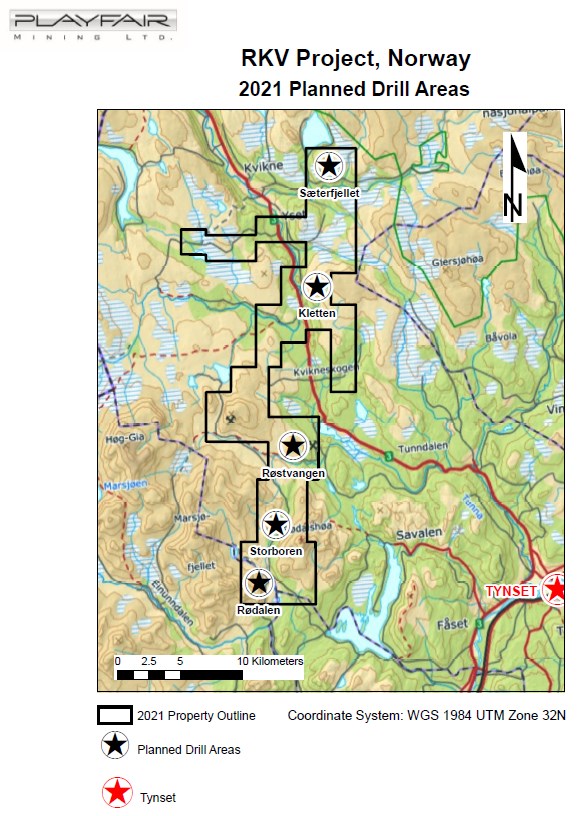
Vancouver, British Columbia–(Newsfile Corp. – September 27, 2021) – Playfair’s (TSXV: PLY) (FSE: P1J1) (OTC Pink: PLYFF) NQ core drilling program on its large (201 square kilometers) 100% owned RKV Copper Project in South Central Norway is in progress at the Rødalen high copper MMI anomaly, the first of seven drill targets delineated by Playfair in five areas. Drill Notifications have been made and approved for 38 initial drillholes and up to 122 additional holes dependent on results.
Don Moore, CEO of Playfair, comments, “It’s a long and winding road to discovery. After over two years of methodical exploration using modern methods in an almost 400-year-old under-explored mining district Playfair has defined seven high priority drill targets in five areas. We have now started our drill program to test these compelling targets.”
In keeping with Playfair’s intent to minimise the impact of its exploration on the natural environment Playfair is using a lightweight drilling machine which can be disassembled and hand-carried to the drill sites. Although lightweight the drill is capable of drilling to 150m depth using BQ sized rods (36.5 mm or 1.437 inches core diameter) and to 100m depth using NQ sized rods (47.8mm or 1.872 inches core diameter).
All seven drill targets show compelling coherent MMI Cu anomalies with multiple MMI Cu values greater than 6,000 ppb. The highest value recorded was 53,300 ppb MMI Cu.
A short MMI Report by SGS states that values greater than 6,000 ppb MMI Cu “are likely to be associated with weathering copper sulphides.”
The Rødalen drill target is less than 350 metres east of the former Rødalen Mine. The large anomaly is open to the North and extends over an area 300m long by up to 100m wide. The highest MMI copper value is 14,700ppb, 108 times the background value of 136.5 ppb. There is no record of previous exploration in the immediate vicinity of the anomaly.
The Norwegian Geological Survey (NGU) reports:
“The Rødalen deposit was mined in the period between 1750 to 1810, with further exploration until 1918. About 40,000 tonnes of copper-rich ore was produced. The deposit is hosted by quartzite and thin horizons of amphibolite in generally calcareous biotite mica schist of the Gula group. The mineralization is totally covered by waste, but old reports describe the ore as 1-2 m wide ore zones rich in chalcopyrite and zones of massive pyrite and pyrrhotite.”
NGU further reports that samples taken from the dump by NGU geologists contained up to 1.81% copper and 0.96 gpt gold.
Overall management and execution of Playfair’s RKV drilling program is provided by Ronacher McKenzie Geoscience Inc., an independent consulting group, who, as part of their supervision, will ensure that appropriate quality assurance/quality control (QA/QC) protocols are in place. RMG follows the Canadian Institute of Mining, Metallurgy and Petroleum’s (CIM) Best Practices.
In Norway, Reidar Gaupås, Playfair’s representative, has and continues to assist Playfair within the local community and enhance Playfair’s profile in Norway.
Promin AS, a Trondheim-based consultancy with extensive experience in the Norwegian Mining industry provides logistical support and experienced geologists. Helge Rushfeldt has greatly assisted in the start-up of the drill program. Kjell Nilsen, one of Norway’s most experienced field geologists who discovered Nussir, Norway’s largest known copper deposit and Jonas Dombrowski will directly supervise the drilling, core logging and analysis.
Arctic Drilling AS, a Norwegian drilling company based in Kautokeino will carry out the drilling assisted by Canadian drillers familiar with the man portable drill who will train Arctic Drilling personnel in the operation of this drill. The two Canadian drillers are onsite following Covid Quarantine on their initial arrival in Norway.
The drill targets are MMI (Mobile Metal Ion) copper anomalies discovered by sampling target areas generated by Windfall Geotek (TSXV: WIN) (OTCQB: WINKF) using their proprietary Computer Aided Resources Detection System (CARDS).
The seven drill targets were previously described: Storboren (November 07, 2019, and December 05, 2019, News Releases), Sæterfjellet, (January 06, 2021, News Release), Kletten North and Kletten South (January 28, 2021, News Release), Røstvangen Northeast and Røstvangen Southwest (February 17, 2021, News Release) and Rødalen (March 11, 2021, News Release).
A presentation on the drilling plans can be found at this direct link or on Playfair’s website.
The technical contents of this release were approved by Greg Davison, PGeo, a qualified person as defined by National Instrument 43-101.
The road to a cleaner environment includes electric vehicles. Electric vehicles need copper, nickel, and cobalt. There is no green future without minerals.
Forward-Looking Statements: This Playfair Mining Ltd News Release may contain certain “forward-looking” statements and information relating to Playfair which are based on the beliefs of Playfair management, as well as assumptions made by and information currently available to Playfair management. Such statements reflect the current risks, uncertainties and assumptions related to certain factors including, without limitations, exploration and development risks, expenditure and financing requirements, title matters, operating hazards, metal prices, political and economic factors, competitive factors, general economic conditions, relationships with vendors and strategic partners, governmental regulation and supervision, seasonality, technological change, industry practices, and one-time events. Should any one or more of these risks or uncertainties materialize or change, or should any underlying assumptions prove incorrect, actual results and forward-looking statements may vary materially from those described herein.
Neither TSX Venture Exchange nor its Regulation Services Provider (as that term is defined in the policies of the TSX Venture Exchange) accepts responsibility for the adequacy or accuracy of this release.
VANCOUVER, BC / ACCESSWIRE / September 24, 2021 / Huntsman Exploration Inc. (TSXV:HMAN)(OTC PINK:BBBMF) (the “Company” or “Huntsman“) announces that further to its news releases of August 28, 2020 and November 12, 2020, it has exercised its option to earn 100% of the Baxter Spring property, Nevada. The Company also advises that the payment of US$250,000 due on December 1, 2021 under the Baxter Spring agreement, is now due to be paid on or before May 31, 2022.
Further updates regarding exploration programs on the Company’s properties will be made available in due course.
On Behalf of the Board of Huntsman Exploration Inc. Scott Patrizi President and Chief Executive Officer
For more information, please contact 1-855-584-0160 or info@huntsmanx.com.
Neither TSX Venture Exchange, the Toronto Stock Exchange nor their Regulation Services Provider (as that term is defined in the policies of the TSX Venture Exchange) accepts responsibility for the adequacy or accuracy of this release.
We are in the liquidity crisis that happens at the end of all roaring bull markets when the piper shows up at the door and demands to be paid. It’s something that both Bob Hoye and I have been predicting for months. Perhaps it will be laid at the feet of Evergrande but it really doesn’t matter. It was fated to happen and someone will always be blamed. The general stock market is about to start the biggest financial crash in history.
Think of the resource market in 2008 that topped in March and kept diving lower and lower into October and beyond. I did some research into the DSI of gold and silver back then. Gold hit a low of 11 and silver a DSI of 5 on September 11th of 2008. Remarkably gold and silver both hit 10 on September 16th of 2021. That should be a tradable low. And Monday September 20th is a full moon and that tends to mark both tops and bottoms. Look for an immediate but short-term bounce.
That is one of those good news-bad news deals though. We were undergoing a liquidity event in 2008 just as we are now. Everything was getting sold because they could sell it. That’s true today. What resource investors have to understand is that this is 100% temporary. Yes, shares are getting creamed but it will end and when the DOW and S&P are much lower, gold and resource stocks are going a lot higher. But gold and silver went sideways from September of 2008 for another four months. That could happen again.
So instead of whining about how low your stocks are, you need to be trimming the dead beats and putting in stink bids for the low hanging fruit. What you do over the next four months is literally going to make you rich or keep you poor. If you think this is a disaster, you are going to end up poor. If you understand what an incredible opportunity it is, you are going to be rich in a year. Bob Hoye says the time to buy gold shares will be November but I see a lot of low hanging fruit right now.
I have written a book a year for pretty much the last five or six years. They are especially valuable today because they will show you how to avoid being part of the crowd that always gets slaughtered.
If you have not read, Nobody Knows Anythingor Basic Investing in Resource Stocks you are being either penny wise and pound foolish or just plain stupid. I tell people how to make money. There isn’t any magic to it. You have to make yourself learn to buy low and sell high. Right now the mass of investors is in a panic and trying to figure out how to sell so they can catch the bottom. This is the bottom, you need to be buying, not selling and I tell you how. You can read both books for under $10. If I was a total idiot doing nothing more that putting words on a page it would still be worth spending $10 in the hope that something I say makes sense.
Frankly in 2008 there were hundreds of interesting crapshoots in the resource market. But they were just crapshoots and most of them died on the vine, as they should have. The quality of stocks today is ten times higher. I am going to cover some of my favorites but there are dozens of quality companies out there with real stories selling for pennies. Unlike any other time frame for investing that I am familiar with, you have to take a global point of view. We are in the end phase that happens after every roaring stupid bull market where people pay silly prices for NFTs of farts. We are going to transition from paper assets to real assets.
But it’s a liquidity crisis and values of what has been booming are going to plummet overnight. You have to buy what will be valuable, not what the crowd has been chasing. Gold and silver are about to have their day. While the $305 billion collapse of Evergrande will be blamed at first, we are going to learn just how many companies have been swimming naked as the tide goes out.
Figure out the companies you would like to own. Put in really stupid stink bids that you know can never be filled. They will be.
For certain, one of the greatest stories of this particular resource cycle is that of Eloro Resources (ELO-V) my last piece on them was six weeks ago. Eighteen months ago the shares were selling for $.175. They hit a high of $5.89 in February of this year and have since corrected to $3.29. That’s a 44% correction that is perfectly normal.
What I am going to say right now is not based on any inside information but rather is based on my visits to hundreds of projects. Actually both Tom Larsen and Quinton Hennigh are far more conservative than I am on Bolivia. They are also dead wrong. The Iska Iska polymetallic deposit is going to be one of the biggest silver deposits in the world. It almost certainly will be the biggest tin project. I have been telling both of them for months that this is far bigger than they think.
Both started out by thinking they would like to see a four hundred or five hundred million tonne project. And they are missing the forest because of all the trees in the way. It’s a caldera. That’s the heat source. The whole damned thing is mineralized. It will be two to three billion tonnes at least of $100 rock. So think $200 billion or $300 billion worth of metal in the ground. And I’m being conservative. That ought to be worth something.
Eloro has been crippled by how long it has taken assay labs to get results to them. By all rights, they have the money to support ten drills turning and that is what should happen but they are 3,000 assays behind because of Covid. When you drill you have to know what you are hitting to know which direction to move. In normal times Eloro would already have a billion dollar market cap. As it stands they are only worth $203 million today in spite of having $21 million in the bank.
There is a second way to own Eloro and that is through Cartier Iron (CFE-C). They own 2.12 million shares of Eloro worth an interesting $6.6 million as of last Friday. For the longest time that was pretty much their entire market value but they do have an interesting gold project in Newfoundland. There is a 10,000-meter drill program in progress on the Big Easy project now but obviously assays are the same problem as everywhere else in Canada.
I wrote a piece earlier in the year talking about both companies, Eloro and Cartier. It is probably worth reading. While the Big Easy drill program is a crapshoot, the 2.12 million-share position in Eloro is like having money in the bank.
Eskay Mining (ESK-V) is another home run out of the park that is still way below the radarscope for most investors. At their peril. Granted, it does have a market cap of $344 million today with enough cash to go into next year before having to do a raise. Like Eloro it is one of the most incredible stories of this cycle. Two years ago the shares were $.075. They hit a high of $3.15 in early February of 2021 when assays showed a major VMS discovery. But two years ago Eskay seemed like a ten year long wet dream of Mac Balkam. He carried the company on his back, convinced he had a deposit similar to that of the original Eskay Creek Mine.
He’s wrong of course. What Eskay Mining has is far bigger than the original Eskay Creek deposit. We have to have a lot more assay information before we know about the grade. The Eskay Creek mine was exceptional and the assay labs in Canada are quoting sixteen weeks for assays today thanks to the idiots in government and their panic over a bad flu season.
The original Eskay Creek Mine was a hit or miss affair with the discovery only taking place on the 109th hole. Mac brought in Quinton Hennigh as an advisor over 2 years ago and he put together a team headed by Dr. John DeDecker with help of some serious VMS people from the Colorado School of Mines. They have done things right this time and done a lot of serious technical work that seems to be showing a whole slew of VMS deposits larger than the original Eskay Creek.
All deposits share certain similarities with others of the same breed. Porphyries tend to be very big and low grade. VMS deposits were originally on the sea floor as black smokers. They tend to occur in clusters. Mac knew this and believed it for years but never had the technical team that could put it all together. Now they have.
The company is well financed into next year so all the assays will be in before they need to tap the market again. If investors will go to the Eskay website there are so many pictures and so much information that if they said more they would be violating 43-101 rules. You can look at VMS material and know what you have. They have more than two major discoveries. My biggest question is who will be the most valuable in two years time, New Found Gold or Eskay? Both are going to be worth multiples of a billion dollars.
New Found Gold (NFG-V) is about as simple a story as you will ever find. They have tonnes of high grade gold in Newfoundland with some of the highest-grade intercepts in the last twenty years. Their initial hole was a discovery hole with a 19.2-meter hole showing 92.9 grams of gold per tonne. The shares shot from $1.85 a year ago to an amazing $13.50 in June before beginning a perfectly normal fifty percent correction.
New Found Gold raised a bunch of money and started drilling a 200,000-meter drill program on their Queensway project in Newfoundland. The company has nine drill rigs turning and will be adding an additional rig shortly. If you do not understand the story you have not been paying attention to the resource market. Here is the last piece I did on the company.
The Swan Zone at the Fosterville gold mine in Australia helped to take Kirkland Lake Gold from a $2 billion dollar market cap at the time of the merger in 2017 to a high of $18 billion. The Swan Zone was deep, expensive to mine and only had just over three million ounces of gold. The Keats/Lotto Zones at Queensway are much closer to the surface, similar grades to that of Fosterville and a lot more gold than the Swan Zone. If you don’t own any shares of NFG you are going to be at the airport when your ship sails in.
With all these stocks that are now the low hanging fruit, you need to be looking for those who have been hammered the most. An almost identical story to that of New Found Gold and on the same mineralized trend is that of Labrador Gold (LAB-V). Lab Gold is in the midst of drilling a 10,000 meter drill program at their 100% owned Kingsway project immediately northeast of New Found Gold. Lab Gold has four drill rigs turning and is generating the same sort of high-grade intercepts as that of New Found Gold.
Labrador Gold was as low as $.30 in March of this year before assay results started flowing showing that they are on the same structure as New Found Gold. The shares shot higher with each release until they hit a high of $1.85 in June.
I started selling some of my shares that I bought in the last year and some I had bought years ago for about a dime. If you are trying to prove just how smart you are, go ahead and marry good stocks with high potential. You can watch them go up and down like a bride’s nighty and you don’t make anything. If on the other hand you buy stocks to make money, you have to learn how to trade them in and out. You will have that opportunity every year. LAB has had a five hundred percent range in the last six months. If you can’t make a profit on a stock with that sort of range, you are going about it in the wrong way.
Trade the damn stocks like baseball cards. They are like lottery tickets. To profit you have to buy low and sell high, unlike the weak hands that want to buy high and sell low.
I make the perfectly valid point in my books that if nothing else has changed on a stock that you have fallen in love with except the price, when it tumbles, instead of seeing it as a problem, treat it as an opportunity and buy more. Lab Gold is a screaming good deal after a 60% drop in three months.
Sokoman Resources (SIC-V) is located in Newfoundland but west of where Lab Gold and New Found Gold are drilling. They had really great drill results for years but weren’t doing a great job of telling their story and as a result got little respect from the market. They talked to me in March. I was as direct with them as I am with everyone else I deal with. If you don’t tell your story, you don’t have a story.
I wrote the company up and all I did was put the information out that was already available. There was no magic to my piece other than I did a better job of telling the story. The stock shot higher and touched $.78 in June before starting a similar correction of 60% as did Lab Gold. So officially as far as I am concerned, nothing has changed except the price and it is cheap today.
There are some times when buying a stock has the potential for getting you into serious legal problems. Such is the case of White Rock Minerals (WRM-AX, WRMCF-OTCBB). If White Rock got any cheaper and you bought shares, the Bobbies would be at your door shortly thereafter for stealing. No shit. This is the most absurdly under priced stock I have ever owned.
White Rock is an Australian listed company with OTCBB listed shares for American and Canadian investors. It has a pair of world class potential projects in Alaska including a VMS project with a $3.5 billion dollar rock in the ground 43-101 and a couple of interesting gold projects worth drilling the crap out of. Alas they signed up a drill contractor who thought he was a hooker and he screwed them royally.
You have a short 100-120 day work period in Alaska. Winter ends late and starts early. If you don’t have drills and crews in place by late June you are screwed for the year. The drill contractor brought the drills but only half the men he promised. While that’s a common story in the north this year, it has cost White Rock tens of millions of dollars in lost market cap. They aren’t producing much in the way of drill core to be sampled. In addition the assay labs are 4-6 months backed up so they may as well be tossing a dart at a dartboard to know where to drill. Since Alaska has been the primary focus, investors are throwing in the towel at exactly the time they should be throwing money at White Rock.
In addition, WRM merged with AuStar Gold in August this year to acquire the Woods Point Gold project in Victoria in Australia with 670 square kilometers of exploration potential. The project is near the Fosterville Mine owned and operated by Kirkland Lake Gold. It includes the former Morningstar Gold mine showing past production of over 800,000 ounces of gold at 26 grams gold per tonne. Currently White Rock has one drill turning underground. The core from the drilling shows visual gold. Australia has the same problem with assays as the US and Canada so results will trickle in over the next few months.
White Rock did come up with incredible drill results already from the Red Mountain silver/zinc/lead VMS in Alaska. On the 16th they released the first assay for this year showing 0.2m @ 11.9% Zinc (Zn), 2.8% lead (Pb), 0.9% Copper (Cu), 63g/t silver (Ag), and 0.2g/t gold (Au), from 184.8m down hole. This polymetallic suite of metals can also be summarized as a 17.5% Zinc equivalent grade. That’s not a wide intercept but it does indicate the strike extends further than they realized. Remember this project already has $3.5 billion worth of high grade gold in the ground.
White Rock has another Australian asset in the Mt Carrington gold and silver project with 352,000 ounces of gold and 23.2 million ounces of silver in a JORC resource. That should be worth something.
WRM has been crippled this year by a lack of obvious progress in Alaska. I’m not concerned, the gold and silver are still there regardless of the lack of progress on the assay side. The current drilling at Morningstar could cause an overnight rerating of the shares. As of right now White Rock has a market cap of about $39 million Aussie with somewhere around $12 million in cash. I was adding to my already very large position a week or so ago at $.24 USD and thought I was robbing a bank. It’s $.19 USD now some 20% cheaper in a week.
I’m not going to spend a lot of time talking about Novo Resources (NVO-V). I wrote a book nine months ago just before they poured the first gold bar at Nullagine. What Became of the Crow? has been very well received with some of the highest ratings I have ever seen on any book. In the book I talk about a flight I made delivering a Rockwell 685 aircraft to Lang Hancock in 1976. I had Hancock’s son in law with me on the flight and I had to put up with 85 hours of him talking about how the Pilbara had the world’s highest grade banded iron formation consisting of 30% of the entire world’s reserve of iron.
Quinton Hennigh came up with a theory that says gold precipitated out of salt water in exactly the same way as iron did around 2.8 billion years ago when single cell creatures began to produce oxygen and that changed the chemistry of the water. His work in the Pilbara over the past dozen years has pretty much proven his theory. If iron and gold each precipitated out of salt water about the same time under the same conditions, if you have the world’s biggest iron deposit in the Pilbara (and they do) by necessity you have to have the world’s biggest gold deposit.
Novo is producing gold today. With a market cap down to right at $500 million CAD it is cheaper with less risk than it has been for years.
The biggest problem in Australia right now is the price of iron and it has blown the entire economy up. It’s about to get way worse. Iron hit an all time high price of about $215 USD in May of this year. That has caused chaos for everyone doing exploration work or mining anything other than iron in the country. The iron companies were throwing money at everyone with two basic attributes. As long as they were warm and had a heartbeat they could earn upwards of $25,000 a month. And everyone thought that was just wonderful.
Labor has been a giant problem for every non-iron company in Australia. Novo has lost a lot of good people who ran over to the iron companies for higher wages. In addition, the iron companies raided every government agency to hire anyone who could spell ionr correctly. So permitting has slowed to a snail’s pace and labor turnover is literally out of control.
The liquidity event is not over, it has just begun and will be getting far worse sooner than anyone but Bob Hoye and me realize. But I suppose I should mention you now have a clue.
Lion One (LIO-V) in Fiji is well cashed up with $57 million in the bank, is permitted to begin construction of a mill and they have their own assay lab so they are not being held hostage by the failure of worldwide assay labs. But they were trying to run the project out of Perth since Australia has turned back into a prison colony. Prisoners don’t do a great job of running mining projects with the sole exception of they do a great job of busting up big rocks into small rocks.
Lion One has been trying to get two highly experienced exploration guys into Fiji for six months. I’ve flown through Fiji dozens of times. The people are industrious, hard working and intelligent. But they are not experienced in drilling and exploration without professional help and supervision. That exists now.
The guys got into the country a month ago and finished quarantine. Lion One now has six drills turning and I expect the shares to get back to all time highs in the next six months regardless of the giant crash we are in. They have millions of ounces of gold with a market cap of $172 million with $57 million in cash. I think Lion One is still my biggest position and I was buying shares at over $2. The shares are down 65% from their high but that isn’t going to last for long.
I-80 Gold (IAU-V) only went public in April at $2.36. It rocketed higher to $3.54 about ten days ago before dropping back to the current $2.52. The company has a $587 million market cap with a 770,000 ounces of high-grade gold deposit in the Granite Creek underground mine. IAU management is highly experienced in Nevada and is doing deals with other mining companies to combine resources.
Granite Creek has an average of +11 g/t gold but the material is refractory. I-80 plans on trucking the material over to an autoclave they control at Lone Tree.
In all categories and deposits, I-80 controls over 14 million ounces of gold. An almost $600 million market cap may seem expensive but that’s about $40 a resource ounce. It should probably be $120-$200 an ounce at the stage they are.
This year I-80 plans a 20,000-meter drill program at Granite Creek. The first assays came out three weeks ago and they were what the company hoped they would find, 51.1 meters of 6.8 g/t gold. Because the company has so many irons in the fire I highly suggest investors take a look at the company presentation because it is complicated to explain.
On occasion I do look at other companies that just resource companies. Someone came to me in the middle of the summer and wanted me to look at a young company that wants to use new technology to improve battery charging performance and behavior. I did and wrote about it. The company is called Neo Battery Materials (NBM-V). It went from about $.20 to $1.31 in a month. It continues to have extraordinary liquidity.
This is going to get a little technical.
It has been well known for years that to improve battery charging time and performance the battery manufacturers should use some form of silicon in the anodes. But the metal expands under charging and is not flexible. So companies are trying various forms of silicon nano particles or micro particles. The micro particles are eight to ten percent of the cost of the nano particles. NBM is achieving exceptional performance improvements through the use of micro particles while keeping their cost of production low. Such anodes stand to drive down battery costs on a dollar per kilowatt-hour basis that in turn will drive the cost of mass-market electrical vehicles lower.
The company is sending out samples on a daily basis of their proprietary silicon anodes to battery producers, the developers of solid-state batteries and automotive manufacturers. Since their initial tests are proving so productive NBM is planning upgrading a pilot plant to a semi-commercial facility with production of 120 tons of anodes per year that would supply anodes for up to forty thousand vehicles per year.
The next leg up in the lithium battery market will be the production of solid-state batteries. NBM has already achieved exceptional performance using a sulphides-based all solid-state electrolyte. This would also solve the flammability issues of current batteries in the market place.
NBM has some of the most experienced battery scientists in the world working with them with five patents already in hand. Similar companies in the silicon anode market place have market caps far higher than NBM’s $65 million. If you like the EV market, NBM offers attractive potential for price appreciation.
Goliath Resources (GOT-V) is another great stock that has gotten absolutely hammered in the last six weeks with the stock dropping from an all time high of $1.62 in August to $.76 on Friday for a 55% decline. I think that 100% of the issue is the criminal delay in assay results.
Company management has been posting a number of news releases giving the length of the intercept in terms of quartz-sulfide veining. And while in that neck of the woods that “should” be an accurate measure of grade potential $5 bucks and some quartz-sulfide veining “should” get you a small cup of coffee at Starbucks.
The Surebet Zone is in the Golden Triangle and actual assay results so far indicate a high degree of correlation between the sulfide veins and the actual gold and silver numbers. This is all part of a fully funded 6,000 meter drill program. In a liquidity crisis investors want, indeed, demand hard numbers. The price of the shares is back to where it was in May taking virtually all the risk out of buying the shares. And who knows, maybe assays will come in some day.
The next company, Solis (SLMN-V) is going to be a simple story to tell and for investors to understand. The company has an option on a copper project in Chile with a historic 10 million tonne resource of near surface high-grade copper/silver. At today’s prices that is worth $94.13 a tonne in USD or just short of a billion dollars.
(Click on image to enlarge)
The option calls for Solis to pay $5 million to the vendor over a four-year period and to invest $5 million in exploration over the same four years. That will get them 100% ownership subject to a 2% NSR. But Solis is not interested in a $940 million copper/silver project in Chile where the government just turned really stupid.
Solis believes the near surface mineralization comes from porphyry located about 300 meters down. Initial plans call for a 2,500 meter drill program on one of five different targets over a ten square km package identified with technical studies.
One of two things happens. They either hit what they are aiming for or they don’t. Should they hit the shares go to $500 million and current shareholders get rich. The market cap of the company today is $8.44 million. If you need me to work out the potential for you, you really should be investing in something safe like Evergrande or Tether.
Golden Lake (GLM-C) is another dead easy to understand company. The company has a $10 million market cap and is in the midst of a 6,000 meter drill program on their Jewel Ridge gold project in Nevada on the Eureka trend. Results to date show economic value of gold near surface.
Investors are not big fans of stocks found on the C-Exchange in a declining market but when the bull shows up again they get real popular. With a $10 million market cap and options on two highly potential projects, it’s a cheap lottery ticket.
Provenance Gold (PAU-V) is another story that is so cheap it screams, “Buy me. Buy me.” The market cap is a tiny $10 million; they have only 61 million shares outstanding. The company is operating in northern Nevada near the Idaho border. That’s interesting to me because company President Rauno Perttu (try bending your tongue around that Finnish origin name) believes the project is an analog of the Black Pine project just north of the border.
I have been to Black Pine twice and frankly I think the way they read the project is 100% correct. Given that Black Pine has a 2 million ounce gold resource starting at surface, a $10 million dollar company with a similar project is damned cheap. Liberty Gold has a market cap 26 times larger than Provenance.
Their primary project today is the White Rock oxide gold project. The project manager is Steve Craig and I have known him for years. He is one of the top geos in Nevada. Between Steve and Rauno, you have a first class management team. White Rock is one of those projects that everyone knows about but no one has ever gotten a real handle on. PAU management believes the project holds a near surface 3.2 by 1.6 oxide gold target. In the past operators were attempting to find the feeder structures.
Provenance theory holds that instead of trying to find the structures with blind drilling, they should simply drill serious stepout holes to define ounces. Last week they announced results from an 800-meter stepout hole showing 117 meters of gold mineralization starting from surface. The hole intercepted 85 meters of 0.369 g/t gold. Within that hole were higher-grade intervals of 0.778 g/t Au from 38 meters to 46 meters. In Nevada oxide gold of those grades is all economic. I believe those assays tend to prove their theory and there will be a lot more similar holes. That is exactly what Liberty Gold was finding at Black Pine.
This is one of the few stocks that has actually acted well over the past couple of months. It is so cheap that I took out a lottery ticket on it and bought some shares. If you buy stocks when they are cheap and sell them when they are dear, you can make a lot of money. It’s not rocket science.
The next six weeks is going to be incredibly dangerous and many people will be wiped out. I own most of these stocks and all of them are advertisers but the combination of a tiny DSI for gold and silver and a full moon on September 20th makes now an interesting time.
As always, I don’t share in your profit or your losses so you need to do your own due diligence. I am biased so take some responsibility for your own actions.
Lakewood Exploration Inc. Thu, September 23, 2021, 4:00 PM In this article:
Figure 1
Non-NI 43-101 Compliant model showing proposed Phase I underground drilling
VANCOUVER, British Columbia, Sept. 23, 2021 (GLOBE NEWSWIRE) — Lakewood Exploration (CSE: LWD / OTC: LWDEF) (“Lakewood” or the “Company”) is pleased to report that it has mobilized a drill in preparation for Phase I drilling at the Silver Strand Project in Idaho. https://s.yimg.com/rq/darla/4-9-0/html/r-sf-flx.html
Phase I of the drill program will include initial underground drilling from the drilling bay that was established through now completed mine rehabilitation work, as well as select shallow surface drilling designed to test for lateral vein extensions along strike. Past production stopped at just 90 metres depth and this first phase of underground drilling will test immediately below what was historically mined at Silver Strand. Results from Phase I drilling are also expected to provide valuable information regarding the plunge, depth, lateral expansion, and dip of the veins, which will support the Company’s modelling and follow-up drilling.
“We are evaluating multiple veins across the 5.5 kilometre (km) Silver Strand property. This first phase of drilling within the project area is intended to test for high-grade mineralization both along strike and immediately beneath existing mine workings,” stated President Morgan Lekstrom. “Expanding the resource potential both down-dip and along the 5.5 kms of prospective structural extent is a pivotal step in demonstrating that this project has exploration potential similar to the large deposits that made Coeur d’Alene one of the top silver districts in the world.”
Veins within the Revett formation host most of the silver mines in the Coeur d’Alene mining district, including the Sunshine Mine, which produced 359 million ounces of silver to depths exceeding 1,800 metres. Silver Strand is located within the Revett formation and shares similar geological characteristics with the Sunshine Mine and other multi-hundred-million-ounce silver deposits also within the Revett formation.
The Company will provide additional updates as its initial drill campaign progresses and will report assays once received and interpreted.
Qualified Person
Technical aspects of this press release have been reviewed and approved under the supervision of Philip Mulholland, P.Geo. Mr. Mulholland is a Qualified Person (QP) under National Instrument 43-101 Standards of Disclosure for Mineral Projects.
About Lakewood Exploration Inc. Lakewood Exploration Inc. is a junior resource company advancing the past-producing Silver Strand Mine in the Coeur d’Alene Mining District in Idaho, USA, both the Eliza Silver Project and the Silverton Silver Mine in one of the world’s most prolific mining jurisdictions in Nevada and the Lacy Gold Project in British Columbia, Canada. The Company is rapidly advancing towards an initial drill program at Silver Strand with the aim of defining a large silver resource within a belt that has produced more than 1.2 billion ounces of silver to-date. Geologic studies indicate that the Silver Strand Mine is hosted by the Revett formation, suggesting the potential for significant down dip extensions as demonstrated by other major mines in the district. Previous operators were solely interested in developing the known shallow mineralization, with the mine’s lowest level extending only 90 meters below surface. Lakewood strives to become a multi-mine silver producer.
*Mineralization hosted on adjacent and/or nearby properties is not necessarily indicative of mineralization hosted on the Company’s property.
ON BEHALF OF LAKEWOOD EXPLORATION INC.
Morgan Lekstrom, President
Corporate Office: 551 Howe Street, Vancouver, British Columbia V6C 2C2, Canada
For more information please contact:
Kristina Pillon, High Tide Consulting Corp. Cell: 604.908.1695 Email: investors@silverhammermining.com
The CSE does not accept responsibility for the adequacy or accuracy of this release.
The Canadian Securities Exchange has not in any way passed upon the merits of the Proposed Transaction and has neither approved nor disapproved the contents of this press release.
1 Level 3 Stope was the only area partially mined out.
VANCOUVER, BC / ACCESSWIRE / September 23, 2021 / Group Ten Metals Inc. (TSX.V:PGE; OTCQB:PGEZF; FSE:5D32) (the “Company” or “Group Ten”) is pleased to provide an update on resource modeling and exploration activities, and further announces that it has engaged researchers at the University of British Columbia to study the potential for large-scale carbon sequestration at its flagship Stillwater West PGE-Ni-Cu-Co + Au project in Montana, USA.
Exploration Update
SGS Geological Services has completed their site visit and is working with Group Ten to deliver inaugural National Instrument 43-101-compliant mineral resource estimates at the most advanced target areas at Stillwater West. Block models consisting of drill-defined nickel and copper sulphide mineralization, enriched in palladium, platinum, rhodium, gold and cobalt, are now being finalized for release in the near term. In addition to the more advanced Chrome Mountain, Camp, and Iron Mountain target areas, the inaugural resource figures will include the Crescent target area following successful expansion of the block models based on the continuity of mineralization observed in all target areas.
Diamond drilling is ongoing, with one rig at the Chrome Mountain target area and a second that completed priority holes at the Camp target area before moving to the Iron Mountain area. A total of twelve holes have been drilled to date. Conditions are favorable and the program is expected to continue into October. Expansion of the inaugural mineral resource estimate is one of the primary objectives of the 2021 drill campaign.
An Induced Polarization geophysical survey is now underway with crews currently working new survey lines to the west of the highly successful 2020 survey in the Chrome Mountain target area. In-fill lines, and additional extension lines off the east end of the previous work at the Crescent target area, are also planned.
Figures 1 and 2 – Group Ten geologists John Bailey, Justin Modroo, and Nate Nelsen examine Stillwater West drill core.
Carbon Sequestration and the Potential for Low-Carbon ‘Green’ Metals at Stillwater West
The Company has engaged Dr. Greg Dipple and his team at the University of British Columbia, Canada, for a second phase of research to assess the capacity to use mineral carbonation to bind carbon dioxide for permanent disposal as part of a potential mining operation at Stillwater West. Preliminary work has shown good potential based on the presence of certain minerals at Stillwater West. This next phase of study is expected to refine and advance that work by identifying specific minerals in rock samples while beginning to look at possible reaction rates, among other items. Contingent upon the success of the current program, subsequent work would then examine reaction rates and other factors in more detail to culminate in large-scale pilot demonstration to provide data necessary for full-scale projections and inclusion in potential broader engineering studies at Stillwater West.
Group Ten President and CEO, Michael Rowley, stated, “We see the potential to reduce atmospheric carbon dioxide while providing needed battery, catalytic, and precious metals at a large scale in a premier US district as a very compelling opportunity to play a significant role in promoting global sustainability initiatives. Stillwater West hosts nickel sulphide mineralization which, compared to the laterite nickel that dominates global production, has been shown to more easily refine to the high-grade nickel sulphate that is required by the battery industry, and with a much lower environmental footprint. This new study paves the way for further reductions in the carbon footprint for all our commodities in a possible production scenario at Stillwater West, offsetting the impact of mining activities and potentially even achieving significant reductions wherein the uptake and disposal of carbon exceeds the emission from operations. In addition to being strongly aligned with Group Ten’s Environmental, Social and Governance (“ESG”) guidelines and principles, the incorporation of carbon uptake may bring financial benefits via initiatives such as the 45Q Tax Credit for Carbon Oxide Sequestration that is now in place in the US. We look forward to further announcements including our inaugural resource estimates in the near term.”
‘Green’ Metals at Stillwater West
The primary metals that are essential to global electrification and improvements in air quality include battery metals, such as nickel, copper, and cobalt, and platinum, which is essential for the low-carbon production of hydrogen via the electrolysis of water, and also for the consumption of hydrogen in fuel cells.
Moreover, platinum – along with palladium and rhodium – is also essential to environmental quality as all three are used in catalytic convertors to reduce exhaust emissions and provide clean air, with demand driven by increasingly stringent emissions requirements globally.
Group Ten has demonstrated world-class potential for both scale and grade of all six of these commodities, plus also gold, in five priority target areas where drill-defined mineralization showing strong correlations with very large geophysical anomalies across 9.2 kilometers in 3D model results, and more broadly in early-stage results across the entire 32-kilometer span of the Stillwater West project.
The Stillwater district is a prolific US mining district that hosts world-class mines and a smelter-refinery complex operated by Sibanye-Stillwater, who are widely recognized for producing palladium and platinum, along with lesser amounts of other commodities including nickel, at the highest environmental and sustainability standards. Group Ten’s location adjacent to Sibanye is very favorable to potential end-users including the domestic auto industry. The Company is focused on advancing Stillwater West as one of only a few projects in North America that may be able to help meet the shortfalls projected by analysts and EV industry leaders for environmentally responsible production of our target commodities.
About Stillwater West
The Stillwater West PGE-Ni-Cu-Co + Au project positions Group Ten as the second-largest landholder in the Stillwater Complex, adjoining and adjacent to Sibanye-Stillwater’s Stillwater, East Boulder, and Blitz PGE mines in south-central Montana, USA1. The Stillwater Complex is recognized as one of the top regions in the world for PGE-Ni-Cu-Co mineralization, alongside the Bushveld Complex and Great Dyke in southern Africa, which are similar layered intrusions. The J-M Reef, and other PGE-enriched sulphide horizons in the Stillwater Complex, share many similarities with the highly prolific Merensky and UG2 Reefs in the Bushveld Complex. Group Ten’s work in the lower Stillwater Complex has demonstrated the presence of large-scale disseminated and high-sulphide battery metals and PGE mineralization, similar to the Platreef in the Bushveld Complex2. Drill campaigns by the Company, complemented by a substantial historic drill database, are driving 3D models of Platreef-style mineralization in the five most advanced target areas, three of which are expected to become formal mineral resources by mid-2021. Multiple earlier-stage Platreef-style and reef-type targets are being advanced across the rest of the 31-kilometer length of the project based on strong correlations seen in soil and rock geochemistry, geophysical surveys, geologic mapping, and drilling.
About Group Ten Metals Inc.
Group Ten Metals Inc. is a TSX-V-listed Canadian mineral exploration company focused on the development of high-quality platinum, palladium, nickel, copper, cobalt, and gold exploration assets in top North American mining jurisdictions. The Company’s core asset is the Stillwater West PGE-Ni-Cu-Co + Au project adjacent to Sibanye-Stillwater’s high-grade PGE mines in Montana, USA. Group Ten also holds the high-grade Black Lake-Drayton Gold project adjacent to Treasury Metals’ development-stage Goliath Gold Complex in northwest Ontario, and the Kluane PGE-Ni-Cu-Co project on trend with Nickel Creek Platinum‘s Wellgreen deposit in Canada‘s Yukon Territory.
About the Metallic Group of Companies
The Metallic Group is a collaboration of leading precious and base metals exploration companies, with a portfolio of large, brownfield assets in established mining districts adjacent to some of the industry’s highest-grade producers of silver and gold, platinum and palladium, and copper. Member companies include Metallic Minerals in the Yukon’s high-grade Keno Hill silver district and La Plata silver-gold-copper district of Colorado, Group Ten Metals in the Stillwater PGM-nickel-copper district of Montana, and Granite Creek Copper in the Yukon’s Minto copper district. The founders and team members of the Metallic Group include highly successful explorationists formerly with some of the industry’s leading explorers/developers and major producers. With this expertise, the companies are undertaking a systematic approach to exploration using new models and technologies to facilitate discoveries in these proven, but under-explored, mining districts. The Metallic Group is headquartered in Vancouver, BC, Canada, and its member companies are listed on the Toronto Venture, US OTC, and Frankfurt stock exchanges.
Note 1: References to adjoining properties are for illustrative purposes only and are not necessarily indicative of the exploration potential, extent, or nature of mineralization or potential future results of the Company’s projects.
Note 2: Magmatic Ore Deposits in Layered Intrusions-Descriptive Model for Reef-Type PGE and Contact-Type Cu-Ni-PGE Deposits, Michael Zientek, USGS Open-File Report 2012-1010.
Forward Looking Statements: This news release includes certain statements that may be deemed “forward-looking statements”. All statements in this release, other than statements of historical facts including, without limitation, statements regarding potential mineralization, historic production, estimation of mineral resources, the realization of mineral resource estimates, interpretation of prior exploration and potential exploration results, the timing and success of exploration activities generally, the timing of the timing and results of future resource estimates, permitting time lines, metal prices and currency exchange rates, availability of capital, government regulation of exploration operations, environmental risks, reclamation, titlefuture driling actiivities and the locations of such drilling, and future plans and objectives of the company are forward-looking statements that involve various risks and uncertainties. Although Group Ten believes the expectations expressed in such forward-looking statements are based on reasonable assumptions, such statements are not guarantees of future performance and actual results or developments may differ materially from those in the forward-looking statements. Forward-looking statements are based on a number of material factors and assumptions. Factors that could cause actual results to differ materially from those in forward-looking statements include failure to obtain necessary approvals, unsuccessful exploration results, changes in project parameters as plans continue to be refined, results of future resource estimates, future metal prices, availability of capital and financing on acceptable terms, general economic, market or business conditions, risks associated with regulatory changes, defects in title, availability of personnel, materials and equipment on a timely basis, accidents or equipment breakdowns, uninsured risks, delays in receiving government approvals, unanticipated environmental impacts on operations and costs to remedy same, and other exploration or other risks detailed herein and from time to time in the filings made by the companies with securities regulators. Readers are cautioned that mineral resources that are not mineral reserves do not have demonstrated economic viability. Mineral exploration and development of mines is an inherently risky business. Accordingly, the actual events may differ materially from those projected in the forward-looking statements. For more information on Group Ten and the risks and challenges of their businesses, investors should review their annual filings that are available at www.sedar.com.
Neither the TSX Venture Exchange nor its Regulation Services Provider (as that term is defined in the policies of the TSX Venture Exchange) accepts responsibility for the adequacy or accuracy of this release.
Thunder Bay, Ontario–(Newsfile Corp. – September 23, 2021) – Kesselrun Resources Ltd. (TSXV: KES) (OTC Pink: KSSRF) (“Kesselrun” or the “Company”) is pleased to provide the following drilling results on its Huronian Gold Project.
Continued drilling of the McKellar zone has been successful in confirming the continuity of the mineralization with the discovery of another high-grade structure. The zone has now been extended to over 500 metres in strike length and approximately 100 metres in depth. Further drilling is planned down plunge of these structures as well as along strike to the southwest.
Highlights
21HUR091 intercepted 47.8 g/t Au over 0.6 m within a 5.9 m wide zone which averaged 6.4 g/tAu
21HUR079 intercepted 22.2 g/t Au over 0.6 m within a 28.8 m wide zone which averaged 1.0 g/t Au
21HUR077 intercepted 13.7 g/t Au over 1.0 m as well as an 11.0 m wide zone averaged 0.7 g/t Au
21HUR076 intercepted 6.3 g/t Au over 1.5 m within a 19.4 m wide zone which averaged 1.1 g/t Au
Michael Thompson, P.Geo., President and CEO of the Company, commented, “Our drilling on the McKellar zone is proving our model of numerous high-grade structures within a wider zone of gold mineralization. Future drilling on McKellar will focus on extending those known high-grade structures at depth as well as building on the impressive 500 metres of strike length already outlined.”
The 2021 Huronian drill program is budgeted at 20,000 metres targeting the Fisher, Fisher North, McKellar and Huronian zones, all in close proximity along an approximate 1500 m strike length in the area of the historic Huronian Mine. The area also has tremendous potential for discovery of new wide zones of significant gold mineralization in light of the new revised mineralization model.
As of this news release, approximately 15,000 metres has been drilled of which the results from approximately 8,000 metres of drilling have been released.
Figure 4: Schematic Plan Map – McKellar Zone – Huronian Project
Table 1: Summary of Significant Drill Intercepts – Current News Release (1)
Hole ID
Zone
From (m)
To (m)
Interval (m)
Au (g/t)
21HUR076
McKellar
107.1
126.5
19.4
1.1
including
118.2
119.7
1.5
6.3
21HUR077
McKellar FW
8.2
9.2
1.0
13.7
McKellar
80.8
91.8
11.0
0.7
21HUR079
McKellar
3.0
31.8
28.8
1.0
including
3.0
3.6
0.6
22.2
21HUR088
McKellar
48.1
63.6
15.5
0.7
including
50.1
60.1
10.0
1.0
McKellar HW
163.6
164.5
0.9
6.6
21HUR090
McKellar
89.6
102.9
13.3
0.7
including
90.8
91.4
0.6
7.3
21HUR091
McKellar
50.1
56.0
5.9
6.4
including
51.8
52.4
0.6
47.8
21HUR092
McKellar
36.6
81.5
35.3
0.3
21HUR093
McKellar
14.7
54.9
40.2
0.3
including
50.2
51.0
0.8
6.7
(1)Widths are drill indicated core length as insufficient drilling has been undertaken to determine true widths at this time. Average grades are calculated with un-capped gold assays as insufficient drilling has been completed to determine capping levels for higher grade gold intercepts.
About the Huronian Gold Project
The 100% owned Huronian Gold Project hosts the past producing Huronian Mine, Northwestern Ontario’s first gold mine with an historic resource estimate of 44,592 oz Au at an average grade of 15.3 g/t Au in the indicated category and 501,377 oz Au at an average grade of 14.4 g/t Au in the inferred category. The resource estimate presented for the Huronian Project is historic in nature. Kesselrun Resources’ qualified person has not completed sufficient work to confirm the results of the historical resource. Kesselrun Resources is not treating this as a current mineral resource but is considering it relevant as a guide to future exploration and is included for reference purposes only. The historic resource was estimated by Minescape Exploration Inc. in 1998. Further drilling will be required by Kesselrun Resources to verify the historic estimate as current mineral resources.
As well, the Huronian Gold Project hosts the same lithological package of rocks, as interpreted from both Government of Ontario and Kesselrun Resources mapping, compilation and modelling, on strike from Wesdome Gold’s adjacent Moss Lake Gold Deposit with a resource estimate of 1,377,300 oz Au at an average grade of 1.1 g/t Au in the indicated category and 1,751,600 oz Au at an average grade of 1.1 g/t Au in the inferred category as outlined in their 2013 PEA2. Mineralization hosted on adjacent and/or nearby properties is not necessarily indicative of mineralization hosted on Kesselrun Resources’ property.
(2)Moss Lake Gold Mines (currently wholly owned subsidiary of Wesdome Gold) news releases February 20, 2013 and September 9, 2013.
On January 26, 2021, Wesdome announced that the Moss Lake Project would be purchased by Goldshore Resources Inc. (see Wesdome and Goldshore news releases dated January 26, 2021).
Qualified Person
Michael Thompson, P.Geo., President and CEO of Kesselrun, is the Qualified Person responsible for the project as defined by National Instrument 43-101 and has approved the technical information in this news release.
QAQC
Kesselrun has implemented a quality control program to comply with industry best practices for sampling, chain of custody and analyses. Certified gold reference standards, blanks and duplicates are inserted at the core processing site as part of the QA/QC program in addition to the control samples inserted by the lab. Samples are prepared and analyzed by Activation Laboratories in Thunder Bay. Samples are analyzed for gold using Fire Assay-AA techniques. Samples returning over 10 g/t gold are analyzed using Fire Assay-Gravimetric methods. Selected samples are also analyzed with a standard 1 kg metallic screen fire assay. All results reported herein have passed QA/QC protocols.
Health and Safety
The health and safety of our personnel and contractors is always top priority to Kesselrun. The current situation presents new challenges above and beyond what we normally face while working in the field. Kesselrun has implemented further measures to ensure the health and safety of all working on the Company’s projects.
About Kesselrun Resources Ltd.
Kesselrun Resources is a Thunder Bay, Ontario-based mineral exploration company focused on growth through property acquisitions and discoveries. Kesselrun’s management team possesses strong geological and exploration expertise in Northwest Ontario. For more information about Kesselrun Resources, please visit www.kesselrunresources.com.
Neither the TSX Venture Exchange nor its Regulation Services Provider (as that term is defined in the policies of the TSX Venture Exchange) accepts responsibility for the adequacy or accuracy of this news release.
Forward-Looking Statements – Certain information set forth in this news release may contain forward-looking statements that involve substantial known and unknown risks and uncertainties. These forward-looking statements are subject to numerous risks and uncertainties, certain of which are beyond the control of Kesselrun, including, but not limited to the impact of general economic conditions, industry conditions, volatility of commodity prices, dependence upon regulatory approvals, the execution of definitive documentation, the availability of financing and exploration risk. Readers are cautioned that the assumptions used in the preparation of such information, although considered reasonable at the time of preparation, may prove to be imprecise and, as such, undue reliance should not be placed on forward-looking statements.