Categories
Precious Metals

JUNIOR MINING | Work Program Commences Ahead of Drill Program on Extensive High Grade Vein System at Boodalyerrie, Pilbara, Western Australia

VANCOUVER , Nov. 15, 2018 /CNW/ – Pacton Gold Inc. (TSXV: PAC, OTC: PACXF, FSE: 2NKN) (the “Company” or “Pacton“) is pleased to announce that it has scheduled a helicopter and ground supported rock chip sampling and detailed geological mapping program on its 62 km2 Boodalyerrie tenement (E 45/3586).  Boodalyerrie is located 85 km northeast of the town of Nullagine, and Novo Resources Corp’s (NVO.V) Beatons Creek project. (Figure 1).

Figure 1. Location of Pacton Pilbara holdings, showing Boodalyerrie tenement. (CNW Group/Pacton Gold Inc.)

View photos

Figure 1. Location of Pacton Pilbara holdings, showing Boodalyerrie tenement. (CNW Group/Pacton Gold Inc.)

Highlights of exploration undertaken at Boodalyerrie to date:

  • Multiple quartz vein reefs extend over a total cumulative strike length of at least 23 km within an area of 25 km2, and range in thickness between 1 to 10 m
  • Significant high-grade rock chip samples of up to 200g/t Au (Plenty River Corporation Ltd, 2000)
  • Channel sampling results of up to 3 m at 88.6g/t Au (Plenty River Corporation Ltd, 2000)
  • Multiple small scale historic high grade workings documented
  • Potential exists for high-grade vein hosted gold mineralizing system associated with the Yilgalong Granite quartz veins. Target style has never been drill tested

Although half of the Boodalyerrie tenement is covered by sedimentary and volcanic rocks of the Fortescue Group, including surface exposures of the Mount Roe, Hardey and Kylena formations, the focus of the immediate exploration program will be to define the extents and controls of gold mineralization within steeply dipping quartz veins hosted in older Archean granitic basement rocks. This extensive swarm of gold-bearing, quartz veins have thicknesses ranging from 1 to 10 m and extend along strike lengths of up to 2.5 km throughout a 25 km2 area. Geological mapping indicates that the veins were emplaced into the Archean granitic basement rocks before the deposition of the overlying Fortescue Group. Accordingly, the mapped vein system is expected to extend under the thin cover of Fortescue formations. (Figures 2 & 3).

Figure 2. Simplified geology of the eastern part of the Pilbara craton, showing Pacton holdings, and the location of the Boodalyerrie tenement. (CNW Group/Pacton Gold Inc.)

View photos

Figure 2. Simplified geology of the eastern part of the Pilbara craton, showing Pacton holdings, and the location of the Boodalyerrie tenement. (CNW Group/Pacton Gold Inc.)
Figure 3. Orthophoto of Boodalyerrie tenement showing granitic basement injected with a pervasive swarm of vertical quartz structures that contain identified gold occurrences. The east and south parts of the tenement are covered by Fortescue Group formations. See Inset in Figure 4 below. (CNW Group/Pacton Gold Inc.)

View photos

Figure 3. Orthophoto of Boodalyerrie tenement showing granitic basement injected with a pervasive swarm of vertical quartz structures that contain identified gold occurrences. The east and south parts of the tenement are covered by Fortescue Group formations. See Inset in Figure 4 below. (CNW Group/Pacton Gold Inc.)

Exploration conducted in 2000, indicated the Boodalyerrie veins are prominent, protruding surface features that dip steeply in a north and north west criss-cross pattern and extend along strike for several kilometers.  The 1 m to 10 m thick veins are composed of white and/or grey quartz, and carry minor sulphides, principally pyrite and galena. Surface and grab samples have been reported by Plenty River Corporation Ltd, in 2000, as grading up to 200 g/t gold, and with a channel sample returning 88.6 g.t gold over 3 m .

Figure 4. Vertically exaggerated view of the inset in Figure 3, showing the resistant nature of the larger quartz vein structures. (CNW Group/Pacton Gold Inc.)

View photos

Figure 4. Vertically exaggerated view of the inset in Figure 3, showing the resistant nature of the larger quartz vein structures. (CNW Group/Pacton Gold Inc.)

Image analysis suggests that a secondary target type of interest consists of dense swarms of smaller quartz vein stockworks that extend throughout the tenement. (Figure 5).

Figure 5. Filtered snapshots of selected areas of Figure 3 (above) showing details of quartz structures, and alteration minerals dispersed on surface. (CNW Group/Pacton Gold Inc.)

View photos

Figure 5. Filtered snapshots of selected areas of Figure 3 (above) showing details of quartz structures, and alteration minerals dispersed on surface. (CNW Group/Pacton Gold Inc.)

Pacton has not independently verified the Boodalyerrie sampling results but considers them to be sufficiently reliable to justify more detailed exploration. Mr. Robert Jewson, BSc. , Mineral Exploration & Mining Geology, and Managing Director of Geonomics Australia will be supervising the implementation of the Boodalyerrie exploration program.

The November-December Boodalyerrie work program will consist of detailed geological mapping and rock chip sampling in order to define the controls and extents of mineralization. Unexplored parts of the vein swarm, together with areas of intense vein stockworks will be mapped and surface sampled. Additionally, a preliminary reconnaissance sampling program will be undertaken in the southwestern portion of the Boodalyerrie tenement, which is underlain by the Mount Roe and Hardey formations of the Fortescue Group.

About Pacton Gold

Pacton Gold is a well-financed Canadian junior with key strategic partners focused on the exploration and development of conglomerate-hosted gold properties located in the district-scale Pilbara gold rush in Western Australia.

The technical content of this news release has been reviewed and approved Peter Caldbick , P.Geo., a director of the Company and a Qualified Person pursuant to National Instrument 43-101. The qualified person has not yet verified the data disclosed, including sampling, analytical, and test data underlying the information or opinions contained in the written disclosure.

ON BEHALF OF THE BOARD OF PACTON GOLD INC.

Alec Pismiris
Interim President & CEO

This news release contains or refers to forward-looking information based on current expectations, including, but not limited to the Company completion of the proposed transaction described herein, the prospect of the Company achieving success in exploring its properties and the impact on the Company of these events, including the effect on its share price. Forward-looking information is subject to significant risks and uncertainties, as actual results may differ materially from forecasted results. Forward-looking information is provided as of the date hereof and we assume no responsibility to update or revise such information to reflect new events or circumstances.

Neither TSX Venture Exchange, the Toronto Stock Exchange nor their Regulation Services Provider (as that term is defined in the policies of the TSX Venture Exchange) accepts responsibility for the adequacy or accuracy of this release

Cision
Cision

View original content to download multimedia:http://www.prnewswire.com/news-releases/work-program-commences-ahead-of-drill-program-on-extensive-high-grade-vein-system-at-boodalyerrie-pilbara-western-australia-300750949.html

SOURCE Pacton Gold Inc.

View photos

View original content to download multimedia: http://www.newswire.ca/en/releases/archive/November2018/15/c1635.html

Categories
Precious Metals

JUNIOR MINING | Gowest Gold Provides Market Update

TORONTO, Nov. 15, 2018 (GLOBE NEWSWIRE) — Gowest Gold Ltd. (“Gowest” or the “Company”) (GWA.V) is pleased to provide an update regarding the progress it is making with its development of the Company’s Bradshaw Gold Deposit (“Bradshaw”) in the Timmins Gold Camp.

As previously announced (see Gowest news release dated October 30, 2018), the Company has recently entered into a definitive Custom Milling Agreement (“the Agreement”) with QMX Gold Corporation (“QMX”) pursuant to which QMX will process material from Bradshaw at its Aurbel Mill located in Val d’Or, Quebec. In reaching this agreement, Gowest has achieved a critical milestone, one that had proven to be a major impediment in the Company’s efforts to raise the additional funds needed to continue Bradshaw’s development, let alone for conducting further work on the rest of its more than 100-square-kilometre North Timmins Gold Project.

With the Agreement in hand, Gowest is actively engaged in discussions with a number of parties to identify the best way to raise new funding. No details can be made available at this time; however, a number of options are being examined including private placement funding, some form of debt or royalty structure, as well as larger equity infusions. Further information on these opportunities will be provided as it becomes available.

The Company’s management also wishes to confirm that it is unaware of any material change in the Company’s operations that would account for the recent negative market activity.

Meanwhile, the Company would like to note the considerable progress that its team has achieved during the past two years.

ACCOMPLISHMENTS:

Gowest has completed over 2,098 metres of underground development, including commissioning a main ramp and portal of sufficient size for the future operating mine. This development was conducted at the 30, 45 and 60 metre levels. Silling has also been initiated as the first stopes are prepared for development. This underground work has revealed the gold structures, shown excellent continuity in the mineralization, and confirmed and enhanced the team’s geological model. Importantly, all of this has been completed with no injuries at the project to date, either at surface or underground.

At the same time, 28,567 tonnes of development material has been stockpiled on surface for sorting, milling, and sale as a concentrate.

Further, in preparation for future production, the water treatment plant has been made fully operational, and the discharge is environmentally compliant. The ore-sorter, which is now completely enclosed in a dome building facility, has been commissioned and proven to perform as expected. Initial tests have shown that it should be producing gold bearing material from the stockpiles grading 6 g/t to 10 g/t for trucking to the Aurbel facility for toll-milling. Previous milling and flotation test work showed 97% recoveries.

Additional work has demonstrated stable and competent ground conditions in the ore and waste areas, and a revised geological model has sharply expanded the potential of the mineralized area.

As previously announced (see news release dated February 14, 2018), the Company has completed an agreement to have the gold concentrate produced at the Aurbel mill sent for final processing and sale at Shandong Humon Smelting in China.

Overall, the past year has seen Gowest sharply enhance and de-risk its Bradshaw asset, including intersecting the highest gold values to date at 155 g/t gold in a new zone outside the resource (see news release dated November 29, 2017). The team has also identified 20 new gold zones in bulk sample area, as well as two new high-grade gold zones north and west of main deposit. A 30-hole, 3,871-metre underground infill drilling program has been completed that has significantly enhanced the Company’s understanding of the deposit. This included tightening drill spacing and increasing the technical team’s detailed knowledge of the mineralized structures. In addition to refining the deposit geometry to define stope limits and enhance grade control, this drilling clearly demonstrated the potential to add significant additional material to the resource.

Gowest President & CEO, Greg Romain said, “Despite the difficult market conditions, our team has much to be proud of. Meanwhile, we continue to work towards our plan of making Bradshaw a commercial mine. We are currently reviewing our financing options, and we are hopeful that we will be able to provide a further update in this regard before the end of the year. Meanwhile, on behalf of the Board and our management team, we appreciate the support we have received from our shareholders, and we look forward to providing them with the proof that their patience has not been in vain.”

Qualified Person

The technical information in this news release has been reviewed and approved by Mr. Jeremy Niemi, P.Geo., Gowest’s Director of Exploration, who is the Qualified Person for the technical information in this news release under National Instrument 43‐101 standards.

About Gowest

Gowest is a Canadian gold exploration and development company focused on the delineation and development of its 100% owned Bradshaw Gold Deposit (Bradshaw), on the Frankfield Property, part of the Corporation’s North Timmins Gold Project (NTGP). Gowest is exploring additional gold targets on its +100‐square‐kilometre NTGP land package and continues to evaluate the area, which is part of the prolific Timmins, Ontario gold camp. Currently, Bradshaw contains a National Instrument 43‐101 Indicated Resource estimated at 2.1 million tonnes (“t”) grading 6.19 grams per tonne gold (g/t Au) containing 422 thousand ounces (oz) Au and an Inferred Resource of 3.6 million t grading 6.47 g/t Au containing 755 thousand oz Au. Further, based on the Pre‐Feasibility Study produced by Stantec Mining and announced on June 9, 2015, Bradshaw contains Mineral Reserves (Mineral Resources are inclusive of Mineral Reserves) in the probable category, using a 3 g/t Au cut‐off and utilizing a gold price of US$1,200 / oz, totaling 1.8 million t grading 4.82 g/t Au for 277 thousand oz Au.

Forward-Looking Statements

This news release may contain certain “forward looking statements”. Forward-looking statements involve known and unknown risks, uncertainties, assumptions and other factors that may cause the actual results, performance or achievements of the Company to be materially different from any future results, performance or achievements expressed or implied by the forward-looking statements.  Any forward-looking statement speaks only as of the date of this news release and, except as may be required by applicable securities laws, the Company disclaims any intent or obligation to update any forward-looking statement, whether as a result of new information, future events or results or otherwise.

NEITHER THE TSX VENTURE EXCHANGE NOR ITS REGULATION PROVIDER (AS THAT TERM IS DEFINED IN THE POLICIES OF THE TSX VENTURE EXCHANGE) ACCEPTS RESPONSIBILITY FOR THE ADEQUACY OF THIS RELEASE.

For further information please contact:

Greg Romain Greg Taylor
President & CEO Investor Relations
Tel: (416) 363-1210 Tel: 416 605-5120
Email: info@gowestgold.com Email: gregt@gowestgold.com
Categories
Base Metals Energy Precious Metals Project Generators

PROJECT GENERATOR | EMX Royalty Announces Third Quarter 2018 Results and Repayment of Sprott Loan

EMX Royalty Corp.
Suite 501 – 543 Granville Street
Vancouver, BC V6C 1X8
Telephone +1 (604) 688-6390

Categories
Base Metals

JUNIOR MINING | Nevada Copper Provides Clarification to Technical Disclosure and Announces Intention to Prepare New Technical Report

VANCOUVER, British Columbia, Nov. 13, 2018 (GLOBE NEWSWIRE) — Nevada Copper Corp. (NCU.TO) (Nevada Copper” or the “Company”) is issuing this news release to clarify its technical disclosure as a result of a recent review by the British Columbia Securities Commission.

On October 11, 2018, the Company filed a technical report for the Pumpkin Hollow project entitled “Pumpkin Hollow Development Options – NI 43-101 Technical report: Pre-feasibility study 5,000 tons/day Underground Project (Case A), Feasibility Study for a 70,000 tons/day Open Pit/Underground Project (Case B), and Preliminary Economic Assessment of an Open Pit Project with Initial Capacity of 37,000 tons/day and Expansion to 70,000 tons/day” (the “October 2018 Technical Report”). That report included the results of a preliminary economic assessment (the “PEA”) of the stand-alone development of the open pit at the Project, in addition to the existing Case A and Case B studies. In preparing and presenting the October 2018 Technical Report, the Company sought to provide full disclosure of the various development alternatives being considered for the Pumpkin Hollow project (the “Project”). However, the presentation of multiple development scenarios using different levels of technical and economic studies within the technical report do not comply with the requirements of National Instrument 43-101 – Standards of Disclosure for Mineral Projects (“NI 43-101”). As a result, investors should not rely on the October 2018 Technical Report.

Nevada Copper remains confident with respect to the quality of the underlying technical work.  Nevada Copper also confirms that it continues its ongoing work on the preparation of a new technical report (the “New Technical Report”) for the Project for release in Q1 2019. The New Technical Report will supersede all prior technical reports for the Project and is expected to incorporate the results of the Company’s previously announced 2018 drilling program and evaluate, in addition to the underground project currently under construction, a standalone, staged, open pit mine development at a preliminary feasibility study level.

Qualified Persons

The technical disclosure in this news release was approved by Gregory French, P.G., Vice-President Exploration & Project Development of Nevada Copper, Robert McKnight, P.Eng., Executive Vice-President of Nevada Copper, both of whom are non-independent Qualified Persons within the meaning of NI 43-101.

About Nevada Copper

Nevada Copper’s (NCU.TO) Pumpkin Hollow project is the only major, shovel-ready and fully-permitted copper project in North America. Located in Nevada, USA, Pumpkin Hollow has substantial reserves and resources including copper, gold and silver. Its two fully-permitted projects include: the high-grade Pumpkin Hollow underground project which is in construction with a view to near-term commencement of copper production; and the Pumpkin Hollow open pit project, a large-scale copper deposit with substantial mineral reserves, and which is currently undergoing an optimization program to target a reduced-capex, staged-development approach.

Additional Information

For further information please visit the Nevada Copper corporate website (www.nevadacopper.com).

NEVADA COPPER CORP.

Matthew Gili, President and CEO

For further information call:

Rich Matthews,
VP Marketing and Investor Relations
Phone: 604-355-7179
Toll free: 1-877-648-8266
Email: rmatthews@nevadacopper.com

We seek safe harbour

Categories
Blog

CAPITALISM & MORALITY 2019

This is a gentle reminder that the early-bird price ends tomorrow, 15th Nov. 2018.


An Unparalleled Philosophy Seminar

Draft program for the next Capitalism & Morality seminar is now available. The seminar will be held on Saturday, 3rd August 2019, with social activities before and after the event. The programme and registration details are linked here.
For a very limited time, early-bird price is available–the price rises substantially as time passes by. You can of course ask for a full refund (minus any transaction fee) until 1st July 2019.
Your early registration helps us enormously with planning the event.
Please use the Paypal button at the bottom of the seminar page to register.
Please register by 15th November to get early-birdprice.
Warm regards,
Jayant Bhandari
www.jayantbhandari.com

Categories
Blog Energy Exclusive Interviews

DNI METALS | Advancing Graphite Projects in Madagascar

Dan Weir, executive chairman of DNI Metals, speaks with Maurice Jackson of Proven and Probable about the personnel changes the company has made and its plans to obtain the environmental permits for the company’s graphite projects in Madagascar.

VIDEO


AUDIO

TRANSCRIPT

Maurice Jackson: Joining us for a conversation is Dan Weir, the executive chairman of DNI Metals Inc. (DNI:CSE; DMNKF:OTC), which is establishing itself to become one of the world’s leading graphite producers.
Dan, glad to have you back on the show. Before we delve into today’s interview, for first time listeners, who is DNI Metals and what is the thesis you’re attempting to prove?
Dan Weir: DNI is a public company, listed in Toronto and the U.S. on the OTCQB. We are developing graphite projects in Madagascar, and we’re very excited to be involved in the graphite industry because, as you know, and I think a lot of your listeners will know that the demand picture for the future of graphite looks very good. If you just take a Tesla and look at the batteries that go into a Tesla, in every Tesla car there’s going to be somewhere between 100 and 200 kilograms of graphite. Multiply that by how many thousands and millions of electric cars that we’re going to have, let alone the batteries in your cellphones and the batteries in our computers. The demand in the world is going to be huge. So we’re very excited about the future and the future for graphite.
Maurice Jackson: Dan, you referenced DNI’s projects are located in Madagascar. I understand that elections are coming up soon. I have a multilayered question, should the current administration remain in place, what type of impact will that have on DNI and what if a new administration takes place, what type of impact could this have on DNI?
Dan Weir: Well, I’m going to take you through how the elections work here in Madagascar. There’s a presidential election that happens every four to five years. I think it’s mandated that it has to happen every five years. In order to become president, you have to have 50% of the votes. Now, the first round of the elections took place on November 7, so just a couple days ago. There were 36 people running for the president, including four of the people running were ex-presidents of the country. So the incumbent is one of the four.
We had the election on the 7th. And it takes approximately 20 days to do all the counting of the votes. Therefore, we won’t know the outcome for approximately three weeks. Legally, all voting has be recorded and published within the next 21 days. So by November 28, legally they have to announce all the different figures or the numbers or percentages that all the different candidates received.
Then what happens is if no candidate gets over 50%, they have a next round of elections. The two top candidates from the first round will compete in a second round. So the second round will happen on December 19 should this situation come to fruition. Again, then you’re going to have probably another 20 days before you get the results. So you’re really looking into mid-January by the time they announce who the president is and who wins the election.
Now, in the government they have a president, then they have a prime minister, then they have different ministers for different areas, minister of mines, minister of the environment, etc. The president doesn’t actually pick the prime minister, but what he does is he goes to parliament and gives them about four or five different names of who he would like to be the prime minister. So he doesn’t technically put the prime minister in place, but he’s the one that provides the names to parliament and then parliament picks who that prime minister is. But the president does pick who all the different ministers are.
So until mid-January, the current prime minister and all the current ministers stay in place and it’s business as usual until mid-January. Does that answer all your questions that you had on that topic, Maurice?
Maurice Jackson: It certainly does. Let’s switch gears here. Since our last interview, there have been a number of personnel changes at DNI Metals. As a shareholder, how concerned should I be, and equally important, why were these changes made?
Dan Weir: So I want to be careful what I say here. You can refer to our press releases that we’ve put out over the last couple weeks. We have decided to make changes here. I think I’m going to make it as polite as I can, Maurice. We have decided to make changes here in Madagascar. The team that we had in place we felt was not doing their jobs properly. So we terminated their contracts. Every single one of them was a contractor to the company. We terminated their contracts and we have brought new people in. I have decided to spend more time in Madagascar and take over as the country manager here in Madagascar to make sure that things are moving forward in the right direction.
As we stated in our previous press releases that we had been promised from our previous team the environmental permits would be done in January of 2018. We’re now in November of 2018. This was not fair to our shareholders, and therefore, we needed to make changes. I am here now taking control of that process and taking control of all the personnel here in Madagascar. I will be spending a lot of time in Madagascar to make sure that everything goes through and goes through smoothly here in Madagascar.
So new team will be myself, we will have a bookkeeper/accountant here in Madagascar as well, and I decided to bring in a lawyer on a contract basis, basically she will work part-time for us here in the company. I brought in a government relations person, again a contractor that will work part-time. And I brought in a community relations person, a CSR expert. He is also a chemical engineer. He will look after all of the local people and probably in the new year, I’ll probably bring him on more as a full-time person. As we get our environmental permits and we’re building our pilot plant initially and then the full on commercial plant, we’ll need somebody like him when you’re dealing with all the locals and all the relationships within the locals; and, again, him being a process engineer, chemical engineer, he’s a great person that can talk to all the locals and help us put processes in place to deal with the locals and deal with all our workers.
Maurice Jackson: You’ve also had some changes on the board. Can you speak to that?
Dan Weir: Yes. On our boards, we had five people. Myself, John Carter, who is an engineer. He’s built multiple processes plants. I think somewhere around 300 different mining processes plants around the world, including four graphite processing plants. We have Keith Minty. He’s a mine engineer. He’s operated graphite mines in Ontario and in Sri Lanka. He has worked all around the world, including Madagascar at one point and time. So these are great guys to have on the board. The other two people that we had on the board were two accountants, Paul Hart and Brian Howlett. They have decided to step down.
As we are moving closer and closer to getting the pilot plant built and commercial production, we will bring in people that have more expertise in graphite sales as well as have technical expertise in building graphite mines. The other people that we might consider for the board as we move forward would maybe be some of the big shareholders who have had a lot of expertise in developing companies and building companies. So we’ll look at that. That will be in the new year. Right now the main focus is making sure that we get all of our environmental licenses and that we’re moving forward.
Maurice Jackson: Before we get to the environmental licenses, talk to us about some good news that you have for U.S. investors.
Dan Weir: We decided to upgrade our listing in the United States on the OTC. We’re going to move it up to a QB listing in the United States. What that does is I’ve had complaints from different people in the U.S. and from around the world where a lot of the discount brokers found it difficult to trade on the CSE, one of the stock exchanges in Canada. So we are getting an upgraded listing in the United States, and we had been fully approved for that listing; that should happen over the next couple months. We will also get what we call DTC settlements set up where it, again, makes it easier for discount brokers in settling the trades in the back office. DTC basically is an electronic transfer system. Again, just makes it much easier for trading and settling of your trades.
Maurice Jackson: All right. The multi-million dollar question everyone wants to know about. What is the next unanswered question for DNI Metals? When should we expect results, and what determines success?
Dan Weir: So results, if you’re referring to getting the environmental licenses and moving the project forward, again, that’s been our biggest delay over the last year is getting these environmental licenses. I’ve been promising and promising and promising that they’re coming, they’re coming. It’ll happen soon. Most of that was from our team here in Madagascar that kept promising me that it was going to happen tomorrow, tomorrow, tomorrow. A number of documents and stuff that they gave us to show that it was going to happen tomorrow and tomorrow and tomorrow ended up not being really truthful documents or proper documents. I’m rectifying all that. I’ve taken charge here.
We have found out, and you can refer to one of our press releases that some of our documents had not even been filed, even though we had been told that they had been filed. For the Vohitsara property, some of the documents been filed, they had not been filed properly. When you’re working here and you’re filing environmental permits, this is the document. It’s about 500 pages long that you file for an environmental license in Madagascar. This had not been filed for the Marofody property. You file that and you also file a document that looks like this, which is called the Cahier des Charges. The Cahier des Charges is about 88 pages. It’s stamped by the director general of the mines ministry. This document had not been filed either for Marofody. So we’ve gotten the copies. We will be filing those with the ONE. Again, the ONE is the ministry of the environment and be moving this project forward.
So, as we said in the press release that I put out in the last couple days here, once you have filed the documents with the ONE, it’s a 60-day process that they must evaluate and grant you the environmental license within those 60 days. They also have a requirement where they need to go to the property twice. We will take them to both Vohitsara and Marofody properties at the same time. As part of that, I’ve requested and I have a meeting next week with the ONE again to try to speed this up. I will be requesting if we can we do those visits within the 60 day-process. I think that my initial meeting with them, they indicated that that was possible, and hopefully I can confirm that up next week.
So when is the exact timing? I can only give you what the laws state in Madagascar, which I have put in the most recent press release. People, again, have been concerned about the elections. If we can work within this 60 day window here, we will have this all completed while the current ministers are still in place. So we should be able to get all the documents completed and get our environmental licenses within those days. Again, that’s kind of a worst case scenario. The ONE knows that there were some people that have not really done their jobs properly here in Madagascar, and that they will work with us to speed up this process as fast as they can, which is fantastic.
Maurice Jackson: It truly is exciting to hear that. Last question for you, what did I forget to ask?
Dan Weir: I’m not sure. I know the two biggest questions for people out there have been: How do the elections effect DNI, and what the heck is going on with the permits? So hopefully we have addressed those today, and with some of the press releases that I have put out recently, I will try to get the market as much as I can update information as we move forward, and I look forward to finally getting the permits and actually getting this thing, the pilot plant, built and get into production. I’ve been trying to do this for a long time, but I’m finally excited that now I am taking control, I will remain in control of this process, and we know exactly what has to be done to complete this process, and I’m pushing forward to make sure that that happens.
Maurice Jackson: Mr. Weir, for someone listening and that wants to get more information on DNI Metals, please share the contact details.
Dan Weir: Best thing to do right now because I’m going to be in Madagascar quite a bit. It gets very expensive to call me on the phone. I’d prefer if you can email me at [email protected]. I will respond to that. It’s about an eight hour time difference between Madagascar and New York or Toronto. So please bear with me, if you don’t hear from me for a couple days, I will get back to you.
Maurice Jackson: And please share the website address.
Dan Weir: The website is www.DNIMetals.com.
Maurice Jackson: And as a reminder, DNI Metals trades on the CSE, symbol DNI, and on the OTC QB, symbol DMNKF. DNI Metals is a sponsor of Proven and Probable, and we are proud shareholders for the virtues conveyed in today’s interview.
And last but not least, please visit our website www.provenandprobable.com where we interview the most respected names in the natural resource space. You may reach us at [email protected].
Dan Weir of DNI Metals, thank you for joining us today on Proven and Probable.
Dan Weir: Thank you, Maurice, and bye to everybody from Madagascar.
Maurice Jackson is the founder of Proven and Probable, a site that aims to enrich its subscribers through education in precious metals and junior mining companies that will enrich the world.

Disclosure:
1) Dan Weir: I, or members of my immediate household or family, own shares of the following companies mentioned in this article: DNI Metals. I personally am, or members of my immediate household or family are, paid by the following companies mentioned in this article: DNI Metals.
2) Maurice Jackson: I, or members of my immediate household or family, own shares of the following companies mentioned in this article: DNI Metals. I personally am, or members of my immediate household or family are, paid by the following companies mentioned in this article: None. My company has a financial relationship with the following companies mentioned in this article: DNI Metals is a sponsor of Proven and Probable. Proven and Probable disclosures are listed below.
3) The following companies mentioned in this article are billboard sponsors of Streetwise Reports: DNI Metals. Click here for important disclosures about sponsor fees.
4) Statements and opinions expressed are the opinions of the author and not of Streetwise Reports or its officers. The author is wholly responsible for the validity of the statements. The author was not paid by Streetwise Reports for this article. Streetwise Reports was not paid by the author to publish or syndicate this article. The information provided above is for informational purposes only and is not a recommendation to buy or sell any security. Streetwise Reports requires contributing authors to disclose any shareholdings in, or economic relationships with, companies that they write about. Streetwise Reports relies upon the authors to accurately provide this information and Streetwise Reports has no means of verifying its accuracy.
5) This article does not constitute investment advice. Each reader is encouraged to consult with his or her individual financial professional and any action a reader takes as a result of information presented here is his or her own responsibility. By opening this page, each reader accepts and agrees to Streetwise Reports’ terms of use and full legal disclaimer. This article is not a solicitation for investment. Streetwise Reports does not render general or specific investment advice and the information on Streetwise Reports should not be considered a recommendation to buy or sell any security. Streetwise Reports does not endorse or recommend the business, products, services or securities of any company mentioned on Streetwise Reports.
6) From time to time, Streetwise Reports LLC and its directors, officers, employees or members of their families, as well as persons interviewed for articles and interviews on the site, may have a long or short position in securities mentioned. Directors, officers, employees or members of their immediate families are prohibited from making purchases and/or sales of those securities in the open market or otherwise from the time of the interview or the decision to write an article, until one week after the publication of the interview or article. As of the date of this article, officers and/or employees of Streetwise Reports LLC (including members of their household) own securities of DNI Metals, a company mentioned in this article.

Proven and Probable LLC receives financial compensation from its sponsors. The compensation is used is to fund both sponsor-specific activities and general report activities, website, and general and administrative costs. Sponsor-specific activities may include aggregating content and publishing that content on the Proven and Probable website, creating and maintaining company landing pages, interviewing key management, posting a banner/billboard, and/or issuing press releases. The fees also cover the costs for Proven and Probable to publish sector-specific information on our site, and also to create content by interviewing experts in the sector. Monthly sponsorship fees range from $1,000 to $4,000 per month. Proven and Probable LLC does accept stock for payment of sponsorship fees. Sponsor pages may be considered advertising for the purposes of 18 U.S.C. 1734.
The Information presented in Proven and Probable is provided for educational and informational purposes only, without any express or implied warranty of any kind, including warranties of accuracy, completeness, or fitness for any particular purpose. The Information contained in or provided from or through this forum is not intended to be and does not constitute financial advice, investment advice, trading advice or any other advice. The Information on this forum and provided from or through this forum is general in nature and is not specific to you the User or anyone else. You should not make any decision, financial, investments, trading or otherwise, based on any of the information presented on this forum without undertaking independent due diligence and consultation with a professional broker or competent financial advisor. You understand that you are using any and all Information available on or through this forum at your own risk.

Categories
Precious Metals

JUNIOR MINING | Anaconda Mining Intersects 8.79 g/t Over 8.0 Metres; Continues to Expand Goldboro Gold Deposit

TORONTO , Nov. 13, 2018 /CNW/ – Anaconda Mining Inc. (“Anaconda” or the “Company“) (ANX.TO) (ANXGF) is pleased to announce initial drill results from a 10,000-metre drill program that began in July 2018 (the “Drill Program“) at the Goldboro Gold Project in Nova Scotia (“ Goldboro “). Six drill holes (BR-18-44 to 49; 3,237 metres) successfully targeted a previously untested deeper area of the Boston Richardson Gold System (“BR Gold System“) over 350 metres of strike and to depths of 525 metres (Exhibit A and B). Drilling expanded two mineralized zones an additional 200 metres along strike and expanded five other zones over 350 metres along strike. The Company observed nineteen occurrences of visible gold in the six drill holes and the character of the mineralization in those holes is consistent with results seen throughout the BR Gold System to date. The BR Gold System remains open for further expansion at depth and down plunge.

Highlights from recent drill results include:

  • 8.79 grams per tonne (“g/t”) gold over 8.0 metres (483.0 to 491.0 metres) in hole BR-18-44, including 64.40 g/t gold over 0.8 metres;
  • 51.89 g/t gold over 1.0 metre (224.5 to 225.5 metres) in hole BR-18-46;
  • 5.15 g/t gold over 4.0 metres (390.9 to 394.9 metres) including 10.08 g/t gold over 1.5 metres in hole BR-18-47;
  • 21.06 g/t gold over 1.0 metre (200.1 to 201.1 metres) in hole BR-18-48; and
  • 6.39 g/t gold over 2.0 metres (457.2 to 459.2 metres) and 3.35 g/t gold over 4.5 metres (539.0 to 543.5 metres) in hole BR-18-49, including 25.68 g/t gold over 0.4 metres.

The continuity of the BR Gold System is evident as the Company drills deeper. Below are select highlights from assays previously reported by the Company from mineralized zones discovered below the existing Mineral Resource and contiguous with mineralization intersected in this Drill Program. The continuity at depth is also illustrated in Exhibit B.

  • 2.21 g/t gold over 25.5 metres (506.1 to 531.6 metres) including 12.39 g/t gold over 3.2 metres in hole BR-18-30;
  • 4.13 g/t gold over 20.5 metres (324.5 to 345.0 metres) including 9.93 g/t over 7.5 metres in hole BR-18-23;
  • 19.99 g/t gold over 1.7 metres (369.7 to 371.4 metres) in hole BR-18-23;
  • 4.82 g/t gold over 3.6 metres (384.7 to 388.3 metres) including 9.90 g/t gold over 1.1 metres in hole BR-18-33;
  • 63.88 g/t gold over 1.0 metre (378.0 to 379.0 metres) in hole BR-18-41;
  • 6.05 g/t gold over 3.7 metres (472.0 to 475.7 metres) including 28.12 g/t gold over 0.7 metres in hole BR-18-42; and
  • 9.29 g/t gold over 2.1 metres (420.6 to 422.7 metres) in hole BR-18-21.

A full table of composited assays from recent drilling is presented below.

“We have demonstrated further expansion of the Goldboro Deposit, particularly in the Boston Richardson Gold System, and discovered that mineralization continues to at least to 525 metres. These results demonstrate the growth potential of the Goldboro Deposit, coming on the heels of an updated Mineral Resource estimate that highlighted a 15% increase of Measured and Indicated Resources to over 600,000 ounces, and a 30% increase of Inferred Resources to 450,000 ounces. Having successfully completed our goal of expanding the Boston Richardson Gold System, we have recently begun drilling at West Goldbrook with the aim of infill drilling critical portions of this area to upgrade Inferred Resources and to test the expansion potential to depths of 400 metres. We have completed approximately 75% of our 10,000-metre drill program which we expect to wrap up by year end. The results of this Drill Program will be used to update the Mineral Resource estimate, and will be incorporated into a feasibility study for Goldboro .”

~ Dustin Angelo , President and CEO, Anaconda Mining Inc.

Expansion of the BR Gold System

Drill holes BR-18-30, -33, -41, and -42 intersected new zones of mineralization within the BR Gold System on Sections 9050E and 9000E as previously reported on July 5, 2018 .  Diamond drill holes BR-18-44 to -49 of the current Drill Program were primarily designed to test the strike gap in drilling between the West Goldbrook Gold System and Section 9050E within the BR Gold System at total depth of 525 metres (Exhibit B).    Holes BR-18-44 to -49 were drilled along sections 8600E, 8700E, 8800E, 8900E and 9100E and contained mineralization characteristic of the BR Gold System. Based on these results and those reported for section 9050E and 9100E, Anaconda believes there is continuity within these newly outlined mineralized zones over the entire 500 metres of strike (from Section 8600E to Section 9100E).

Assays for drill hole BR-18-43 will be reported with other holes drilled in the West Goldbrook Gold System.

Table of selected composited assays from drill holes reported in this press release:

Drillhole

From
(m)

To
(m)

Interval
(m)

Au (g/t)

Gold
System

Visible
Gold

Section

BR-18-44

217.5

218.5

1.0

6.13

EG

8900E

and

269.0

269.5

0.5

7.53

EG

vg

and

316.5

317.0

0.5

2.76

BR

vg

and

322.0

322.5

0.5

0.94

BR

vg

and

363.7

365.7

2.0

0.76

BR

vg

and

368.2

370.1

1.9

2.89

BR

and

399.2

400.7

1.5

4.02

BR

and

426.5

429.7

3.2

1.61

BR

vg

and

432.5

433.0

0.5

19.95

BR

vg

and

471.0

477.0

6.0

1.64

BR

vg

including

473.0

474.0

1.0

5.42

BR

and

483.0

491.0

8.0

8.79

BR

vg

including

485.9

486.6

0.7

18.63

BR

including

490.2

491.0

0.8

64.40

BR

vg

BR-18-45

264.0

265.0

1.0

0.65

EG

vg

8800E

and

424.9

427.0

2.1

2.34

BR

vg

and

461.0

461.9

0.9

6.02

BR

and

501.5

503.5

2.0

2.61

BR

BR-18-46

224.5

225.5

1.0

51.89

EG

8700E

and

334.0

340.5

6.5

1.89

BR

and

383.5

384.6

1.1

4.67

BR

and

459.0

460.0

1.0

7.55

BR

and

475.0

476.5

1.5

0.82

BR

vg

and

482.5

483.5

1.0

4.61

BR

BR-18-47

341.8

342.7

0.9

6.11

BR

vg

8600E

and

377.9

380.4

2.5

4.12

BR

incl.

378.9

379.4

0.5

14.65

BR

and

390.9

394.9

4.0

5.15

BR

vg

incl.

391.9

393.4

1.5

10.08

BR

BR-18-48

200.1

201.1

1.0

21.06

EG

9100E

and

291.7

292.2

0.5

6.07

EG

vg

and

395.4

401.0

5.6

0.83

BR

vg

and

476.0

478.4

2.4

4.20

BR

incl.

477.8

478.4

0.6

15.52

BR

BR-18-49

457.2

459.2

2.0

6.39

BR

8800E

and

476.5

480.9

4.4

2.86

BR

vg

and

502.5

504.9

2.4

0.97

BR

vg

and

539.0

543.6

4.6

3.35

BR

including

541.9

542.3

0.4

25.68

BR

and

550.0

551.5

1.5

6.51

BR

vg

and

561.2

563.0

1.8

2.93

BR

including

562.0

562.5

0.5

6.25

BR

and

597.7

598.2

0.5

1.83

BR

vg

This news release has been reviewed and approved by Paul McNeill , P. Geo., VP Exploration with Anaconda Mining Inc., a “Qualified Person”, under National Instrument 43-101 Standard for Disclosure for Mineral Projects.

All samples and the resultant composites referred to in this release are collected using QA/QC protocols including the regular insertion of standards and blanks within the sample batch for analysis and check assays of select samples. All samples quoted in this release were analyzed at Eastern Analytical Ltd. in Springdale, NL , for Au by fire assay (30 g) with an AA finish.

Samples analyzing greater than 0.5 g/t Au via 30 g fire assay were re-analyzed at Eastern via total pulp metallic. For the total pulp metallic analysis, the entire sample is crushed to -10mesh and pulverized to 95% -150mesh. The total sample is then weighed and screened to 150mesh. The +150mesh fraction is fire assayed for Au, and a 30 g subsample of the -150mesh fraction analyzed via fire assay. A weighted average gold grade is calculated for the final reportable gold grade.  Anaconda considers total pulp metallic analysis to be more representative than 30 g fire assay in coarse gold systems such as the Goldboro Deposit.

Reported mineralized intervals are measured from core lengths. Intervals are estimated to be approximately 75-100% of true widths of the mineralized zones, except for drill intersections below 450 metres depth in hole BR-18-30, 49, 41, 44 where the drill of the host fold structure near the bottom of the hole.  In these areas reported intervals may be as much as 50% of true width.

A version of this press release will be available in French on Anaconda’s website (www.anacondamining.com) in two to three business days.

ABOUT ANACONDA

Anaconda Mining is a TSX-listed gold mining, development, and exploration company, focused in the prospective Atlantic Canadian jurisdictions of Newfoundland and Nova Scotia . The Company operates the Point Rousse Project located in the Baie Verte Mining District in Newfoundland , comprised of the Stog’er Tight open pit mine, the Pine Cove open pit mine, the Argyle Mineral Resource, the fully-permitted Pine Cove Mill and 7-million tonne capacity tailings facility, and approximately 9,150 hectares of prospective gold-bearing property. Anaconda is also developing the Goldboro Gold Project in Nova Scotia , a high-grade Mineral Resource, subject of a 2018 a preliminary economic assessment which demonstrates a strong project economics.

The Company also has a wholly owned exploration company that is solely focused on early stage exploration in Newfoundland and New Brunswick .

FORWARD-LOOKING STATEMENTS

This news release contains “forward-looking information” within the meaning of applicable Canadian and United States securities legislation. Generally, forward-looking information can be identified by the use of forward-looking terminology such as “plans”, “expects”, or “does not expect”, “is expected”, “budget”, “scheduled”, “estimates”, “forecasts”, “intends”, “anticipates”, or “does not anticipate”, or “believes” or variations of such words and phrases or state that certain actions, events or results “may”, “could”, “would”, “might”, or “will be taken”, “occur”, or “be achieved”. Forward-looking information is based on the opinions and estimates of management at the date the information is made, and is based on a number of assumptions and is subject to known and unknown risks, uncertainties and other factors that may cause the actual results, level of activity, performance or achievements of Anaconda to be materially different from those expressed or implied by such forward-looking information, including risks associated with the exploration, development and mining such as economic factors as they effect exploration, future commodity prices, changes in foreign exchange and interest rates, actual results of current production, development and exploration activities, government regulation, political or economic developments, environmental risks, permitting timelines, capital expenditures, operating or technical difficulties in connection with development activities, employee relations, the speculative nature of gold exploration and development, including the risks of diminishing quantities of grades of resources, contests over title to properties, and changes in project parameters as plans continue to be refined as well as those risk factors discussed in the annual information form for the fiscal year ended December 31, 2017 , available on www.sedar.com. Although Anaconda has attempted to identify important factors that could cause actual results to differ materially from those contained in forward-looking information, there may be other factors that cause results not to be as anticipated, estimated or intended. There can be no assurance that such information will prove to be accurate, as actual results and future events could differ materially from those anticipated in such information. Accordingly, readers should not place undue reliance on forward-looking information. Anaconda does not undertake to update any forward-looking information, except in accordance with applicable securities laws.

Exhibit A. A map of the Goldboro Deposit showing the location of drill holes reported in this press release, drill collar locations at West Goldbrook area where drilling has been initiated as well as historic collars. (CNW Group/Anaconda Mining Inc.)

View photos

Exhibit A. A map of the Goldboro Deposit showing the location of drill holes reported in this press release, drill collar locations at West Goldbrook area where drilling has been initiated as well as historic collars. (CNW Group/Anaconda Mining Inc.)
Exhibit B. A partial long section through the Boston Richardson Gold System of the Goldboro Deposit (see corresponding section lines in map shown in Exhibit A) showing the pierce points and highlighted assays for intersections of mineralization discovered (orange) below the current resource model (red). (CNW Group/Anaconda Mining Inc.)

View photos

Exhibit B. A partial long section through the Boston Richardson Gold System of the Goldboro Deposit (see corresponding section lines in map shown in Exhibit A) showing the pierce points and highlighted assays for intersections of mineralization discovered (orange) below the current resource model (red). (CNW Group/Anaconda Mining Inc.)
Exhibit C. A long section through the Goldboro Deposit showing the area highlighted in Exhibit B relative to the whole Goldboro Deposit Long Section. (CNW Group/Anaconda Mining Inc.)

View photos

Exhibit C. A long section through the Goldboro Deposit showing the area highlighted in Exhibit B relative to the whole Goldboro Deposit Long Section. (CNW Group/Anaconda Mining Inc.)

SOURCE Anaconda Mining Inc.

View photos

View original content to download multimedia: http://www.newswire.ca/en/releases/archive/November2018/13/c2401.html

Categories
Precious Metals

JUNIOR MINING | Novo shareholders, do not vote your shares yet

Bob Moriarty
Archives

Nov 13, 2018
I am at the end of a four-day trip to see Novo Resources’ projects at Karratha and Egina. I am leaving for London in about 24 hours but won’t be home until Saturday night. As soon as I get home I will do a full report on what I have learned on this trip. As an interested shareholder or potential shareholder, you need to read what I have found out before voting or taking any action.
Novo has their Annual General Meeting on the 5th of December. They have sent out the voting Proxies and some shareholders have already started to vote. I highly encourage you to NOT VOTE until you read what I have to say.
A Toronto group is trying to take over the board with the intention of stripping off the assets into two other companies leaving Novo owners holding an empty shell. If you vote before you know all the facts you are cutting your own throat.
I know a lot of shareholders all the way to the top are angry at the decline in price from $8.80 to $1.97 and they would like to start seeing scalps hanging from their mantelpiece but Novo has made far more progress in a year than any company I have ever seen. You want to know about it and then make an intelligent vote.
Do not even think about letting the Toronto Mafia take over control of Novo just to carve it into small pieces. I was humping through the outback in 105.8-degree temperature yesterday to learn what the future for Novo was. I came within a couple of minutes of heat stroke just so I could see their progress. You want to know what I know and I will post it early next week.
Until then do not under any circumstances vote your Novo shares.
Novo Resources
NVO-V $1.97 (Nov 12, 2018)
NSRPF $1.50 OTCQX 163.7 million shares
Novo Resources website
###

Categories
Base Metals Exclusive Interviews

GROUP ELEVEN RESOURCES | Using the ‘Big Think’ to Find Zinc in Ireland

Bart Jaworski, Director and CEO of Group Eleven Resources sits down with Maurice Jackson of Proven and Probable to discuss his companies exploration for zinc in Ireland. Listeners will be introduced to the unique value proposition Group Eleven Resources of the largest land position of any explorer or miner in Ireland. All together encompassing approximately 3,200 sq km, or 320,000 hectares or nearly 800,000 acres, which hosts 2 flagship projects the Stonewall and the Ballinalack respectively.

VIDEO:

AUDIO:

TRANSCRIPT:

Original Source: https://www.theaureport.com/article/2018/11/12/using-the-big-think-to-find-zinc-in-ireland.html

Source: Maurice Jackson for Streetwise Reports  (11/12/18)

Maurice JacksonBart Jaworski, CEO of Group Eleven Resources, talks with Maurice Jackson of Proven and Probable about his company’s exploration efforts in Ireland.

Maurice Jackson: Joining us today is Bart Jaworski, the CEO and director of Group Eleven Resources Corp. (ZNG:TSX.V; GRLVF:OTCQB), which is known for advanced stage zinc exploration in Ireland.
Mr. Jaworski, for someone new to the story, who is Group Eleven Resources and what is the thesis you are attempting to prove?
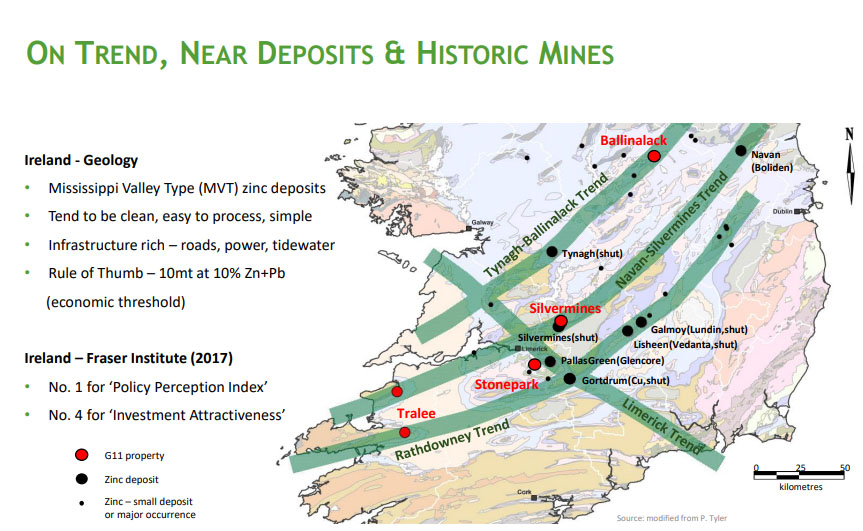
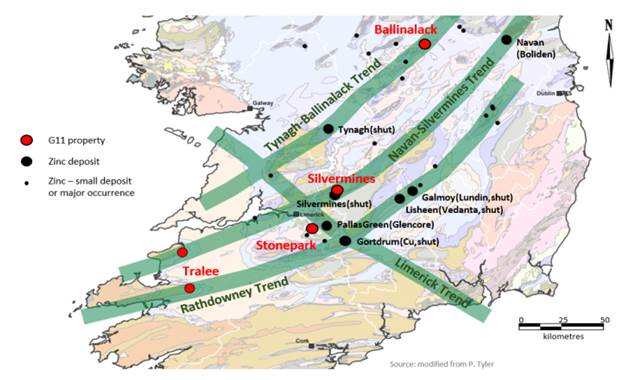
Trend Map
Bart Jaworski: Well, our overall thesis is that by Group Eleven Resources having the largest land position in the richest country for zinc in the world, that being Ireland, we have a very substantiated vision, and that vision is to discover the next big zinc deposit in the country.
We already have the second and third largest undeveloped zinc occurrence in the country, that being the Stonepark current resource and the Ballinalack historical estimate, and those are second only to Glencore’s very substantial Pallas Green deposit, which is one of the largest undeveloped zinc deposits in the world.
People-wise, of course, you need people with the right mind-set and experience to drive towards this goal of discovery. And we certainly have that part covered with MAG Silver as a strategic backer and people like Peter Megaw and Dan MacInnis involved, as well as,] very experienced Irish geologists like John Barry, David Furlong and Dr. Mark Holdstock, who have spent most of their careers exploring for zinc in this country.
Maurice Jackson: Before we discuss the unique value proposition of Group Eleven Resources, I would like to begin our discussion today at the 10,000-foot level regarding zinc, it’s a metal that is not on a lot of radars. What can you tell us about the zinc supply and demand fundamentals?
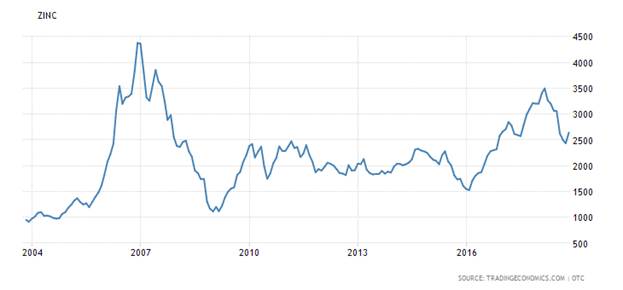
Source: TradingEconomics.com (US$/tonne)
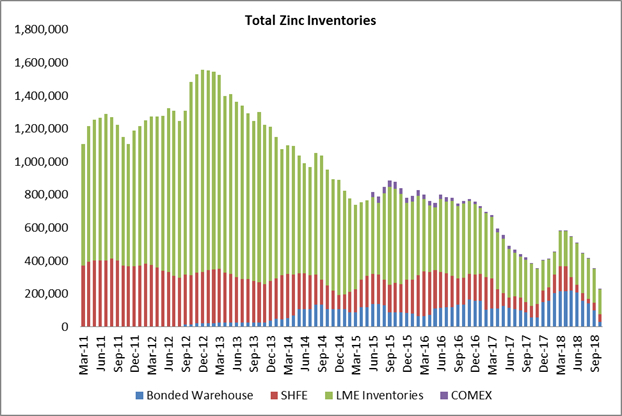
Source: Scotiabank (The Daily Mining Scoop)
Bart Jaworski: Zinc demand is roughly 14 Mt/year, so that’s about US$40 billion/year turnover (at current prices). Zinc is the fourth most consumed metal, after iron, aluminum and copper. The price of zinc was on fire in 2016 and 2017—roughly doubling from 70c/lb to $1.60/lb; then in 2018, the price took a bit of a breather, falling to about $1.00/lb in September and now starting to rise again towards the $1.20/lb level.
Zinc is primarily used for galvanizing steel, which means making steel rust proof and that then feeds the construction and automotive sectors. Zinc is also an essential nutrient for embryonic growth and normal metabolic processes inside the human body.
So that’s a bit about the demand side. On the supply side this is where things get interesting. A number of mines around the world have been shutting down because they’ve run out of ore or because they are no longer economic to run because, for example, they’ve been starved of capitalized for too long, etc. Lisheen, Galmoy and Century are a few examples of large mines that have been depleted over the last few years.
This has led to a shortage in mine supply, which in turn has led to diminishing global inventories—which are now down to levels we haven’t seen since 2007/2008 and remember, back then, prices reached as high as $2.08/lb. So the question becomes why are prices relatively muted now, despite these multi-year inventory lows? Well, I think the key issues are the trade war rhetoric, Chinese slow down fears and of course, the threat of a supply response.
Now obviously, no one has a crystal ball, but I suspect trade war talks will conclude constructively or at least I hope so. The Chinese economy, I suspect, still has a number of very large buffers at its disposal and one has to wonder if the trade talks with the U.S. do indeed falter the Chinese government could notionally just double-down on internal infrastructure growth again bolstering its Belt and Road initiative even further, for example.
On the supply response, as a former mining analyst, I definitely learned over the years that slippage on getting new mines up and running happens more often than not. So you always want to take a haircut to guidance on start-ups. Then there is the question of Chinese supply, which accounts for about half of world’s mine supply. Historically it has been the case that whenever zinc price went up, Chinese supply would go up as well, leading to a moderation of zinc prices.
This hasn’t been the case so far this cycle. The reason is that China has imposed a number of strict environmental regulations on industry, including mining, over the last year or two. The effect has been that a lot of small “mom and pop” zinc mines in China have been shut down and that has suppressed the supply response from China in a big way.
So, that’s the crux of the market.
There is one other key bright spot that I believe is starting to show great promise and that is the evolution of zinc batteries. I think this could be a potential game-changer for the industry. The background here is that zinc was always an ideal metal for batteries since Edison’s time 100 years ago; however, the problem has always been “rechargeability,” you couldn’t recharge a zinc battery without needles growing inside the cell and quickly bursting the battery.
A few years ago a scientific breakthrough by the U.S. Naval Research Laboratory changed all that and this was written up in the prestigious Science magazine in April 2017; by the way, I recommend people take a look. With the advent of 3D lattice technology, electric charges can now be dissipated homogeneously enough to prevent needle growth and whamo! Zinc now has the potential to compete and offset the likes of Li-ion batteries. That’s pretty exciting.
Now there are small zinc batteries for cars and small equipment, etc., which I don’t think will have much impact on zinc demand. Then there are the large zinc batteries aimed for grid power storage and here is where we could definitely move the needle significantly on annual zinc demand.
A great example of these large zinc batteries is NantEnergy, which is run by a California-based billionaire named Patrick Soon Shiong. He’s developed a Zinc-Air battery, which run on photons, zinc and air; and he’s demonstrated he can successfully run dozens of cell phone towers and villages completely off the grid in Africa and other regions. There is a great video on Bloomberg interviewing Mr. Soon Shiong on this technology, plus the New York Times has recently written it up as well.

Source: NantEnergy
Maurice Jackson: Group Eleven Resources projects are strategically located in Ireland, provide us with some historical context on the relationship between zinc and Ireland.
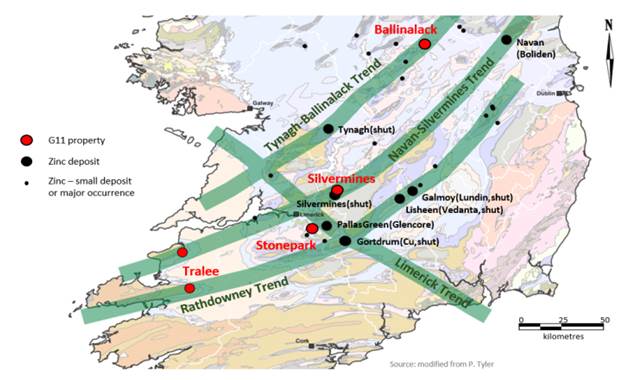
Bart Jaworski: Ireland is estimated to be No 1 in terms of zinc found per square km, so it’s a very prospective country. It also hosts some of the world’s largest zinc deposits (e.g., Boliden’s Navan mine and Glencore’s Pallas Green deposit). It’s infrastructure-rich and has year-round tidewater for shipping. The product is clean and you’re close to consumer. Irish zinc concentrates tend to be very good quality. European smelters are around the corner in Norway, Sweden, Belgium, etc.
Politically Ireland is a safe, first world jurisdiction with security of tenure and rule of law. And lastly, the Fraser Institute, which is the only think tank that ranks the world’s mining jurisdictions, ranks Ireland No 1 in terms of Policy Perception Index for five years running. So Ireland has all the ingredients you’d want.
One key aspect to add is that over the last 70 years of mining history in Ireland, a general rule of thumb of what it takes to break-even economically in Ireland is what is known as “10 and 10” or 10 Mt at 10% Zinc+Pb combined. That reflects the infrastructure and tidewater (so in more remote part of the world were you need to truck in your diesel and truck out your concentrates; you may need 50–100 Mt to break-even. In Ireland you typically need much less, which is very comforting to know).
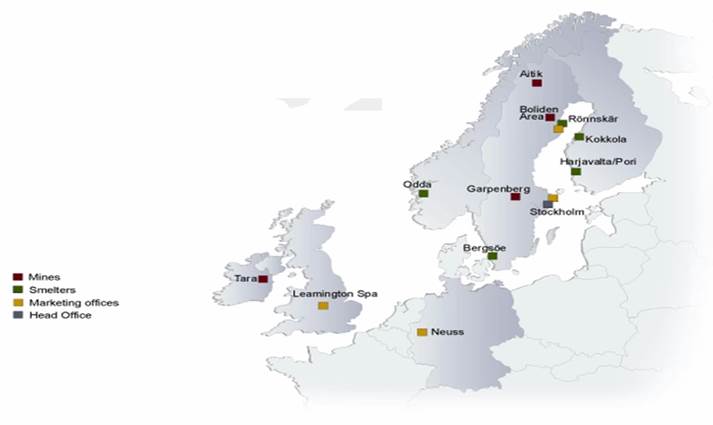
Source: Boliden (location of zinc smelters in green)
Maurice Jackson: Bart, now that we know the virtues of exploring for zinc in Ireland, how much of a land position does Group Eleven Resources have in Ireland?
Bart Jaworski: We have the largest land position of any explorer or miner in Ireland. All together we hold approximately 3,200 sq km, or 320,000 hectares or nearly 800,000 acres. This gives us the dominant position over two geological basins, which gives us the ability to think big and think outside the box, and this greatly aides our exploration approach.
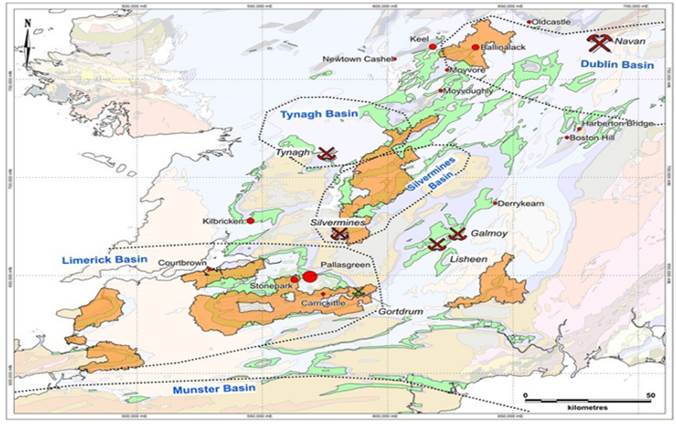
Source: Group Eleven (G11 licenses in orange)
Maurice Jackson: You mention approach, is there anything different that you are doing that others are not?
Bart Jaworski: Well, yes, absolutely! Our “Big Think” approach is what really makes us different. Essentially, we are tearing up the old geology textbooks and putting them back together again using a very open minded and thorough approach to exploration by systematically conducting detailed data compilation. Mining data in Ireland goes back all the way to the 1200s and beyond and we are coupling that with cutting edge exploration techniques such as seismic surveys, airborne geophysics, ionic leach soil sampling, etc.
Now, not just anybody can have the “Big Think.” You can’t have the “Big Think” without the ground position, right? Because if you come up with a great idea, it’s likely on someone else’s ground and you can’t do anything about it. You also can’t do the “Big Think” without the right people—big picture thinkers—and that’s again where the likes of Peter Megaw and Dan MacInnis, both from MAG Silver, come in, as well as deep Irish bench-strength with the likes of Dr. Mark Holdstock, John Barry and David Furlong.
Maurice Jackson: A virtue of having the largest ground position in Ireland is that Group Eleven has two flagship projects. Let’s delve into them shall we. Mr. Jaworski, introduce us to your first flagship project, the Stonepark and the unique value propositions it presents.
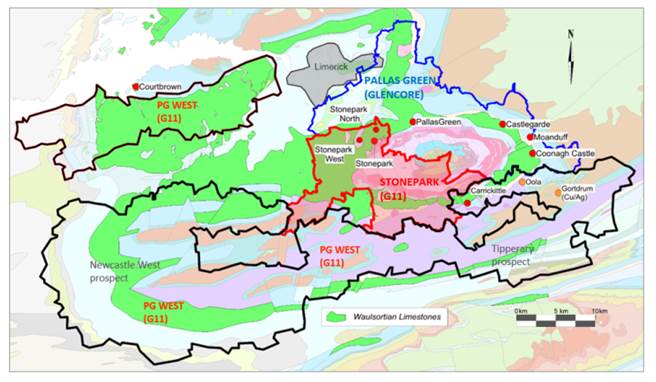
Note: Red and Black outlines are G11. Blue outline is Glencore
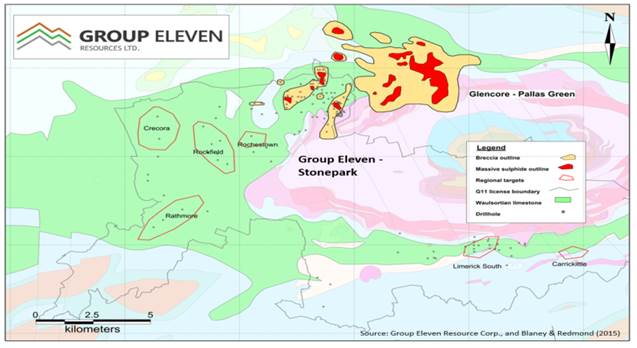
Note: This map is a zoom-in on the Pallas Green/Stonepark area; shows the Carrickittle and Limerick South prospects, which may be a quasi-mirror image to the small red blobs to the north of Pallas Green
Bart Jaworski: Well, at Stonepark we are very excited because we are right next door to Glencore’s Pallas Green deposit, and we think we might have at least some of the key mineralizing faults from that deposit trending onto our ground. Our ground, by the way, covers nearly the entire prospective geology in this area, outside of Glencore’s ground. We have by far the largest land position in this region much bigger than Glencore’s area and we cover about 1200 sq km or 300,000 acres.
We also already have a maiden resource 43-101 compliant in the Inferred Category on our ground totaling 5mt @ 11% Zinc+Pb (Stonepark deposit). That is located only about 1km away (very close) from Glencore’s Pallas Green deposit, which hosts about 44mt @ 8% Zinc+Pb.
Our deposit is about 200–400m deep. whereas Glencore’s Pallas Green is 300–1300m deep, with its new discovery called Caherline about 10mt @ 10% Zinc+Pb at the deepest part of that range (i.e., towards 1300m). We know Glencore has been actively drilling at Pallas Green since early 2017. So from the above you can see that our Stonepark deposit is much shallower and about 30–40% higher grade.
That’s a good starting point.
But the key is this! This is an emerging camp. The discoveries here at Pallas and Stonepark are relatively new and yet this is already the most metal-endowed region within all of Ireland, outside of Boliden’s Navan deposit. And yet the main mineralization structures (or faults) have not yet been found. It’s a complete mystery.
Usually in Ireland, the zinc occurs butted up against a fault. But in this camp the main structure appears to be further away, suggesting that what has been discovered to date is actually the periphery of the system. Thus, the heart may be lurking somewhere underneath, in what we call the Limerick volcanics.
So the question becomes how do we find the center of the system? And this is where our preliminary drilling and the Tellus survey come in. We announced last week the start of a preliminary 1500–2000m drill program, which will be primarily aimed at answering the big geological questions on the architecture of this camp. If we hit some mineralization too, that’s great, but the primary aim is geological.
We’re going to couple this data with a large ongoing airborne survey that is currently being flown by the Irish Geological Survey. It’s called Tellus and it comprises flying 2,500 sq km or 620,000 acres or so, covering our ground, Glencore’s ground and our nearby Silvermines ground and using three state-of-the-art detection methods all together, which are radiometrics, magnetics and electro-magnetics.
This information will be publicly available early next year and will hopefully tell us where the major faults are and how they line up with the known mineralization in this camp. Now we already have our suspicions on where this key fault corridor might be—one clue is that the main Pallas Green body seems to trend in a NW orientation; this is from an academic paper that was published in 2015.
If you continue that trend towards the south you line up perfectly with our Carrickittle and our Limerick South prospects. At Carrickittle, for example, there are about a half dozen historical holes that intersected about 5m @ 12% Zinc+Pb and they have been largely forgotten about since the late 1960s.
However, now that we know about Pallas Green and Stonepark, these 1960s prospects are starting to look at lot like the small satellites you see just outside the Pallas Green deposit to the north, which poses an interesting question: Do we have a “quasi-mirror image” down to the south?
So this is one of key ideas we are working on and that is what we’ll be working on as part of the “Big Drill of 2019.”
Maurice Jackson: Let’s move north now and discuss your second flagship project, Ballinalack. What has the company excited there?
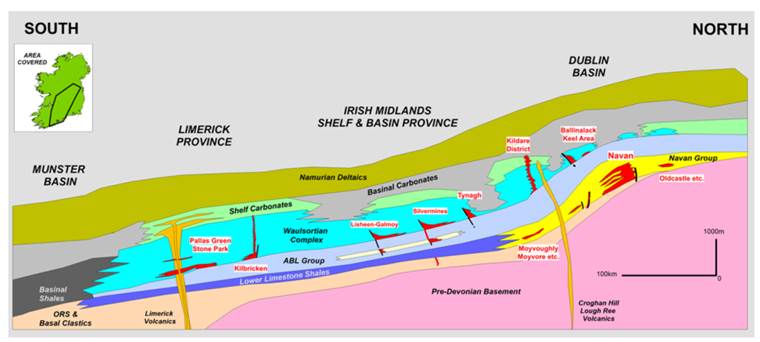
Note: above shows regional cross-section across Ireland, demonstrating that the zinc (red) occurs in two prospective horizons (blue and yellow) at Ballinalack. We have BOTH of these horizons (This is unique, given if you move north, you lose the blue layer; if you move south, you lose the yellow layer.)
Bart Jaworski: At our second flagship project, Ballinalack, we also have an exciting idea that we will be testing as part of the Big Drill of 2019. It is located about 50km away from Boliden’s giant Navan zinc mine, which has approximately 100 Mt @ 10% Zinc+Pb; it’s mostly mined out now, but still operating. It’s the biggest mine in Europe and considered one of the top five zinc deposits in the world.
Ballinalack is unique as it’s still close enough to Navan to have well-developed Navan Beds on the property in addition to the other prospective horizon called the Waulsortian limestone. In fact, Ballinalack is the only known zinc occurrence in Ireland that has significant mineralization in both horizons.
Interestingly, in the 1970s, when Ballinalack was discovered, the old-timers only drilled down to about 300m to define the historical estimate, which by the way totals 7.7 Mt @ 7.3% Zinc+Pb, which is not too far off from our 10 and 10 rule of thumb.
So drilling beyond 300m was considered “very deep” at that time. Now, of course, mining reaches much deeper, for example, at Boliden and Pallas Green, drilling is going down well beyond 1000m or 3300 feet. Our big idea at Ballinalack is that the Navan Beds directly underneath the historical estimate have not yet been tested for Navan-style mineralization.
Case in point, of the 30 holes historically drilled deep enough to actually intersect the Navan Beds in the vicinity of the old estimate, a surprisingly high number, about half of the holes, hit significant mineralization. And directly underneath the historical estimate the area is virtually undrilled.
So our preliminary drilling of two holes earlier this year was also primarily aimed at geology, and we successfully identified (1) that cross-faults exist and they seem to have a lot more to do with mineralization than ever recognized before, and (2) that the Ballinalack fault is much steeper than previously thought, which shows definitively how previous drilling was missing the target.
By the way, Group Eleven Resources intersected 10m @ 10% Zinc+Pb in an area of known mineralization, which is also comforting, plus a zone of mineralization in the Navan Beds.
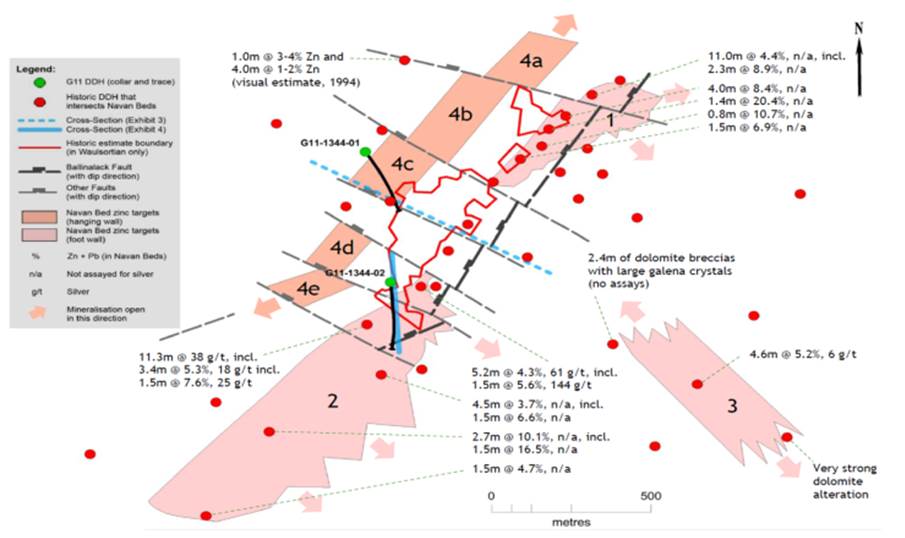
Note: The orange zone (4a-4e) is our hanging-wall Navan Bed target (which has been virtually undrilled) and targets 1, 2 and 3 are our footwall Navan Bed targets where historical drilling has yielded significant mineralization worthy of follow up (all the red dots are the historical holes, which were drilled deep enough to intersect Navan Beds, and half of them hit. ‘n/a’ means not assayed for silver.
Maurice Jackson: What are your plans going forward at Ballinalack?
Bart Jaworski: We will be relogging and in some cases re-assaying some of the historical core with the aim of sharpening our understanding of the architecture of this area even further, and we will then do more drilling in 2019 as part of the Big Drill.
Maurice Jackson:
Are these brownfields explorations that the company is undertaking?
Bart Jaworski: If “brownfield” means an area that was previously mined, then the answer is no. However, I think in this case, you are referring to the notion that in these areas we have seen significant heavy lifting already done on the exploration side by previous operators, than definitely yes.
Maurice Jackson:
For someone new to the term brownfields, please share how that improves the probability of discovery.
Bart Jaworski: Well, with the heavy lifting already done for us, this puts us in great position to allow us to get up the learning curve much quicker than if we had to drill all those initial holes ourselves. So we’re walking on the shoulder of a giant amount of historical work, and if you infuse that with cutting edge technology and truly open minded thinking—that’s where the magic happens.
Maurice Jackson: For current and prospective shareholders, the story doesn’t end with zinc. You have recently discovered some silver at the Ballinalack. How was “Big Think” responsible for the discovery and share the results with us.
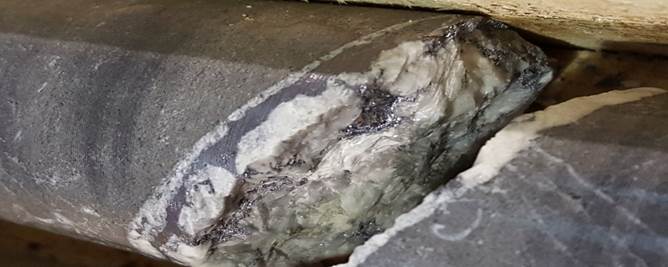
Note: Drill core from G11 recent drill hole (G11-1344-02) at Ballinalack
Bart Jaworski: Correct, at Ballinalack only some of the historical intervals were ever assayed for silver and those that were often had good silver numbers in them, say between 20–100 g/t, and our highest was about 380 g/t. So we know there is silver in the system, but that was never calculated historically.
I see that as a potential sweetener to the story, which has yet not been borne out. Also at Stonepark and the broader Limerick basin, we have the idea that because you have a lot of volcanics intruding limestones, you might expect to see some overlooked deposit types, which can host a much higher precious metal component, for example, CRD deposit types that you see in Mexico.
That is I believe what captured the imagination of Peter Megaw. I think all that I’ve mentioned above speaks to the open-minded approach that we have and hence the “Big Think.”
Maurice Jackson: What is management’s philosophy, are you looking to build mines or are you focused on exploration?
Bart Jaworski: Similar to most juniors, our exit strategy is to make a large discovery and then sell it to the highest bidder. We are not interested in becoming miners.
Maurice Jackson: Switching gears, I’ve learned from some of the most serially successful in industry—from Rick Rule, Doug Casey, Jayant Bhandari, Mickey Fulp and Bob Moriarty—that the people running the business are equally if not more important that the latent material in the ground. Mr. Jaworski, please introduce us to your board of directors and management team and the unique skill sets they bring to the Group Eleven Resources.
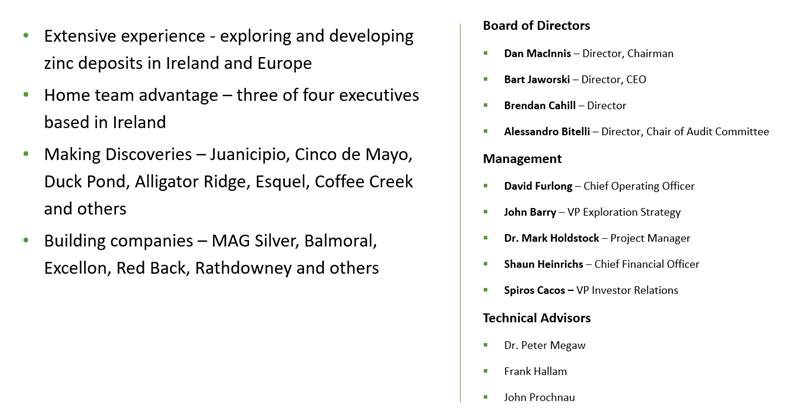
Bart Jaworski: We have four on the board currently.
Dan MacInnis is our chairman. (a) He is the retired CEO of MAG Silver (and currently sits on the MAG board) (b) Dan has over 40 years of experience and has been involved with seven discoveries during his career including Duck Pond and Juanicipio (c) Interestingly, Dan worked in Ireland for five years back in the late 1970s/early 1980s with Noranda, so he definitely knows the lay of the land in Ireland.
Alessandro Bitelli is our chair of the Audit Committee. He is currently the CFO of Lundin Gold, and interestingly was the CFO of RedBack when it was taken over for $10 billion by Kinross back in 2010.
Brendan Cahill is a lawyer and all round very sharp guy. He’s the CEO of Excellon Resources, which is mining the Platosa silver deposit in Mexico.
On the management side:
We have John Barry and David Furlong, who I’ve mentioned earlier in our discussion. Both are Irish geologists. ex-Rathdowney Resources (which is another European zinc development company). John was the founder and CEO of Rathdowney. So both John and David have deep experience with Irish-style zinc deposits and with operating in Ireland.
Dr. Mark Holdstock is a very well-known geologist in Ireland. He recently joined us (in early 2018). He led the team that discovered the 20-Mt SWEX extension of the Navan orebody.
So John, David, Mark and myself, we’re a home team. All of us live in the country we’re operating in and that’s different from many juniors and a big plus because we have our ear close to the rail.
And now onto the advisers:
Peter Megaw is the brainchild behind MAG Silver’s success in Mexico with the Juanicipio discovery. Peter is the chief exploration officer at MAG. and he’s a big help on our “Big Think” initiative.
We also have John Prochnau and Frank Hallam as advisers. John Prochnau is on Doug Casey’s Exploration Hall of Fame actually for his Esquel and Alligator Ridge discoveries. John also worked on our Ballinalack project back in the 1970s.
Frank Hallam has a lot of experience in M&A with the majors and has been involved with over a $1 billion in financings over his career. Last but far from least are Shaun Heinrichs, our CFO, and Spiros Cacos, our VP Investor Relations.
Maurice Jackson: Tell us about Bart Jaworski; what makes him qualified for the task at hand?
Bart Jaworski: I’m an exploration geologist and ex-mining equity analyst. I have about 24 years of experience since 1994, my first year in the field. I was an analyst for about 12 years. Initially, I began with Raymond James in Vancouver for about nine years and then for over three years with Davy in Ireland. I’ve been on a lot of site visits and met with a lot of CEOs and VP Ex’s over that time frame. I also covered many exploration and mining companies over the years.
The reason I ended up in Ireland is because my wife, who is Irish, wanted to move back home after being in Canada with me for nine years. And that’s how I ended up at Davy in Dublin covering the UK listed golds, plus Rio Tinto and the iron ore sector. As an exploration geo I discovered the original soil anomaly at Coffee Creek, which later became a multi-million ounce gold deposit (which was taken out for $0.5 billion when Goldcorp took over Kaminak). Going back a little further, I also helped discover industrial minerals in the Iskut area.
Maurice Jackson: Tell us about your capital structure.
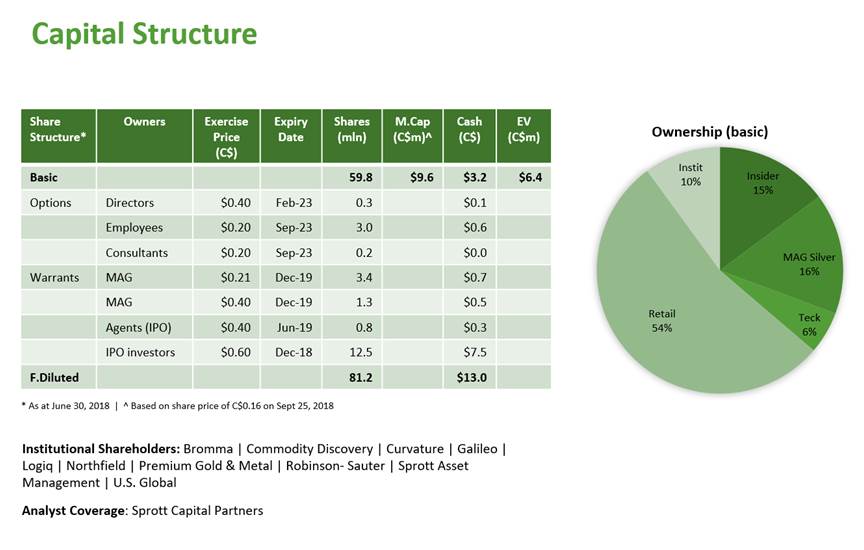
Bart Jaworski: We have just under 60 million shares outstanding. So at our current share price (14c) our market cap is only CA$8.4 million or about US$6 million. About 20 million warrants and options outstanding: more than half of those are set to expire this December. Cash: our last Quarterly Financials have $3.2 million in the till. We have no debt.
Maurice Jackson: Let’s discuss some numbers: What is your burn rate?
Bart Jaworski: Burn is about $100k–$130k/month, so call it roughly $1.5 million per annum. So our runway is still fairly comfortable, at least another 12 to 15 months doing what we need to do, depending on how hard we step on the gas pedal.
Maurice Jackson: Do you have institutional Investors at this point?
Bart Jaworski: Yes, we’ve been lucky enough to garner the support of about a dozen institutions, mostly during the IPO, but some pre-IPO and some post-IPO. Most well-known institutions include Sprott, US Global, Galileo and Logiq.
Maurice Jackson: What is the float?
Bart Jaworski: About half our 60 million shares are owned by high-net worth investors, which is about 30 million shares. The rest is owned by MAG, Teck, the funds and insiders.
Maurice Jackson: Are there change of control fees? If yes, please convey the terms.
Bart Jaworski: There are no change-of-control fees for M&A transactions but there are fees associated with management being fired by the board without cause, which is fairly standard.
Maurice Jackson: When is the last time you purchased shares and at what price?
Bart Jaworski: I actually bought shares last just after our last press release last week at a price of 13c and 12.5c. I believe at least one other insider bought shares on the heels of last weeks’ press release as well.
Maurice Jackson: Any redundant assets such as patented mining claims and or reversionary interests, meaning are Group Eleven Projects 100% owned by Group Eleven Resources?
Bart Jaworski: We don’t have any patented mining claims in Ireland. We own all our licenses 100% except at Ballinalack where we have 60% interest with the remainder owned by a large Chinese zinc producer called Nonfemet. At Stonepark, where we own roughly 77% and the remainder owned by a small Irish exploreco. Important to note, these joint venture interests are participating, i.e., they have to pay their share of exploration costs or they get diluted down.
Maurice Jackson: All right, sir, you’ve survived the storm. Mr. Jaworski, multilayered question, what is the unanswered question for Group Eleven Resources, when should we expect results, and what will determine success?
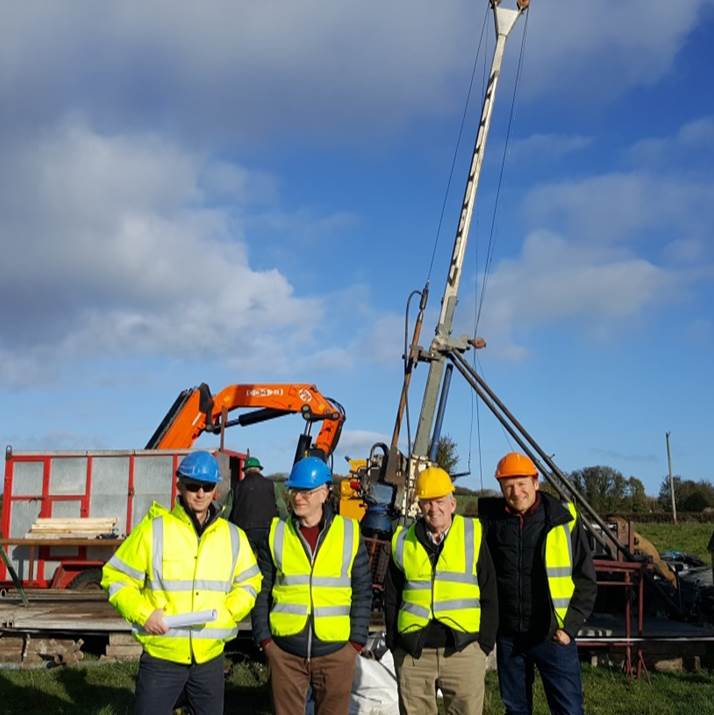
Source: G11, October 2018 (L to R: David Furlong, John Barry, Bob Moriarty and Bart Jaworski)
Bart Jaworski: Results, we are currently doing a “preliminary drilling” campaign (1500–2000m) and we should have results from that over the coming weeks and months. The results of the Tellus survey will also be forthcoming early next year and that will tell us a lot. We will then couple the two datasets, i.e., the drill data and the airborne data and that should lead to very high-priority drill targets, which will be part of our Big Drill in 2019. A few months ago we put out a maiden resource at Stonepark measured 5mt @ 11% Zinc+Pb combined. We are working on updating the Ballinalack historical estimate, but we are not sure yet if we can upgrade to a current estimate without re-drilling, but we are looking into it so that something else to be aware of.
MAURICE JACKSON: What keeps you up at night that we don’t know about?
BART JAWORSKI: Well, I’m an optimist, as long as people keep remembering the lessons of Adam Smith and the Wealth of Nations. I think we’ll be ok and the world economy will keep on growing and with it, so will the prosperity of humanity. Other than that I try not to sweat the small stuff.
Regarding Group Eleven, obviously exploration is a risky and cyclical business, so one needs to be aware and cognizant of that. However, with high-risk comes high-rewards, and that’s really what I’m focusing on as a shareholder myself.
Maurice Jackson: Finally, what did I forget to ask?
Bart Jaworski: I guess one important element of the Irish exploration landscape is the support from the government, specifically iCRAG, which stands for the Irish Centre for Research in Applied Geosciences. This is a government-industry-academia partnership that is well-funded and has a number of very smart people working on a number of fronts. One of the main remits of iCRAG is to help companies like Group Eleven find the next zinc mine in Ireland.
So, interestingly, the individual who recently stepped into the role of CEO and Director at iCRAG is a gentleman by the name of Dr. Murray Hitzman. Dr. Hitzman was once at the White House shaping Science and Technology policy, as well as, the head of the Colorado School of Mines and more recently at the U.S. Geological Survey. He is one of the leading experts on Irish-style zinc deposits and has written many academic papers on the subject. When Murray was announced as the Head of iCRAG, I personally thought this was a major signal by the Irish government and a catalyst, really, for future discoveries in Ireland.
Maurice Jackson: For someone listening that wants to get more information on Group Eleven Resources the website is here. And as a reminder, Group Eleven Resources trades on the TSX-V: ZINCG and on the OTCQB: GRLVF.For direct inquiries please contact Spiros Cacos at 604 630 8839 Ext. 503 and he may also be reached at s.cacos@groupelevenresources.com.
And last but not least please visit our website provenandprobable.com, where we interview the most respected names in the natural resources space. You may reach at contact@provenandprobable.com.
Bart Jaworski of Group Eleven Resources, thank you for joining us today on Proven and Probable.
Maurice Jackson is the founder of Proven and Probable, a site that aims to enrich its subscribers through education in precious metals and junior mining companies that will enrich the world.
Disclosure: 
1) Maurice Jackson: I, or members of my immediate household or family, own shares of the following companies mentioned in this article: None. I personally am, or members of my immediate household or family are, paid by the following companies mentioned in this article: None. My company has a financial relationship with the following companies mentioned in this article: None. Proven and Probable disclosures are listed below.
2) The following companies mentioned in this article are billboard sponsors of Streetwise Reports: MAG Silver. Click here for important disclosures about sponsor fees.
3) Statements and opinions expressed are the opinions of the author and not of Streetwise Reports or its officers. The author is wholly responsible for the validity of the statements. The author was not paid by Streetwise Reports for this article. Streetwise Reports was not paid by the author to publish or syndicate this article. The information provided above is for informational purposes only and is not a recommendation to buy or sell any security. Streetwise Reports requires contributing authors to disclose any shareholdings in, or economic relationships with, companies that they write about. Streetwise Reports relies upon the authors to accurately provide this information and Streetwise Reports has no means of verifying its accuracy.
4) This article does not constitute investment advice. Each reader is encouraged to consult with his or her individual financial professional and any action a reader takes as a result of information presented here is his or her own responsibility. By opening this page, each reader accepts and agrees to Streetwise Reports’ terms of use and full legal disclaimer. This article is not a solicitation for investment. Streetwise Reports does not render general or specific investment advice and the information on Streetwise Reports should not be considered a recommendation to buy or sell any security. Streetwise Reports does not endorse or recommend the business, products, services or securities of any company mentioned on Streetwise Reports.
5) From time to time, Streetwise Reports LLC and its directors, officers, employees or members of their families, as well as persons interviewed for articles and interviews on the site, may have a long or short position in securities mentioned. Directors, officers, employees or members of their immediate families are prohibited from making purchases and/or sales of those securities in the open market or otherwise from the time of the interview or the decision to write an article, until one week after the publication of the interview or article.
Proven and Probable LLC receives financial compensation from its sponsors. The compensation is used is to fund both sponsor-specific activities and general report activities, website, and general and administrative costs. Sponsor-specific activities may include aggregating content and publishing that content on the Proven and Probable website, creating and maintaining company landing pages, interviewing key management, posting a banner/billboard, and/or issuing press releases. The fees also cover the costs for Proven and Probable to publish sector-specific information on our site, and also to create content by interviewing experts in the sector. Monthly sponsorship fees range from $1,000 to $4,000 per month. Proven and Probable LLC does accept stock for payment of sponsorship fees. Sponsor pages may be considered advertising for the purposes of 18 U.S.C. 1734.
The Information presented in Proven and Probable is provided for educational and informational purposes only, without any express or implied warranty of any kind, including warranties of accuracy, completeness, or fitness for any particular purpose. The Information contained in or provided from or through this forum is not intended to be and does not constitute financial advice, investment advice, trading advice or any other advice. The Information on this forum and provided from or through this forum is general in nature and is not specific to you the User or anyone else. You should not make any decision, financial, investments, trading or otherwise, based on any of the information presented on this forum without undertaking independent due diligence and consultation with a professional broker or competent financial advisor. You understand that you are using any and all Information available on or through this forum at your own risk.
Images and graphs provided by the author.