Categories
Junior Mining

PACTON GOLD Commences Heliborne Magnetic Survery at Red Lake Gold Project in Ontario, Canada

VANCOUVER , Jan. 31, 2019 /CNW/ – Pacton Gold Inc. (TSXV: PAC, OTC: PACXF) (the “Company” or “Pacton“) is pleased to announce that it has commenced a high-resolution heliborne magnetic survey over Pacton’s claims in Red Lake, Ontario (Figure 1). This is the initial step in order to prioritize upcoming drill targets as part of an aggressive exploration strategy going forward in this prospective area.

Pacton Red Lake Key Highlights:

  • Completion of heliborne magnetic survey to identify high priority D2 structures in the Red Lake district
  • Surface programs to commence on both geological and geophysical targets in 2019
  • Geologically and structurally similar to Great Bear’s Dixie Project

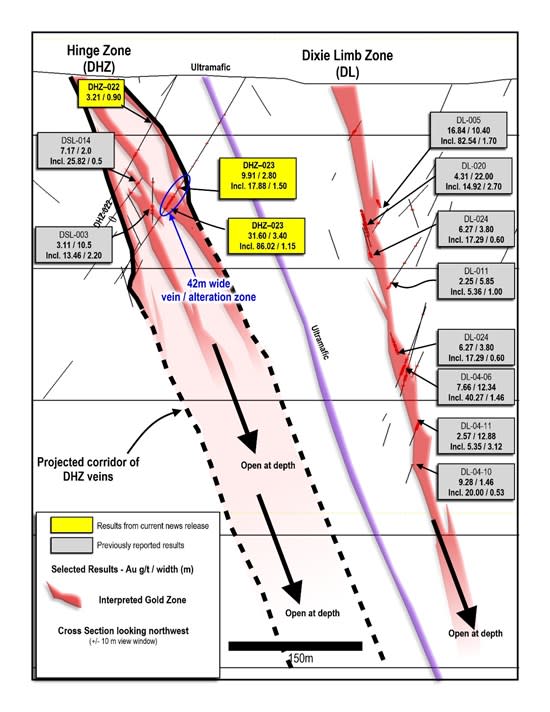
Pacton’s mineral claims are strategically located between Pure Gold’s Madsen property including the Wedge Zone and Great Bear Resource’s Dixie discovery. Recent drill results from Great Bear Resources (GBR.V) reported 190.78 g/t Au over 5.90 meters including 1,600 g/t Au over a drill width of 0.7 meters in the Hinge Zone (see Great Bear Resources press release dated January 16, 2019 ). Pacton’s Red Lake property geology is similar to the geology that hosts the high-grade discoveries at the Dixie project and Pacton will be using the geophysical data to focus on D2 structures that are proposed to have significant control on gold deposits in the Confederation Assemblage (Figure 2).

Figure 1. Location map of Pacton Claims in Red Lake, Ontario (CNW Group/Pacton Gold Inc.)

View photos

Figure 1. Location map of Pacton Claims in Red Lake, Ontario (CNW Group/Pacton Gold Inc.)
Figure 2. Geology map with D2 structures and Pacton Claims in Red Lake, Ontario (CNW Group/Pacton Gold Inc.)

View photos

Figure 2. Geology map with D2 structures and Pacton Claims in Red Lake, Ontario (CNW Group/Pacton Gold Inc.)

About Pacton Gold

Pacton Gold (PAC: TSXV; PACXF: US) is a well-financed Canadian junior with key strategic partners focused on the exploration and development of their Red Lake project in North-Western Ontario and their conglomerate-hosted gold properties located in the district-scale Pilbara gold rush in Western Australia. The Company currently controls the third largest conglomerate-hosted gold property portfolio totaling in excess of 2,500 km2, and continues to aggressively review additional accretive acquisitions.

The technical content of this news release has been reviewed and approved by Peter Caldbick , P.Geo., a director of the Company and a Qualified Person pursuant to National Instrument 43-101. The qualified person has not yet verified the data disclosed, including sampling, analytical, and test data underlying the information or opinions contained in the written disclosure.

On Behalf of the Board of Pacton Gold Inc.

Alec Pismiris
Interim President and CEO

This news release may contain or refer to forward-looking information based on current expectations, including, but not limited to the Company achieving success in exploring its properties and the impact on the Company of these events, including the effect on its share price. Forward-looking information is subject to significant risks and uncertainties, as actual results may differ materially from forecasted results. Forward-looking information is provided as of the date hereof and we assume no responsibility to update or revise such information to reflect new events or circumstances. References to other issuers with nearby projects is for information purposes only and there are no assurances the Company will achieve similar results.

Neither TSX Venture Exchange, the Toronto Stock Exchange nor their Regulation Services Provider (as that term is defined in the policies of the TSX Venture Exchange) accepts responsibility for the adequacy or accuracy of this release.

Cision
Cision

View original content to download multimedia:http://www.prnewswire.com/news-releases/pacton-gold-commences-heliborne-magnetic-survery-at-red-lake-gold-project-in-ontario-canada-300787292.html

SOURCE Pacton Gold Inc.

View photos

View original content to download multimedia: http://www.newswire.ca/en/releases/archive/January2019/31/c6908.html

Categories
Exclusive Interviews Precious Metals

KEVIN VECMANIS What Happens When Central Banks Unwind Balance Sheets

Kevin Vecmains the founder of VanAurum Financial Technologies sits down with Maurice Jackson of Proven and Probable to discuss: What Happens When Central Banks Unwind Balance Sheets.

VIDEO

AUDIO

TRANSCRIPTS

Contributed Opinion

Source: Maurice Jackson for Streetwise Reports  (1/30/19)

Maurice JacksonKevin Vecmanis, founder of VanAurum Financial Technologies, sits down with Maurice Jackson of Proven and Probable to discuss what the unwinding of central bank balance sheets may mean for investors.

Dollar
Maurice J.: Joining us for a conversation is Kevin Vecmanis, the founder of VanAurum Financial Technologies. Mr. Vecmanis, welcome to the show, sir.
Kevin V.: Hello, Maurice. It’s great to be here. Thanks a lot.
Maurice J.: Glad to have you back on the program. In our last interview, we addressed the value proposition for the next capital vortex. Today, we will address central banks unwinding their balance sheets, and the duplicitous effects that may occur. And what actions you, the investor, may take to prepare yourself.
But before we begin, Kevin, your company uses a unique skill set that I find intriguing, which is artificial intelligence for investing. For our first time listeners, please introduce us to VanAurum Financial Technologies.
Kevin V.: VanAurum is an intelligent lead generator for trading opportunities. That’s probably the best way to summarize it. We use machine learning techniques to detect anomalies, and unusual market behavior and then we report on it to members on a daily basis.
Our platform attracts a global cross-section of sectors, ratios and economic data points. And then when something occurs that has some kind of historical precedent for being either positive or negative for forward returns, VanAurum will report on it to members.
We believe that by having an intelligent filter that’s hand-picking market events to look at, it frees up our members’ time to focus their efforts on more productive means, such as, constructing trading strategies and or analysis on their own. So if someone uses a charting service, or trades on technical analysis, VanAurum’s definitely worthy of membership consideration.
Maurice J.: Kevin, your research has noted a mega trend occurring that is related to central banks unwinding their balance sheets. Beginning at the 10,000-foot level, can you share with us why central banks are unwinding their balance sheets, and what this means for investors?
Kevin V.: Stepping back for a moment, in 2009, the Federal Reserve came up with an explicit program called Quantitative Easing, to buy mortgage-backed securities and other debt-related securities from the balance sheets of different institutions, and most central banks globally eventually caught on to this well, to bail out financial institutions in the sector that were carrying this “toxic debt” on their balance sheets.
The Fed conversely grew its balance sheet from about $800 billion to almost $4.5 trillion. And it was maintaining it at that level for a while. When the Fed is maintaining the size of its balance sheet with these debt-related securities what its intentions are as follows: as the securities mature on its balance sheet, it is actively seeking out other similar securities to buy to replace them, so that the Fed can keep the size of its balance sheet at a constant level.
So, the process of expanding the balance sheet, as well as maintaining it at a certain level, there was an implicit assumption in the market that the central bank was going to be there, and be a significant source of debt demand for a lot of these securities, which would be the primary driver behind interest rates ultimately hitting rock-bottom yields. The Fed was such a heavy influence on interest rates that, in January of 2018, the yield on the S&P 500 was about 1.73%. And the yield on the three-month Treasuries, which is considered to be the United States’ riskless asset, was higher than that.
The end result is that the S&P equity yields, which are considered to be risky assets on somebody’s balance sheet, or within their portfolio, these yields are essentially risk-free. Which is a really amazing thing if you think about it. A situation that is really unsustainable.
Going forward, the Fed has now communicated that it is going to shrink the size of its balance sheet. So in effect what that’s actually doing is removing a major source of demand out the market, for not only U.S. Treasuries, but other mortgage-backed securities as well. This is a simple supply and demand factor. The likelihood of supply and demand to equalize will not be accomplished until rates are much higher.
Maurice J.: I always find it disingenuous that the U.S. Treasury references the nominal rate of return and omits the real rate of return on Treasuries.
Twofold question here for you. How will this impact currencies and capital markets?
Kevin V.: We have witnessed the Fed go through hiking cycles in the past, typically any kind of economic turmoil that led to a flight to safe haven assets increased the demand for Treasuries and the U.S. dollar.
I am of the opinion that the Federal Reserve is in a bit of a tricky situation right now. And over time, more and more investors are going to actually start picking up on this. In a historical context, the level to which they’ve actually raised interest rates is not really that high. What is unprecedented is the extended period of time that the Fed has pinned along interest rates to zero. The Fed recognizes that it needs to raise rates because it has artificially suppressed interest rates, which were driving the yields on the S&P and of bonds respectively to disproportionate levels.
Should the market witness again that the Federal Reserve is willing to reverse course, by printing currency (inflation) to buy up a lot of assets and thus further expand its balance sheet again, I believe the market will react violently to the Fed’s attempts. I think this time around, the impact could actually be very negative on the U.S. dollar and Western currencies as investors will begin to realize maybe how unsustainable some of the debt trajectories actually are.
Maurice J.: If currencies and equities will be negatively impacted, what is the prudent investment decision that one should make now?
Kevin V.: In this situation, I like to look at what were the major beneficiaries within the broad markets when the Federal Reserve decided to embark down this path of explicit balance sheet expansion. And I guess the answer to that is bonds, equities, and to a large extent, real estate within major urban centers. So we’ve seen significant inflation in a lot of these markets. They were the major beneficiaries of what I call the risk premium compression that resulted from the Fed artificially lowering interest rates.
After the crisis everybody thought that commodities and other markets like that were going to go hyperbolic. But we actually didn’t see that. And, in my opinion, a lot of the reason why we didn’t see that was because the market was front running all these explicit purchases from the central bank. Why wouldn’t you buy bonds if you knew that the Federal Reserve was going to be buying, $30, $40 billion of them a month, on an open-ended basis.
So I think that drew a lot of capital away from resource sector stocks, from commodities. Any commodity, really. And so I think this time around, when we see this whole process unwinding, to me it only seems logical that the markets that were previous beneficiaries might suffer. Conversely, the markets that didn’t benefit we will start to see a lot of those begin to mean revert. I foresee big potential in platinum, gold, resource sector stocks and energy stocks, which have been punished to a significant degree, especially within the explorers and the producers, which experienced some of the sharpest declines in record.
So, I think it all depends on how the market decides to react with the U.S. dollar. Whatever it is, we get the next major trajectory change from the Federal Reserve. But my inkling, my instincts right now, and all the data that I look at with VanAurum and our research, suggests that the U.S. dollar will probably be negatively impacted the next time around.
Maurice J.: So then the answer will be, if I’m correct here, would physical gold be the first prudent investment decision?
Kevin V.: Yes, definitely at this point. I always advocate having some allocation to gold in your portfolio, especially right now with the debt-based currencies in the West really starting to balloon out of control. But there’s lots of fear in the market right now. We’ve experienced a significant correction on the S&P 500 and the broad equities. A lot of the valuation extremes that we saw leading up to this point was causing everybody to warn of bubbles. We’ve actually seen a fair amount of that lead off. And it’s come back into nominal territories.
I sent a message out to my members earlier this week saying that at this juncture, if the correction in the S&P 500 extends into bear market territory, closer to it being down 20%, which at that point, going back to 1980 within our data that VanAurum analyzes, most of the precedence, if not all of them, are actually positive for one-year returns going forward once the market has experienced a selloff greater than 20%.
So there could be draw downs in the broad equity market from here. In September 2008, the market ultimately fell 40% before hitting its ultimate bottom. And then exactly one year later, from September 2008, the market was almost unchanged again. So, could the market accelerate to the downside again, and resume a bear market? It’s likely. But at this point, I think prudent investors will start trying to anticipate some type of accumulation program for broad equities.
I have my attention on what I would term as the kind of the forgotten markets right now, like gold, which is carving out a multi-year base; platinum, which has been absolutely crushed recently; and silver are going to do extremely well in the environment that we’re about to move into.
Maurice J.: Regarding physical precious metals, would precious metal equities be the right place to be as well, once someone has secured a position first in the physical metals?
Kevin V.: Yes, full disclosure, I have long positions in GDX and GDXJ. With VanAurum, and my research, I study sectors. There are lots of people who are really good at picking individual issues. But when we’re working with our machine learning system, for reasons that maybe are beyond the subject of this interview, we try to stick with a sector. So, I do have exposure to the gold mining equities, through GDX and GDXJ.
Depending on what the investors are looking for, royalty companies and the gold streaming companies really tend to do well during downside turmoil in gold and equity markets. We saw companies like Franco-Nevada, whose stock performed incredibly well during the gold bear market from 2011 to 2015. Where you really get your upside leverage, in the gold mining and the resource space, is when you’re dealing with an issuer whose cost of production is really close to the prevailing gold price.
What happens there is you get profit leverage. So, if you have a gold mining company that’s selling gold for $1,200 an ounce, and say its all-in cost to produce that ounce of gold are $1,199. So it’s making $1 of profit. If the price of gold increases by a dollar, then the earnings for that particular company increased by 100%. So you go from $1 to $2, you double your earnings. And so that’s what we mean by profit leverage.
You start to see a lot of the high-cost companies really start to accelerate when you see gold moving into a particularly strong bull market. I think what’s happening right now is you’re seeing a lot of the accumulation, and a lot of the higher quality issuers, and they’ve been doing well for quite some time.
But the sectors like GDX and GDXJ, I think have been languishing partly because they’re full of lots of producers that a lot of them haven’t been particularly well in this environment. But I think that will change if gold can stage a major breakout. I think you’ll see a bid under, pretty much any company that’s producing gold. And stage a breakout, and sustain it above $1,400 US.
Maurice J.: Switching gears, Mr. Vecmanis, what is the next unanswered question that VanAurum Technologies is researching? And when do you believe we will have an answer?
Kevin V.: Right now, to me the elephant in the room are interest rates, and how the market is fully going to react to the Federal Reserve removing itself as a major demand source in the debt markets. So, it seems to me like there’s a little bit of disbelief. You’re starting to see two-year Treasury yields, which is a fairly close proxy for interest rate hike expectations, you’ve seen a lot of those rates come down recently. Some of that might have been because the yields were overbought. And the bonds were due for a rally.
But to me that really is the biggest question, because the Federal Reserve was such a huge component of this equity rally that we had from 2009 until now. And I think whatever its action will be is going to be a major component of how the market plays out going forward. You can see the market starting to begin to call its bluff. But what I’m really interested in finding out is what the Federal Reserve actually intends to do. If the markets truly start to react violently to the rate hike cycle, it is going to end it? And is the Fed going to start to ease again, meaning increasing the size of its balance sheet. Or is it going to start cutting rates?
I think if the Fed starts cutting rates, having only reached the levels that they’re at, I think that’s going to be a really, really scary warning sign to market participants everywhere that the U.S. economy just can’t handle higher rates and has become almost addicted to Federal Reserve accommodation. And I think at that point, how the market reacts to that is going to be the primary determinant of which people are going to make a lot of money, and which people are going to lose a lot of money. And I think we’ll have the answer to that probably by the summertime.
Maurice J.: Truly interesting times, and unprecedented times. And I’m tickled to death to be here just to watch it all, and actually participate. Sir, last question. What did I forget to ask?
Kevin V.: I think we covered a lot, Maurice. But, I’d like to discuss a little bit about VanAurum’s AI curated newsletter that we put out daily. The core of our research service that we offer right now is our daily AI curated report, which is a combination of human and machine learning and behavior. So, I’m a big believer fundamentally in the convergence of machine learning-based systems and human-based systems. I believe the people and machines are really good at particular things. And what I try to do at VanAurum is to create workflows that combine the best of those worlds.
The AI curated report analyzes a global cross-section of assets, whether it’s Chinese stocks, Israeli stocks, resource sector stocks, yield curves and economic data points. And it figures out when something is behaving unusual in the market. It performs some hypothesis testing on it, to see if there’s any historical precedent for meaningful positive or negative returns. And then it presents that in a report to our members. And that’s kind of the launch point for the analysis that we do.
So, we’re getting this pipeline of trading and investment suggestions coming from VanAurum daily, which are really high quality. Our members love it. The feedback I get from the members is that it’s exposing them to things in markets that they wouldn’t have thought to look at before, which is really what it’s all about.
Maurice J.: For readers that want to get more information about VanAurum Financial Technologies report, please share the contact details with us.
Kevin V.: Sure. Readers and listeners can visit vanaurum.ai. And we have a public version of the report, which is delayed a certain number of days, to keep our best information fresh for our members. But if they’re interested in how that report works, there’s a link on our homepage to the public report. And they can also take a look at the other services that we offer as well.
Maurice J.: And we would like to take this opportunity to remind our listeners, if you’re interested in buying or selling physical precious metals, please call us at 855-505-1900. Or visit our website, provenandprobable.com, where we interview the most respected names in the natural resource space. You may reach us at contact@provenandprobable.com.
Kevin Vecmanis of VanAurum Financial Technologies, thank you for joining us today on Proven and Probable.
Maurice Jackson is the founder of Proven and Probable, a site that aims to enrich its subscribers through education in precious metals and junior mining companies that will enrich the world.

Disclosure: 

1) Maurice Jackson: I, or members of my immediate household or family, own shares of the following companies mentioned in this article: None. I personally am, or members of my immediate household or family are, paid by the following companies mentioned in this article: None. My company has a financial relationship with the following companies mentioned in this article: None. Proven and Probable disclosures are listed below.
2) The following companies mentioned in this article are billboard sponsors of Streetwise Reports: None. Click herefor important disclosures about sponsor fees.
3) Statements and opinions expressed are the opinions of the author and not of Streetwise Reports or its officers. The author is wholly responsible for the validity of the statements. The author was not paid by Streetwise Reports for this article. Streetwise Reports was not paid by the author to publish or syndicate this article. The information provided above is for informational purposes only and is not a recommendation to buy or sell any security. Streetwise Reports requires contributing authors to disclose any shareholdings in, or economic relationships with, companies that they write about. Streetwise Reports relies upon the authors to accurately provide this information and Streetwise Reports has no means of verifying its accuracy.
4) This article does not constitute investment advice. Each reader is encouraged to consult with his or her individual financial professional and any action a reader takes as a result of information presented here is his or her own responsibility. By opening this page, each reader accepts and agrees to Streetwise Reports’ terms of use and full legal disclaimer. This article is not a solicitation for investment. Streetwise Reports does not render general or specific investment advice and the information on Streetwise Reports should not be considered a recommendation to buy or sell any security. Streetwise Reports does not endorse or recommend the business, products, services or securities of any company mentioned on Streetwise Reports.
5) From time to time, Streetwise Reports LLC and its directors, officers, employees or members of their families, as well as persons interviewed for articles and interviews on the site, may have a long or short position in securities mentioned. Directors, officers, employees or members of their immediate families are prohibited from making purchases and/or sales of those securities in the open market or otherwise from the time of the interview or the decision to write an article until three business days after the publication of the interview or article. The foregoing prohibition does not apply to articles that in substance only restate previously published company releases. As of the date of this article, officers and/or employees of Streetwise Reports LLC (including members of their household) own securities of Franco-Nevada, a company mentioned in this article.
Proven and Probable LLC receives financial compensation from its sponsors. The compensation is used is to fund both sponsor-specific activities and general report activities, website, and general and administrative costs. Sponsor-specific activities may include aggregating content and publishing that content on the Proven and Probable website, creating and maintaining company landing pages, interviewing key management, posting a banner/billboard, and/or issuing press releases. The fees also cover the costs for Proven and Probable to publish sector-specific information on our site, and also to create content by interviewing experts in the sector. Monthly sponsorship fees range from $1,000 to $4,000 per month. Proven and Probable LLC does accept stock for payment of sponsorship fees. Sponsor pages may be considered advertising for the purposes of 18 U.S.C. 1734.
The Information presented in Proven and Probable is provided for educational and informational purposes only, without any express or implied warranty of any kind, including warranties of accuracy, completeness, or fitness for any particular purpose. The Information contained in or provided from or through this forum is not intended to be and does not constitute financial advice, investment advice, trading advice or any other advice. The Information on this forum and provided from or through this forum is general in nature and is not specific to you the User or anyone else. You should not make any decision, financial, investments, trading or otherwise, based on any of the information presented on this forum without undertaking independent due diligence and consultation with a professional broker or competent financial advisor. You understand that you are using any and all Information available on or through this forum at your own risk.

Categories
Base Metals

NEVADA COPPER: U.S. copper projects gain steam thanks to electric vehicle trend

Original Link: https://www.reuters.com/article/us-usa-copper-electric-focus/u-s-copper-projects-gain-steam-thanks-to-electric-vehicle-trend-idUSKCN1PI0GZ
YERINGTON, Nev. (Reuters) – Once seen as a laggard in the global mining industry, U.S. copper deposits have quietly drawn more than $1.1 billion in investments from small and large miners alike as Tesla and other electric carmakers scramble for more of the red metal.

Four U.S. copper projects are set to open by next year – the first to come online in more than a decade – with several mine expansions also underway across the country, home to the world’s fifth-largest copper reserves, according to the U.S. Geological Survey.
The rising popularity of electric vehicles – which use twice as much copper as internal combustion engines – and increasingly pro-mining policies in the U.S. while other nations exert greater control over their mineral deposits are fueling the spending, according to mining executives and investors.

“Fifteen years ago, U.S. mining was thought to be a dead industry, but now it’s a profitable area for us,” said Richard Adkerson, chief executive of Freeport-McMoran Inc (FCX.N).
The Phoenix-based miner, which last month relinquished majority control of the world’s second-largest copper mine under pressure from the Indonesian government even though it will remain the project’s operator, is set to open a $850 million expansion of one of its Arizona copper mines next year.
“The U.S. is really the core for our future growth,” Adkerson said. The U.S. is home to half of Freeport’s reserves.

General view of Nevada Copper’s Pumpkin Hollow copper mine in Yerington, Nevada, U.S., January 10, 2019. REUTERS/Bob Strong

The buildouts are expected to boost U.S. copper production by at least 8 percent in the next four years, according to data from the International Copper Study Group and DBS, with Nevada Copper Corp (NCU.TO), Taseko Mines Ltd (TKO.TO), THEMAC Resources Group Ltd (MAC.V) and Excelsior Mining Corp (MIN.TO) aiming to open copper mines by the end of 2020.
The development trend has gone largely under the radar, with copper industry customers like Tesla Inc (TSLA.O) – rather than miners themselves – grabbing the headlines. But that is slowly changing.
The prospect of a copper boom in the U.S., where the Trump administration is pushing for mining permit approvals to be approved five times faster and where resource nationalism fears are largely absent, is starting to draw major institutional investors.
Industry analysts recommend investors buy shares of companies building new U.S. copper mines, a marked change from just 12 months ago when most recommendations were to hold.

Four analysts, for instance, advise buying Taseko shares; none did a year ago. These analysts also have set price targets for the miners at more than double current trading levels, according to Refinitiv data.
“The copper industry needs areas of good supply with low political risk, and that’s what we get in the United States,” said Stephen Gill of Switzerland-based Pala Investments, Nevada Copper’s largest shareholder.

‘COPPER IS KING’

Nevada Copper’s Pumpkin Hollow copper project in Yerington, Nevada is less than 60 miles (100 km) from Tesla’s massive Gigafactory, a proximity that Gill said was a key factor in Pala’s investment.

Slideshow (13 Images)

Surrounded by onion farms and backed by the Sierra Nevada mountains, the Pumpkin Hollow mine will produce more than 100,000 tons of copper each year once its underground and open-pit portions fully open, which is slated to happen in phases.
“Copper is king for this electrification trend taking over the global economy,” said Matt Gili, Nevada Copper’s chief executive. “We see demand increasing steadily in the years ahead and, so far, supply is not keeping up.”
Majors Freeport, Rio Tinto (RIO.L) and BHP Group Ltd (BHP.AX) also have U.S. copper projects of their own under development. These come just as copper prices are forecast to rise more than 10 percent in the next two years, according to Canaccord Genuity.
Nevada Copper’s project has been largely supported by local residents in a state whose economy is linked to mining. But elsewhere, there has been opposition due to concerns about water rights and native lands.

Categories
Junior Mining

PACTON GOLD Acquires More Ground in Red Lake

VANCOUVERJan. 30, 2019 /PRNewswire/ – Pacton Gold Inc. (TSXV: PAC, OTC: PACXF) (the “Company” or “Pacton“) is pleased to announce that it has entered into an acquisition agreement with Frontline Gold Corporation (FGC.V) to acquire additional mineral claims in the Red Lake District, Ontario (the “Property“). The Property is comprised of 88 mineral claims totaling 1,760 Ha.

Figure 1. Location map of mineral claims acquired by Pacton Gold. (CNW Group/Pacton Gold Inc.)

View photos

Figure 1. Location map of mineral claims acquired by Pacton Gold. (CNW Group/Pacton Gold Inc.)

Under the terms of the agreement, Pacton will purchase 100% of the Property by issuing 192,310 common shares on receipt of TSX Venture Exchange acceptance to the transaction. The Property is subject to net smelter return royalties totaling 2.25%. The Company has the option to buy back a portion of the royalties for $250,000.

The transaction is subject to the acceptance of the TSX Venture Exchange.

About Pacton Gold

Pacton Gold is a well-financed Canadian explorer with key strategic partners focused on the exploration and development of high grade conglomerate and orogenic gold properties located in the district-scale Pilbara gold rush in Western Australia and the Red Lake District, Ontario.

The technical content of this news release has been reviewed and approved by Peter Caldbick, P.Geo., a director of the Company and a Qualified Person pursuant to National Instrument 43-101. The qualified person has not yet verified the data disclosed, including sampling, analytical, and test data underlying the information or opinions contained in the written disclosure.

On Behalf of the Board of Pacton Gold Inc.

R. Dale Ginn
Executive Chairman

This news release may contain or refer to forward-looking information based on current expectations, including, but not limited to the Company achieving success in exploring its properties and the impact on the Company of these events, including the effect on its share price. Forward-looking information is subject to significant risks and uncertainties, as actual results may differ materially from forecasted results. Forward-looking information is provided as of the date hereof and we assume no responsibility to update or revise such information to reflect new events or circumstances. References to other issuers with nearby projects is for information purposes only and there are no assurances the Company will achieve similar results.

Neither TSX Venture Exchange, the Toronto Stock Exchange nor their Regulation Services Provider (as that term is defined in the policies of the TSX Venture Exchange) accepts responsibility for the adequacy or accuracy of this release.

Pacton Gold Inc. (CNW Group/Pacton Gold Inc.)

View photos

Pacton Gold Inc. (CNW Group/Pacton Gold Inc.)
Categories
Base Metals

FISSION URANIUM Accelerates Towards Feasibility Status with 28 New Hole Winter Program

Six-month program to include 28 holes and advanced engineering studies

TSX SYMBOL: FCU
OTCQX SYMBOL: FCUUF
FRANKFURT SYMBOL: 2FU

KELOWNA, BC , Jan. 30, 2019 /CNW/ – FISSION URANIUM CORP. (“Fission” or “the Company“) is pleased to announce a Winter work program for its’ PLS property in Canada’s Athabasca Basin region. The program will focus on the Resource Development Phase required to progress the Triple R deposit to Feasibility (“FS”) status. Work is expected to commence during the first week of February. It will comprise 3,730m of drilling in 28 geotechnical holes, together with advanced engineering studies that are required to reach feasibility level.

Fission Uranium Corp. (CNW Group/Fission Uranium Corp.)

View photos

Fission Uranium Corp. (CNW Group/Fission Uranium Corp.)

Winter Program Highlights include:

  • Ring Dyke and Cut-Off wall drill holes (13 holes)
  • Geotechnical Rock Mechanic / Resource Expansion drill holes (3 holes)
  • Hydrological pumping / monitoring drill holes (4 holes)
  • Tailings Management Facility “TMF” area shallow depth characterization drill holes (8 holes)
  • Geochemical characterization for waste rock acid drainage studies
  • Air photo interpretation and desk top study for suitable aggregate gravel and clay sources for surface infrastructure construction
  • Environmental data collection / analysis
  • Community and stakeholder relations

Ross McElroy , President, COO, and Chief Geologist for Fission, commented,

“We are continuing to advance the Triple R deposit at PLS. With our pre-feasibility technical report expected in Q1 of this year, it is important to commence work on the next stage of development. This winter program, which includes resource development drilling and engineering studies, will assist with a seamless transition from pre-feasibility to feasibility status. This, in turn, will further de-risk the Triple R deposit and enhance shareholder value.”

Further details of the six-month resource development phase

Ring Dyke & Cut-Off Wall Drilling (13 Holes in 1,040m ):
The goal of this work is to obtain geotechnical properties of the subsurface soil and hydraulic conductivity of the shallow bedrock to support ring dyke and cut-of wall designs for the open pit model. Drill holes will fill in data gaps along the proposed location of the cut-off wall as well as characterize the ring dyke foundation conditions. Thirteen holes drilled with a sonic drill will test a number of areas around the dyke / cut-off wall around its perimeter. Results will be analyzed by geotechnical consultants to be included in mine design parameters.

Geotechnical Rock Mechanic / Resource Expansion Drilling (3 Holes in 1,125m ):
Three dual purpose rock mechanic / resource expansion holes will test portions of the R780E area where additional data is required for geotechnical modeling and where the potential exists to add to the high-grade mineralized core.  From a geotechnical perspective, drill holes aim to identify the location and orientation of large-scale structures that have the potential to affect pit wall and underground excavation stability. Geotechnical data will also be collected for open pit and underground mine design and for crown pillar stability analyses. Drill holes will extend into projected R780E high-grade mineralization where interpretation indicates the potential to expand the high-grade core resource on lines 615E, 735E and 990E.

Hydrogeological Pumping Test / Monitoring Wells (4 Holes in 605m ):
Hydrogeological pumping tests are required to obtain bulk hydraulic properties of the shallow and deep bedrock. The groundwater flow model will be updated using the results of the pumping tests to establish pit wall depressurization requirements and preferred method as well as to estimate pore pressure distribution for pit slope stability assessments.  A mud rotary drill be used to drill 4 large diameter wells.  Two pumping wells will be drilled 5m apart, and two additional holes spaced 40m apart will be drilled as monitoring wells.

Tailings Management Facility Drilling (8 Holes in 960m ):
The objective of the TMF drilling is to collect geotechnical and hydrogeological data by drilling through the soil and weathered bedrock to support the selection of the preferred TMF site. Two potential sites are currently under consideration. The drilling aims to determine which is the favorable location. Future work to follow during the summer program will focus on the selected area.

Geochemical Characterization of Mine Waste:
Mine waste is expected to be stored on surface in a waste rock stockpile and overburden stockpile. The potential impact of production and storage of mine waste will be assessed during the Environmental Impact Assessment submission. The Phase 1 (PFS level), geochemical characterization focused on understanding the static geochemical characteristics of bedrock anticipated to be mined as waste rock.  Phase 2 (FS level) will expand upon the Phase 1 testing to assess short term soluble metal leaching characteristics and will involve long term kinetic test work.  Sample selection from historic drill core will occur during the W2019 program, while geochemical monitoring and reporting will occur in later programs, such as the summer 2019 program.

Aggregate Gravel and Clay Study :
An assessment of for sources to supply aggregate and clay for surface infrastructure construction will be advanced during the winter program. Work will involve air photo interpretation and a geomorphological study for potential sources.

Environmental Baseline
Canada North Environmental Services “CanNorth” will continue to manage the data collection and analysis for the comprehensive baseline environmental study, ultimately required for the Environmental Impact Assessment permitting process for future mine development.  Areas of focus for the winter program will include a tracking survey and the finalization of terrestrial and aquatic report.

Community Relations
Fission continues to engage the services of CanNorth to help develop a proactive strategy with respect to community relations.  In part, this includes recognition and frequent communication with the various major stakeholders in the PLS project area.  Fission remains committed to hiring and training local personnel for field work.

PLS Mineralized Trend & Triple R Deposit Summary

Uranium mineralization of the Triple R deposit at PLS occurs within the Patterson Lake Conductive Corridor and has been traced by core drilling over ~3.18km of east-west strike length in five separated mineralized “zones” which collectively make up the Triple R deposit. From west to east, these zones are: R1515W, R840W, R00E, R780E and R1620E. Through successful exploration programs completed to date, Triple R has evolved into a large, near surface, basement hosted, structurally controlled high-grade uranium deposit.  The discovery hole was announced on November 05, 2012 with drill hole PLS12-022, from what is now referred to as the R00E zone.

The R1515W, R840W and R00E zones make up the western region of the Triple R deposit and are located on land, where overburden thickness is generally between 55m to 100m .  R1515W is the western-most of the zones and is drill defined to ~90m in strike-length, ~68m across strike and ~220m vertical and where mineralization remains open in several directions.  R840W is located ~515m to the east along strike of R1515W and has a drill defined strike length of ~430m.  R00E is located ~485m to the east along strike of R840W and is drill defined to ~115m in strike length.  The R780E zone and R1620E zones make up the eastern region of the Triple R deposit.  Both zones are located beneath Patterson Lake where water depth is generally less than six metres and overburden thickness is generally about 50m .  R780E is located ~225m to the east of R00E and has a drill defined strike length of ~945m.  R1620E is located ~210m along strike to the east of R780E, and is drill defined to ~185m in strike length.

Mineralization along the Patterson Lake Corridor trend remains prospective along strike in both the western and eastern directions. Basement rocks within the mineralized trend are identified primarily as mafic volcanic rocks with varying degrees of alteration.  Mineralization is both located within and associated with mafic volcanic intrusives with varying degrees of silicification, metasomatic mineral assemblages and hydrothermal graphite. The graphitic sequences are associated with the PL-3B basement Electro-Magnetic (EM) conductor.

Patterson Lake South Property

The 31,039 hectare PLS project is 100% owned and operated by Fission Uranium Corp. PLS is accessible by road with primary access from all-weather Highway 955, which runs north to the former Cluff Lake mine and passes through the nearby UEX-Areva Shea Creek discoveries located 50km to the north, currently under active exploration and development.

The technical information in this news release has been prepared in accordance with the Canadian regulatory requirements set out in National Instrument 43-101 and reviewed on behalf of the company by Ross McElroy , P.Geol., President and COO for Fission Uranium Corp., a qualified person.

About Fission Uranium Corp.

Fission Uranium Corp. is a Canadian based resource company specializing in the strategic exploration and development of the Patterson Lake South uranium property – host to the class-leading Triple R uranium deposit – and is headquartered in Kelowna , British Columbia.  Fission’s common shares are listed on the TSX Exchange under the symbol “FCU” and trade on the OTCQX marketplace in the U.S. under the symbol “FCUUF.”

ON BEHALF OF THE BOARD

“Ross McElroy”
__________________________
Ross McElroy , President and COO

Cautionary Statement:

Certain information contained in this press release constitutes “forward-looking information”, within the meaning of Canadian legislation. Generally, these forward-looking statements can be identified by the use of forward-looking terminology such as “plans”, “expects” or “does not expect”, “is expected”, “budget”, “scheduled”, “estimates”, “forecasts”, “intends”, “anticipates” or “does not anticipate”, or “believes”, or variations of such words and phrases or state that certain actions, events or results “may”, “could”, “would”, “might” or “will be taken”, “occur”, “be achieved” or “has the potential to”.  Forward looking statements contained in this press release may include statements regarding the future operating or financial performance of Fission and Fission Uranium which involve known and unknown risks and uncertainties which may not prove to be accurate. Actual results and outcomes may differ materially from what is expressed or forecasted in these forward-looking statements. Such statements are qualified in their entirety by the inherent risks and uncertainties surrounding future expectations. Among those factors which could cause actual results to differ materially are the following: market conditions and other risk factors listed from time to time in our reports filed with Canadian securities regulators on SEDAR at www.sedar.comThe forward-looking statements included in this press release are made as of the date of this press release and the Company and Fission Uranium disclaim any intention or obligation to update or revise any forward-looking statements, whether as a result of new information, future events or otherwise, except as expressly required by applicable securities legislation.

SOURCE Fission Uranium Corp.

View photos

View original content to download multimedia: http://www.newswire.ca/en/releases/archive/January2019/30/c1991.html

Categories
Precious Metals

SPROTT’S THOUGHTS Catalyst for Gold Locked and Loaded?

Catalyst for Gold Locked and Loaded?

Jan 29, 2019 01:00 pm
By Trey Reik, Senior Portfolio Manager, Sprott Asset Management USA, Inc.

Gold Outshines the S&P 500 in 2018

We believe that gold bullion and gold mining equities may be poised for a multi-year uptrend. Gold bullion beat U.S. equities for the month of December, the fourth quarter, and the full calendar year of 2018. Spot gold1 declined 1.58% versus the 4.39% drop in the S&P 500 Total Return Index2 in 2018 (Figure 1). Gold also outperformed most currencies last year, with the exception of the Swiss franc and the Japanese yen.
The bulk of gold’s 2018 outperformance came in the fourth quarter, on the back of the steep fall of the S&P 500 after it hit a high in late September, as shown in Figure 2. Gold rallied 7.54% in the fourth quarter, while the S&P 500 lost 13.52%. The rise in gold mining equities was also impressive in Q4, with Sprott Gold Miners ETF (SGDM)3 gaining 12.63%.
To read the rest of the article CLICK HERE.
 

1 Spot gold is measured by the XAU: The ISO 4217 standard code for one troy ounce of gold, considered as a currency.
2 S&P 500® Total Return Index represents 505 stocks issued by 500 large companies with market capitalizations of at least $6.1 billion, and reflects reinvestment of dividends. This Index is viewed as a leading indicator of U.S. equities and a reflection of the performance of the large-cap universe. The TR Index represents dividends reinvested.
3 Sprott Gold Miners ETF (NYSE: SGDM) seeks to deliver exposure to the Sprott Zacks Gold Miners Index (NYSE: ZAXSGDM). The Index aims to track the performance of large to mid-capitalization gold companies whose stocks are listed on major U.S. exchanges

Read in browser »
share on Twitter Like Catalyst for Gold Locked and Loaded? on Facebook

Recent Articles:

The Palladium Play – Part 2
Sprott Gold Report: Housing Crunch
Sprott Gold Report: Everything is Cool
Sprott Gold Report: Brinkmanship
Sprott Gold Report: Physical Matters

Sprott U.S. Media, Inc. is a wholly owned subsidiary of Sprott Inc., which is a public company listed on the Toronto Stock Exchange and operates through its wholly-owned direct and indirect subsidiaries: Sprott Asset Management LP, an adviser registered with the Ontario Securities Commission; Sprott Private Wealth LP, an investment dealer and member of the Investment Industry Regulatory Organization of Canada; Sprott Global Resource Investments Ltd., a US full service broker-dealer and member FINRA/SIPC; Sprott Asset Management USA Inc., an SEC Registered Investment Advisor; and Resource Capital Investment Corp., also an SEC Registered Investment Advisor. We refer to the above entities collectively as “Sprott”.
The information contained herein does not constitute an offer or solicitation by anyone in any jurisdiction in which such an offer or solicitation is not authorized or to any person to whom it is unlawful to make such an offer or solicitation.
Forward-Looking Statement
This report contains forward-looking statements which reflect the current expectations of management regarding future growth, results of operations, performance and business prospects and opportunities. Wherever possible, words such as “may”, “would”, “could”, “will”, “anticipate”, “believe”, “plan”, “expect”, “intend”, “estimate”, and similar expressions have been used to identify these forward-looking statements. These statements reflect management’s current beliefs with respect to future events and are based on information currently available to management. Forward-looking statements involve significant known and unknown risks, uncertainties and assumptions. Many factors could cause actual results, performance or achievements to be materially different from any future results, performance or achievements that may be expressed or implied by such forward-looking statements. Should one or more of these risks or uncertainties materialize, or should assumptions underlying the forward-looking statements prove incorrect, actual results, performance or achievements could vary materially from those expressed or implied by the forward-looking statements contained in this document. These factors should be considered carefully and undue reliance should not be placed on these forward-looking statements. Although the forward-looking statements contained in this document are based upon what management currently believes to be reasonable assumptions, there is no assurance that actual results, performance or achievements will be consistent with these forward-looking statements. These forward-looking statements are made as of the date of this presentation and Sprott does not assume any obligation to update or revise.
Views expressed regarding a particular company, security, industry or market sector should not be considered an indication of trading intent of any fund or account managed by Sprott. Any reference to a particular company is for illustrative purposes only and should not to be considered as investment advice or a recommendation to buy or sell nor should it be considered as an indication of how the portfolio of any fund or account managed by Sprott will be invested.
Past performance does not guarantee future results. The views and opinions expressed herein are those of the author’s as of the date of this commentary, and are subject to change without notice. This information is for information purposes only and is not intended to be an offer or solicitation for the sale of any financial product or service or a recommendation or determination by Sprott Global Resource Investments Ltd. that any investment strategy is suitable for a specific investor. Investors should seek financial advice regarding the suitability of any investment strategy based on the objectives of the investor, financial situation, investment horizon, and their particular needs. This information is not intended to provide financial, tax, legal, accounting or other professional advice since such advice always requires consideration of individual circumstances. The products discussed herein are not insured by the FDIC or any other governmental agency, are subject to risks, including a possible loss of the principal amount invested.
Generally, natural resources investments are more volatile on a daily basis and have higher headline risk than other sectors as they tend to be more sensitive to economic data, political and regulatory events as well as underlying commodity prices. Natural resource investments are influenced by the price of underlying commodities like oil, gas, metals, coal, etc.; several of which trade on various exchanges and have price fluctuations based on short-term dynamics partly driven by demand/supply and also by investment flows. Natural resource investments tend to react more sensitively to global events and economic data than other sectors, whether it is a natural disaster like an earthquake, political upheaval in the Middle East or release of employment data in the U.S. Low priced securities can be very risky and may result in the loss of part or all of your investment.  Because of significant volatility,  large dealer spreads and very limited market liquidity, typically you will  not be able to sell a low priced security immediately back to the dealer at the same price it sold the stock to you. In some cases, the stock may fall quickly in value. Investing in foreign markets may entail greater risks than those normally associated with domestic markets, such as political, currency, economic and market risks. You should carefully consider whether trading in low priced and international securities is suitable for you in light of your circumstances and financial resources. Past performance is no guarantee of future returns. Sprott Global, entities that it controls, family, friends, employees, associates, and others may hold positions in the securities it recommends to clients, and may sell the same at any time.
Copyright © 2019 Sprott US Media, All rights reserved.
You are receiving this email because you requested information about the Sprott Group.
Our mailing address is:

Sprott US Media

1910 Palomar Point Way Ste 200

CarlsbadCA 92008-5578

Add us to your address book

Categories
Base Metals Precious Metals Project Generators

MILLROCK Announces Drilling Results From La Navidad Gold Project, Sonora State, Mexico And Corporate Developments

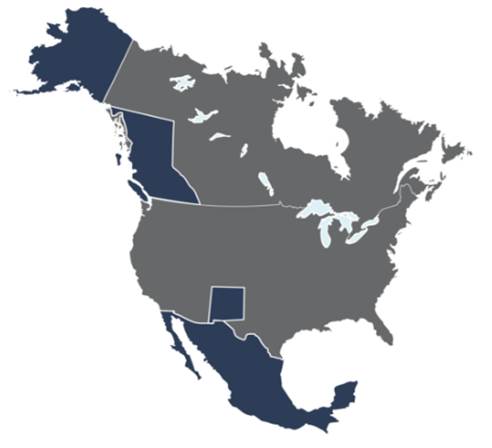
VANCOUVER, BRITISH COLUMBIA, January 29, 2019 – Millrock Resources Inc. (TSX-V: MRO, OTCQX: MLRKF) (“Millrock” or the “Company”) reports that results from a drilling program completed at the La Navidad gold project in Sonora State, Mexico have been received. The program focused on the northwestern portion of the project. Four holes were drilled at El Tigre prospect, where gold had been detected by soil sampling in the vicinity of historic mine workings. The drill holes tested induced polarization geophysical anomalies and northwest-trending high-angle structures that appear to control mineralization observed at surface. Four further holes tested El Chupadero prospect where alteration (decalcification and jasperoid replacement of limestone) pointed to the possibility of an intrusion-related gold deposit. In total, eight holes totaling 1,844 meters were drilled in the program. The exploration work was funded under an option to joint venture agreement by Centerra Gold Inc. (“Centerra”).
The drilling results were generally disappointing. Only a few weakly anomalous gold values were returned. The alteration and mineralization observed at surface appear to weaken in the subsurface. It does not appear that further exploration work on these prospects is warranted.
Millrock has received notification from Centerra that it is terminating the option to joint venture agreements on both La Navidad and El Picacho gold projects.
Millrock President & CEO Gregory Beischer stated “Millrock thanks Centerra for the investment they made in advancing these projects. While Centerra has elected to leave, we strongly believe the projects have excellent technical merit. We think they will be attractive to mid-tier or smaller mining companies. Our intention is to seek out new funding partners, but at the same time we will have to balance the cost to hold to La Navidad and El Picacho concessions in the face of Millrock’s currently limited cash position.” 

Corporate Developments:
PolarX Shares and Cash Position

Millrock recently sold 10 million PolarX shares for A$475,000. While Millrock continues to be a strong believer in the Alaska Range Project, given Millrock’s relatively weak cash position it made sense to sell the shares. Millrock continues to be entitled to a production royalty, an advanced minimum royalty, and certain milestone payments.
Gregory Beischer, Millrock President and CEO stated, “Equity markets continue to be very tight. Millrock has to be extremely careful with its remaining funds. Management is cutting costs in all ways possible while the technical team works diligently to secure new funding partners. It is management’s view that securing new partnerships will be the best way for the Company to reduce overhead costs. The Company has an excellent portfolio of gold and copper projects but there is a cost to hold un-partnered projects until new partners are secured. Given the continued weakness of Millrock’s cash position (approximately C$790,000, as of today’s date, net of near-term accounts receivable and payable), the Company is considering all possible alternatives to move forward, including divestiture of Mexico projects and other assets.”
Quality Control – Quality Assurance
Millrock adheres to stringent Quality Assurance – Quality Control (“QA/QC”) standards. For the La Navidad drill program drill core samples were kept in a secure location at all times. Rock samples were assayed at the Bureau Veritas laboratory in Hermosillo, Mexico. Preparation and analysis methods are described in further detail here. The sample preparation method code being utilized for the current rock sampling program was PRP70-250. Analysis methods used include FA430 (30 gr/Fire Assay/ICP) and AQ-200 (Aqua Regia – ICP/MS). For every 20 rock samples a blank sample known to contain less than 3 parts per billion gold or a standard sample (Certified Reference Materials) of known gold concentration, or a duplicate sample was also analyzed. The qualified person is of the opinion that the results received from the laboratory for the samples in collected in this drill program are reliable.
Qualified Person
The scientific and technical information disclosed within this document has been prepared, reviewed and approved by Gregory A. Beischer, President, CEO and a director of Millrock Resources. Mr. Beischer is a qualified person as defined in NI 43-101.
About Millrock Resources Inc.
Millrock Resources Inc. is a premier project generator to the mining industry. Millrock identifies, packages and operates large-scale projects for joint venture, thereby exposing its shareholders to the benefits of mineral discovery without the usual financial risk taken on by most exploration companies. The company is active in Alaska, the southwest USA and Sonora State, Mexico. Funding for drilling at Millrock’s exploration projects is primarily provided by its joint venture partners. Business partners of Millrock have included some of the leading names in the mining industry: Centerra Gold, First Quantum, Teck, Kinross, Vale, Inmet, Altius, and Riverside. Millrock is a major shareholder of junior explorer Sojourn Exploration Inc.
ON BEHALF OF THE BOARD
“Gregory Beischer”
Gregory Beischer, President & CEO
FOR FURTHER INFORMATION, PLEASE CONTACT:
Melanee Henderson, Investor Relations
(604) 638-3164
(877) 217-8978 (toll-free)
Some statements in this news release contain forward-looking information (within the meaning of Canadian securities legislation) including, without limitation, the statement thatis management’s view that securing new partnerships will be the best way for the Company to reduce overhead costs. These statements address future events and conditions and, as such, involve known and unknown risks, uncertainties and other factors which may cause the actual results, performance or achievements to be materially different from any future results, performance or achievements expressed or implied by the statements. Such factors include, without limitation, the ability of Millrock to negotiate agreements with third parties to fund exploration programs on terms beneficial to the Company.

Copyright © 2019 Millrock Resources, All rights reserved.
You are receiving this email because you opted in to our mailing list.
Our mailing address is:

Millrock Resources

Suite 2300 – 1177 West Hastings St.

VancouverBc V6E2K3

Canada

Add us to your address book

Categories
Blog

CHRIS MARCUS Russia To Respond to U.S. Sanctions By Buying Bitcoin?

More blowback to U.S. Sanctions. As Russia is reportedly responding by further moving towards cryptos and less dollar reliance.
What does this mean for the dollar? And for the cryptocurrency market?
To find out, click to watch the video now!

Chris Marcus
Arcadia Economics

“Helping You Thrive While We Watch The Dollar Die”
www.ArcadiaEconomics.com
 

Categories
Blog

BOB MORIARTY When The Fed Reinstates QE-Infinity You Are Going To Want To Own Precious Metals

Bob Moriarty

 
Original Source: https://bit.ly/2FT3LF3

The last time Bob and I spoke global equity markets were coming unhinged and he very calmly stated that he thought there was a very good chance of a stock market rally starting very soon. As it turns out he was right, within a couple of days only because markets were closed on Christmas Day. Stock have essentially rallied non-stop for the last month and Bob now thinks the dead-cat bounce is about to come to an end. He also has some interesting thoughts on the global debt bubble that is about to pop and the government shutdown that just ended in the U.S. Without further ado here is Energy & Gold’s January 2019 conversation with 321gold founder Bob Moriarty…
 
Goldfinger: We’ve seen a nice move up in precious metals since the last time we spoke (Christmas Eve) and gold is currently knocking on the door of important resistance near $1300. Gold mining shares have also spent the last few weeks undergoing a healthy consolidation. What do you see for precious metals and mining stocks right now?
Bob Moriarty: I think that gold is the antithesis of the stock market right now. When stocks went down in December gold went up and two Fridays ago we saw gold get dinged about 1% while stocks rallied. I think a lot of smart people are sensing a crash is right around the corner and I think that gold and gold mining shares will soar when the stock bubble pops.
Goldfinger: We’ve received quarterly earnings reports for many of the world’s largest mining companies and generally speaking they have been quite poor; BHP disappointed, Freeport lowered guidance, Barrick didn’t impress with higher than expected costs, etc. We are starting to see a trend of increasing costs across the mining sector – even a massive miner like Barrick Gold reported US$3.00 per pound all-in sustaining costs (AISC) for copper production which means that Barrick is losing money mining copper on an all-in cost basis. While their cash costs are considerably lower (around US$2.00/lb) which means they won’t be reducing production anytime soon, the fact is that many global copper producers aren’t really incentivized to find new sources of copper production with copper prices sitting at US$2.65/lb.
Bob Moriarty: Here’s the deal, prices go from extreme highs to extreme lows. The prices of commodities will often go below the cost of production and people will shut projects down which will help commodity prices go back up again. The cost of labor has gone up while grades keep dropping, this explains why costs keep rising. Now when I see a price of copper of US$2.65/lb and I see all-in sustaining costs of US$3/lb I know we’re near a low.
Goldfinger: Considering the growing demand for electric vehicles and the rewiring of the global energy grid the future looks particularly bright for copper right now, however, you wouldn’t have guessed that by looking at the copper price chart:
The world is going to need a lot more copper over the next couple of decades. If Barrick can’t even mine the stuff profitably where are we going to find new sources of economic copper? Or I guess another way to ask that question is why aren’t copper prices a lot higher?
Bob Moriarty: It’s pretty clear to me that resource prices will have to move a lot higher and that would include base metals like copper and zinc. If copper prices remain below US$3/lb we simply won’t have enough supply to meet demand and prices will skyrocket higher in a very short period of time.
Goldfinger: Do you have any comments on the big gold producer mergers we have seen recently (Barrick and Randgold, Goldcorp and Newmont)? Do these mega-mergers have any impact upon the juniors and are we likely to see even more M&A within the gold sector in 2019?
Bob Moriarty: In general this trend is good for the juniors because the majors do not have exploration departments anymore, most of their new projects have to come from juniors. If metals prices go the way I think they will this year we will see more and more M&A throughout the year. You have to remember that majors like to acquire exploration & developments projects when prices are high and/or rising – nobody is going to make a big copper project acquisition at $2.65/lb but you can be certain that at $3.65/lb we will have more takeovers.
Goldfinger: One of my themes for 2019 is outperformance by the mid-tier gold producers and developers. One of the key catalysts to drive this outperformance should be M&A, with majors acquiring the most attractive mid-tiers while we will see mid-tiers combining with one another to create larger companies that will be treated better by the market, due to increased synergies and better cost structures.
Do you agree that we will see a lot of consolidation among mid-tiers in 2019?
Bob Moriarty: There has to be more consolidation in the sector, they have no choice. When you mine you are constantly consuming your young so you either have to explore and make new discoveries to replace the ounces you’re producing (read consuming) or you have to use M&A to replace reserves. Right now we aren’t seeing much exploration and certainly not much exploration success so the mid-tiers and majors have no choice but to merge with one another.
The big mergers that we’ve seen are also designed to make the companies more efficient and to lower costs per ounce. They should be more efficient and they should have lower costs, it’s not excusable for a major gold mining company to have all-in costs of over US$1,200 per ounce.
Goldfinger: The CEOs of Barrick and Newmont have stated publicly that they are no longer in the business of growth at all costs, they are going to manage their companies with an eye to the bottom line and clearly these recent mega-mergers help to achieve that objective.
Bob Moriarty: One of things that I don’t hear mentioned very often is that since 2007 the financial mismanagement by the global central banks has caused so many whipsaws in commodity prices that it has made it very hard to run a large commodity producer. How can you run an oil company when oil is $140 one day and then $35 the next day?
We need to get back to financial sanity and I believe we are seeing the gold mining sector get back to financial sanity with a focus on the bottom line.
Goldfinger: At the end of 2018 we had a brief stock market panic, let’s call it the Christmas Eve 2018 panic, you had been calling for a market crash and while I wouldn’t call it a crash it was definitely a serious panic. Is that it? Or was that just a tremor before the real crash happens?
Bob Moriarty: The last time we spoke I predicted a turnaround in stocks and then I wrote a post stating as much on Christmas Eve. Stocks have basically moved straight up for the last month and I still believe we have a monster crash coming. It could start next week or 1-2 months from now, but it is coming. December was the end of the beginning, we’ve just seen the previews of the real movie. The financial system is so warped that when the crash comes it’s going to the greatest financial tsunami in history. The action since Christmas Eve up until now is just a dead-cat bounce which helps to build up some more complacency before the real downturn begins.
Goldfinger: It’s more evident than ever to me that we are in a central bank controlled financial system and this was clearly evident when the Fed quickly backpedaled after New Year’s indicating they would be “patient” with regard to any further rate hikes. The market took this to mean that there wouldn’t be another hike for at least six months and that any hike would be well telegraphed far in advance.
Meanwhile, we’re seeing a lot of evidence that global economic growth has been deteriorating and there are few indications that this trend will change anytime soon. Precious metals and gold in particular could be in a sweet spot as global central banks begin easing (after a couple years of tightening via rate hikes and balance sheet shrinkage) against the backdrop of weakening economic growth and an unusually daunting set of global macro uncertainties. Price action in precious metals has also been quite constructive since August of last year while sentiment has remained relatively muted and institutional exposure to gold and silver continues to be virtually non-existent.
With the US dollar looking like it’s about to turn lower after a strong performance in 2018, gold in US dollar terms is poised to perform exceptionally well in 2019. It feels like conditions are ripe for a stellar year for precious metals in 2019.
Bob Moriarty: I think you’re onto something there and there’s some data that’s shown that gold has been making record highs in almost every other currency other than the US dollar. What I see happening is the stock market beginning to crash in the next couple of months which will cause the Fed to panic and reimplement QE-infinity which will weigh heavily on the dollar and in turn turbo-charge precious metals and other hard assets.
There are tremendous forces building up across the world right now that will eventually result in a massive explosion. Let me give you an example, I just wrote a piece about the yellow vests in France. Did you know that there are now protests going on in more than 30 countries around the world? Yellow vest protests.
Goldfinger: No, I didn’t know that. The Gilets-Jaunes (yellow vests) are a symptom of a bigger problem. The elite and ruling classes have ripped off the system and left the common working class people paying for their excesses and the excesses of central banks that they have managed to profit from.
What do you think about the FBI dawn raid and arrest of Roger Stone?
Bob Moriarty: We’re in never never land, we’ve got the FBI and the DOJ trying to say who the President of the United States should be. This is treason being carried about by government law enforcement agencies. This is the most bizarre thing in American history, i’ve never seen anything like it. And then you have incidences like the one with the Kentucky high school kids at the Lincoln Memorial where the leftists and left-stream media are trying to completely distort reality and it can only end in tragedy. There is going to be a revolution/civil war in the United States and it is going to spread worldwide. There are yellow vest protests in China and Poland and around the world. They’re even protesting in Canada! Who the heck protests in Canada?!!
Goldfinger: Trump caved in on the government shutdown last week after 35 days of shutting down the federal government. What was accomplished through this government shutdown and can Trump really build a wall via emergency order?
Bob Moriarty: Nothing at all. Trump tried to show Pelosi how much power he had and he did. He has next to none. The whole wall issue is a circus side show. We have had open borders for a hundred years and we somehow survived. Fifty years ago I would go dove hunting in Mexico and you could wave at the customs guys as you passed through.
Goldfinger: I read a statistic the other day that the US has US$122 Trillion of unfunded liabilities which equates to 564% of Fiscal 2018 GDP.  To fund these unfunded liabilities would require 10% of GDP for more than 56 years. The debt pile that has built up around the world, particularly in the US, is so large that it will never be repaid. I don’t think these massive government liabilities were ever meant to be repaid.
Bob Moriarty: You’re right, it will never be repaid and it was never intended to be repaid. When you were a kid did you ever blow up a balloon at a party?
Goldfinger: Yes, of course.
Bob Moriarty: I want you to imagine the biggest balloon you’ve ever seen and you start blowing into it, you keep blowing into it, and it keeps expanding, what is going to eventually happen?
Goldfinger: Eventually it’s going to pop!
Bob Moriarty: No shit! If you understand balloons then you understand debt bubbles. You can keep blowing into that balloon but you can be sure that if you keep blowing into it then it’s going to pop. The same way that if we keep inflating the debt bubble you can be sure that it’s going to pop one day and the consequences will be like nothing you or I have ever seen before. One day grandma is going to go try to cash her social security check and the bank is going to tell her the check bounced. Want to see a panic? That will be a real panic.
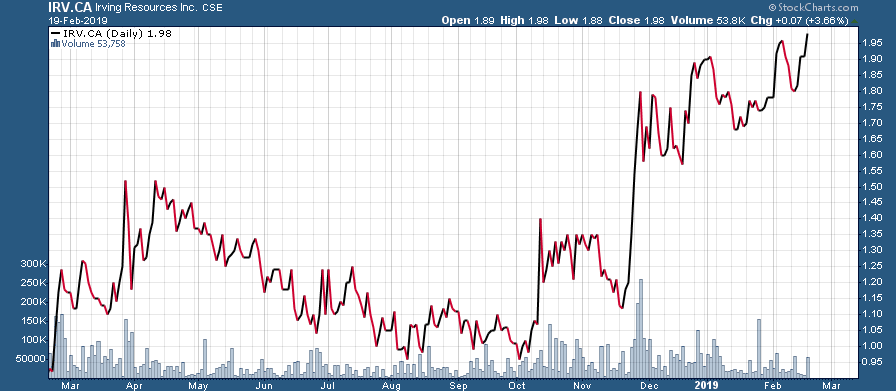
Goldfinger: One more topic before we wrap up, we’ve talked about a few companies recently including Westhaven Ventures (TSX-V:WHN), Irving Resources (CSE:IRV), and Novo Resources (TSX-V:NVO). Do you have any comments or updates on these stories?
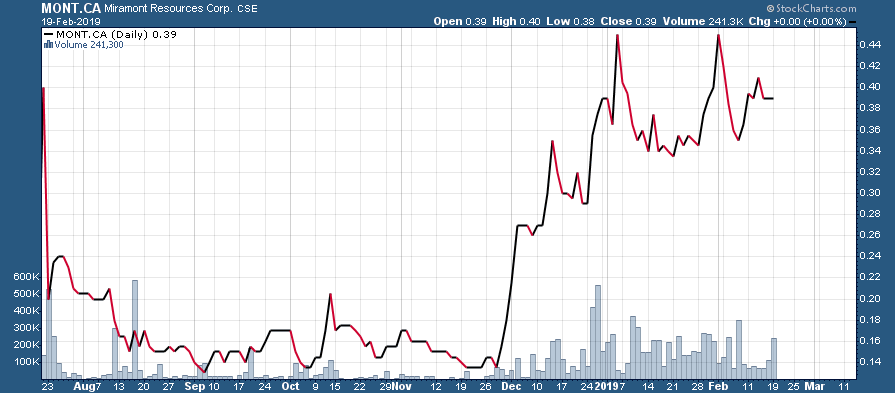
Bob Moriarty: Novo is everything i’ve been saying for the last six years and they are making wonderful progress. Novo CEO Quinton Hennigh is also Chairman of the Board of a company called Miramont (CSE:MONT) that literally just started drilling some attractive targets in Peru and that one is going to be a home run. Quinton is also involved with Irving Resources and they are about to start drilling on Hokkaido Island in Japan.
Westhaven delivered some nice intercepts recently and notwithstanding the short term market gyrations I believe that Shovelnose is a great project that will eventually be a mine.
Goldfinger: So Irving is about to start drilling within the next couple of weeks?
Bob Moriarty: Yes, and they will announce it to the market when they do begin.
Goldfinger: I posted a couple of charts of gold and silver recently illustrating a positive outlook for both metals. What is sentiment telling you here? Is there room for silver to get up to $17 and gold up above $1350 before we have the next correction?
 
Gold (Weekly)

 
Silver (Weekly)

Bob Moriarty: I’m ok at predicting price direction but hopeless at predicting price. We have had a bottom in silver, gold and platinum. Palladium has gotten pretty toppy. If and when the Fed reinstates QE, you are going to want to hold precious metals.
 
Well that sums it up succinctly; we’ve made a bottom in precious metals and the growing global debt tsunami increasingly makes precious metals a compelling asset for investors to hold. Bob doesn’t proclaim to be a market timer, nevertheless his calls at key market turning points are among the best i’ve ever seen. I believe him when he says the dead-cat bounce in large cap US equities is coming to an end very soon. As always, we’d like to thank Bob for his time and insights. Until next time…
 
Disclaimer:
The article is for informational purposes only and is neither a solicitation for the purchase of securities nor an offer of securities. Readers of the article are expressly cautioned to seek the advice of a registered investment advisor and other professional advisors, as applicable, regarding the appropriateness of investing in any securities or any investment strategies, including those discussed above. Some of the stocks mentioned are high-risk venture stocks and not suitable for most investors. Consult the companies’ SEDAR profile for important risk disclosures.
EnergyandGold.com, EnergyandGold Publishing LTD, its writers and principals are not registered investment advisors and advice you to do your own due diligence with a licensed investment advisor prior to making any investment decisions.
This article contains certain forward-looking information and forward-looking statements within the meaning of applicable securities legislation (collectively “forward-looking statements”). Certain information contained herein constitutes “forward-looking information” under Canadian securities legislation. Generally, forward-looking information can be identified by the use of forward-looking terminology such as “expects”, “believes”, “aims to”, “plans to” or “intends to” or variations of such words and phrases or statements that certain actions, events or results “will” occur. Forward-looking statements are based on the opinions and estimates of management as of the date such statements are made and they are subject to known and unknown risks, uncertainties and other factors that may cause the actual results, level of activity, performance or achievements of the Company to be materially different from those expressed by such forward-looking statements or forward-looking information, standard transaction risks; impact of the transaction on the parties; and risks relating to financings; regulatory approvals; foreign country operations and volatile share prices. Although management of the Company has attempted to identify important factors that could cause actual results to differ materially from those contained in forward-looking statements or forward-looking information, there may be other factors that cause results not to be as anticipated, estimated or intended. There can be no assurance that such statements will prove to be accurate, as actual results and future events could differ materially from those anticipated in such statements. Actual results may differ materially from those currently anticipated in such statements. The views expressed in this publication and on the EnergyandGold website do not necessarily reflect the views of Energy and Gold Publishing LTD, publisher of EnergyandGold.com. Accordingly, readers should not place undue reliance on forward-looking statements and forward looking information. The Company does not undertake to update any forward-looking statements or forward-looking information that are incorporated by reference herein, except as required by applicable securities laws. Always thoroughly do your own due diligence and talk to a licensed investment adviser prior to making any investment decisions. Junior resource companies can easily lose 100% of their value so read company profiles on www.SEDAR.com for important risk disclosures. It’s your money and your responsibility.

Categories
Junior Mining

ALLEGIANT Reports Commencement of Drilling at its Monitor Hills Gold Project

VANCOUVER, British Columbia, Jan. 29, 2019 (GLOBE NEWSWIRE) — Allegiant Gold Ltd. (“ALLEGIANT”) (AUAU:TSX-V) (AUXXF:OTCQX) is pleased to report that drilling has commenced at its Monitor Hills gold project in Nevada. ALLEGIANT is drilling a total of six “discovery potential” projects located principally in the world-class gold mining jurisdiction of Nevada, over a 10-12-month period to approximately June 2019. The drilling campaign was initiated at the Red Hills project in August 2018; Monitor Hills is the 4th project to be drilled.

Monitor Hills is 100% owned by ALLEGIANT and is located approximately 35km east-southeast of Tonopah, Nevada. ALLEGIANT began drilling at Monitor Hills in late January 2019; 10-12 rotary drill holes, totaling up to 2,150 meters are planned. Drilling is focused on geochemical gold anomalies determined by surface sampling.

ALLEGIANT performed detailed geologic mapping, completed grid geochemical surveys, and collected over 250 samples of outcrop and float at Monitor Hills. Surface sampling identified eight new target areas where gold values in outcrop exceed 1 g/t gold. Several gold anomalies (values from 20-245 ppb gold) were identified in mostly covered areas that are up to 300 metres long and 100 metres wide.

The target at Monitor Hills is Carlin-type gold mineralization in Cambrian and Ordovician sedimentary rocks. Gold occurs in replacement silicification (jasperoid) of carbonate rocks, or along iron-stained fault zones. The mineralized faults trend mainly north, but northeast and northwest trending structures are also mineralized. A buried Tertiary diorite intrusive body, believed to be shallow under blow sand and sand dunes, occurs just west and southwest of the claim block.

A geology map showing the location of proposed drill sites can be viewed at the following link:

www.allegiantgold.com/nr/2019-01-29-map.pdf

Qualified Person
Andy Wallace is a Certified Professional Geologist (CPG) with the American Institute of Professional Geologists and is a Qualified Person as defined under National Instrument 43-101 – Standards of Disclosure for Mineral Projects. Mr. Wallace has reviewed and approved the technical content of this press release.

ABOUT ALLEGIANT
ALLEGIANT owns 100% of 12 highly-prospective drill-ready gold projects in the United States, 9 of which are located in the mining-friendly jurisdiction of Nevada. ALLEGIANT is one of the most active explorers in the gold sector; three projects with “discovery” potential have been drilled since August 2018, and at least four more are planned to be drilled in 2019. ALLEGIANT’s flagship Eastside project hosts a large and expanding gold resource, is district scale, and is located in an area of excellent infrastructure. Preliminary metallurgical testing indicates that both oxide and sulphide gold mineralization at Eastside is amenable to heap leaching.

Further information regarding ALLEGIANT can be found at www.allegiantgold.com

ON BEHALF OF THE BOARD,

Robert F. Giustra
Chairman

For more information contact:

Investor Relations
(604) 634-0970 or
1-888-818-1364
ir@allegiantgold.com

Neither TSX Venture Exchange nor its Regulation Services Provider (as that term is defined in policies of the TSX Venture Exchange) accepts responsibility for the adequacy or accuracy of this release.

Certain statements and information contained in this press release constitute “forward-looking statements” within the meaning of applicable U.S. securities laws and “forward-looking information” within the meaning of applicable Canadian securities laws, which are referred to collectively as “forward-looking statements”. The United States Private Securities Litigation Reform Act of 1995 provides a “safe harbor” for certain forward-looking statements. Forward-looking statements are statements and information regarding possible events, conditions or results of operations that are based upon assumptions about future economic conditions and courses of action. All statements and information other than statements of historical fact may be forward-looking statements. In some cases, forward-looking statements can be identified by the use of words such as “seek”, “expect”, “anticipate”, “budget”, “plan”, “estimate”, “continue”, “forecast”, “intend”, “believe”, “predict”, “potential”, “target”, “may”, “could”, “would”, “might”, “will” and similar words or phrases (including negative variations) suggesting future outcomes or statements regarding an outlook. Forward-looking statements in this and other press releases include, but are not limited to statements and information regarding: Allegiant’s property holding costs savings or income generated from optioning out certain properties; Allegiant’s drilling and exploration plans for its properties, including anticipated costs and timing thereof; the potential of hosting good grade gold mineralization or expansion; Allegiant’s belief with respect to North Brown anomalies and the related transportation of mineralized fragments, including the discovery of the source of the mineralized breccia fragments; Allegiant’s plans for growth through exploration activities, acquisitions or otherwise; and expectations regarding future maintenance and capital expenditures, working capital requirements; and Barrian’s plan to complete an initial public offering and its acquisition of certain properties. Such forward-looking statements are based on a number of material factors and assumptions and involve known and unknown risks, uncertainties and other factors which may cause actual results, performance or achievements, or industry results, to differ materially from those anticipated in such forward-looking information. You are cautioned not to place undue reliance on forward-looking statements contained in this press release. Some of the known risks and other factors which could cause actual results to differ materially from those expressed in the forward-looking statements are described in the sections entitled “Risk Factors” in Allegiant’s Listing Application, dated January 24, 2018, as filed with the TSX Venture Exchange and available on SEDAR under Allegiant’s profile at www.sedar.com. Actual results and future events could differ materially from those anticipated in such statements. Allegiant undertakes no obligation to update or revise any forward-looking statements included in this press release if these beliefs, estimates and opinions or other circumstances should change, except as otherwise required by applicable law.