Categories
Blog

JAYANT BHANDARI Avoid Commodity Price Speculation; and about Resource Stocks

Maritime Resources (MAE)

I have never met anyone who succeeds in speculating in commodities. Most commodity speculatorscome to believe in the bright future of a certain commodity using oft-repeated slogans and soundbites entering a sort of trance and calling themselves contrarians while staying in the emotional “safety” of their echo chamber. And then the situation gets worse, much worse. They then “invest” in mining companies for leverage. This is a very dangerous cocktail, something that is responsible for so many people losing their homes and making the mining industry a loss-making sector of the economy.
I spoke on the above at the recently held Vancouver Resource Investment Conference (VRIC). Here is a discussion, I had with Fergus Hodgson on the same theme:

On investments…
Maritime Resources (MAE; C$0.09) has done a pre-feasibility study (PFS) on a small, high-grade deposit they have in Newfoundland. Last year, Anaconda Mining made a failed attempt to takeover MAE. In the same area as that of MAE is another company, Rambler Metals. According to their PFS, MAE is expected to use the process plant of Rambler Metals.
A few months back, Sprott Capital Partners and Dundee Resources financed MAE at C$0.11 per unit. Since then the index of early-stage mining companies has gone up nicely, but MAE has stagnated.
MAE has a market capitalization of C$12 million. It has C$2.5 million in cash. Based on my calculations there is an easy 50% upside in owning MAE. There is also enough evidence that the project can be looked at differently than it has been in the PFS, to improve the economics. Moreover, the company changed its management last week, an event that went unnoticed by the market. The new management will likely find it easier to give another look at a merger with Anaconda. Perhaps they should also invite Rambler to the negotiation table.
The combined market capitalization of the above three companies is less than C$100 million. There should be a lot of synergies—operational, scheduling, tax-related, and in terms of financing required for the projects—in combining the three companies. Just the savings in administrative expenses will be huge. If such a merger happens, there is extra money to be made in owning MAE.
On other matters…
In my view, the US is lucky to have Trump as its President. The US is one of the best countries in the world, but there are forces at play—given democracy and the resulting rapid rise of culturally Marxist values in the institutions—that means that Trump can succeed in only delaying the degradation of the US. As Doug Casey says “America” is an idea whose home has so far been the US.
Next month, I will be speaking at PDAC, on how East Asia is the future of humanity. This is not just about economic growth, which I see continuing to happen, but more importantly about how the idea of America and the western civilization is setting its roots in East Asia.
Warm regards,

Jayant Bhandari

Associate: Rajni Bala

Disclaimer: All information found here, including any ideas, opinions, views, predictions, forecasts, commentaries, suggestions, or stock picks, expressed or implied herein, are for informational, entertainment or educational purposes only and should not be construed as personal investment advice. While the information provided is believed to be accurate, it may include errors or inaccuracies. The sole purpose of these musings is to show my thinking process when analyzing a stock, not to provide any recommendation. I will not and cannot be held liable for any actions you take as a result of anything you read here. Conduct your own due diligence, or consult a licensed financial advisor or broker before making any and all investment decisions. Any investments, trades, speculations, or decisions made on the basis of any information found on this site, expressed or implied herein, are committed at your own risk, financial or otherwise.

Categories
Blog

MARITIME Announces Board and Management Changes

Vancouver, British Columbia–(Newsfile Corp. – February 1, 2019) – Maritime Resources Corp. (TSXV: MAE) (“Maritime”) announced that effective January 31, 2019 the following board and management changes have occurred to reflect the continued evolution and development of Maritime as it works to further advance the high-grade Hammerdown gold project and its Whisker and Orion exploration projects in Newfoundland:

  • Mr. Douglas Fulcher will no longer serve as Maritime’s President and Chief Executive Officer and has resigned as a member of the board;
  • Mr. Andrew Pooler will no longer serve as Maritime’s Chief Operating Officer and has resigned as a member of the board; and
  • Mr. Garett Macdonald, currently a member of the board, will serve as Maritime’s President and Chief Executive Officer.

Maritime’s Chairman, Mr. John Hayes, stated, “I would like to thank Doug and Andrew, on behalf of Maritime and Maritime’s board, for their service as Maritime’s President and Chief Executive Officer and as Maritime’s Chief Operating Officer, respectively. The company has benefited from Doug’s efforts in guiding Maritime’s operations and has also benefitted from Andrew’s technical expertise as reflected in the progress the company has made to date on its projects.”

Mr. Hayes continued, “On behalf of Maritime and Maritime’s board, I would like to take this opportunity to welcome Garett as Maritime’s President and Chief Executive Officer. With his diverse and extensive engineering experience in project development and mine operations, including both open pit and narrow vein underground settings, the board believes that Garrett will provide the necessary technical and corporate leadership to Maritime as the company examines and advances development opportunities at Hammerdown. His innovation and commercial focus have earned him the reputation for producing results which will benefit Maritime at this important stage in its history and in the development of the company’s projects.”

About Maritime Resources Corp:

Maritime Resources holds a 100% interest in the Green Bay Property, located near Springdale, Newfoundland and Labrador, Canada.

On behalf of the Board of Directors,

John Hayes
Chairman

For further information, please call: 
John Hayes
Telephone: 1-866-991-7004
info@maritimeresourcescorp.co

The TSX Venture Exchange does not accept responsibility for the adequacy or accuracy of this release. Statements in this press release, other than purely historical information, including statements relating to the Company’s future plans and objectives or expected results, may include forward-looking statements. Forward-looking statements are based on numerous assumptions and are subject to all of the risks and uncertainties inherent in resource exploration and development. As a result, actual results may vary materially from those described in the forward-looking statements

Caution Regarding Forward Looking Statements:

Certain information included in this press release, including information relating to future financial or operating performance and other statements that express the expectations of management or estimates of future performance constitute “forward-looking statements”. Such forward-looking statements include, without limitation, statements regarding copper, gold and silver forecasts, the financial strength of the Company, estimates regarding timing of future development and production and statements concerning possible expansion opportunities for the Company. Where the Company expresses or implies an expectation or belief as to future events or results, such expectation or belief are based on assumptions made in good faith and believed to have a reasonable basis. Such assumptions include, without limitation, the price of and anticipated costs of recovery of, copper concentrate, gold and silver, the presence of and continuity of such minerals at modeled grades and values, the capacities of various machinery and equipment, the availability of personnel, machinery and equipment at estimated prices, mineral recovery rates, and others. However, forward-looking statements are subject to risks, uncertainties and other factors, which could cause actual results to differ materially from future results expressed, projected or implied by such forward-looking statements. Such risks include, but are not limited to, interpretation and implications of drilling and geophysical results; estimates regarding timing of future capital expenditures and costs towards profitable commercial operations. Other factors that could cause actual results, developments or events to differ materially from those anticipated include, among others, increases/decreases in production; volatility in metals prices and demand; currency fluctuations; cash operating margins; cash operating cost per pound sold; costs per ton of ore; variances in ore grade or recovery rates from those assumed in mining plans; reserves and/or resources; the ability to successfully integrate acquired assets; operational risks inherent in mining or development activities and legislative factors relating to prices, taxes, royalties, land use, title and permits, importing and exporting of minerals and environmental protection. Accordingly, undue reliance should not be placed on forward-looking statements and the forward-looking statements contained in this press release are expressly qualified in their entirety by this cautionary statement. The forward-looking statements contained herein are made as at the date hereof and the Company does not undertake any obligation to update publicly or revise any such forward-looking statements or any forward-looking statements contained in any other documents whether as a result of new information, future events or otherwise, except as required under applicable security law.

To view the source version of this press release, please visit https://www.newsfilecorp.com/release/42598

Categories
Blog

GRANITE CREEK COPPER Appoints Mathew Lee as Chief Financial Officer

VANCOUVER, British Columbia, Feb. 01, 2019 (GLOBE NEWSWIRE) — Granite Creek Copper Ltd. (GCX.V(“Granite Creek” or the “Company”) announces the appointment of Mr. Mathew Lee to the role of Chief Financial Officer (“CFO”), effective immediately.

Mr. Lee is a Chartered Accountant with a Bachelor of Commerce Degree from the University of British Columbia and is a member of the Chartered Professional Accountants of British Columbia. Mr. Lee brings broad depth of financial experience in both public and private company operations across various sectors, including mineral resources and financial services. Mr. Lee replaces Mr. Michael Rowley who has stepped down from his role as CFO for Granite Creek in order to concentrate on his responsibilities as President and CEO of fellow Metallic Group company, Group Ten Metals. Mr. Rowley will continue as a Director of Granite Creek.

Mr. Timothy Johnson, President and CEO, stated, “We are very pleased to have Mr. Lee join Granite Creek and to take another positive step forward in developing our corporate team. The Company anticipates release of substantive, project-related updates over the coming weeks and sustained news flow with respect to the Stu Copper project and operational fundamentals.”

Granite Creek further announces it has granted 2,900,000 incentive stock options (the “Options”) to Directors, Officers, employees and consultants of the Company. The Options are exercisable for up to five years, expiring on February 1, 2024, and each Option will allow the holder to purchase one common share of the Company at a price of $0.15 per share, being the closing price of the previous trading day.

About Granite Creek Copper

Granite Creek is a newly-launched copper-focused exploration company. The Company’s flagship project is the 111 square kilometer Stu Copper project located in the Yukon’s Carmacks copper district, adjacent to Capstone Mining’s high-grade Minto Cu-Au-Ag mine and Copper North’s advanced-stage Carmacks Cu-Au-Ag project. More information about the company and the Stu Copper project can be viewed on the Company’s website at www.gcxcopper.com.

About the Metallic Group of Companies

The Metallic Group is a collaboration of leading precious and base metals exploration companies with a portfolio of large, brownfields assets in established mining districts adjacent to some of the industry’s highest-grade copper, silver, and platinum/palladium producers. Member companies include Granite Creek Copper (GCX.V) in the Yukon’s Carmacks copper district, Metallic Minerals (MMG.V) in the Yukon’s Keno Hill Silver District, and Group Ten Metals (PGE.V) in the Stillwater PGM-Ni-Cu district of Montana. Highly experienced management and technical teams at the Metallic Group have expertise across the spectrum of resource exploration and project development from initial discoveries to advanced development, including strong project finance and capital markets experience and have demonstrated a commitment to community engagement and environmental best practices. The founders and team members of the Metallic Group include highly successful explorationists formerly with some of the industry’s leading explorer/developers and major producers and are undertaking a systematic approach to exploration using new models and technologies to facilitate discoveries in these proven historic mining districts.

FOR FURTHER INFORMATION PLEASE CONTACT:

Timothy Johnson, President
Telephone:  1 (604) 235-1982 E-mail: info@gcxcopper.com
Toll Free:  1 (888) 361-3494 Website: www.gcxcopper.com
Metallic Group: www.metallicgroup.ca

Neither the TSX Venture Exchange nor its Regulation Services Provider (as that term is defined in the policies of the TSX Venture Exchange) accepts responsibility for the adequacy or accuracy of this release.

Categories
Blog

SPROTT’S THOUGHTS State Of The Union: The Art Of No Deal

State of the Union 2018. The White House from Washington, D.C. Wikimedia Commons.

The partial government shutdown barreled into Day 35 with no immediate end in sight. Airports in the northeastern U.S. announced major delays much to the dismay of travelers who meandered through the long lines at TSA checkpoints.
The FAA temporarily halted flights on the morning of Friday, Jan. 25, as regional air traffic control centers reported a staffing shortage. With more workers calling in sick at the nation’s airports, the threat of further disruption to the aviation system raised additional questions about security and the overall shutdown impact.
As furloughed federal employees missed their second paycheck, the worries mounted for many Americans. How long would the longest shutdown in history last? What are the long-term implications for the affected services? And will the strain on air travel result in perpetual delays?
The web sites for the affected federal agencies displayed the message: “Shutdown Due to Lapse of Congressional Appropriations.” As days extended into weeks, weeks surpassed a month, Americans were reminded of the extent of government involvement in the infrastructure of the nation.
The partial shutdown officially came to an end before the sun set on Friday, January 25. President Trump signed a bipartisan continuing resolution that concluded the longest shutdown in U.S. history. Yet, the action was a temporary stopgap measure that would reopen and fund the government until Feb. 15.
CHIPPING AWAY AT SENTIMENT
According to the Congressional Budget Office (CBO), the shutdown cost the U.S. economy an estimated $3 billion while the overall damage totaled $11 billion – although the majority of the latter estimate is expected to be recovered as federal workers return to work. The CBO estimates that the economy will lose 0.4% from the annual growth rate in Q1 2019.
Separately, S&P Global Ratings says the shutdown cost the nation’s economy an estimated $6 billion. Some critics were quick to point out that the costs to the U.S. economy surpassed Trump’s request for border funding security.
Meanwhile, the State of the Union did not be take place as scheduled on Tuesday, Jan. 29.  The Speaker of the House, Nancy Pelosi, invited Trump to deliver the SOTU on Feb. 5. With Trump’s acceptance, the annual event will take place a week later than originally scheduled.
Earlier this month, Danielle DiMartino Booth, CEO of Quill Intelligence, and former adviser to the President of the Dallas Federal Reserve, sat down with me. She weighed in on the partial U.S. government shutdown and its ramifications on the economy and stated that the drag on confidence and growth are detrimental:

Watch the Video

 
FEDERAL RESERVE OUTLOOK
The central bank’s January meeting came and went with the Fed indicating that rates won’t be rising soon. The FOMC announced no change in its benchmark rate with a continued pledge to be “patient.” All eyes and ears were on the statement issued by Fed Chair Jerome Powell in the post-announcement press conference. When asked if the Fed is on pause, Powell stated that “This patient period is going to depend on incoming data and its implications for the outlook.”
Danielle DiMartino Booth also graded the performance of Fed Chairman Jerome Powell since he has taken the helm. There is nothing like a progress report from the author of “Fed Up: An Insider’s Take on the Why the Federal Reserve is Bad for America.”

Watch the Video

 
With limited data being released by the government due to the partial shutdown it’s been difficult to assess the health of the economy. In January, several data points considered “primary” economic data were not published.
The Commerce Department’s Bureau of Economic Analysis did not release Q4 U.S. GDP data for 2018 as scheduled on January 30. The U.S. employment report for January is scheduled for release on Friday, Feb. 1.
One thing is for certain: disruption to “business as usual” is not favorable. But it is more concerning that this type of disruption does not seem to be backed by strategy for a new alternative order. As earnings season continues, the major technology and industrial companies are issuing guidance that are lower-than-expected. With bellwether firms easing back on forecasts it’s apparent that the shadows being cast on the global growth outlook could darken.
GOFUNDME: CROWDFUNDING FOR THE MODERN ERA
In the era of social media, online fundraising platforms and convenient electronic payments, the stories of assistance for federal contractors and furloughed workers during the shutdown are plentiful. It’s difficult not to grimace when hearing dire stories of Americans struggling to make ends meet and listening to some of the tone-deaf responses coming out from politicians.
If you’ve been paying close attention to some of the GoFundMe campaigns, you’re aware of some of the obscure and bizarre pages that have popped up. Some of the campaigns could be deemed as extreme, leading to many late-night comedians and pundits mocking the huge donations and how one can raise funds for just about anything. Of course publicity and hype can help direct eyeballs to certain campaigns.
The shutdown pain was immediate for those who missed their second paycheck and the pain spilled over into the U.S. economy. It can be surprising to see how quickly donations poured in for some GoFundMe campaigns but it is also a sign of the changing times. Social media and crowdfunding platforms have changed how citizens voice their support as well as opposition.
SHUTDOWN AFTERMATH
When the partial government shutdown finally came to an end, Americans let out a collective sigh of relief. Yet there are risk events on the horizon. The countdown clock is ticking for the major fiscal deadline of the debt ceiling on Mar. 1. Don’t forget that the that date also marks the hard deadline for a U.S.-China trade deal. The SOTU address may mark the dwindling days until another shutdown is avoided.
Many Americans hope that the 15th of February brings no surprises. There is nothing worse than the bite into the unexpected piece of unpalatable chocolate.
Forrest Gump is known for his famous quote, “My mom always said life was like a box of chocolates. You never know what you’re gonna get.”
Feb. 15 is the day after Valentine’s Day but love may not be in the air in Washington D.C. There are concerns that Shutdown 2.0 could become a reality. It is too soon to tell whether Trump and lawmakers will reach a compromise by the deadline or another standoff will commence. The President stated that if Democrats and Republicans can’t reach an agreement on border security, then he would bypass Congress for funding.
The stock market doesn’t like uncertainty and investors sure don’t like the accompanying instability. Yet, the Dow Industrials, S&P 500 and Nasdaq Composite settled higher in January. The major equity averages advanced over 7% for the month.
Shutdown 2.0 on the horizon? We will all have to wait and see if an agreement is negotiated and whether Congress passes another continuing resolution.
Read in browser »
share on Twitter Like State Of The Union: The Art Of No Deal on Facebook

Recent Articles:

Flawed Fundamentals Won’t Fly
Eric Sprott: “Are We Surprised Stocks Are Going Down? We Shouldn’t Be.”
Markets Admonish Fed: Powell Sends Stocks Tumbling
Ron Paul On The Coming Crisis: “Could Be Worse Than 1929”
Deal Or No Deal — 4 Signs Of Economic Trouble Ahead

Sprott U.S. Media, Inc. is a wholly owned subsidiary of Sprott Inc., which is a public company listed on the Toronto Stock Exchange and operates through its wholly-owned direct and indirect subsidiaries: Sprott Asset Management LP, an adviser registered with the Ontario Securities Commission; Sprott Private Wealth LP, an investment dealer and member of the Investment Industry Regulatory Organization of Canada; Sprott Global Resource Investments Ltd., a US full service broker-dealer and member FINRA/SIPC; Sprott Asset Management USA Inc., an SEC Registered Investment Advisor; and Resource Capital Investment Corp., also an SEC Registered Investment Advisor. We refer to the above entities collectively as “Sprott”.
The information contained herein does not constitute an offer or solicitation by anyone in any jurisdiction in which such an offer or solicitation is not authorized or to any person to whom it is unlawful to make such an offer or solicitation.
Forward-Looking Statement
This report contains forward-looking statements which reflect the current expectations of management regarding future growth, results of operations, performance and business prospects and opportunities. Wherever possible, words such as “may”, “would”, “could”, “will”, “anticipate”, “believe”, “plan”, “expect”, “intend”, “estimate”, and similar expressions have been used to identify these forward-looking statements. These statements reflect management’s current beliefs with respect to future events and are based on information currently available to management. Forward-looking statements involve significant known and unknown risks, uncertainties and assumptions. Many factors could cause actual results, performance or achievements to be materially different from any future results, performance or achievements that may be expressed or implied by such forward-looking statements. Should one or more of these risks or uncertainties materialize, or should assumptions underlying the forward-looking statements prove incorrect, actual results, performance or achievements could vary materially from those expressed or implied by the forward-looking statements contained in this document. These factors should be considered carefully and undue reliance should not be placed on these forward-looking statements. Although the forward-looking statements contained in this document are based upon what management currently believes to be reasonable assumptions, there is no assurance that actual results, performance or achievements will be consistent with these forward-looking statements. These forward-looking statements are made as of the date of this presentation and Sprott does not assume any obligation to update or revise.
Views expressed regarding a particular company, security, industry or market sector should not be considered an indication of trading intent of any fund or account managed by Sprott. Any reference to a particular company is for illustrative purposes only and should not to be considered as investment advice or a recommendation to buy or sell nor should it be considered as an indication of how the portfolio of any fund or account managed by Sprott will be invested.
Past performance does not guarantee future results. The views and opinions expressed herein are those of the author’s as of the date of this commentary, and are subject to change without notice. This information is for information purposes only and is not intended to be an offer or solicitation for the sale of any financial product or service or a recommendation or determination by Sprott Global Resource Investments Ltd. that any investment strategy is suitable for a specific investor. Investors should seek financial advice regarding the suitability of any investment strategy based on the objectives of the investor, financial situation, investment horizon, and their particular needs. This information is not intended to provide financial, tax, legal, accounting or other professional advice since such advice always requires consideration of individual circumstances. The products discussed herein are not insured by the FDIC or any other governmental agency, are subject to risks, including a possible loss of the principal amount invested.
Generally, natural resources investments are more volatile on a daily basis and have higher headline risk than other sectors as they tend to be more sensitive to economic data, political and regulatory events as well as underlying commodity prices. Natural resource investments are influenced by the price of underlying commodities like oil, gas, metals, coal, etc.; several of which trade on various exchanges and have price fluctuations based on short-term dynamics partly driven by demand/supply and also by investment flows. Natural resource investments tend to react more sensitively to global events and economic data than other sectors, whether it is a natural disaster like an earthquake, political upheaval in the Middle East or release of employment data in the U.S. Low priced securities can be very risky and may result in the loss of part or all of your investment.  Because of significant volatility,  large dealer spreads and very limited market liquidity, typically you will  not be able to sell a low priced security immediately back to the dealer at the same price it sold the stock to you. In some cases, the stock may fall quickly in value. Investing in foreign markets may entail greater risks than those normally associated with domestic markets, such as political, currency, economic and market risks. You should carefully consider whether trading in low priced and international securities is suitable for you in light of your circumstances and financial resources. Past performance is no guarantee of future returns. Sprott Global, entities that it controls, family, friends, employees, associates, and others may hold positions in the securities it recommends to clients, and may sell the same at any time.
Copyright © 2019 Sprott US Media, All rights reserved.
You are receiving this email because you requested information about the Sprott Group.
Our mailing address is:

Sprott US Media

1910 Palomar Point Way Ste 200

CarlsbadCA 92008-5578

Add us to your address book

Categories
Blog

CHRIS MARCUS Russia To Respond to U.S. Sanctions By Buying Bitcoin?

More blowback to U.S. Sanctions. As Russia is reportedly responding by further moving towards cryptos and less dollar reliance.
What does this mean for the dollar? And for the cryptocurrency market?
To find out, click to watch the video now!

Chris Marcus
Arcadia Economics

“Helping You Thrive While We Watch The Dollar Die”
www.ArcadiaEconomics.com
 

Categories
Blog

BOB MORIARTY When The Fed Reinstates QE-Infinity You Are Going To Want To Own Precious Metals

Bob Moriarty

 
Original Source: https://bit.ly/2FT3LF3

The last time Bob and I spoke global equity markets were coming unhinged and he very calmly stated that he thought there was a very good chance of a stock market rally starting very soon. As it turns out he was right, within a couple of days only because markets were closed on Christmas Day. Stock have essentially rallied non-stop for the last month and Bob now thinks the dead-cat bounce is about to come to an end. He also has some interesting thoughts on the global debt bubble that is about to pop and the government shutdown that just ended in the U.S. Without further ado here is Energy & Gold’s January 2019 conversation with 321gold founder Bob Moriarty…
 
Goldfinger: We’ve seen a nice move up in precious metals since the last time we spoke (Christmas Eve) and gold is currently knocking on the door of important resistance near $1300. Gold mining shares have also spent the last few weeks undergoing a healthy consolidation. What do you see for precious metals and mining stocks right now?
Bob Moriarty: I think that gold is the antithesis of the stock market right now. When stocks went down in December gold went up and two Fridays ago we saw gold get dinged about 1% while stocks rallied. I think a lot of smart people are sensing a crash is right around the corner and I think that gold and gold mining shares will soar when the stock bubble pops.
Goldfinger: We’ve received quarterly earnings reports for many of the world’s largest mining companies and generally speaking they have been quite poor; BHP disappointed, Freeport lowered guidance, Barrick didn’t impress with higher than expected costs, etc. We are starting to see a trend of increasing costs across the mining sector – even a massive miner like Barrick Gold reported US$3.00 per pound all-in sustaining costs (AISC) for copper production which means that Barrick is losing money mining copper on an all-in cost basis. While their cash costs are considerably lower (around US$2.00/lb) which means they won’t be reducing production anytime soon, the fact is that many global copper producers aren’t really incentivized to find new sources of copper production with copper prices sitting at US$2.65/lb.
Bob Moriarty: Here’s the deal, prices go from extreme highs to extreme lows. The prices of commodities will often go below the cost of production and people will shut projects down which will help commodity prices go back up again. The cost of labor has gone up while grades keep dropping, this explains why costs keep rising. Now when I see a price of copper of US$2.65/lb and I see all-in sustaining costs of US$3/lb I know we’re near a low.
Goldfinger: Considering the growing demand for electric vehicles and the rewiring of the global energy grid the future looks particularly bright for copper right now, however, you wouldn’t have guessed that by looking at the copper price chart:
The world is going to need a lot more copper over the next couple of decades. If Barrick can’t even mine the stuff profitably where are we going to find new sources of economic copper? Or I guess another way to ask that question is why aren’t copper prices a lot higher?
Bob Moriarty: It’s pretty clear to me that resource prices will have to move a lot higher and that would include base metals like copper and zinc. If copper prices remain below US$3/lb we simply won’t have enough supply to meet demand and prices will skyrocket higher in a very short period of time.
Goldfinger: Do you have any comments on the big gold producer mergers we have seen recently (Barrick and Randgold, Goldcorp and Newmont)? Do these mega-mergers have any impact upon the juniors and are we likely to see even more M&A within the gold sector in 2019?
Bob Moriarty: In general this trend is good for the juniors because the majors do not have exploration departments anymore, most of their new projects have to come from juniors. If metals prices go the way I think they will this year we will see more and more M&A throughout the year. You have to remember that majors like to acquire exploration & developments projects when prices are high and/or rising – nobody is going to make a big copper project acquisition at $2.65/lb but you can be certain that at $3.65/lb we will have more takeovers.
Goldfinger: One of my themes for 2019 is outperformance by the mid-tier gold producers and developers. One of the key catalysts to drive this outperformance should be M&A, with majors acquiring the most attractive mid-tiers while we will see mid-tiers combining with one another to create larger companies that will be treated better by the market, due to increased synergies and better cost structures.
Do you agree that we will see a lot of consolidation among mid-tiers in 2019?
Bob Moriarty: There has to be more consolidation in the sector, they have no choice. When you mine you are constantly consuming your young so you either have to explore and make new discoveries to replace the ounces you’re producing (read consuming) or you have to use M&A to replace reserves. Right now we aren’t seeing much exploration and certainly not much exploration success so the mid-tiers and majors have no choice but to merge with one another.
The big mergers that we’ve seen are also designed to make the companies more efficient and to lower costs per ounce. They should be more efficient and they should have lower costs, it’s not excusable for a major gold mining company to have all-in costs of over US$1,200 per ounce.
Goldfinger: The CEOs of Barrick and Newmont have stated publicly that they are no longer in the business of growth at all costs, they are going to manage their companies with an eye to the bottom line and clearly these recent mega-mergers help to achieve that objective.
Bob Moriarty: One of things that I don’t hear mentioned very often is that since 2007 the financial mismanagement by the global central banks has caused so many whipsaws in commodity prices that it has made it very hard to run a large commodity producer. How can you run an oil company when oil is $140 one day and then $35 the next day?
We need to get back to financial sanity and I believe we are seeing the gold mining sector get back to financial sanity with a focus on the bottom line.
Goldfinger: At the end of 2018 we had a brief stock market panic, let’s call it the Christmas Eve 2018 panic, you had been calling for a market crash and while I wouldn’t call it a crash it was definitely a serious panic. Is that it? Or was that just a tremor before the real crash happens?
Bob Moriarty: The last time we spoke I predicted a turnaround in stocks and then I wrote a post stating as much on Christmas Eve. Stocks have basically moved straight up for the last month and I still believe we have a monster crash coming. It could start next week or 1-2 months from now, but it is coming. December was the end of the beginning, we’ve just seen the previews of the real movie. The financial system is so warped that when the crash comes it’s going to the greatest financial tsunami in history. The action since Christmas Eve up until now is just a dead-cat bounce which helps to build up some more complacency before the real downturn begins.
Goldfinger: It’s more evident than ever to me that we are in a central bank controlled financial system and this was clearly evident when the Fed quickly backpedaled after New Year’s indicating they would be “patient” with regard to any further rate hikes. The market took this to mean that there wouldn’t be another hike for at least six months and that any hike would be well telegraphed far in advance.
Meanwhile, we’re seeing a lot of evidence that global economic growth has been deteriorating and there are few indications that this trend will change anytime soon. Precious metals and gold in particular could be in a sweet spot as global central banks begin easing (after a couple years of tightening via rate hikes and balance sheet shrinkage) against the backdrop of weakening economic growth and an unusually daunting set of global macro uncertainties. Price action in precious metals has also been quite constructive since August of last year while sentiment has remained relatively muted and institutional exposure to gold and silver continues to be virtually non-existent.
With the US dollar looking like it’s about to turn lower after a strong performance in 2018, gold in US dollar terms is poised to perform exceptionally well in 2019. It feels like conditions are ripe for a stellar year for precious metals in 2019.
Bob Moriarty: I think you’re onto something there and there’s some data that’s shown that gold has been making record highs in almost every other currency other than the US dollar. What I see happening is the stock market beginning to crash in the next couple of months which will cause the Fed to panic and reimplement QE-infinity which will weigh heavily on the dollar and in turn turbo-charge precious metals and other hard assets.
There are tremendous forces building up across the world right now that will eventually result in a massive explosion. Let me give you an example, I just wrote a piece about the yellow vests in France. Did you know that there are now protests going on in more than 30 countries around the world? Yellow vest protests.
Goldfinger: No, I didn’t know that. The Gilets-Jaunes (yellow vests) are a symptom of a bigger problem. The elite and ruling classes have ripped off the system and left the common working class people paying for their excesses and the excesses of central banks that they have managed to profit from.
What do you think about the FBI dawn raid and arrest of Roger Stone?
Bob Moriarty: We’re in never never land, we’ve got the FBI and the DOJ trying to say who the President of the United States should be. This is treason being carried about by government law enforcement agencies. This is the most bizarre thing in American history, i’ve never seen anything like it. And then you have incidences like the one with the Kentucky high school kids at the Lincoln Memorial where the leftists and left-stream media are trying to completely distort reality and it can only end in tragedy. There is going to be a revolution/civil war in the United States and it is going to spread worldwide. There are yellow vest protests in China and Poland and around the world. They’re even protesting in Canada! Who the heck protests in Canada?!!
Goldfinger: Trump caved in on the government shutdown last week after 35 days of shutting down the federal government. What was accomplished through this government shutdown and can Trump really build a wall via emergency order?
Bob Moriarty: Nothing at all. Trump tried to show Pelosi how much power he had and he did. He has next to none. The whole wall issue is a circus side show. We have had open borders for a hundred years and we somehow survived. Fifty years ago I would go dove hunting in Mexico and you could wave at the customs guys as you passed through.
Goldfinger: I read a statistic the other day that the US has US$122 Trillion of unfunded liabilities which equates to 564% of Fiscal 2018 GDP.  To fund these unfunded liabilities would require 10% of GDP for more than 56 years. The debt pile that has built up around the world, particularly in the US, is so large that it will never be repaid. I don’t think these massive government liabilities were ever meant to be repaid.
Bob Moriarty: You’re right, it will never be repaid and it was never intended to be repaid. When you were a kid did you ever blow up a balloon at a party?
Goldfinger: Yes, of course.
Bob Moriarty: I want you to imagine the biggest balloon you’ve ever seen and you start blowing into it, you keep blowing into it, and it keeps expanding, what is going to eventually happen?
Goldfinger: Eventually it’s going to pop!
Bob Moriarty: No shit! If you understand balloons then you understand debt bubbles. You can keep blowing into that balloon but you can be sure that if you keep blowing into it then it’s going to pop. The same way that if we keep inflating the debt bubble you can be sure that it’s going to pop one day and the consequences will be like nothing you or I have ever seen before. One day grandma is going to go try to cash her social security check and the bank is going to tell her the check bounced. Want to see a panic? That will be a real panic.
Goldfinger: One more topic before we wrap up, we’ve talked about a few companies recently including Westhaven Ventures (TSX-V:WHN), Irving Resources (CSE:IRV), and Novo Resources (TSX-V:NVO). Do you have any comments or updates on these stories?
Bob Moriarty: Novo is everything i’ve been saying for the last six years and they are making wonderful progress. Novo CEO Quinton Hennigh is also Chairman of the Board of a company called Miramont (CSE:MONT) that literally just started drilling some attractive targets in Peru and that one is going to be a home run. Quinton is also involved with Irving Resources and they are about to start drilling on Hokkaido Island in Japan.
Westhaven delivered some nice intercepts recently and notwithstanding the short term market gyrations I believe that Shovelnose is a great project that will eventually be a mine.
Goldfinger: So Irving is about to start drilling within the next couple of weeks?
Bob Moriarty: Yes, and they will announce it to the market when they do begin.
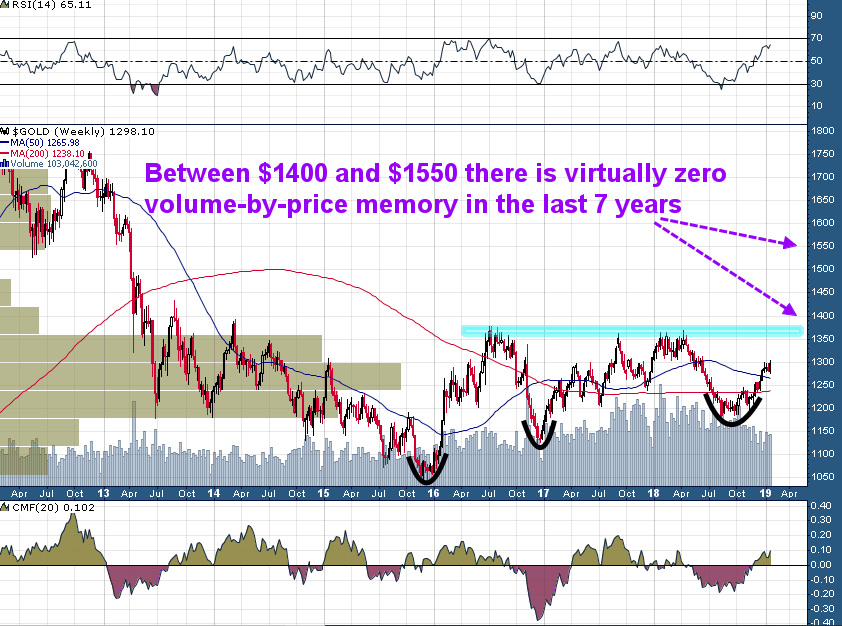
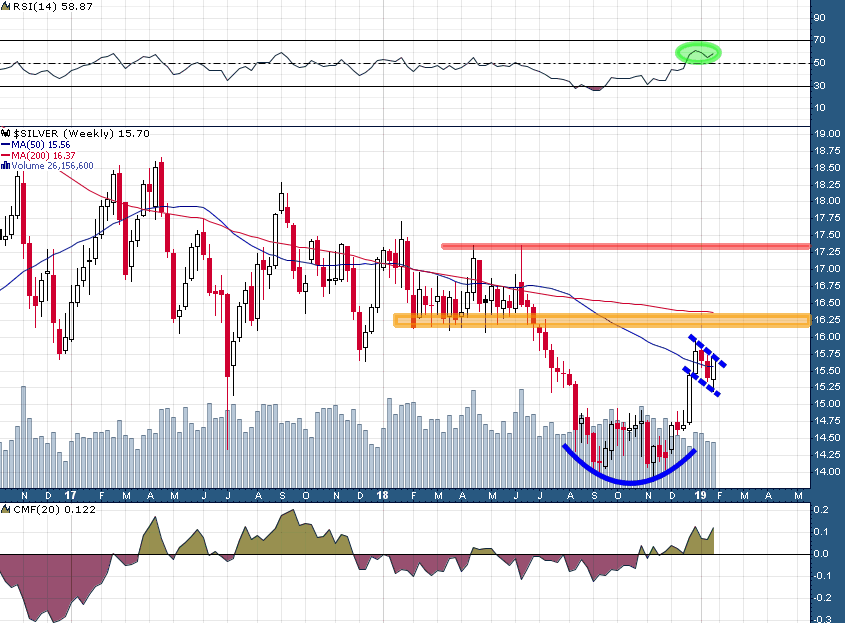
Goldfinger: I posted a couple of charts of gold and silver recently illustrating a positive outlook for both metals. What is sentiment telling you here? Is there room for silver to get up to $17 and gold up above $1350 before we have the next correction?
 
Gold (Weekly)

 
Silver (Weekly)

Bob Moriarty: I’m ok at predicting price direction but hopeless at predicting price. We have had a bottom in silver, gold and platinum. Palladium has gotten pretty toppy. If and when the Fed reinstates QE, you are going to want to hold precious metals.
 
Well that sums it up succinctly; we’ve made a bottom in precious metals and the growing global debt tsunami increasingly makes precious metals a compelling asset for investors to hold. Bob doesn’t proclaim to be a market timer, nevertheless his calls at key market turning points are among the best i’ve ever seen. I believe him when he says the dead-cat bounce in large cap US equities is coming to an end very soon. As always, we’d like to thank Bob for his time and insights. Until next time…
 
Disclaimer:
The article is for informational purposes only and is neither a solicitation for the purchase of securities nor an offer of securities. Readers of the article are expressly cautioned to seek the advice of a registered investment advisor and other professional advisors, as applicable, regarding the appropriateness of investing in any securities or any investment strategies, including those discussed above. Some of the stocks mentioned are high-risk venture stocks and not suitable for most investors. Consult the companies’ SEDAR profile for important risk disclosures.
EnergyandGold.com, EnergyandGold Publishing LTD, its writers and principals are not registered investment advisors and advice you to do your own due diligence with a licensed investment advisor prior to making any investment decisions.
This article contains certain forward-looking information and forward-looking statements within the meaning of applicable securities legislation (collectively “forward-looking statements”). Certain information contained herein constitutes “forward-looking information” under Canadian securities legislation. Generally, forward-looking information can be identified by the use of forward-looking terminology such as “expects”, “believes”, “aims to”, “plans to” or “intends to” or variations of such words and phrases or statements that certain actions, events or results “will” occur. Forward-looking statements are based on the opinions and estimates of management as of the date such statements are made and they are subject to known and unknown risks, uncertainties and other factors that may cause the actual results, level of activity, performance or achievements of the Company to be materially different from those expressed by such forward-looking statements or forward-looking information, standard transaction risks; impact of the transaction on the parties; and risks relating to financings; regulatory approvals; foreign country operations and volatile share prices. Although management of the Company has attempted to identify important factors that could cause actual results to differ materially from those contained in forward-looking statements or forward-looking information, there may be other factors that cause results not to be as anticipated, estimated or intended. There can be no assurance that such statements will prove to be accurate, as actual results and future events could differ materially from those anticipated in such statements. Actual results may differ materially from those currently anticipated in such statements. The views expressed in this publication and on the EnergyandGold website do not necessarily reflect the views of Energy and Gold Publishing LTD, publisher of EnergyandGold.com. Accordingly, readers should not place undue reliance on forward-looking statements and forward looking information. The Company does not undertake to update any forward-looking statements or forward-looking information that are incorporated by reference herein, except as required by applicable securities laws. Always thoroughly do your own due diligence and talk to a licensed investment adviser prior to making any investment decisions. Junior resource companies can easily lose 100% of their value so read company profiles on www.SEDAR.com for important risk disclosures. It’s your money and your responsibility.

Categories
Blog

EXCELLON Expands High Grade Platosa Footprint Intersecting 2,356 g/p AgEq Over 5 Metres From Surface

Excellon Resources Inc. (CNW Group/Excellon Resources Inc.)

TORONTO , Jan. 24, 2019 /CNW/ – Excellon  Resources Inc. (TSX:EXN; OTC:EXLLF) (“Excellon” or the “Company”) is pleased to announce high-grade results from the ongoing surface exploration program at the Platosa Property in Durango, Mexico , where diamond drilling has expanded the NE-1S Manto eastward and identified an open zone of mineralization, with drilling ongoing.

Highlights:

  • Highest grade intersections encountered to date on NE-1S Manto, extending open zone of potential mineralization eastward from existing mineral resources.
  • Anomalous gold continues to be intersected along 623 Trend which continues into NE-1S Manto and remains open for expansion to the east.
  • High-grade intersections include:
    • 968 g/t Ag, 9.4% Pb, 20.1% Zn and 0.28 g/t Au or 2,356 g/t silver equivalent (“AgEq”) over 5.0 metres in EX18LP1151;
    • 1,127 g/t Ag, 8.41% Pb and 10.46% Zn or 1,996 g/t AgEq over 4.8 metres in EX18LP1155.

“We have encountered significantly higher than anticipated grades and widths at NE-1S from surface,” stated Ben Pullinger , Senior Vice President Geology. “More importantly, we have identified an open zone to continue expanding the mineralized footprint to the east with our ongoing drilling program during 2019.”
Exploration Results
The following table shows highlighted intervals from the current surface drilling program currently targeting the NE-1S Manto.

Hole ID

Interval(1)

Interval(2)

Au

Ag

Pb

Zn

AgEq (3)

From

To

metres

g/t

g/t

%

%

g/t

EX18LP1144

344.0

344.8

0.9

0.02

283

9.8

0.3

705

EX18LP1147

343.5

349.1

5.6

0.03

383

8.0

0.2

725

including

343.5

344.2

0.7

0.07

1,394

12.5

0.1

1,917

and

350.4

352.9

2.5

0.01

406

3.7

0.2

570

including

351.0

351.8

0.8

0.01

1,015

8.2

0.2

1,362

EX18LP1149

347.3

347.9

0.6

0.01

2,060

7.8

9.1

2,831

EX18LP1151

352.0

357.0

5.0

0.28

968

9.4

20.2

2,356

including

352.0

353.2

1.2

0.38

1,312

17.2

24.7

3,252

EX18LP1154

350.3

350.2

0.4

391

1.5

0.5

478

EX18LP1155

349.5

354.5

4.8

0.02

1,127

8.4

10.5

1,996

including

349.9

350.6

0.7

0.01

4,284

24.9

8.1

5,720


(1)

From-to intervals are measured from the drill collar.

(2)

All intervals are reported as core length, true width is estimated to be 85-95% of reported intervals.

(3)

AgEq in drill results assumes $17.00 Ag, $1.03 Pb and $1.23 Zn with 100% metallurgical recovery, consistent with earlier results from the ongoing drilling program.

 
Today’s results are from systematic step out drilling to the east of the NE-1S Manto. These holes define an additional approximately 35 metres of eastward extension, where mineralization remains open and is the target of ongoing surface drilling. These holes are also located along a gold-bearing northeast structural trend that continues from the 623 Manto.
Surface drilling continues with a drill rig testing targets in the same target horizon that hosts the Platosa Mine within the north-south trending Platosa corridor. The Company is also in the process of defining new targets at Jaboncillo , PDN, Saltillera North and South and San Gilberto through its ongoing fieldwork program.
Platosa drill core samples are prepared and assayed by SGS Minerals Services in Durango, Mexico . The lab is accredited to ISO/IEC 17025. The Company has a comprehensive QA/QC program, supervised by an independent Qualified Person.

Platosa NE-1S Results – January 2019 (CNW Group/Excellon Resources Inc.)

Qualified Person
Mr. Ben Pullinger , P. Geo, Senior Vice-President Geology, has acted as the Qualified Person, as defined in NI 43-101, with respect to the disclosure of the scientific and technical information relating to exploration results contained in this press release.
About Excellon
Excellon’s 100%-owned Platosa Mine has been Mexico’s highest-grade silver mine since production commenced in 2005. The Company is focused on optimizing Platosa’s cost and production profile, discovering further high-grade silver and carbonate replacement deposit (CRD) mineralization on the 21,000 hectare Platosa Project and epithermal silver mineralization on the 100%-owned 45,000 hectare Evolución Property, and capitalizing on current market conditions by acquiring undervalued projects in the Americas.
Additional details on the La Platosa Mine and the rest of Excellon’s exploration properties are available at www.excellonresources.com.
Forward-Looking Statements
The Toronto Stock Exchange has not reviewed and does not accept responsibility for the adequacy or accuracy of the content of this Press Release, which has been prepared by management. This press release contains forward-looking statements within the meaning of Section 27A of the Securities Act and Section 27E of the Exchange Act. Such statements include, without limitation, statements regarding the future results of operations, performance and achievements of the Company, including potential property acquisitions, the timing, content, cost and results of proposed work programs, the discovery and delineation of mineral deposits/resources/reserves, geological interpretations, proposed production rates, potential mineral recovery processes and rates, business and financing plans, business trends and future operating revenues. Although the Company believes that such statements are reasonable, it can give no assurance that such expectations will prove to be correct. Forward-looking statements are typically identified by words such as: believe, expect, anticipate, intend, estimate, postulate and similar expressions, or are those, which, by their nature, refer to future events. The Company cautions investors that any forward-looking statements by the Company are not guarantees of future results or performance, and that actual results may differ materially from those in forward looking statements as a result of various factors, including, but not limited to, variations in the nature, quality and quantity of any mineral deposits that may be located, significant downward variations in the market price of any minerals produced, the Company’s inability to obtain any necessary permits, consents or authorizations required for its activities, to produce minerals from its properties successfully or profitably, to continue its projected growth, to raise the necessary capital or to be fully able to implement its business strategies. All of the Company’s public disclosure filings may be accessed via www.sedar.com and readers are urged to review these materials, including the technical reports filed with respect to the Company’s mineral properties, and particularly the September 7, 2018 NI 43-101 technical report prepared by SRK Consulting ( Canada ) Inc. with respect to the Platosa Property. This press release is not, and is not to be construed in any way as, an offer to buy or sell securities in the United States. 

SOURCE Excellon Resources Inc.

View original content to download multimedia: http://www.newswire.ca/en/releases/archive/January2019/24/c7446.html

Categories
Blog

JAYANT BHANDARI More Nuances on the Third World

A Speculator’s Portfolio

My experience based on having run three companies in India is that there is not much, if anything, you can do about those in the Third World. Fear of ghosts, and superstitions—and an over-whelming irrationality—is hardwired in them.
They simply have no passion to do well in life, accumulate, and build a civilization. They want to make money quickly and use it for decadence. They have no gratitude, and you can do nothing about it. They have no capability to be respectful. The only thing that makes them toe the line is the fear of the higher-ups. If you remove this fear, they go wild. Carrots and sticks do not work, for they cannot calculate. You can give them all you can, and they will merely expect more, as a right. 
Europeans brought written language to sub-Saharan Africa; and railways, science and enlightenment to India. Without European management, all the benefits the Third World got are getting rapidly neutralized. Without Europeans running them, the Third World will revert back to the dark ages.
None of the above stops the compulsive virtue-signalers—the World Bank, the IMF, main-stream media, big corporations, etc.—from claiming that the Third World will have the biggest economies in the near future.
In a recent report, Standard Chartered Bank claims that by 2030 India’s economy will be $46 trillion large, while US’s will be only $31 trillion. I tried all sensible tricks possible on my spreadsheet to see what growth rate India would require to get from a country where half the population poops in the open to become an economy 50% larger than the US, all in a mere 12 years. Reports like these can be reasonably assured to go unchallenged. Who wants to look racist by suggesting that India cannot be such a big economy if at all India will still be a single country by 2030?
On investments…
Today, I gave a presentation on building a “speculator’s portfolio,” at the just concluded Vancouver Resource Investment Conference. Here is the list that I gave, with my preferred buying prices:

  • Keras Resources (KRS.LON; £0.0032)
  • Lorraine Copper (LLC; C$0.115)
  • Nkwe Platinum (NKP; A$0.064)
  • G-Resources (1051.HKG; HK$0.048)
  • Condor Resources (CN; C$0.05)
  • IDM Mining (IDM; C$0.055)
  • FPX Nickel (FPX; C$0.105)
  • Amarillo Gold (AGC; C$0.23)
  • Globex Mining (GMX; C$0.29)
  • Miramont Resources (MONT; C$0.30)
  • VR Resources (VRR; C$0.16)
  • Altus Strategies (ALTS; C$0.045; in the “watch-list”)
  • Energold (EGD; C$0.125; in the “watch-list”)

Half of the seats of the next Capitalism & Morality are gone. Please register now if you would like to be assured a seat.
Warm regards,

Jayant Bhandari

Associate: Rajni Bala

Disclaimer: All information found here, including any ideas, opinions, views, predictions, forecasts, commentaries, suggestions, or stock picks, expressed or implied herein, are for informational, entertainment or educational purposes only and should not be construed as personal investment advice. While the information provided is believed to be accurate, it may include errors or inaccuracies. The sole purpose of these musings is to show my thinking process when analyzing a stock, not to provide any recommendation. I will not and cannot be held liable for any actions you take as a result of anything you read here. Conduct your own due diligence, or consult a licensed financial advisor or broker before making any and all investment decisions. Any investments, trades, speculations, or decisions made on the basis of any information found on this site, expressed or implied herein, are committed at your own risk, financial or otherwise.

Categories
Blog

SPROTT’S THOUGHTS Quarterly Market Update: No IPOs, No IPAs

The New Year is off to a murky start. The broader market managed to ease off lows seen at the end of last year and recover key technical levels. Yet volatility continues to keep investors on their toes. Gone are the days when “minor” triple-digit moves for the Dow Jones Industrial Average elicit nary a raised eyebrow.
2018 came to an end with a sigh of relief. After a tumultuous December the U.S. stock indexes posted their worst performance since the financial crisis. For the year, the Dow closed down 5.6% while the S&P 500 index declined 6.2%. The Nasdaq Composite shed 3.9% in 2018 and bid adieu to the worst year in a decade.
Revelers rang in the New Year with a pause in global trading. The holiday season brought its ups and downs with the S&P 500 off by a double-digit percentage point on Christmas Eve from its record highs. With the index touching bear market territory, perhaps setting the precedent for an investor’s version of the Ghost of Christmas Past. Nonetheless, the market rally on the day after Christmas on Dec. 26 boosted the Dow to hit its biggest gain on record.
There are plenty of unanswered questions on the fundamental front. Uncertainty has set the tone and put a damper on overall investor sentiment. The headwinds of yesteryear remain steadfast in 2019. The potential fallout from the longest U.S. government shutdown in history coupled with the ongoing U.S.-China trade negotiations as well as Brexit woes are doing little to boost confidence in this year’s outlook.
2019 WORD OF THE YEAR: PARTIAL
We can’t have partial growth or expansion; we can’t have a partial recession. The partial U.S. government shutdown is having a complete and negative impact on the economy.
As the shutdown enters Day 28, the U.S. market averages have bounced back from the Christmas lows with the major indexes out of correction territory. The partial government shutdown has halted a myriad of government operations. The Treasury’s Alcohol and Tobacco Tax and Trade Bureau (TTB), considered non-essential, has ceased the review of keg collars for beer. This means breweries can’t ship product outside state lines without regulatory approval. Bad news for small craft brewers with perishable IPA and seasonal releases.
The IPO traffic jam is also notable as the result of the shutdown. Companies planning to go public could face delays in launching. The SEC shutdown plan includes only essential staff who are keeping an eye on the markets and responding to emergency situations. The government furlough could stall the pipeline for IPOs in 2019.
With federal agencies such as the FDA working only on “imminent threats” and federal workers missing paychecks, the headlines about national security and disruptions to government programs are sure to evoke distress.
BANKING ON INCENTIVES
As earnings season got underway, the major banks reported results that showed mixed results. Results marked by a mostly positive season for banks were hampered by underperformance by one of the big banks at the end of the week. Of course, one of the investment banks missing profit forecasts reflected the volatility in trading and dour capital-raising environment during the last month of 2018.
The drum beat of recession may be getting louder and it’s not just Main Street expressing concern over mounting risks.
According to the latest survey by the Conference Board, recession is a major concern for CEOs around the world. The business research group conducted the survey of over 800 chief executives and found that out of the 28 issues, recession risk ranked as the main concern. The fact that the survey was conducted in the autumn of 2018, before the turbulent pullback in equity prices points to risks to the world economies.
Trading incentives may be limited for the time being amid a backlog of economic data and lack of breakthroughs in the global political arena. At the same time, U.K. Prime Minister Theresa May survived a vote of no-confidence following her Brexit deal defeat in Parliament. As earnings season continues in earnest, keep an eye on any surprises that could shed light on industry or sector shifts.
BAND-AID ON A BULLET WOUND
It’s not business as usual in the nation’s capital. With no end in sight for the partial government shutdown, key economic data including Q4 2018 GDP may not be released on schedule. Of course, the estimates for how the shutdown is already affecting the economy in Q1 2019 are nothing short of worrisome.
Market corrections can present opportunities, but prolonged uncertainty does little for economic growth. The domino effect of uncertainty on business investment amid murmurs of an end to the Federal Reserve’s tightening cycle will weigh on sentiment.
Should progress be swift on tariffs and a resolution reached on the partial shutdown, opportunity for growth remains a possibility. The risks to growth in the two largest economies can be characterized as self-inflicted ones. With government efforts to stimulate growth being dismantled by risks to stability, the recovery trajectory is fragile.
Read in browser »
share on Twitter Like Quarterly Market Update: No IPOs, No IPAs on Facebook

Recent Articles:

Quarterly Market Wrap: Volatility Returns In 2018

Sprott U.S. Media, Inc. is a wholly owned subsidiary of Sprott Inc., which is a public company listed on the Toronto Stock Exchange and operates through its wholly-owned direct and indirect subsidiaries: Sprott Asset Management LP, an adviser registered with the Ontario Securities Commission; Sprott Private Wealth LP, an investment dealer and member of the Investment Industry Regulatory Organization of Canada; Sprott Global Resource Investments Ltd., a US full service broker-dealer and member FINRA/SIPC; Sprott Asset Management USA Inc., an SEC Registered Investment Advisor; and Resource Capital Investment Corp., also an SEC Registered Investment Advisor. We refer to the above entities collectively as “Sprott”.
The information contained herein does not constitute an offer or solicitation by anyone in any jurisdiction in which such an offer or solicitation is not authorized or to any person to whom it is unlawful to make such an offer or solicitation.
Forward-Looking Statement
This report contains forward-looking statements which reflect the current expectations of management regarding future growth, results of operations, performance and business prospects and opportunities. Wherever possible, words such as “may”, “would”, “could”, “will”, “anticipate”, “believe”, “plan”, “expect”, “intend”, “estimate”, and similar expressions have been used to identify these forward-looking statements. These statements reflect management’s current beliefs with respect to future events and are based on information currently available to management. Forward-looking statements involve significant known and unknown risks, uncertainties and assumptions. Many factors could cause actual results, performance or achievements to be materially different from any future results, performance or achievements that may be expressed or implied by such forward-looking statements. Should one or more of these risks or uncertainties materialize, or should assumptions underlying the forward-looking statements prove incorrect, actual results, performance or achievements could vary materially from those expressed or implied by the forward-looking statements contained in this document. These factors should be considered carefully and undue reliance should not be placed on these forward-looking statements. Although the forward-looking statements contained in this document are based upon what management currently believes to be reasonable assumptions, there is no assurance that actual results, performance or achievements will be consistent with these forward-looking statements. These forward-looking statements are made as of the date of this presentation and Sprott does not assume any obligation to update or revise.
Views expressed regarding a particular company, security, industry or market sector should not be considered an indication of trading intent of any fund or account managed by Sprott. Any reference to a particular company is for illustrative purposes only and should not to be considered as investment advice or a recommendation to buy or sell nor should it be considered as an indication of how the portfolio of any fund or account managed by Sprott will be invested.
Past performance does not guarantee future results. The views and opinions expressed herein are those of the author’s as of the date of this commentary, and are subject to change without notice. This information is for information purposes only and is not intended to be an offer or solicitation for the sale of any financial product or service or a recommendation or determination by Sprott Global Resource Investments Ltd. that any investment strategy is suitable for a specific investor. Investors should seek financial advice regarding the suitability of any investment strategy based on the objectives of the investor, financial situation, investment horizon, and their particular needs. This information is not intended to provide financial, tax, legal, accounting or other professional advice since such advice always requires consideration of individual circumstances. The products discussed herein are not insured by the FDIC or any other governmental agency, are subject to risks, including a possible loss of the principal amount invested.
Generally, natural resources investments are more volatile on a daily basis and have higher headline risk than other sectors as they tend to be more sensitive to economic data, political and regulatory events as well as underlying commodity prices. Natural resource investments are influenced by the price of underlying commodities like oil, gas, metals, coal, etc.; several of which trade on various exchanges and have price fluctuations based on short-term dynamics partly driven by demand/supply and also by investment flows. Natural resource investments tend to react more sensitively to global events and economic data than other sectors, whether it is a natural disaster like an earthquake, political upheaval in the Middle East or release of employment data in the U.S. Low priced securities can be very risky and may result in the loss of part or all of your investment.  Because of significant volatility,  large dealer spreads and very limited market liquidity, typically you will  not be able to sell a low priced security immediately back to the dealer at the same price it sold the stock to you. In some cases, the stock may fall quickly in value. Investing in foreign markets may entail greater risks than those normally associated with domestic markets, such as political, currency, economic and market risks. You should carefully consider whether trading in low priced and international securities is suitable for you in light of your circumstances and financial resources. Past performance is no guarantee of future returns. Sprott Global, entities that it controls, family, friends, employees, associates, and others may hold positions in the securities it recommends to clients, and may sell the same at any time.
Copyright © 2019 Sprott US Media, All rights reserved.
You are receiving this email because you requested information about the Sprott Group.Our mailing address is:

Sprott US Media

1910 Palomar Point Way Ste 200

CarlsbadCA 92008-5578

Add us to your address book

Categories
Blog

BOB MORIARTY Let Them Eat Cake

Original Source: http://www.321gold.com/editorials/moriarty/moriarty011819.html
Bob Moriarty
Archives

Jan 18, 2019

It was the best of times, it was the worst of times, it was the age of wisdom, it was the age of foolishness, it was the epoch of belief, it was the epoch of incredulity, it was the season of Light, it was the season of Darkness, it was the spring of hope, it was the winter of despair, we had everything before us, we had nothing before us, we were all going direct to Heaven, we were all going direct the other way – in short, the period was so far like the present period, that some of its noisiest authorities insisted on its being received, for good or for evil, in the superlative degree of comparison only.

Those memorable words penned by Charles Dickens in 1859 begin the story of the times leading up to the French Revolution and ending in the Jacobin Reign of Terror. The Tale of Two Cities may be back for an encore. So might the Reign of Terror.
The earth’s very first worldwide revolution began in Paris on November 17th 2018. The immediate cause was an increase in taxes on diesel and gasoline. The French government levied higher taxes on diesel of 7.6 cents per liter in 2018 with a planned increase of an additional 6.5 cents effective on January 1st 2019. Gasoline taxes rose by 3.9 cents in 2018 and were due to go up 2.9 cents more with the turn of the New Year.
Globalization has caused a mass migration all over the world from rural areas and small towns to the large cities. As the migration took place, the balance of political power shifted and the rural areas had less and less of an impact on the decision making process.
French law requires all vehicles be equipped with neon yellow vests for safety if the automobile is disabled or the driver needs to change a tire. Yellow vests or Gilets Jaunes are in every car in case of emergency. Any emergency will do, even a protest.
The protests began simply with a demand that the increases in fuel taxes be rescinded. From Paris other groups of the Gilets Jaunes sprang up spontaneously all over France in village squares and in the ubitiquous traffic circles controlling the flow of traffic rather than red lights found in most countries. People in the streets protesting actions of the government are the ultimate form of direct democracy.
There were no leaders. As times some labor unions and politicians have attempted to coopt the movement without success. The Yellow Vests reject centralized power no matter where it comes from. All of the protests came directly from local residents angry at their lack of voice.
By and large it was peaceful from the beginning with pretty much the exception of the actions of the police. Most people in most cities simply walked around talking to other Yellow Vests. As time went by the list of demands grew to include the resignation of French President Emmanuel Macron as well as other changes in forms of taxation and benefit modifications.
Naturally the elite in government smiled as the requests for change grew out of control. They knew that as the demands expanded the chance of them being enacted declined. Under pressure Macron agreed to postpone or cancel the fuel tax increase and went along with some minor modifications to minimum wage and retirement benefits. But he soon tired of the sops to the masses and began to harden his position.
The Yellow Vest movement is simple. The people want more say in how the government affects their lives. Over the past week the stakes may have risen as the French Prime Minister Edouard Philippe announced support for a new law banning unapproved protests. The idea was not complicated. It’s ok to riot but you need to fill out forms in triplicate and get government approval first. I have a suggestion for the Gilets Jaunes, “Don’t hold your breath.”
The Yellow Vest masses seemed to have touched a nerve with angry people all over the world. There have been similar protests in TaiwanIsrael,BrusselsCanadaSpain and no doubt many other locations. It is a worldwide revolution and it will only grow.
As long as there have been groups gathered together for protection the elite have ruled. It didn’t matter if it was the head of a clan, a Pope, a king or eventually presidents and prime ministers. The elite ruled and the peasants could stuff themselves with cake if they didn’t like the lack of bread. But the elites have always been out of touch with what the people, the mob, the masses want.
When the peasants went hungry for long enough because of mismanagement of government, they manned the barricades and sharpened their pikes. In the end after every revolution all they managed to accomplish was change one group of elites with a different group of clueless elites. Look at the elections in the US and the UK. One party rules, then the other party rules, then it goes back again. Nothing ever changes.
Who do the Yellow Vests think will take over if they boot Macron? I can tell you right now it will be another brain dead idiot determined to line his own pockets until he gets the boot.
This process of rule by elites has led to the bizarre situation in the US where a tiny group of determined Neocons managed to subvert the entire political and military establishment of the country on behalf of a meaningless little shit for brains country in the Middle East. No more than thirty total they still took total control of the establishment involving the nation in one meaningless and expensive war after another. It has gotten so stupid and out of control that the very first law considered by the US Congress and US Senate in 2019 was a bill to make boycotts of Israel illegal.
You may still boycott the Mormons and Buddhists. It’s legal and OK to boycott the Pope or Donald Trump should you wish. And advocating boycotts of Hillary will still be allowed. You can boycott whoever and whatever you wish. Except for Israel. Twenty-six states have already incorporated rules requiring loyalty oaths to Israel. In Europe you may not question the Holocaust. If you even debate what happened, you may go to jail.
Now that’s power.
In an ominous move on the part of the French government just took action that might morph a peaceful protest against petty taxes into a violent reign of terror and a resurrection of the guillotine. And a lot of heads of the former elite swinging from long pikes.
As reported on the 13th of January, some units of the riot police have been issued fully automatic G36 rifles. If and when some fool policeman starts shooting at the protestors, a bloody war will have started. Eventually more and more of the police will realize they are shooting their own citizens. At that point they will start shooting politicians.
There is a simple and bloodless solution that the elite will hate and the
Gilets Jaunes of all countries will love. But to understand it, you must also understand why these protests have expanded so quickly.
Until the Internet came along twenty years or so ago, the elite ruled because they controlled the narrative. Americans believed that Kennedy was killed by a lone assassin, Vietnam was fought to save the Vietnamese from godless Communism, nineteen hijackers led by a guy with terminal kidney disease living in a cave in Afghanistan managed to win the most effective battle in history.
Then the Internet gave everyone a voice. Every damned fool given a new keyboard for Christmas by momma could go out on chatboards and say whatever idiotic things they wanted and remain anonymous so they didn’t have to account for their stupidity to anyone. If they wished, they could and did watch porn from the confines of their government office if that is what they did for a living. Communication was instant and total.
A few people posting on the Internet actually made sense. The Internet is not a Mecca of accurate information. But some of the voices made sense and if you ignored the clutter and listened to the bells that peeled with the ring of truth eventually a false flag operation that would have passed with flying colors fifty years ago would be exposed in minutes today.
More and more of the middle class realized the actions of governments and central banks were destroying their financial security. There was nothing new to that; governments have always waged war first on their own people. Throughout history people have resented their standard of living being destroyed by the elite.
But they couldn’t do a damned thing about it. They might be angry but they had no voice.
Eventually they could take a marvelous weapon right at hand such as the Yellow Vests and make them a symbol of protest. But they still didn’t have a solution that was both reasonable and possible until a genius named Etienne Chouard came up with a magic bullet.
Monsieur Chouard teaches college in Marseilles France on the southern coast. For years he has advocated adoption of something he calls theCitizens Initiative Referendum or CIR. The CIR only asks that citizens be allowed to choose the rules and regulations by which they are governed and the best way to achieve such direct democracy is by way of the referendum.
The concept is brilliant. A certain number of signatories on a petition would allow for a referendum to be published and voted on.
The Swiss did it in 2016 with the idea of a guaranteed basic income for all. It was suggested that all Swiss citizens be granted an automatic 2,500 SF monthly. Naturally the Swiss being the Swiss, they also understood that someone had to pay for that largess and it would be by themselves. Governments don’t have any money; all they do is take it from one group and hand it to another. 77% of Swiss voting soundly rejected the idea.
A worldwide revolution has been started. It’s pretty much led by the middle class who feel government policies are destroying them financially. If and when the police start shooting at protestors, protestors will start shooting back. It has all the potential for being the greatest war in history. The governments will eventually lose as the police and military change sides.
A well thought out CIR would solve the issue. It is both practical and workable. The elites will hate it because they will lose their franchise on power and money. The people will love it because it makes them responsible for their own decisions. They should be allowed direct democracy because they are the ones paying for it.
In the end the world will owe a giant debt for the ideas of Etienne Chouard. It may not be a perfect solution but it is a solution. The alternatives are far worse.
###
Bob Moriarty
President: 321gold
Archives

321gold Ltd

Sign up to Stay Up to Date on News and Progress from Page